
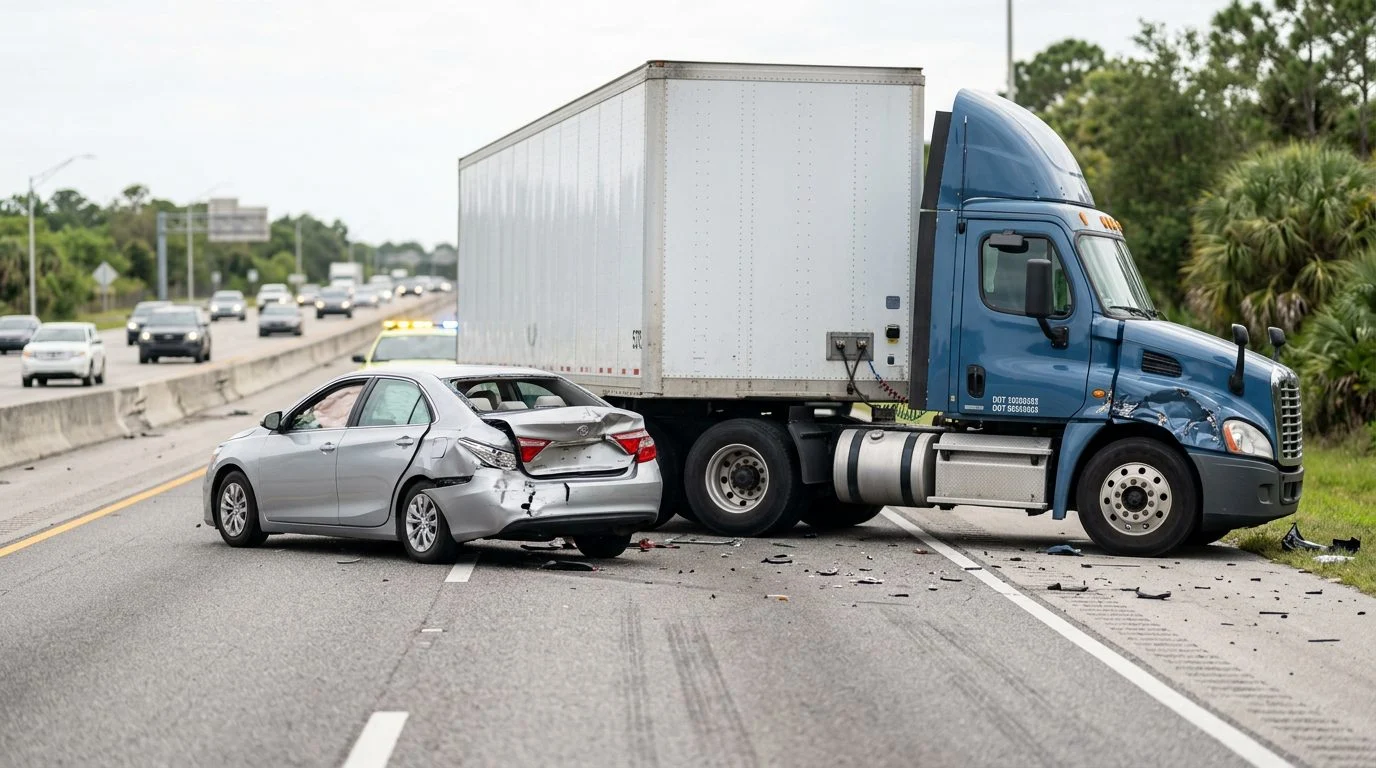
Florida Truck Accidents | Amazon Delivery Vehicles
Hurt by an Amazon Delivery Truck? Find Out Who May Be Responsible
Delivery trucks move through Florida neighborhoods every day. When one crash leaves you or someone you love with serious injuries, several companies may share responsibility. CHG Personal Injury Lawyers can help you understand your options.
Why Floridians Contact CHG Personal Injury Lawyers
Florida
Florida-based personal injury firm serving clients throughout the state
Free
Confidential first consultation with no obligation to continue
$0
No attorney's fees or case costs unless there is a recovery
By CHG Lawyers · Published October 23, 2026
Quick Answer: Who Can Be Responsible After an Amazon Delivery Truck Crash in Florida
Several people or companies may be responsible after an Amazon truck accident in Florida. This can include the driver, the company that hired and supervised the driver, the vehicle’s owner or lessor, or Amazon itself. Which party is responsible depends on the facts. The key question is who controlled the driver, the vehicle, and the route.
That last point surprises many people. Amazon packages often move on vans and trucks that carry another company’s name. Many routes are run by delivery service partners. These are separate businesses that hire their own drivers.
So the first question is not simply “Was it an Amazon truck?” The better question is “Who had the duty to run that vehicle safely?”
Three steps protect you right now:
- Get medical care and follow your doctors’ care.
- Report the crash to the police.
- Talk with a lawyer early. Florida sets deadlines for filing an injury lawsuit, and waiting can hurt a claim, so it is important to contact the firm promptly.
Fault is divided among the people involved. Each person’s share can affect what they recover. We explain both rules below.
Not sure what your next step is?
Talk it through with our team — the first consultation is free, confidential, and carries no obligation.
What Happens When an Amazon Delivery Driver Crashes
The usual sequence has four parts. First, there is a crash. Next comes a police report and notice to insurers. Then an injury claim is made against the people responsible.
Florida law requires a crash report. This applies to crashes that cause death, injury, or any indication of complaints of pain or discomfort by a party or passenger, to crashes involving a violation of s. 316.061(1) or s. 316.193, and to crashes that render a vehicle inoperable to a degree that required a wrecker to remove it from the scene. It also applies to crashes involving a commercial motor vehicle. The report must be completed and submitted within 10 days after the investigating officer finishes the investigation. The report also lists the insurance companies for the parties involved (Fla. Stat. § 316.066).
Amazon delivery vehicles come in different forms. They include small vans, box trucks, and tractor-trailers. The driver may be an employee of a delivery service partner. The driver may be an independent driver working through Amazon Flex. The driver may also work for another contracted company.
Each arrangement can involve different company names and different insurance policies. That is why the crash report and insurance details matter so much.
The injured person is not always the other driver. It may be a passenger, a pedestrian, or a cyclist. Each injured person may have a claim against the parties whose conduct caused the harm.
A typical path looks like this. First comes medical care and the crash report. Next, the insurers for each party are notified. Then the claim is investigated. Investigators ask who was driving and who employed that driver. They also ask what the vehicle’s records show and how the crash happened.
Some claims settle through negotiation. Others move into a lawsuit. Early steps help keep the record complete.
Who Can Be Responsible: Driver, Delivery Partner, Vehicle Owner, or Amazon
Responsibility can fall on several parties:
- The driver
- The company that hired and supervised that driver
- The vehicle’s owner or lessor
- Amazon, when the facts show it controlled the operation
The driver is responsible for careless driving. Examples include speeding, distraction, or driving while exhausted. A company may also answer for its own choices. Lawyers often describe these claims with three phrases:
- Negligent hiring: The company hired a driver it should have screened more carefully.
Each phrase must be backed by facts. Examples include training records, prior incidents, or how the company ran its routes. A label alone proves nothing.
Ownership on paper can also matter. Under Florida’s financial-responsibility statute, a lessor under an agreement to lease a motor vehicle for 1 year or longer is not deemed the owner of that vehicle for the purpose of determining financial responsibility, when the conditions in the statute are met (Fla. Stat. § 324.021).
Florida also divides fault among the parties. Each party answers for its own share.
That is why an Amazon crash often involves several parties at once. A claim may involve the driver, the delivery partner, the vehicle owner, and Amazon. Our team looks at who controlled each part of the trip.
Is the Driver an Employee or a Contractor? Why Classification Matters
Whether a driver is an employee or an independent contractor affects two things. It affects which company may be responsible. It also affects which insurance may apply.
An employee works under the company’s direction. An independent contractor usually runs his or her own business. That person has more freedom over how the work gets done.
The label a company puts on a driver matters. But the label does not end the analysis. The facts about control matter more than the title.
Control shows up in practical ways. Who set the hours? Who picked the route, and could the driver change it? Who supplied the van, the scanner, or the phone app? Who trained the driver and disciplined mistakes? The answers often matter more than the words in a contract.
Amazon arrangements vary. Some drivers work for a delivery service partner. That is a separate company that runs its own delivery business. Others sign up through Amazon Flex, which uses independent drivers. Each arrangement can involve different insurance. The coverage that applies depends on the arrangement in place on the day of the crash.
This question has real consequences for an injured person. If the wrong company is named, the claim can stall. Early records help identify the right parties sooner. Dispatch logs, app records, and contracts are worth preserving from the start.
Federal Trucking Rules and Safety Regulations for Amazon Delivery Vehicles
Federal trucking rules set limits on driver hours, driver qualifications, and vehicle inspections. Violations can become part of the evidence in a claim.
Federal law lets the Secretary of Transportation prescribe requirements for qualifications, hours of service, safety of operation, and equipment of motor carriers (49 U.S.C. § 31502). For property-carrying commercial vehicles, a driver must take 10 consecutive hours off duty before driving. Driving is barred after a 14-consecutive-hour period. That period starts when the driver comes on duty (49 CFR § 395.3).
Within the period described in the rule, a driver may drive a total of 11 hours (49 C.F.R. § 395.3). Driving is also not permitted after more than 8 hours of driving time pass without at least a 30-minute break. Some short-haul drivers have exceptions.
Our team checks that question early.
Inspection records have a short life. A carrier must keep driver vehicle inspection reports for three months from the date each report was prepared. These rules do not apply to a private motor carrier of passengers (nonbusiness), a driveaway-towaway operation, or a motor carrier operating only one commercial motor vehicle (49 CFR § 396.11). That short window is why early requests matter.
Electronic logs also matter.
Florida Deadlines and Fault Rules: Statute 95.11 and Statute 768.81
Florida’s general deadline for a negligence claim is two years (Fla. Stat. § 95.11(5)(a)). This rule is found in Florida Statute 95.11(5)(a).
The statute reads, in part, “WITHIN TWO YEARS.— (a) An action founded on negligence” (Fla. Stat. § 95.11). Fla. Stat. § 95.11 reads: “(b) An action for professional malpractice, other than medical malpractice, whether founded on contract or tort; provided that the period of limitations shall run from the time the cause of action is discovered or should have been discovered with the exercise of due diligence. However, the limitation of actions herein for professional malpractice shall be limited to persons in privity with the professional.” Under Fla. Stat. § 95.11, an action founded on negligence is subject to a two-year limitation period under subsection (5)(a), and subsection (5)(b) separately addresses professional malpractice other than medical malpractice, limited to persons in privity with the professional. Most car, truck, and delivery-van crash claims rest on negligence. This is the rule people most often need to know.
Deadlines do not pause while you recover. Other claim types can carry different time limits, so waiting is the riskiest choice. Medical care and insurance talks can take months. That combination can make a deadline easy to lose sight of. Talk with a lawyer early so the time limit is tracked from the start.
Comparative fault, also called shared fault, works differently. Under Florida law, a party found to be greater than 50 percent at fault for his or her own harm may not recover any damages. That rule does not apply to medical negligence actions under chapter 766 (Fla. Stat. § 768.81).
In plain words, an injured person’s own share of blame matters. Above 50 percent, nothing is recoverable. At or below that line, the recovery reflects the injured person’s share of fault.
Have questions about what happened?
Ask our team directly. The first conversation is free, confidential, and there is no obligation to continue.
What to Do After an Amazon Delivery Truck Hits You: Steps and Evidence
The most important steps are getting medical care, reporting the crash, and recording details. Do this before evidence changes or disappears.
- Get medical care and follow your doctors’ care. Some injuries, including head injuries, do not show their full effect right away. Keep every appointment and tell each provider about the crash.
- Report the crash to police. Ask for the report number and the officer’s name and badge number.
- Record the company details. Write down the company name on the vehicle, the vehicle number, the driver’s name, and the insurance information the driver gives you.
- Photograph the scene. Capture the vehicles, the damage, the road, the signs, and the weather.
- Collect witness contacts. Names and phone numbers of people who saw the crash can matter later.
- Keep a written record. Track bills, missed work, and how injuries affect daily life.
- Be careful online. Insurers may read posts about the crash.
Ask for a copy as soon as it is filed.
Some evidence disappears quickly. GPS and telematics data can change or be purged. Dash camera footage, dispatch and route records, driver logs, and maintenance records can also be lost. Motor carriers must maintain the driver vehicle inspection report for three months from the date it was prepared, but this rule does not apply to private passenger carriers, driveaway-towaway operations, or carriers operating only one commercial motor vehicle. That is why requesting them early matters. A written request to preserve evidence can go out early. Our team can help prepare it.
Damages, Fault Sharing, and Wrongful Death After a Fatal Crash
Under Fla. Stat. § 768.21, a surviving spouse may also recover for loss of the decedent’s companionship and protection and for mental pain and suffering from the date of injury; minor children, and all children if there is no surviving spouse, may recover for lost parental companionship, instruction, and guidance and for mental pain and suffering; each parent of a deceased minor child may recover for mental pain and suffering, while each parent of an adult child may do so only if there are no other survivors; and a survivor who has paid medical or funeral expenses due to the decedent’s injury or death may recover them. When a crash causes death, Florida law also sets out who may bring a wrongful-death claim.
Harm after a delivery truck crash can be physical, financial, and emotional. Medical bills can grow fast. Lost income can strain a household for months. Severe injuries can change a person’s life permanently. These include spinal cord injuries, traumatic brain injuries, amputations, burns, and paralysis. A general article cannot set the value of any claim. Each claim turns on its own records and facts.
Under Fla. Stat. § 768.19, when the death of a person is caused by the wrongful act, negligence, default, or breach of contract or warranty of any person, including those occurring on navigable waters, and the event would have entitled the person injured to maintain an action and recover damages if death had not ensued, the person or watercraft that would have been liable in damages if death had not ensued is liable for damages as specified in that act, notwithstanding the death of the person injured, although death was caused under circumstances constituting a felony.
Florida law also describes what survivors may recover. A surviving spouse may recover loss of companionship and protection. A surviving spouse may also recover mental pain and suffering. Minor children, and all children if there is no surviving spouse, may recover lost parental companionship, instruction, and guidance, and mental pain and suffering from the date of injury. Adult children cannot recover these damages in claims for medical negligence. Each parent of a deceased minor child may recover mental pain and suffering (Fla. Stat. § 768.21).
Families facing this kind of loss have many decisions at once. They deserve clear, patient help with each step.
What Crash Data Shows About Delivery Vehicle Crashes in Florida
Crash data shows patterns across many crashes. It cannot prove fault in any single crash.
The National Highway Traffic Safety Administration (NHTSA) collects crash-fatality information through its Fatality Analysis Reporting System. Researchers and safety officials use that information. They study where and how fatal crashes happen.
A statistic cannot tell a court who ran a red light on a particular morning. That answer comes from the crash report, the vehicle records, witness accounts, and the driver’s own logs. Each crash is investigated on its own facts.
Behind every crash report is a person and a family. When we talk about crash data, we keep that person at the center.
Frequently Asked Questions About Amazon Truck Accidents in Florida
Can I sue Amazon after a delivery truck crash?
Each case turns on who had that control.
Can you sue a truck driver?
Yes. A driver whose careless driving caused a crash can be named in a claim under Florida’s fault rules.
How long do I have to file a claim in Florida?
Florida’s general deadline for a negligence claim is two years under Fla. Stat. § 95.11. Other claims can carry different deadlines. Contact a lawyer promptly.
What if the driver was over their hours?
Federal hours-of-service rules limit driving time. Driver logs and related records can become key evidence, so they are worth requesting early.
How does a lawyer get paid on an accident case?
CHG charges no attorney’s fees and no case costs unless there is a recovery.
Who handles Amazon auto claims?
Claims usually go to the insurer for the responsible vehicle or company. Your own insurance may also apply, depending on your policy.
Want to know where you stand?
Tell us what happened and our team will walk you through the options available to you, at no cost.
Talk With CHG Personal Injury Lawyers About Your Amazon Truck Crash
If you are living through the aftermath of a crash, bills may be arriving. You may also have unanswered questions about which company is responsible. A conversation can help you see your options.
CHG Personal Injury Lawyers is a Florida-based personal injury firm. It handles car, truck, and delivery vehicle crashes for people throughout Florida, with an office in Coral Gables. Igor Hernandez is the responsible lawyer for this page.
Our team can review the facts of your crash with you. The first consultation is free, confidential, and comes with no obligation to continue. Contact our team to start that conversation.
If an Amazon delivery truck or van hurt you or someone you love, you may have a claim. Our team can review who may be responsible.
How We Can Help After an Amazon Truck Crash
Start with a free, confidential call
Tell us what happened. Our team will listen, answer your questions, and explain your options at no cost and with no obligation to continue.
Preserve the evidence
Trucking companies and delivery contractors keep driver logs, GPS data, dashcam footage, and maintenance records. We can help identify and request the records that matter in your case.
Look at every party involved
Amazon trucks are often driven by contracted drivers for delivery companies. We review who employed the driver, who maintained the vehicle, and who else may share responsibility.
Focus on your recovery
Serious injuries affect your health, your work, and your family. We handle the claim process so you can concentrate on your medical care and your loved ones.
Protect Your Claim From the Start
If you are able, take photos of the vehicles, the scene, and your injuries. Write down the delivery company name and the truck's number, and ask for the names of any witnesses. Keep copies of all medical records and bills. Then follow your doctors' care and contact a lawyer promptly, because deadlines apply to these claims.
Who May Be Responsible in an Amazon Truck Accident
The Driver
A driver who was speeding, distracted, fatigued, or otherwise driving carelessly may be named in a claim for the harm that driving caused.
The Delivery Company
Contracted delivery companies that employ or direct drivers may be responsible for how their drivers were trained, scheduled, and supervised.
Vehicle Makers and Parts Suppliers
When a defective part or design made a crash more severe, other companies may be part of the claim. These cases are sometimes called crashworthiness claims.