
Truck Accidents | Serving Florida
Why Semi-Truck Claims Are Different From Car Crash Claims
A collision with a commercial truck can involve many more people, companies, and records than a typical fender-bender. Here is how that changes the path after a crash.
Why Florida Families Call CHG
Florida-Based
Serving people hurt across Florida
Licensed
Attorneys admitted to The Florida Bar
Free
Confidential first consultation with no obligation to continue
By CHG Lawyers · Published November 20, 2026
If someone you love was hurt in a crash with a semi-truck, you may be trying to understand what comes next. A semi-truck claim is different from a car accident claim in several concrete ways. The main differences are vehicle size, the number of parties who may share responsibility, federal trucking records, evidence that can disappear, and layered insurance.
This page explains each difference and the Florida rules that apply. It is general information, not advice for your specific situation.
Why the Same Kind of Crash Can Lead to a Very Different Claim
A crash with a semi-truck can look a lot like a car crash from the roadside. The claim behind it often has more moving parts.
By Igor Hernandez, CHG Personal Injury Lawyers. CHG is a Florida-based firm that serves clients throughout Florida, including Miami, Orlando, Tampa, and Jacksonville.
When two cars collide, the claim often involves two drivers and their insurers. A truck crash can involve the driver, the company that runs the truck, a leasing company, and sometimes a contracted delivery carrier. The paperwork is different too. Commercial trucks must follow federal safety rules that create records most car drivers never produce. Many families are surprised by this. A crash that seems simple on the road can turn into a case with several companies, several insurers, and a long paper trail.
This page covers five differences: vehicle size, responsible parties, federal trucking records, evidence that can be lost, and Florida’s fault and deadline rules. Each one can change how a claim is built.
If a semi-truck crash hurt someone you love, our team can talk with you about whether a claim may be available and what deadlines may apply. Talk it through with our team — the first consultation is free, confidential, and carries no obligation.
The Size and Weight Difference Changes How a Crash Happens
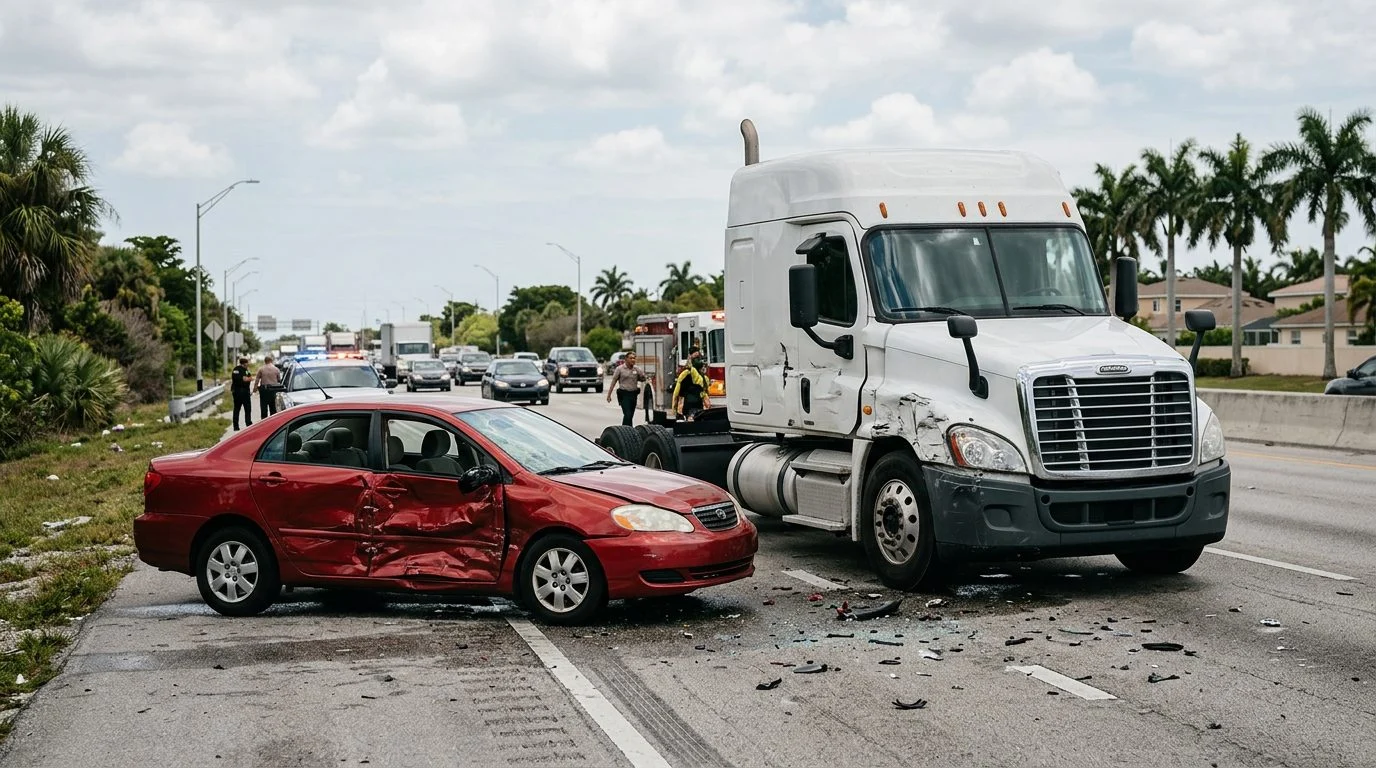
A loaded semi-truck is far heavier than a passenger car. That difference changes what happens in a collision.
A heavy truck needs much more distance to stop. Once a crash starts, the truck carries far more force, and the car has much less mass to absorb it.
Some crashes push a passenger vehicle under the trailer or the truck’s body. Others crush the space around the people inside. Both can cause severe injuries.
The people most at risk are often those in smaller vehicles, motorcyclists, bicyclists, and pedestrians. A motorcycle or bicycle claim can involve the same heavy-vehicle force.
Injuries in these crashes can include head injuries, spinal cord injuries, back and neck injuries, broken bones, and amputations. Families often learn quickly that recovery takes time. This is one reason the size of the truck matters to the claim itself. It affects the injuries, the medical care needed, and how long a family may spend dealing with both.
More Than One Party May Be Responsible
In a truck crash, more than one company or person may share responsibility.
A car crash often comes down to two drivers. A truck crash can involve the driver, the motor carrier that runs the truck, a leasing company that owns it, a company that loaded the cargo, a maintenance contractor, and in some cases a maker of a part that failed.
Florida law does not split blame into one shared debt. The court enters judgment against each liable party based on that party’s own percentage of fault (Florida comparative fault statute).
A defendant may also point to someone who is not in the lawsuit. To do that, it must plead the nonparty’s fault early and, absent a showing of good cause, identify that person if known or describe the nonparty as specifically as practicable (Florida comparative fault statute).
Delivery trucks add another layer. Our Amazon truck accident and FedEx truck accident pages explain how delivery claims are often structured. Finding each possible party early helps every later step.
Federal Trucking Rules Create Records That Car Crashes Often Do Not
Commercial trucking companies must follow federal safety rules. Those rules create paperwork that often does not exist after a car crash.
Hours-of-service rules limit how long a driver may work and drive. A driver may not drive without first taking 10 consecutive hours off duty. A driver also may not drive after a 14-consecutive-hour period that began when coming on duty (49 C.F.R. § 395.3).
There are further limits. A driver may not drive once more than 8 hours of driving time pass without a 30-minute break; under 49 C.F.R. § 395.1(e), a qualifying short-haul driver is exempt from the requirements of §§ 395.8 and 395.11. Weekly limits also apply: 60 hours on duty in any 7 consecutive days if the employing carrier does not operate every day of the week, or 70 hours on duty in any 8 consecutive days if it operates every day of the week (49 C.F.R. § 395.3).
Drivers must also keep a record of duty status for each 24-hour period. Some drivers may record it on paper instead of using an electronic logging device. The carrier’s name must appear on the record, and drivers of leased trucks must show the carrier performing the work (49 C.F.R. § 395.8).
Companies often keep other files, including inspection and maintenance records and dispatch messages. These can help show what happened in the hours before a crash. Reviewing them is a key part of building a truck claim.
Evidence Can Disappear Faster in a Truck Case
In a truck case, important evidence can be overwritten, repaired, or discarded as ordinary business moves forward.
Evidence that may be lost includes onboard camera footage, GPS and dispatch records, engine data, maintenance logs, witness contact information, and the truck itself after it is repaired. Federal rules let companies keep records electronically, as long as the copy accurately reflects the original and can be reproduced later (49 C.F.R. § 379.7).
That is why a written preservation request sent early matters. It asks the other side to keep these records. Lawyers often send one soon after a crash.
You can help now. Write down what you remember while it’s fresh. Note the company name and the truck number on the trailer. Take photos of the scene and vehicles, and get the names of any witnesses. Evidence like this can be the difference between a claim that is well documented and one that is hard to rebuild.
Keep your focus on your health, too. Follow your doctors’ care and keep every bill and record.
Insurance Layers and What a Claim May Include
A truck crash can involve several insurance policies, not just one driver’s policy.
The driver may have a personal policy. The motor carrier may have a commercial policy. Some companies also carry excess or umbrella coverage above that.
Federal rules set minimum liability coverage for certain trucks. For example, the federal schedule sets $750,000 for for-hire interstate carriers hauling nonhazardous property on trucks rated 10,001 pounds or more (49 C.F.R. § 387.9). Federal law also requires motor carriers to meet minimum financial responsibility levels, and coverage can come from more than one source (49 U.S.C. § 31139).
A minimum is a floor, not a measure of what any claim is worth. No one can promise a dollar figure. The value depends on the facts of each case.
In a Florida injury claim, damages often look at medical bills, lost income, future care needs, and pain and suffering. For past medical bills that have already been paid, Florida limits proof to the amount actually paid, regardless of the source of payment (Fla. Stat. § 768.0427).
If the injured person has Medicare, CMS explains that liability insurance generally pays first for accident-related care. A Medicare conditional payment must be repaid from a settlement or judgment (CMS Medicare Secondary Payer overview).
Not sure what your next step is?
Talk it through with our team — the first consultation is free, confidential, and carries no obligation.
Florida Rules That Shape a Truck Crash Claim
Florida’s comparative fault rule can reduce what a person recovers. In a negligence action to which this section applies, a person found more than 50 percent at fault for their own harm may not recover any damages, but this does not apply to an action for personal injury or wrongful death arising out of medical negligence (Florida comparative fault statute).
In a negligence action to which Florida’s comparative fault statute applies, a person found more than 50 percent at fault for his or her own harm may not recover any damages, but this does not apply to an action for damages for personal injury or wrongful death arising out of medical negligence pursuant to chapter 766.
Wrongful death claims are brought under the Florida Wrongful Death Act (Fla. Stat. § 768.16). A wrongful death claim against a state agency must be presented in writing to the appropriate agency and also to the Department of Financial Services within 2 years after the claim accrues (Fla. Stat. § 768.28).
Deadlines apply, so talk with a lawyer promptly rather than waiting. The facts of each crash decide how these rules apply.
Common Injuries in Truck Crashes and Why Recovery Takes Time
Serious truck crashes can cause injuries that need long-term care. Some injuries are not fully understood for weeks or months.
Families often see head injuries, spinal cord and back or neck injuries, broken bones, and, in some crashes, amputations. Each injury has its own treatment path. The early weeks are often filled with appointments and calls with insurers.
Some injuries reveal their full effects only over time. That is why a claim may be evaluated over months, not days.
Keep track of symptoms, appointments, and bills in one place. Tell your doctors about every symptom, even ones that seem minor. Follow your doctors’ care.
Insurance adjusters may call early and ask for statements. It is reasonable to pause and talk with someone who understands these cases before you answer detailed questions.
If back or neck pain continues after the crash, bring it up with your doctors right away. The firm handles spinal cord injury and traumatic brain injury claims, as well as neck and back injury cases.

Deciding What to Do Next
You do not have to decide anything today. You can take time to learn your options while you care for someone you love.
You may be caring for a spouse, parent, or child who was hurt. You may be managing bills or making sense of a loss. The decision in front of you is whether to talk with a Florida personal injury firm about the crash and the deadlines that may apply.
If a truck crash killed someone you love, Florida’s Wrongful Death Act lets certain survivors seek damages. These can include lost support and services, and for a surviving spouse, loss of companionship (Fla. Stat. § 768.21). When the injured person dies, a surviving spouse’s losses are recovered in the wrongful death claim, not a separate lawsuit (Ripple v. CBS Corp.).
How is a semi-truck claim different from a car accident claim?
Truck claims usually involve more parties, more records, larger insurance, and faster-moving evidence. Those differences shape how the claim is built.
How long do I have to file in Florida?
For most negligence claims from a crash after March 24, 2023, the deadline is generally two years. Other deadlines can apply, so contact a lawyer promptly.
Can more than one company be responsible?
Yes. Florida assigns each liable party a share of fault, and a truck crash can involve several parties.
If a semi-truck crash hurt someone you love, you don’t have to sort out these rules alone. Our team can talk with you about your situation and what may come next. You can contact CHG Personal Injury Lawyers for a free, confidential first consultation with no obligation to continue. CHG charges no attorney’s fees and no case costs unless there is a recovery.
Key Differences in Truck Crash Claims
More Parties Involved
A truck crash can involve the driver, the trucking company, the vehicle owner, a cargo or maintenance contractor, and others. Each may have a role in what happened.
More Records to Gather
Driver logs, maintenance files, inspection reports, and electronic data from the truck can all matter. Many of these records must be requested quickly.
Larger Insurance Policies
Commercial trucks are usually insured under policies that differ from personal auto coverage. Understanding which policies may apply is an important early step.
Evidence That Can Disappear
Dash cams, electronic data, and scene evidence can be overwritten or lost over time. Acting early helps protect the facts of your case.
Before You Speak With an Insurance Company
Insurance adjusters for trucking companies may contact you soon after a crash. Talk with your doctor about your injuries first, and consider speaking with a lawyer before giving any recorded statement.