
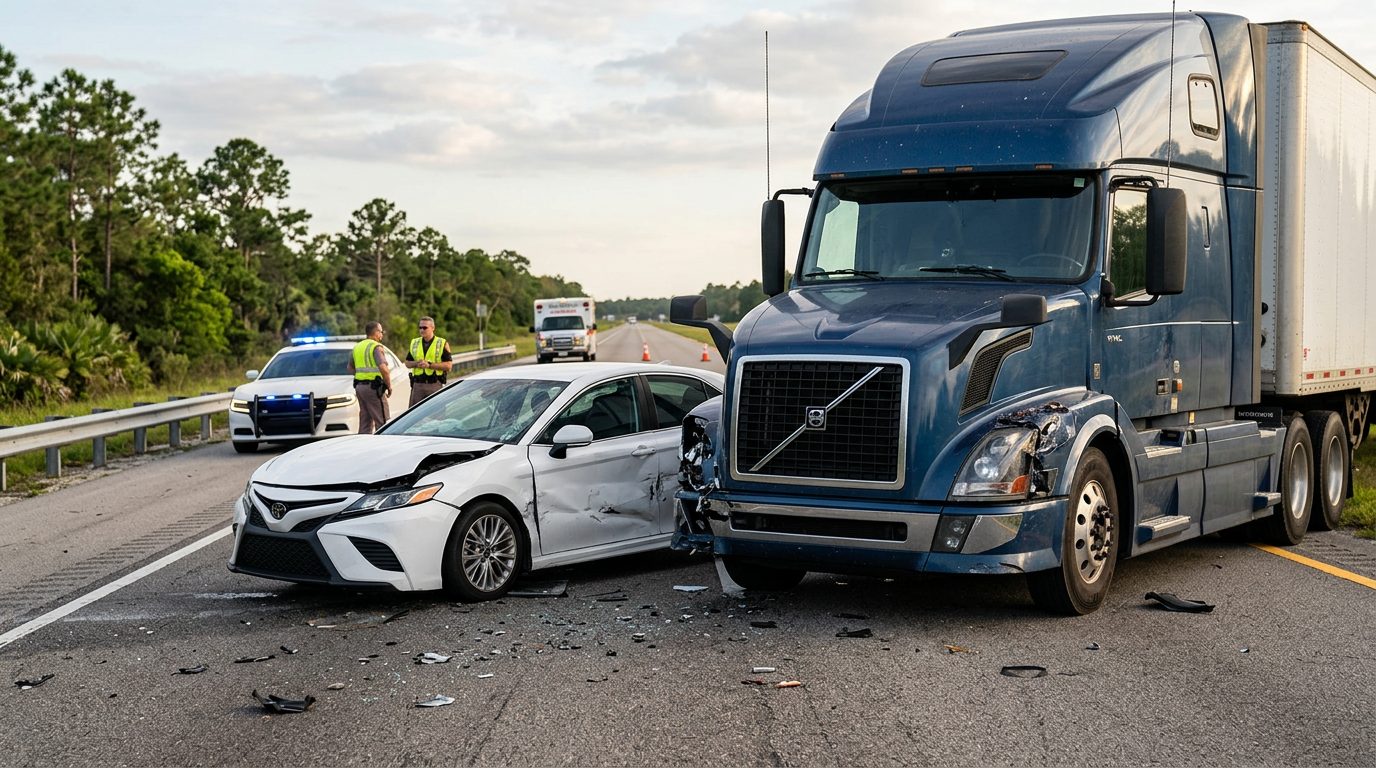
Truck Accidents | Serving Florida
What Are Damages in a Truck Accident Case?
After a truck crash, the question many families ask is what losses the law can address. Here is a plain-language guide from CHG Personal Injury Lawyers, a Florida firm that handles truck accident claims.
By CHG Lawyers · Published November 1, 2026
What are damages in truck accident cases? Damages are money a court or insurer may award for losses. Those losses are caused by someone else’s negligence. Negligence means carelessness that causes harm.
In a Florida truck crash, losses can include:
- Medical bills
- Lost income
- Future care
- The pain a crash leaves behind
When someone dies, the family may have its own claim.
This guide explains each category in plain language. It is written for injured people and the family members who help them.
What Are Damages in a Florida Truck Accident Case?
Damages are payments a person may seek. They make up for harm caused by another party’s negligence.
Truck crashes often cause bigger losses than car crashes. Semi trucks and delivery vans are heavy. Their impact can cause severe injuries.
More than one party may share responsibility. That can include:
- The driver
- The trucking company
- A freight broker (a company that arranges shipments between shippers and trucking companies)
- A company that hired the truck to deliver goods, such as an Amazon or FedEx contractor
In Montgomery v. Caribe Transport II, LLC (2026), the U.S. Supreme Court held that a state-law claim falls within a federal safety exception. Put simply, Montgomery’s negligent-hiring claim falls within the FAAAA’s safety exception.
- A negligent-hiring claim says a company was careless in hiring someone.
- Whether federal or state law applies to a particular claim depends on the facts of each case.
- That exception saves the claim from preemption. In other words, federal law does not override it.
Florida law sorts losses into groups. Each group needs different proof. Knowing the groups helps you keep the right records from the start.
Learn more about truck accident claims.

Not sure what your next step is?
Talk it through with our team — the first consultation is free, confidential, and carries no obligation.
The Two Main Categories of Damages: Economic and Non-Economic
Economic damages are losses with a bill, receipt, or number attached.
Non-economic damages are real losses that have no price tag.
Florida defines economic damages to include past and future lost income, medical and funeral expenses, and other losses (Fla. Stat. § 768.81). These losses would not have happened without the injury. Proof comes from bills, pay records, and billing statements.
Non-economic damages include pain and suffering, emotional distress, and loss of enjoyment of life. Proof usually comes from medical records, your own account, and the words of family and friends.
Punitive damages are a separate, narrower category. They punish reckless conduct. Reckless conduct shows serious disregard for safety. Punitive damages do not repay a loss.
Florida caps (sets a maximum on) most punitive damages awards. Under Florida law, an award of punitive damages generally may not exceed the greater of three times the compensatory damages awarded to each claimant or $500,000, subject to exceptions set out in the statute. The first is three times the compensatory damages awarded to each claimant. The second is $500,000. Compensatory damages are payments meant to repay the harm you suffered.
Economic Losses: Medical Bills, Lost Income, and Future Care
Economic losses cover the bills you have. They also cover the wages you missed, the care you will need, and the property the crash damaged.
- Past and current medical bills: ambulance rides, emergency care, hospital stays, surgery, imaging, medicines, therapy, and follow-up visits.
- Future medical care: ongoing treatment, equipment, and home or vehicle changes that a treating doctor has recommended.
- Lost wages: missed paid and unpaid work, plus lost benefits.
- Loss of earning capacity: the loss that happens when an injury limits your ability to do the same job or earn the same pay later.
- Property damage: your vehicle, personal items, and other property destroyed in the crash.
Florida limits how paid medical bills can be proven. For bills already paid, evidence is limited to the amount actually paid (Fla. Stat. § 768.0427). It does not matter who made the payment.
Some patients treat under a letter of protection. This is a promise to pay the provider from any judgment or settlement. Ask about one before you sign anything.
Keep every bill, pay stub, and record of missed work. Follow your doctors’ care plans.
Non-Economic Losses and the Impact of Catastrophic Injuries
Non-economic losses describe how an injury changes your body, your mind, and your daily life.
- Pain and suffering: physical pain, anxiety, sleep trouble, and fear after a crash.
- Loss of enjoyment of life: hobbies, work you loved, parenting, and time with friends.
- Scarring or disfigurement: how it affects daily life and self-image.
- Loss of consortium (the effect on a marriage): how an injury can change a spouse’s relationship with the injured person.
Some truck crashes cause catastrophic injuries. These are severe, life-changing harms. They include spinal cord injuries and paralysis, traumatic brain injuries, amputations, severe burns, and serious back and neck injuries. Many bring long-term care needs.
Read about catastrophic injury claims.
Brain injuries show how lasting these losses can be. The Brain Injury Association of America compares brain injuries from vehicle crashes, violence, and falls. It uses research that tracks one-year outcomes.
Non-economic losses are shown through the injured person, medical providers, and family. No formula reduces them to a number.
Wrongful Death Damages for the Family
When a truck crash causes a death, Florida’s Wrongful Death Act lets certain family members seek damages. Under Fla. Stat. § 768.21, each survivor may recover the value of lost support and services. Survivors are the family members left behind.
The surviving spouse may also recover for loss of the decedent’s companionship and protection. The spouse may also recover for mental pain and suffering from the date of injury.
- The decedent is the person who died.
- The personal representative is the person who manages that person’s estate.
- The personal representative may recover for the decedent’s estate under the same statute.
Minor children may recover for lost parental companionship, instruction, and guidance. If there is no surviving spouse, all children of the decedent may recover these damages. They may also recover for mental pain and suffering from the date of injury. Adult children cannot recover these damages in medical negligence claims.
A survivor who paid medical or funeral bills may recover them.
Families should also know the deadline. Florida law sets deadlines for filing wrongful death claims. Families should contact a lawyer promptly. If you are grieving, contact our team promptly.
Have questions about what happened?
Ask our team directly. The first conversation is free, confidential, and there is no obligation to continue.
How Much Can You Recover, and What Affects the Amount
The value of a truck accident claim depends on the facts of each case. No general article can name a dollar figure for your situation.
Common factors include:
- How severe and permanent the injuries are
- The treatment history
- Age and earning history
- Clear proof of fault
Evidence matters.
Federal rules limit how long a property-carrying driver may drive. For example, a driver may drive a total of 11 hours during a 14-hour period. That 14-hour period must begin after 10 consecutive hours off duty (49 C.F.R. § 395.3). Early action matters.
Other useful proof includes:
- Photos
- Witness names
- Maintenance records
- Medical documentation
Early statements can shape a claim. Insurers may ask for a recorded statement. They may also offer a quick payment. This can happen before you know the full extent of your injuries. Speak with our team before you give a recorded statement.
Florida Deadlines and Fault Rules That Affect Your Claim
Florida sets filing deadlines for these claims. Deadlines apply, so contact our team promptly.
Florida uses comparative fault, and in most negligence cases, a person found more than 50 percent at fault for his or her own harm may not recover any damages. This means blame is shared.
- Under Fla. Stat. § 768.81, in a negligence action, fault chargeable to the injured person diminishes proportionately the amount awarded as economic and noneconomic damages.
- It does not bar recovery, subject to the statute’s other limits.
- In a negligence action, the court enters judgment (a final court decision) against each liable party. The judgment is based on that party’s percentage of fault.
Insurers and defendants often argue that the injured person shares blame. Clear records help answer that argument.
Statements about the crash on social media can also be used by the other side. Think before you post.
How the Claim Process Works and How to Reach the Firm
The first step is a free, confidential initial consultation. There is no obligation to continue.
- Consultation: You describe the crash, your injuries, and your losses. We explain how Florida rules may apply.
- Investigation: We review the crash report. We also review the trucking companies and insurers involved. We work to preserve evidence, such as driver logs.
- Documenting losses: We work with your medical providers. We gather records of economic and non-economic losses.
- Negotiation or lawsuit: We negotiate with insurers. If a fair resolution is not reached, a lawsuit may be filed in court.
CHG charges no attorney’s fees and no case costs unless there is a recovery.
CHG Personal Injury Lawyers is a Florida firm. We serve clients throughout Florida, including Miami, Orlando, Tampa, and Jacksonville. Our attorneys are licensed in Florida. Igor Hernandez, one of the firm’s lawyers, is the responsible lawyer for this page.
You can contact our team to get started.
Frequently Asked Questions About Truck Accident Damages
What are damages in truck accident cases?
They are payments for losses caused by a crash. Examples of wrongful death damages include medical or funeral expenses paid by a survivor. They also include lost support and services and mental pain and suffering. Only certain survivors may recover these. Examples include a surviving spouse, minor children, or a parent of a deceased minor child.
How much money can you get if a semi truck hits you?
The amount depends on the facts of each case. These include the injuries, the bills, and fault. No general article can name a figure.
What are the three main categories of damages?
Economic damages cover bills and measurable losses. Non-economic damages cover pain and life changes. Punitive damages punish reckless conduct. Florida generally caps them under Fla. Stat. § 768.73.
What should I avoid saying to the insurance company?
Avoid recorded statements and signed papers until you understand your injuries. Speak with our team first.
Can family members recover if someone died in a truck crash?
Yes. Certain family members may bring a claim under Florida’s Wrongful Death Act. See § 768.21.
What if I was partly at fault?
Florida compares fault. Under Fla. Stat. § 768.81, contributory fault reduces the amount awarded in proportion to the injured person’s share, but in a negligence case a person found more than 50 percent at fault for his or her own harm may not recover any damages, except in a case for personal injury or wrongful death arising out of medical negligence under chapter 766.
If a truck crash has left you or someone you love facing medical bills and missed work, our Florida team can talk through which losses may apply. There is no obligation to continue. You can reach out here when you are ready.
Want to know where you stand?
Tell us what happened and our team will walk you through the options available to you, at no cost.
Common Types of Losses in Truck Accident Claims
Medical Bills
Emergency care, hospital stays, surgery, rehabilitation, medication, and future treatment linked to the crash.
Lost Income
Wages and earning ability lost while recovering, and reduced ability to work in the future.
Pain and Suffering
Physical pain, emotional distress, and the loss of everyday activities and enjoyment of life.
Life-Care Needs
In catastrophic injuries such as spinal cord injuries or traumatic brain injuries, long-term care, equipment, and home modifications.
Act Promptly
Deadlines apply to injury claims in Florida, and evidence from a truck crash, such as driver logs, vehicle data, and repair records, can be hard to preserve. Follow your doctors' care, keep your records, and contact our team as soon as you can.
How Damages Are Organized
Economic Losses
Losses with a clear dollar value, such as medical bills, lost wages, and future care costs.
Non-Economic Losses
Harms that are harder to put a number on, such as physical pain, emotional suffering, and changes to family life.
Documenting Your Losses
Keep medical records, bills, pay stubs, and a journal of how the injury affects daily life. These details help explain the full impact of the crash.