

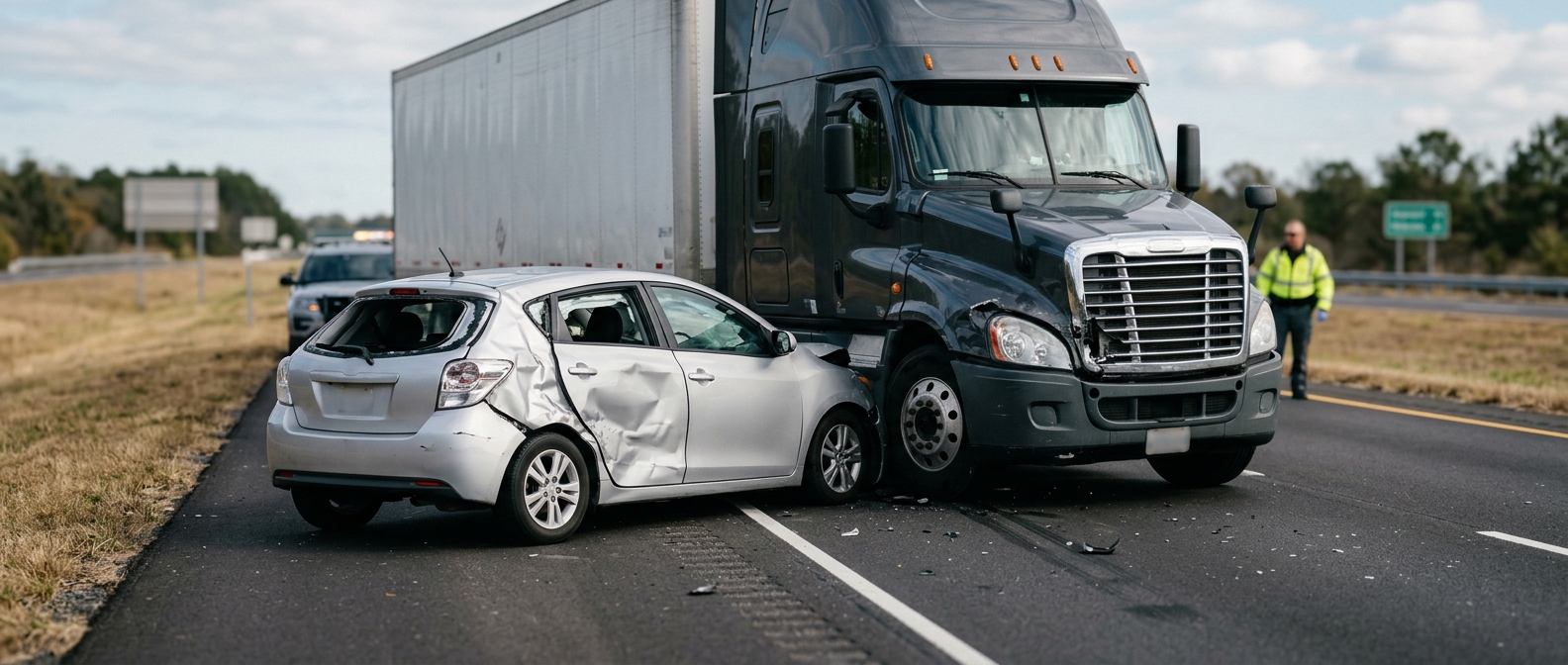
Truck Accident Claims
How Truck Insurance Coverage Shapes a Catastrophic Injury Claim
When a commercial truck causes a spinal cord injury, brain injury, amputation, or a death in the family, the insurance behind that truck is very different from an ordinary car policy. Here is what you need to understand.
Focused on the most serious cases
$750K+
Minimum federal coverage for many interstate trucks
Nationwide
Cases handled across the U.S. from our Florida base
Bilingual
Guidance in English and Spanish
Licensed
Florida Bar–admitted attorneys
By CHG Lawyers · Published August 08, 2026
Truck Accident Insurance Coverage: Why Serious-Injury Claims Reach Bigger Policies
A serious truck accident claim usually reaches much larger insurance policies than a car crash claim. Why? Interstate trucking companies must carry federal coverage. It starts at $750,000. That is 15 times a typical Florida minimum. These cases often add more policies and defendants on top.
That gap matters most when injuries are catastrophic. Spinal cord damage, brain injury, amputation, severe burns, or a death in the family bring lifetime costs. Those costs are far larger than any ordinary auto policy could cover.
This page explains, in plain language, how truck insurance really works. It covers what makes a serious claim valuable. It also shows how Florida’s deadlines and fault rules apply. This is general information, not a promise of any result.
For the bigger picture, see our main guide on catastrophic truck accident injuries.
Not sure what your next step is?
Talk it through with our team — the first consultation is free, confidential, and carries no obligation.
Why truck insurance is different from car insurance
A commercial truck is a business vehicle. It runs for profit. Federal regulators treat it that way. A loaded tractor-trailer can weigh up to 80,000 pounds. That is about 20 times a typical car.
So when a truck causes a crash, the physics alone explain the harm. The damage is often catastrophic. The law responds. It makes trucking companies carry far more coverage than everyday drivers.
This matters because catastrophic injuries cost far more than routine harm. A permanent spinal cord injury can need many surgeries. It can require lifelong care and a rebuilt home. A traumatic brain injury can permanently change how a person thinks, works, and lives.
These claims reach the trucking company’s larger coverage because the losses are so severe. A small auto policy could never pay for a lifetime of care.
How much insurance do commercial trucks carry?
The Federal Motor Carrier Safety Administration (FMCSA) sets federal minimums under 49 CFR §387.9. Most for-hire trucks over 10,000 pounds carry non-hazardous freight across state lines. Their minimum is $750,000 in liability coverage.
That figure rises to $1,000,000 for many hazardous loads. It goes up to $5,000,000 for certain very dangerous cargo. Examples include some explosives or bulk hazardous gases.
Now compare that to Florida’s rules for regular cars. Florida does not even require bodily-injury liability coverage on a standard car. It requires only $10,000 in Personal Injury Protection and $10,000 in property damage under Fla. Stat. §627.736.
That contrast — $10,000 versus $750,000 or more — is the single biggest reason a serious truck claim can reach coverage a two-car crash never could.
Remember, these are floors. Many carriers, shippers, or brokers require higher limits by contract. Companies often buy “excess” or “umbrella” policies. These stack on top of the primary policy. So the true amount available can be far higher than the federal minimum. Finding all of it is one reason an early, aggressive investigation matters.
Why serious-injury truck claims reach higher coverage
The harm suffered drives value in these cases. There is no fixed formula. Consider what a permanent injury actually costs across a lifetime:
- Emergency care, multiple surgeries, and hospital stays
- Long-term rehabilitation and therapy
- In-home nursing or personal attendant care
- Wheelchairs, prosthetics, and assistive equipment
- Home and vehicle changes for accessibility
- Lost wages and reduced future earning power
A spinal cord injury causes permanent changes in strength, feeling, and body function. The effects depend on where the injury sits and how complete it is, according to the Mayo Clinic.
The National Spinal Cord Injury Statistical Center reports on average lifetime costs. For a person injured at age 25, those costs can range from roughly $1.7 million to more than $5 million. It depends on how severe the injury is. That is far beyond any single auto policy. Doctors grade that severity using the standard scale published by the American Spinal Injury Association.
Wrongful death is the most catastrophic outcome of all. When a crash takes a life, Florida’s Wrongful Death Act (Fla. Stat. §768.16–768.26) lets surviving family members pursue the losses that follow. We treat these cases with dignity. We center them on the family left behind and what they can do next.
For context, see our page on truck crash fatality statistics in Florida. For one specific serious injury type, see truck fire and burn injuries.
Multiple policies and defendants can be involved
A two-car crash usually has one other driver. A serious truck case is different. It may involve several parties. Each may have its own insurance:
- The truck driver
- The motor carrier that employed the driver
- A separate company that loaded or secured the cargo
- A maintenance contractor that serviced the truck
- The truck or parts manufacturer
- A leasing company that owned the tractor or trailer
Each may carry a different policy. Coverage is often layered. A primary policy pays first. Then excess or umbrella policies sit above it for larger losses.
Finding every responsible party takes work. This is a key reason serious truck claims move more slowly than a fender-bender. A thorough investigation protects your ability to reach the full coverage available.
Have questions about what happened?
Ask our team directly. The first conversation is free, confidential, and there is no obligation to continue.
What happens when a truck driver causes a crash
When a trucking company learns of a serious crash, its insurer often sends a rapid-response team. Sometimes they reach the scene within hours. Their job is to protect the company, not you.
A motor carrier can be legally responsible for a driver acting within the scope of the job. Lawyers call this vicarious liability. In plain terms, the employer can be on the hook for its employee’s on-the-clock conduct.
Be careful of the early, friendly-sounding phone call. Adjusters may ask for a recorded statement. They may offer a quick, low payment before anyone knows how serious your injuries truly are. You do not have to accept a fast offer. You do not have to guess about your rights.
For a plain checklist of early steps, read what to do after a catastrophic truck accident.
How the claim process works
If the crash wasn’t your fault, you can file a claim against the at-fault party’s insurance. Strong evidence and prompt action make a real difference. A serious truck claim generally moves through these stages:
Report and document. Report the crash and get medical care right away. Prompt records tie your injuries to the wreck.
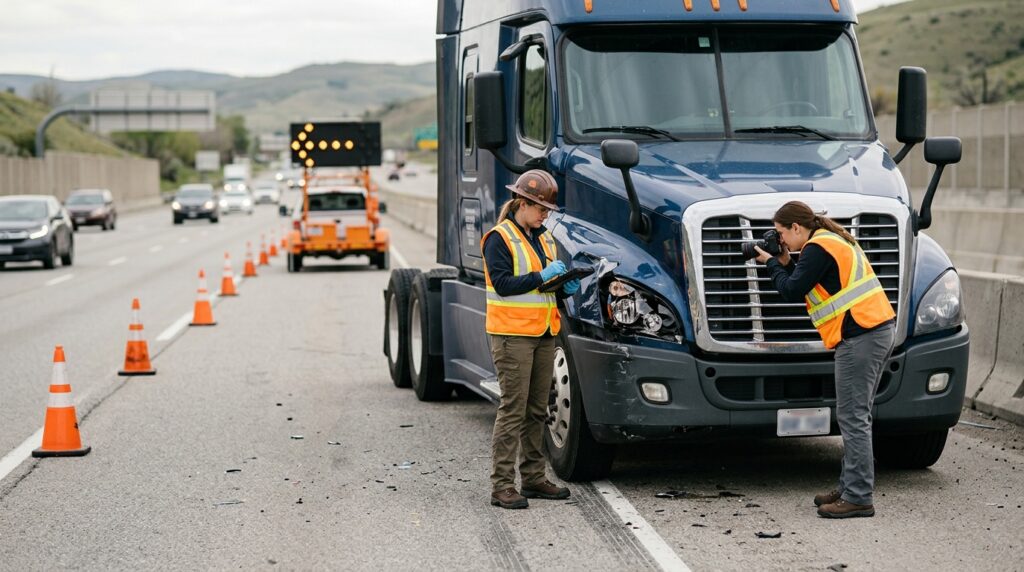
Preserve evidence. Trucks carry data that ordinary cars don’t. The engine control module (its “black box”) may record speed and braking. Electronic logging devices track hours of service. They may show driver fatigue. Maintenance files may reveal neglected repairs. This evidence can be erased or lost. That is why a preservation (“spoliation”) letter should go out fast. A spoliation letter tells the company to keep this evidence.
Understand fault and deadlines. Florida follows modified comparative negligence. This rule reduces or blocks recovery based on your share of fault. Under Fla. Stat. §768.81, a person found more than 50% at fault generally recovers nothing. Any share of fault reduces recovery by that amount. There is also a filing deadline. For most negligence claims arising on or after March 24, 2023, Florida sets a two-year statute of limitations (filing deadline) under Fla. Stat. §95.11. Claims before that date generally fell under the older four-year rule.
Settle or sue. Many claims settle through negotiation. If the insurer refuses fair value, a lawsuit may follow. The path a case takes depends on its facts. No one can promise a result.
What can be recovered after a catastrophic truck crash
Florida law lets you seek two kinds of losses. Economic losses are real dollar costs. Non-economic losses are the human toll. Common categories include:
- Medical bills, past and future
- Lost income and reduced future earning capacity
- Long-term care, nursing, and assistive equipment
- Pain and suffering and loss of enjoyment of life
- Wrongful-death losses — funeral costs and the loss of support, services, and companionship
Catastrophic cases usually need experts to project lifetime numbers. A certified life-care planner maps out decades of medical and attendant care. A forensic economist figures out today’s value of future costs and lost earnings. That professional groundwork is a major reason these claims reach the larger commercial and excess policies.
How much are truck accident claims worth?
There is no honest “average” for a serious truck accident settlement. Value turns on the individual’s losses. It is not a single number. Anyone who quotes a guaranteed figure or an “average payout” is misleading you.
Several factors move value up or down:
- The severity and permanence of the injury
- The total lifetime cost of care and lost earnings
- How much coverage is actually available across all policies
- How clearly the evidence shows who was at fault
- Whether fault is shared under Florida’s comparative-negligence rule
A catastrophic case with permanent paralysis and clear fault sits in a very different range than a disputed, minor-injury claim. That is exactly why a full investigation must come first. Until every policy and every responsible party is identified, no one can responsibly estimate a serious claim.
Want to know where you stand?
Tell us what happened and our team will walk you through the options available to you, at no cost.
Frequently asked questions
How much insurance is a commercial truck required to carry?
Most interstate for-hire trucks over 10,000 pounds hauling non-hazardous freight must carry at least $750,000 in liability coverage under FMCSA rules (49 CFR §387.9). That rises to $1 million, or up to $5 million, for certain hazardous loads.
Why are serious truck claims worth more than car claims?
They often involve much larger federally required insurance. They also involve catastrophic injuries. Those lifetime costs far exceed what an ordinary auto policy could pay.
Who besides the driver can be held responsible?
The motor carrier, a cargo loader, a maintenance contractor, a parts manufacturer, and a leasing company may each share responsibility. Each may carry separate insurance.
How long do I have to file in Florida?
For most negligence claims arising on or after March 24, 2023, Florida sets a two-year deadline under Fla. Stat. §95.11.
Can I recover if I was partly at fault?
Possibly. Under Fla. Stat. §768.81, a person found more than 50% at fault generally recovers nothing. Any lesser share reduces recovery by that amount.
Get a free case evaluation
Understanding coverage is the first step. A lawyer can dig deeper. They can find every policy and responsible party. They can send preservation letters for the truck’s data. And they can build the life-care and economic evidence that shows a catastrophic injury’s true lifetime cost.
CHG Personal Injury Lawyers is made up of licensed attorneys admitted to the Florida Bar. We serve clients in English and Spanish. We take catastrophic-injury cases nationwide from our Florida base. We cannot promise a specific outcome. But we can help you understand your options.
Request a free, confidential case evaluation. You can also read our main guide to catastrophic truck accident injuries.
This page is general information, not legal advice.
Why truck insurance is different
Higher federal minimums
Many interstate for-hire trucks over 10,000 pounds must carry at least $750,000 in liability coverage under FMCSA rules (49 CFR §387.9). Certain hazardous loads require $1 million to $5 million.
Multiple responsible parties
A serious crash may involve the driver, the trucking company, a freight broker, a maintenance contractor, or a cargo loader — each with its own insurer and its own coverage.
More evidence to protect
Trucks carry logs, electronic control data, and inspection records that can disappear quickly. Preserving them early can be decisive in a catastrophic-injury claim.
Be careful before you sign or settle
A large insurer may contact you soon after a catastrophic crash and offer a quick payout. Life-altering injuries — paralysis, brain trauma, limb loss, severe burns — often need lifelong care that early offers do not account for. Speak with a lawyer before agreeing to anything.
Common questions about truck coverage
How much insurance must a truck carry?
Most interstate for-hire trucks over 10,000 pounds hauling non-hazardous freight must carry at least $750,000 in liability coverage under FMCSA rules (49 CFR §387.9). That rises to $1 million, or up to $5 million, for certain hazardous loads.
Why are serious truck claims worth more?
Because catastrophic injuries carry higher stakes — permanent disability, lifelong medical care, lost earning capacity, and in the worst cases a wrongful-death loss — the higher coverage limits on trucks reflect the greater harm these crashes can cause.
What if the injuries were fatal?
A death is the most catastrophic outcome of all. Families can bring a wrongful-death claim, and the same commercial policies and federal minimums apply. We handle these cases with dignity and care for the family left behind.
Who actually pays the claim?
Payment usually comes from the truck's liability insurer, but multiple companies and policies may apply. Identifying every responsible party and every layer of coverage is a key part of a catastrophic case.