
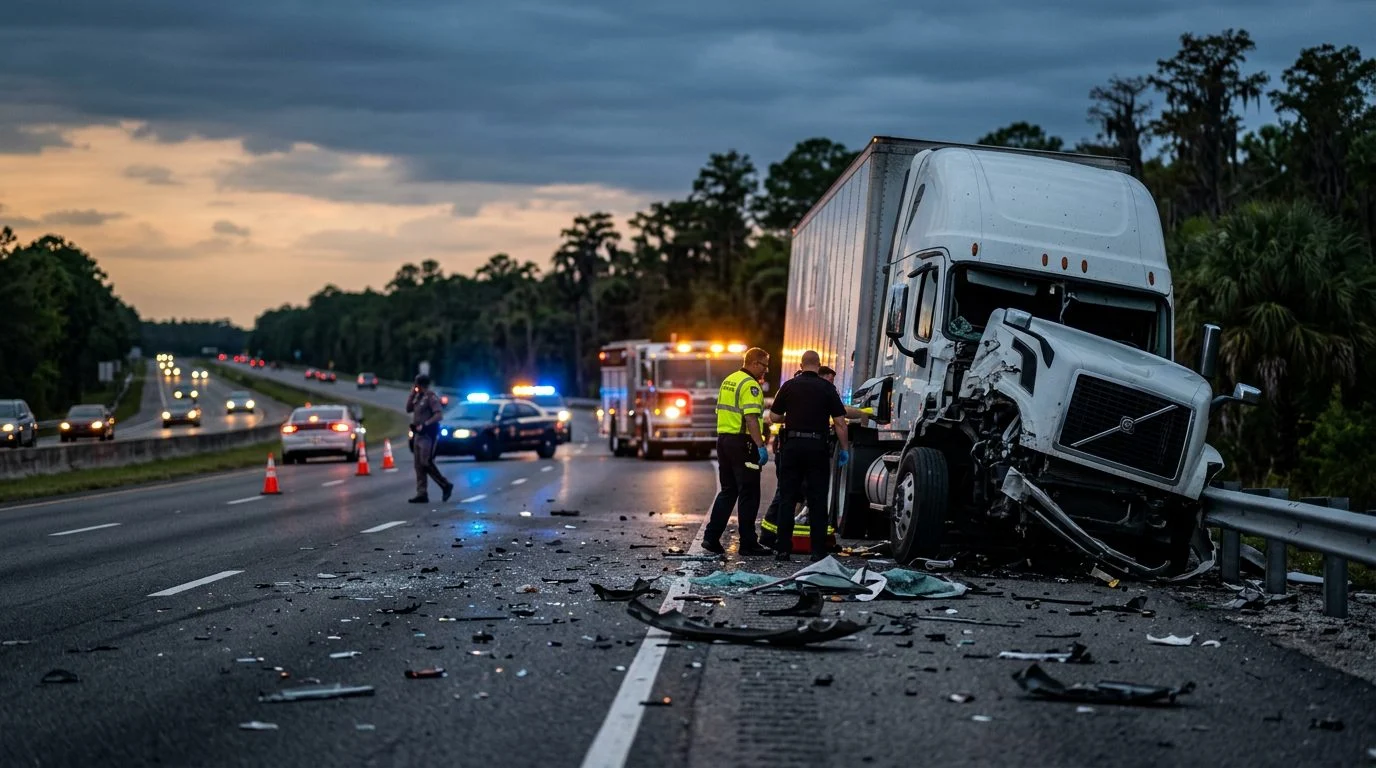
Truck Accidents | Serving Florida
What Happens After a Commercial Truck Crash in Florida: A Step-by-Step Timeline
Commercial truck cases move through several stages, from the first days after the crash to settlement or trial. Here is what to expect, and how an early call to our Florida personal injury lawyers can help you prepare.
Our Florida Practice at a Glance
Free
First consultation, confidential and without obligation
No fee
Unless there is a recovery
Florida
Florida-based firm serving clients statewide
Licensed
Attorneys admitted to The Florida Bar
By CHG Lawyers · Published October 29, 2026
What Is the Timeline for a Commercial Truck Accident Claim in Florida?
If a commercial truck crash hurt you or someone you love, one question likely comes first: what is the timeline for a commercial truck accident claim in Florida? How much time do you have? Florida sets a filing deadline for injury lawsuits under Fla. Stat. § 95.11. This page explains that deadline, when the clock starts, and what a claim timeline usually looks like. Igor Hernandez is the attorney responsible for this page at CHG Personal Injury Lawyers, a Florida firm serving clients throughout Florida.

Not sure what your next step is?
Talk it through with our team — the first consultation is free, confidential, and carries no obligation.
Who This Page Is For and Why the Date Matters
This page is for people hurt in a commercial truck crash in Florida, and for families who lost someone in one. Many readers are still recovering. Insurance adjusters may already be calling, and medical bills may be piling up. It’s easy to assume there’s plenty of time. That assumption can cost people their claim.
Florida sets time limits, called statutes of limitations, for injury lawsuits. If you file after the limit, a court can refuse to hear your case, even when the other driver was clearly at fault. The rules that apply depend on the facts of your crash. The sooner you review them, the more options you keep.
Florida’s Filing Deadline for Commercial Truck Accident Claims
For most injury claims, the filing period is set by statute. Under Fla. Stat. § 95.11, actions other than for recovery of real property must be commenced within the time set for each type of action. A lawsuit generally must be filed before that time runs out.
This is a filing deadline, not a settlement window. Waiting for treatment to finish or for an offer to arrive does not stop the clock by itself.
Comparative fault matters too. Under Fla. Stat. § 768.81, in a negligence action your share of fault reduces your damages proportionately, but if you are found more than 50 percent at fault for your own harm, you may not recover any damages, except in a personal injury or wrongful death case arising out of medical negligence under chapter 766, where that bar does not apply.
When the Clock Starts: Accident Date and Discovery
In most crashes, the clock starts when the last required element of the claim occurs, which is usually the crash itself. Florida’s accrual rule says a cause of action “accrues when the last element constituting the cause of action occurs” (Fla. Stat. § 95.031).
Delayed symptoms make the start date harder to pin down. Brain and spinal injuries can show up days or weeks later. Keep a record of every symptom, visit, and date. Follow your doctors’ care, and report new symptoms right away.
Early records protect your timeline. A law enforcement crash report is required for crashes involving death, personal injury, complaints of pain, or a commercial motor vehicle. It must be submitted within 10 days after the investigation is completed (Fla. Stat. § 316.066).
Post-accident testing rules move quickly too. If an alcohol test is not given within two hours, the employer must keep a record of the reasons. Ask for these records early.
Have questions about what happened?
Ask our team directly. The first conversation is free, confidential, and there is no obligation to continue.
Claim Versus Lawsuit: Why Insurance Talks Don’t Stop the Deadline
An insurance claim is the demand and negotiation with the insurer. A lawsuit is the formal filing in court, and it must be made before the deadline runs.
Talking with an adjuster is not one of the events that Fla. Stat. § 95.051 lists as tolling, or pausing, the time to file. That section says the running of time under any statute of limitations, except ss. 95.281, 95.35, and 95.36, is tolled by the events it lists. These include the pendency of an arbitral proceeding about the dispute and the absence from the state of the person to be sued. The absence rule does not apply if service of process or service by publication can be made in a manner sufficient to confer jurisdiction. The section also says a disability or other reason does not toll the running of any statute of limitations, except those it specifies, s. 095.091, the Florida Probate Code, or the Florida Guardianship Law.
You can ask your insurer for coverage details in writing, and keep a copy of every request.
Report the crash to your own insurer promptly. Read your policy’s notice wording, since policies set their own reporting rules. Commercial trucking insurers can take a long time to respond, so track the filing deadline separately from settlement talks.
Exceptions That Can Shorten or Extend the Deadline
Florida’s exceptions are narrow, and each one has its own conditions.
A minor or a person with an adjudicated incapacity may get more time in limited cases. Even then, the action must begin within seven years after the event (Fla. Stat. § 95.051).
A defendant’s absence from Florida can also pause the clock. That pause does not apply when the defendant can still be served in a way that lets the court hear the case.
Do not count on an exception. Treat the filing date as your working deadline until someone reviews your crash.
Wrongful Death and Claims Against Government Vehicles
A wrongful death claim lets a family seek damages after a fatal truck crash. The statute says the party who would have been liable “shall be liable for damages” even after the injured person has died (Fla. Stat. § 768.19).
Families in this situation carry grief along with paperwork. Review the timing early instead of waiting for final bills.
Government vehicles can change the rules. If a government agency may be involved in your crash, ask about it early so the right deadlines are reviewed.
What Is the Timeline for a Commercial Truck Accident Claim in Florida?
Most truck claims move from evidence gathering to an insurance demand, and to a lawsuit only if needed. Here is the typical path for a commercial truck accident claim timeline in Florida:
- First call. You tell us what happened. We review your injuries, key dates, and deadlines in a confidential conversation.
- Evidence. We work to preserve the crash report, driver logs, coverage statements, and trucking company details.
- Demand. We present a settlement demand to the insurers involved.
- Negotiation. Insurers respond on their own schedules. Responses can take time.
- Filing. If the claim cannot be fairly resolved, a lawsuit is filed before the deadline.
Trucking companies and brokers can both be part of a case.
Timing varies case by case. Treatment, the number of insurers, and whether a lawsuit is needed all shape the schedule. CHG charges no attorney’s fees and no case costs unless there is a recovery.
Want to know where you stand?
Tell us what happened and our team will walk you through the options available to you, at no cost.
Frequently Asked Questions
How long do you have to file an auto insurance claim in Florida?
An insurance claim has no court deadline. For most injury lawsuits in Florida, the filing time is set by Fla. Stat. § 95.11.
How long do I have to declare a crash on my insurance?
Report the crash to your own insurer promptly. Your policy’s notice wording sets the rule for your coverage.
How common is it to get sued after a car accident?
It can happen, and the other side may raise claims in return. Keep your records and deadlines organized if it does.
How long does a semi truck accident settlement take?
Timing varies with treatment, the number of insurers, and whether a lawsuit is needed. The lawsuit deadline runs on its own schedule.

Talk With CHG Before the Clock Runs Down
If a commercial truck crash has left you facing bills, insurer calls, and an unclear deadline, now is the time to get clear answers. You can reach CHG Personal Injury Lawyers for a free, confidential first consultation, with no obligation to continue. Contact CHG for your free consultation and let us review your timeline while there is still time to act.
The Commercial Truck Claim Timeline, Stage by Stage
Days 1 to 7: Protect the Evidence
Trucking companies often begin gathering records, driver logs, electronic data and dashcam footage soon after a crash. Our team can send preservation demands so that critical evidence is kept, and can help you document the scene, your injuries and the names of witnesses.
Weeks 1 to 8: Investigation and Medical Care
Investigators review the crash report, vehicle inspections, maintenance and hiring records, and the driver's hours of service. Follow your doctors' care closely, keep every medical record, and tell us about new symptoms as they appear. We handle communications with insurers so you can focus on recovery.
Months 2 to 12: Claim and Negotiation
Once the injuries and their impact are clearer, we prepare a demand that explains the losses to the insurer. Negotiations can take time, and many cases involve several insurance companies, including the trucking company's commercial carrier.
If Needed: Lawsuit, Discovery and Trial
When a fair resolution cannot be reached through negotiation, a lawsuit may be filed. The discovery phase, depositions, expert witness testimony and mediation can extend the timeline, and some cases proceed to trial. Our lawyers keep you informed at each step.
Why Early Action Matters
Evidence from a commercial truck crash, including electronic logs, maintenance files and video, can be lost or overwritten as time passes. Contacting a lawyer early gives your claim the best opportunity to preserve that evidence. Deadlines apply to every claim, so please contact our office promptly.
What You Can Expect From Our Team
Clear Communication
We explain each stage of your claim in plain language and answer your questions as the case develops.
Thorough Case Preparation
We gather crash reports, trucking records, medical documentation and witness statements to build your claim.
Focus on Your Family
We understand that a serious truck crash affects the whole family, and we work to reduce the burden on yours.
Serving Florida
Our Florida-based firm represents people injured in Miami, Orlando, Tampa, Jacksonville and communities across the state. Some cases may be referred to or handled together with another law firm, and we will tell you if that applies to your matter.