


Truck Accidents · Florida & Nationwide
When a Truck Crash Takes Someone You Love
A death is the most catastrophic outcome there is. This guide explains, in plain language, how a wrongful death claim works after a fatal truck accident — who can file, what it may cover, and the steps a grieving family can take next.
Who You're Working With
Licensed
Florida Bar–admitted attorneys
Nationwide
Serious and fatal injury cases
Bilingual
English & Spanish support
Free
Case evaluations, no upfront cost
By CHG Lawyers · Published July 29, 2026
Losing a Loved One in a Truck Crash: Wrongful Death Claims Explained
A truck accident wrongful death claim is a civil case a family can bring when a loved one is killed. It applies when someone else’s carelessness caused a crash with a large commercial truck. The claim lets surviving family members seek accountability. It also helps them recover the financial and emotional losses they now face.
If you’re reading this, you may be living through the worst days of your life. We’re sorry for your loss. This guide is written for you. It uses plain language and no graphic detail. We’ll explain what a claim is, who can file one, what it can recover, and what you can do next.
Our attorneys handle catastrophic and fatal truck crash cases. We take cases nationwide. A free case evaluation is confidential and comes with no obligation.
Not sure what your next step is?
Talk it through with our team — the first consultation is free, confidential, and carries no obligation.
Why fatal truck crashes are a category of their own
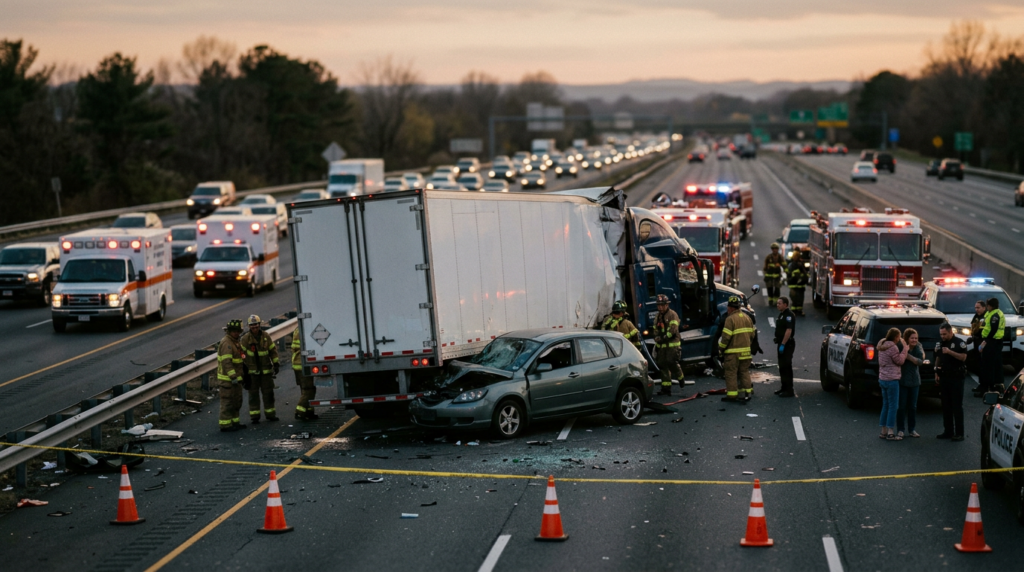
Large trucks are heavier and harder to stop than passenger cars. That physics shows up in the crash data. According to the Insurance Institute for Highway Safety (IIHS), 96% of vehicle occupants killed in two-vehicle crashes involving a passenger vehicle and a large truck in 2024 were occupants of the passenger vehicle — not the truck.
Federal crash records confirm the trend. The National Highway Traffic Safety Administration runs the Fatality Analysis Reporting System (FARS). This public dataset tracks every fatal U.S. traffic crash. You can look up Florida’s numbers there.
These figures don’t tell you anything about a particular case. They explain why a crash with a commercial truck so often ends in permanent injury or death. They also show why these claims are handled differently from an ordinary car accident.
What a wrongful death claim is — and what it is not
A wrongful death claim is a civil lawsuit. Surviving family members or the estate bring it after someone is killed by another party’s negligence (carelessness). It is separate from any criminal case.
The difference from a regular injury case is simple. In an injury claim, the injured person brings the case themselves. In a wrongful death case, the person did not survive. So the family or the estate steps in and pursues the claim on their behalf.
A wrongful death case does two things. It compensates the family for their losses. It also holds negligent people and companies accountable. A criminal case, if one happens, can punish wrongdoing. But it usually does not pay the family a dime. These are two separate tracks. They can run at the same time.
Who can file a truck accident wrongful death claim?
State law decides who can file. Eligible people usually include a surviving spouse, children, parents, and sometimes other financial dependents.
Florida handles this in a specific way. Under Florida’s Wrongful Death Act (Fla. Stat. §§768.16–768.26), the case must be filed by the personal representative of the deceased’s estate. Individual family members cannot file directly. The personal representative files one action for every eligible survivor and the estate. Fla. Stat. §768.18 defines who counts as a “survivor.” That means the spouse, children, parents, and certain blood relatives or adoptive siblings who depended on the deceased for support.
Other states let certain family members file directly. Because we take cases nationwide, the rule for your family depends on where the crash happened. If you’re unsure whether you can file, that’s normal. Many grieving families don’t know. A free case evaluation can clarify who qualifies in your state.
Why more than one company may be responsible
Fault in a truck crash rarely stops with the driver. Several parties can share responsibility. Finding all of them is often what makes these cases worth pursuing.
- The trucking company. A legal rule called vicarious liability means an employer is usually responsible for what its driver does on the job. A company can also be directly at fault for negligent hiring, training, or supervision. For example, it might keep a driver with a known safety history on the road.
- A cargo loader or shipper. Cargo that is loaded wrong or overweight can cause a rollover or a jackknife.
- A maintenance provider or parts maker. Bad brakes or worn tires can point to a repair shop or manufacturer.
Federal rules give an investigation a roadmap. Interstate truckers must follow the Federal Motor Carrier Safety Regulations (49 C.F.R. Parts 350–399). These rules cap driving hours. They require electronic logging devices to record those hours. They set driver-qualification standards. They also require inspection and maintenance records. When a carrier broke one of those rules, the violation itself can be strong evidence of negligence.
Time-sensitive evidence: why the first weeks matter
Much of the proof in a truck case lives in records that can vanish. Electronic logging device data and the truck’s engine control module (the “black box”) can be overwritten in days or weeks. Dash-cam footage, dispatch messages, and maintenance logs can be lost or thrown out on a routine cycle.
That is why one of the first steps is sending a spoliation (evidence-preservation) letter. This is a formal legal notice. It demands the carrier keep this data intact. Our attorneys send it early in the catastrophic truck cases we handle. Waiting can mean losing proof you will never get back. For the bigger picture, see our pillar page on catastrophic truck accident injuries.
Have questions about what happened?
Ask our team directly. The first conversation is free, confidential, and there is no obligation to continue.
What a wrongful death claim must prove
A negligence-based claim usually has to prove four things. In plain terms: someone owed a duty to be careful, failed at it, that failure caused the death, and the family suffered losses.
- Duty. A driver and trucking company must operate safely and follow the law.
- Breach. They failed to. This can happen through fatigued driving, distraction, speeding, unsafe loading, poor maintenance, or unsafe hiring.
- Causation. That failure led to the crash and the death.
- Damages. The family and estate suffered financial and personal losses.
What damages can a family recover?
Florida is unusually specific about who recovers what. It helps to understand the split. Under Fla. Stat. §768.21:
- Surviving family members can recover the value of lost support and services. A surviving spouse may also recover for loss of the decedent’s companionship and protection and for mental pain and suffering. Children over 25 or parents of adult children face tighter limits under the statute.
- The estate can recover lost earnings the deceased would have built up. It can also recover medical and funeral costs paid by the estate, and other economic losses.
Punitive damages are meant to punish and deter, not to compensate. They may apply when the conduct was more than careless. One example is a company that knowingly kept an impaired driver working. Whether they’re available depends on the facts and state law.
Every case is different. We can’t and don’t promise any specific result. But we can explain honestly what your family may be able to pursue. For a deeper breakdown, see our page on wrongful death damages.
Why there is no “average payout”
There is no reliable average value for a truck accident wrongful death claim, despite what some websites suggest. Be skeptical of a page that leads with a “$16 million verdict.” That figure came from one case with its own facts. It tells you nothing about your family’s claim. Quoting big numbers as if they’re typical is misleading.
Many things genuinely affect value. These include the deceased’s income, age, and earning potential. They also include the number of dependents and survivors, how clear the negligence was, how many parties share fault, and the available insurance coverage. Interstate carriers must carry minimum liability insurance. Many carry much more. No one can honestly promise a settlement of any particular size before the facts are known.
How long do you have to file?
Every state sets a filing deadline called a statute of limitations. Miss it, and you can lose the right to file forever. That is true no matter how strong the case is.
In Florida, a wrongful death action must usually be filed within two years of the death under Fla. Stat. §95.11(5)(e). Note this is measured from the date of death, not the crash, if they differ. Deadlines depend on the facts of each case, so use this Florida rule as a starting point, not a substitute for advice about your claim. Evidence also fades fast. The sooner a lawyer can act to preserve it, the better.
First steps a grieving family can take
- Keep every document. Save the crash report, any letters or emails, insurance information, and your loved one’s important records.
- Don’t sign or accept a quick settlement. A fast offer from the carrier’s insurer is often far below what the claim is worth. Signing a release can end your rights.
- Don’t speak with the trucking company or its insurer alone. They may seem kind. But their job is to limit what the company pays. What you say can be used against the claim.
- Act promptly on evidence. The faster someone sends a preservation letter, the stronger the case can be.
A lawyer’s job is to carry this weight for you. That means investigating the crash, dealing with insurers, and valuing the claim, so your family can grieve.
Want to know where you stand?
Tell us what happened and our team will walk you through the options available to you, at no cost.
Frequently asked questions
Who actually files the case in Florida?
The personal representative of the estate, under Florida’s Wrongful Death Act. They file one action for all eligible survivors. If no personal representative has been named, the court can appoint one.
What is the average payout for a wrongful death claim?
There’s no reliable average. Every case turns on its own facts, losses, insurance, and state law. Any site claiming a single average number is oversimplifying.
Can I still file if my loved one was partly at fault?
Often yes, depending on your state. Florida uses modified comparative negligence under Fla. Stat. §768.81. Being more than 50% at fault generally bars recovery. Any recovery is reduced by the deceased’s share of fault.
Do most wrongful death cases settle or go to trial?
Many personal injury cases settle. Some go to court when no fair offer is made. A case should be prepared as if it will go to trial from day one.
How much does a wrongful death lawyer cost?
Most personal injury firms, including ours, work on a contingency fee. There’s no attorney fee up front. The fee comes out of any recovery, so there’s no fee unless the case succeeds.

Talk to CHG Personal Injury Lawyers about your loss
No claim can replace the person your family has lost. But a truck accident wrongful death claim can help secure your family’s future. It can also hold the responsible parties accountable.
Our firm focuses on catastrophic and fatal truck crash cases. We take cases nationwide, and we provide bilingual support in English and Spanish. When you’re ready, contact us for a free case evaluation. You can also learn more on our page about catastrophic truck accident injuries. There’s no pressure and no obligation — just answers, when you need them most.
First Questions Families Ask
Who actually files the case in Florida?
Under Florida's Wrongful Death Act, the personal representative of the estate files a single action on behalf of all eligible survivors. If no personal representative has been named yet, the court can appoint one.
Is there an 'average' payout?
No. There is no reliable average, and any lawyer who promises a specific figure is misleading you. Every case turns on its own facts — the losses suffered, the survivors involved, and the available insurance and evidence.
How long do we have to act?
Time limits apply, and critical evidence — truck logs, dashcam footage, maintenance records — can disappear quickly. Getting advice early helps protect what the family may need later.
Who can be held responsible?
A fatal truck crash can involve more than the driver — trucking companies, cargo loaders, maintenance providers, and others. Sorting this out is part of what an investigation determines.
How We Try to Help
Preserve the evidence
We move to secure records that matter in truck cases — driver logs, electronic data, inspection and maintenance history — before they can be lost.
Stand in for the family
We work alongside the personal representative so the family isn't left managing insurers and paperwork during the hardest time of their lives.
Explain your options clearly
No legal jargon, no pressure. We tell you what a claim can and cannot do so you can make decisions with full information.
Treat the loss with dignity
We center every case on the people left behind — never sensational, always focused on what you can do next.
Be careful before signing or speaking with an insurer
After a fatal crash, an insurance company may reach out early and ask for a recorded statement or offer a quick settlement. You are not required to accept anything or sign a release right away. Consider getting independent advice first so your family's rights are protected.