

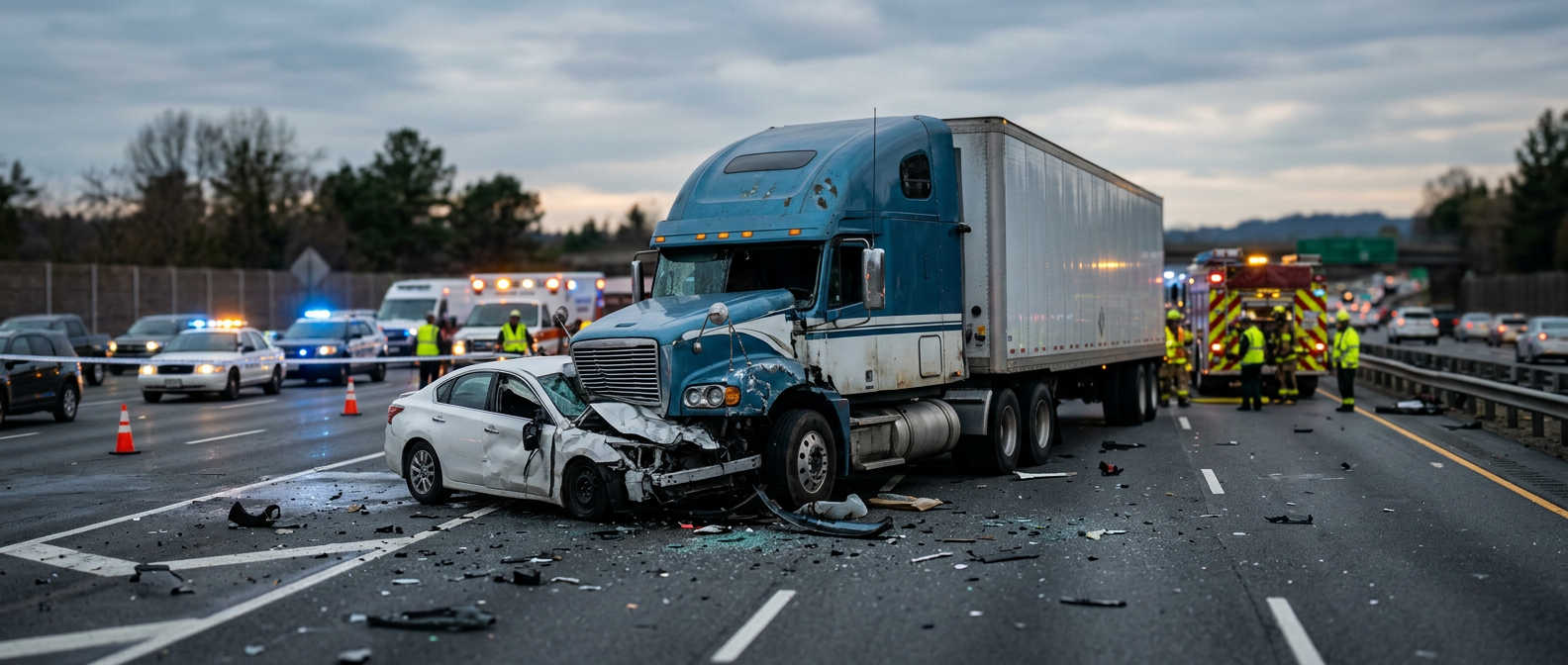
Truck Accidents: Catastrophic Injuries, Causes, and Your Legal Options
Did a large truck crash leave you or someone you love with a permanent, life-altering injury? You may have the right to hold the truck driver and the trucking company responsible.
This page explains why these crashes cause such severe harm. It also covers what causes them, who can be held responsible, and how a claim works. We focus on the evidence that can vanish within days.
We write only about serious truck accidents. These are crashes that cause permanent, disabling injuries or death. If you are facing that kind of loss, keep reading. Our attorneys handle catastrophic-injury cases in Florida and nationwide. A first consultation is always free.
When a Truck Crash Changes Everything
A serious truck crash can turn a normal day into a lifelong struggle in seconds. Families suddenly face intensive-care stays and many surgeries. The future looks nothing like the one they planned. Often, they must also figure out how to pay for it all.
This is not about a minor fender-bender. A crash with an 18-wheeler or other large truck often causes injuries that never fully heal.
We wrote this guide for the injured person and the family. We want to help you understand what happened and what to do next — not help lawyers or insurers.
Below, we cover why truck crashes are so devastating. We explain the real leading causes and the injuries that follow. We also cover who may be responsible, the time-sensitive evidence that decides these cases, and how the legal process works.
If you're in a major Florida metro, we have city-specific resources: No matter where the crash happened, we're ready to review your case. Talk it through with our team — the first consultation is free, confidential, and carries no obligation.
Why Truck Crashes Cause Catastrophic Injuries
The physics are unforgiving. Federal rules cap most loaded tractor-trailers at 80,000 pounds (FMCSA). A typical passenger car weighs about 3,000–4,000 pounds. When the two collide, the smaller car and the people inside absorb enormous force.
That weight gap also affects stopping distance. A fully loaded truck can need 20–40% more distance to stop than a car. It needs even more on wet roads. When brakes are worn or a driver reacts too late, the impact is often catastrophic.
Several crash types are especially deadly:
- Underride crashes. A car slides beneath the truck’s trailer. The passenger area takes the impact.
- Rollovers. The truck tips over and crushes nearby vehicles.
- Jackknifes. The trailer folds against the cab and sweeps across lanes.
These forces don’t cause bruises. They cause damaged spinal cords, brain injuries, and lost limbs.
The trucks involved include semis, 18-wheelers, tanker trucks, dump trucks, and delivery or box trucks. Each one carries enough weight to change a life forever.
The Leading Cause of Truck Crashes — Explained Honestly
Driver-related factors are the most common cause of serious truck crashes. These include fatigue, distraction, speeding, and impairment (driving while drunk or on drugs).
You may have seen the claim that “90% of accidents are caused by human error.” We won’t repeat a number we can’t stand behind. The research is more careful. The FMCSA and NHTSA ran the Large Truck Crash Causation Study, the largest study of its kind. It found that the “critical reason” for a crash was assigned to the driver far more often than to the vehicle or the road.
In plain terms, human choices — not just mechanical failures — cause most crashes. That difference matters. It points investigations toward the people and companies whose choices can be examined.
Truck drivers also face long hours and tight deadlines. Federal hours-of-service rules limit driving time. But some drivers and carriers break them. A tired driver reacts slowly. A distracted one may never react at all.
Other common causes include:
- Improper loading or shifting cargo that throws off balance.
- Poor maintenance, including worn brakes and bald tires.
- Scheduling pressure that pushes drivers past safe limits.
Often several factors combine in one crash. That’s why more than one party may share the blame, as we explain below.
Catastrophic Injuries Common in Truck Accidents
The extreme force often causes permanent, disabling injuries. Below are the ones we see most.
Spinal cord injuries and paralysis. A crushing impact can damage the spinal cord and cause paralysis. This includes paraplegia (loss of movement in the legs) and quadriplegia (loss in all four limbs). Vehicle crashes are a leading cause of spinal cord injury, according to the Mayo Clinic. Doctors often describe how severe an injury is using the ASIA Impairment Scale. The National Spinal Cord Injury Statistical Center (NSCISC) tracks the long-term costs of these injuries. Learn more on our spinal cord injuries page.
Traumatic brain injuries (TBI). A violent blow to the head can cause lasting problems with thinking, memory, movement, and mood. See our traumatic brain injuries page.
Amputations and limb loss. Crush injuries sometimes lead to surgical amputation when a limb can’t be saved. Read about amputation injuries.
Severe burns. Fuel fires and tanker incidents can cause deep, disfiguring burns. These often need years of treatment and skin grafting. See our severe burn injuries page.
Catastrophic back and neck injuries. Beyond the spinal cord itself, severe damage to the back and neck can cause lasting pain and disability. Learn more about catastrophic back and neck injuries.
When a crash takes a life, surviving family members may have a claim too. Our wrongful death page explains those rights.
Who May Be Responsible for a Truck Crash
Responsibility often reaches far beyond the driver. That’s a key way these cases differ from ordinary car accidents. Parties who may be legally responsible include:
- The truck driver, for unsafe or reckless driving.
- The trucking company (motor carrier), for pushing unsafe schedules or hiring unqualified drivers.
- Cargo loaders, for unbalanced or unsecured loads.
- Maintenance contractors, for ignored repairs.
- Truck or parts makers, for defective brakes, tires, or other parts.
Federal safety rules from the Federal Motor Carrier Safety Administration (FMCSA) set standards for driving hours, vehicle maintenance, and driver qualifications. When a carrier breaks those rules, that violation can support a claim.
Finding every responsible party usually takes investigation. That’s why getting legal help early can matter so much.
Evidence That Disappears Fast — and How to Protect It
This is where a serious truck case is won or lost. No viral crash video can help you here. The most important evidence often lives inside the truck and the carrier’s computers. It can be erased in days.
Key evidence often includes:
- The truck’s electronic control module (ECM), or “black box.” It can record speed, braking, throttle, and engine hours right before impact.
- The driver’s logs (often electronic logging device data). These show hours behind the wheel and possible hours-of-service violations.
- Dispatch and telematics data from the carrier, including GPS and messaging.
- Maintenance and inspection records for brakes, tires, and repairs.
- The driver’s qualification file and any drug or alcohol testing.
During normal operations, ECM data can be overwritten and logs recycled, sometimes within weeks. That’s why an attorney moves quickly to send a spoliation / preservation letter. This is a formal notice. It legally requires the carrier to keep this data and not destroy or change it.
Scene photos, witness statements, the police report, and medical records matter too. Attorneys also work with crash-reconstruction and life-care-planning experts. These experts explain what happened and how the injuries will affect the rest of your life.
Here’s the practical takeaway. The sooner the evidence is locked down, the harder it is for a carrier to say “we no longer have it.”
Not sure what your next step is?
Talk it through with our team — the first consultation is free, confidential, and carries no obligation.
What a Truck Accident Claim May Cover
A serious claim may cover both financial losses and personal harm. Every case depends on its own facts. The goal is to account for the full, lifelong cost of a catastrophic injury.
Common types of damages include:
- Medical care, past and future, including surgeries and hospital stays.
- Long-term rehabilitation and devices like wheelchairs.
- Lost income and lost earning capacity when you can’t return to work.
- Home and vehicle changes and in-home care for permanent disability.
- Pain, disability, and loss of quality of life.
- Wrongful-death damages for families who lost a loved one.
Catastrophic injuries carry costs that last decades. A high-level spinal cord injury can require lifelong care for problems with breathing, blood pressure, and pressure sores, as the Mayo Clinic explains. The Christopher & Dana Reeve Foundation offers guidance on daily living and long-term care.
We can’t promise a specific result. Outcomes depend on the facts and the law. But a careful review helps make sure nothing important gets left out.
How the Legal Process Works
The process usually starts with a free case evaluation. Then it moves through investigation, negotiation, and — if needed — a lawsuit.
An attorney reviews your situation at no cost. They gather evidence, find every responsible party, and deal with the insurers. If the insurer won’t be fair, the case may go to court.
Time limits apply. In Florida, the deadline to file most negligence-based injury lawsuits is two years. This applies to claims that arise on or after March 24, 2023, under Fla. Stat. §95.11.
Florida also follows a modified comparative-negligence rule. This means fault is shared. Under Fla. Stat. §768.81, a person found more than 50% at fault generally cannot recover damages. Deadlines and fault rules vary by state, so ask early.
Many personal-injury firms, including CHG, work on a contingency fee. In plain terms, you don’t pay attorney fees up front. The fee comes from any recovery.
Truck Accident Help in Your Area
We represent catastrophic truck-crash victims across Florida and nationwide. If you’re in a major Florida metro, we have city-specific resources:
- Jacksonville truck accidents
- Orlando truck accidents
- Tampa truck accidents
- Miami truck accidents
No matter where the crash happened, we’re ready to review your case. You can also read our overview of catastrophic injury claims.
Frequently Asked Questions
What is the number one cause of trucking accidents?
Driver-related factors are the leading cause. These include fatigue, distraction, speeding, and impairment. In the FMCSA/NHTSA Large Truck Crash Causation Study, the driver was assigned the “critical reason” for a crash far more often than the vehicle or road. Scheduling pressure and poor maintenance also play major roles.
Are the “90% of accidents are human error” claims true?
The exact figure is often overstated. But the research reliably shows that human choices cause most crashes. Investigators still examine the vehicle, the load, and the carrier’s practices. More than one factor — and more than one party — is often to blame.
How long do I have to file a truck accident claim in Florida?
For most injury claims that arise on or after March 24, 2023, Florida’s deadline is two years under Fla. Stat. §95.11. Talk to a lawyer promptly. The truck’s data can be overwritten long before that deadline.
Do I need a lawyer for a serious truck accident?
Truck crashes are more complex than car crashes. Several parties may share fault, federal rules apply, and key electronic evidence can disappear quickly. A lawyer can send a preservation letter, find every responsible party, and handle the insurers for you.
Have questions about what happened?
Ask our team directly. The first conversation is free, confidential, and there is no obligation to continue.
Talk to a Truck Accident Attorney About Your Situation
We know this is one of the hardest times of your life. A catastrophic truck crash brings pain, fear, and uncertainty. You shouldn’t have to sort through it alone.
Our licensed attorneys are admitted to the Florida Bar. We focus on serious and permanent injuries from truck crashes. We can’t guarantee any outcome. But we can give your case a thorough review and explain your options in plain language.
Request your free, confidential case evaluation today. There’s no cost to talk, and no obligation. Let us help you understand what happened and what comes next.