

Truck Safety • Florida & Nationwide
Which Truck Is Safest in a Crash? What the Ratings Really Tell You
Crash ratings can help you choose a safer vehicle — but no truck stops a negligent driver. Here's how to read IIHS and NHTSA scores, and what to do when a serious crash has already changed everything.
By CHG Lawyers · Published August 05, 2026
Which Truck Is Safest in a Crash? What IIHS and NHTSA Actually Show
There is no single “safest truck” for every crash. The safest pickups earn top marks from both the Insurance Institute for Highway Safety (IIHS) and the National Highway Traffic Safety Administration (NHTSA) in the current model year. These ratings change every year. So any fixed “top 10” list — including this page — goes out of date the moment a truck is redesigned.
Below, we explain how the tests work. We compare full-size and midsize trucks. We show why “most accidents” is a misleading question. And we share one hard truth that dealer and affiliate pages skip: even a top-rated truck can’t beat the physics of a crash with a heavy commercial truck.
Not sure what your next step is?
Talk it through with our team — the first consultation is free, confidential, and carries no obligation.
First, know who you’re reading
Search results for “safest truck” are full of dealership pages and affiliate sites. These sites earn money when you buy or click. They are not neutral. They tend to push the trucks they sell and hide weaker scores.
Two sources have no product to sell you:
- NHTSA’s 5-Star Safety Ratings — a federal government program. Search by make, model, and year.
- IIHS.org — a nonprofit funded by auto insurers. Its crashworthiness ratings and “Top Safety Pick” awards are widely cited across the industry.
Before you trust any list, look up your exact truck on both. A rating shows how a vehicle performs in standard tests. It is never a promise of safety in a specific real-world crash.
How IIHS and NHTSA test pickup crash safety
The two agencies use separate systems. They measure different things. Together, they give a fuller picture than either one alone.
NHTSA uses its 5-Star Safety Ratings. More stars mean better protection for people inside during the agency’s crash tests. IIHS gives crashworthiness grades: good, acceptable, marginal, or poor. It saves its Top Safety Pick and Top Safety Pick+ awards for the best performers.
The main crash tests
Both programs copy common, serious crashes:
- Small and moderate overlap front tests — front-corner and offset frontal crashes, where only part of the front end hits the barrier. IIHS updated its moderate-overlap test in 2022 to add a back-seat dummy. Several trucks that once scored “good” slipped after that change. This shows why the year matters.
- Side impact test — a moving barrier hits the side. IIHS made this test tougher in 2021 to match higher real-world crash speeds.
- Roof strength test — how well the roof holds up in a rollover.
- Head restraint and seat tests — protection against neck injury in rear crashes.
Crash-avoidance and driver-assist technology
Ratings also weigh technology that helps you avoid a crash. This includes automatic emergency braking, pedestrian detection, and headlight quality. Since 2022, IIHS has required good-rated headlights on all trims for a truck to win a top award — not just on the pricey package. A truck can earn top honors only if it passes these checks too.
One detail matters a lot. A rating applies to a specific model year, trim, and equipment level. A 2026 truck may score differently from a 2019 version of the “same” nameplate. Always look up the exact year and trim, not a marketing claim.
Safest full-size pickups (what the ratings show)
Full-size pickups — the Ford F-150, Chevrolet Silverado 1500, Ram 1500, Toyota Tundra — are grouped and tested as “large pickups.” They compete within that class.
A top full-size result usually needs good crashworthiness scores across the main tests. It also needs qualifying crash-avoidance tech and good headlights. Because awards shift every model year, don’t assume last year’s winner still leads. Confirm the current results directly on IIHS and NHTSA.
Marketing pages rarely mention one trade-off. A bigger truck’s mass helps protect its own passengers. But that same mass raises the danger to people in the smaller vehicle it hits. Size can help you and harm others in the very same crash.
Safest midsize pickups
Midsize trucks like the Toyota Tacoma and Hyundai Santa Cruz run the same tests. But they are compared within their own, smaller size class.
That’s why you cannot directly compare a midsize truck’s stars to a full-size truck’s stars. Each rating reflects performance against similar-weight vehicles. In a crash between two vehicles of very different weight, the heavier one usually protects its passengers better — no matter the stars. For the current midsize rankings, check the official sources again, not a single blog.
Is Ford or Chevy safer?
Neither is flat-out “safer.” It depends on the specific model, model year, and equipment.
Compare the exact two trucks side by side on IIHS and NHTSA. A brand you trust may build a top-rated truck one year and a lower-rated one the next, after a redesign. Loyalty is not a safety rating. The live data is.
Have questions about what happened?
Ask our team directly. The first conversation is free, confidential, and there is no obligation to continue.
What truck gets in the most accidents? (Frequency is not safety)
This is one of the most misread questions online. So let’s answer it clearly.
Popular, high-volume trucks appear in more total crashes simply because more of them are on the road. The Ford F-Series has been the best-selling vehicle in the United States for decades. So it shows up in raw crash counts more than a low-volume model. That is a math quirk of sales, not a safety defect.
There are two very different measures:
- Crash frequency (exposure) — how often a model is involved in a crash. This depends largely on how many are sold, who drives them, and how far.
- Crashworthiness (outcome) — how well the vehicle protects people when a crash happens. This is what IIHS and NHTSA scores actually measure.
A best-selling truck can appear in many crashes and still earn top crashworthiness marks. And most crashes trace back to driver behavior, road conditions, and other drivers — not to the vehicle by itself. If a page answers “most accidents” by calling a model “dangerous,” it is confusing exposure with outcome.
The limits of crash ratings: why the “safest” truck can’t prevent every catastrophic injury
Crash ratings copy standard conditions at set speeds. They can’t cover every real-world crash. And they can’t rewrite physics.
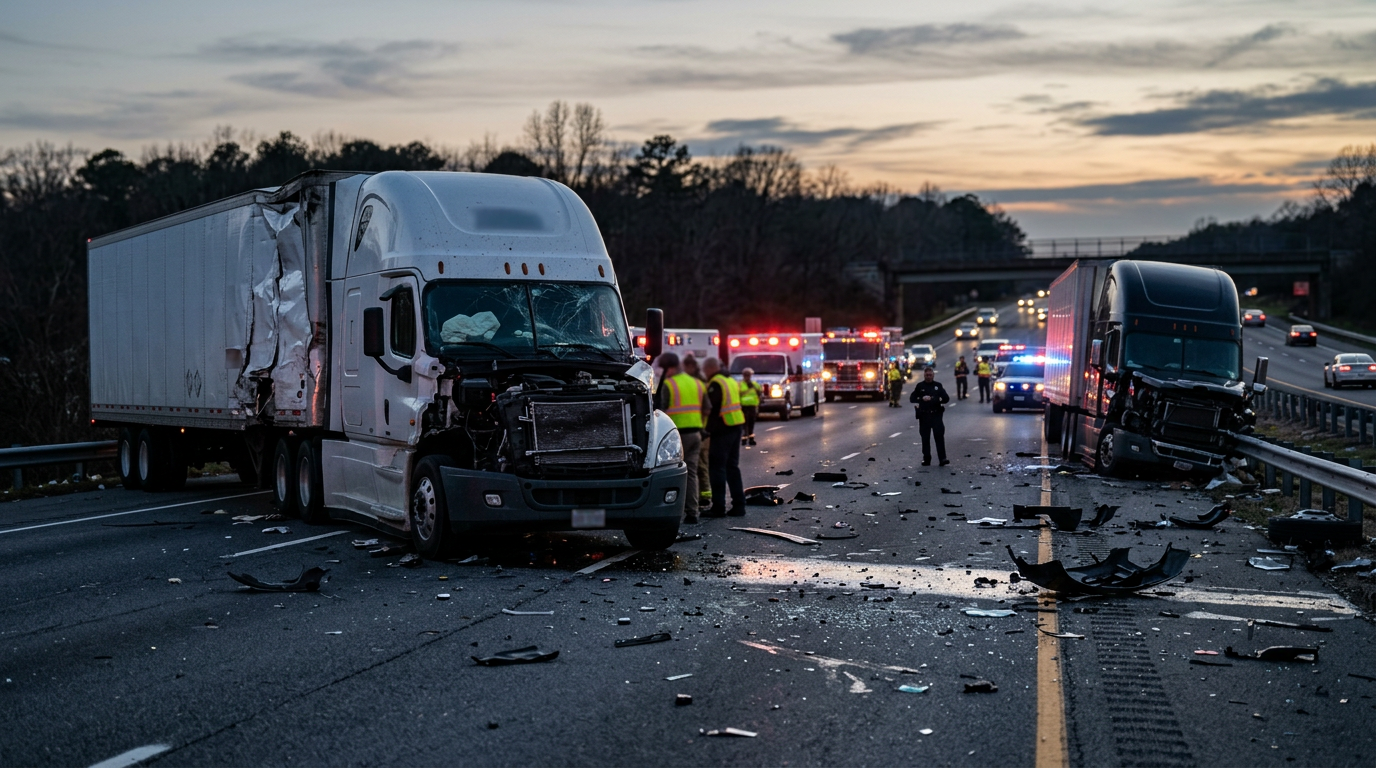
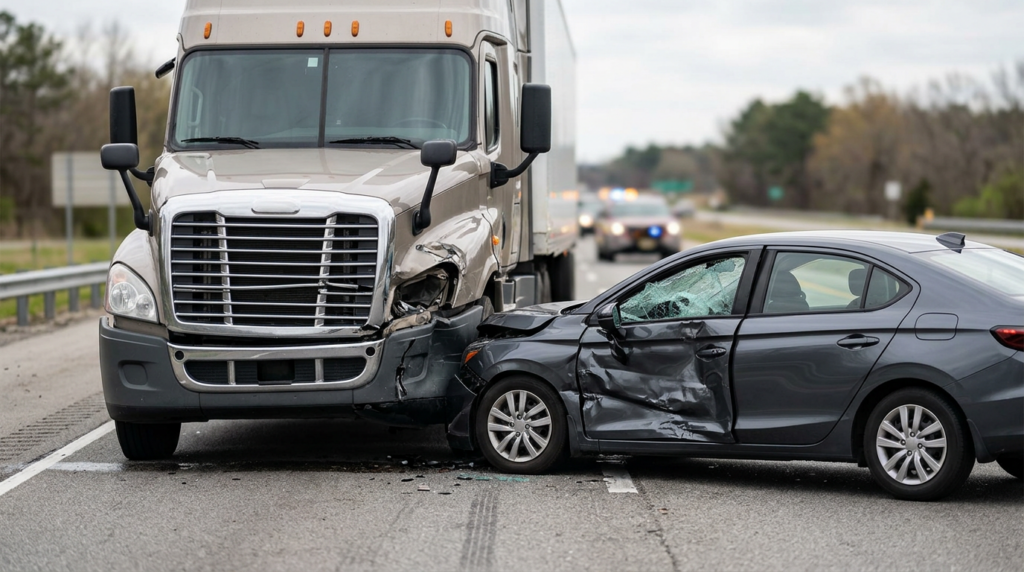
Here is the mismatch ratings don’t capture. NHTSA’s crash tests use controlled speeds against fixed or matched barriers. A fully loaded tractor-trailer can weigh up to 80,000 pounds under federal limits. That’s roughly 15 to 20 times more than a half-ton pickup. When that much mass strikes a passenger truck, the forces can overwhelm any consumer safety rating. A five-star truck is still the much smaller object in that crash.
Our attorneys handle catastrophic-injury truck cases. We see how a severe crash can change a life in seconds. These crashes can cause:
- Spinal cord injury and paralysis. Motor vehicle crashes are a leading cause of spinal cord injury. This injury can permanently take away movement and feeling below the injury, according to the Mayo Clinic. Doctors rate its severity using the ASIA Impairment Scale. National data comes from the National Spinal Cord Injury Statistical Center. Paralysis figures come from the Christopher & Dana Reeve Foundation.
- Traumatic brain injury (TBI).
- Amputation and limb loss.
- Severe burns.
- Catastrophic back and neck injuries.
- Fatal outcomes, which leave families to face the deepest loss of all. NHTSA’s Fatality Analysis Reporting System (FARS) is the federal count of U.S. traffic deaths. It is the dataset behind most crash-fatality figures.
A high safety rating lowers your risk. It is never a guarantee against serious harm.
If you or a loved one was seriously hurt in a truck crash
If a truck crash caused a life-altering injury or a death in your family, you’re likely facing large medical bills and painful choices all at once. We’re sorry you’re going through this.
When another driver’s or a trucking company’s negligence caused the crash, you may have a legal claim. You could recover the cost of medical care, lost income, and long-term needs. Families often talk to a lawyer because these cases can be complex. They may involve federal trucking rules (the Federal Motor Carrier Safety Regulations) and more than one responsible party — the driver, the trucking company, a cargo loader, or a maintenance contractor.
Timing and fault rules matter in Florida. For most negligence claims that started on or after March 24, 2023, you generally have two years to file a lawsuit under Fla. Stat. §95.11. Florida also follows modified comparative negligence. Under Fla. Stat. §768.81, a person found more than 50% at fault generally cannot recover damages.
CHG Personal Injury Lawyers is a Florida-based firm. Our licensed attorneys are admitted to the Florida Bar, and we handle catastrophic-injury cases nationwide. You can request a free case evaluation to learn your options. Every case is different. Results depend on the specific facts, and no outcome can be promised.
Learn more about truck accident claims
- Truck accident claims — our main resource on serious and fatal truck crashes.
- Florida truck accidents
- Miami truck accidents
- Orlando truck accidents
You can also read about spinal cord injuries, traumatic brain injuries, and catastrophic injury claims.
Want to know where you stand?
Tell us what happened and our team will walk you through the options available to you, at no cost.
Frequently asked questions
Which truck is safest in a crash?
The safest truck is the current-year model with top scores from both IIHS and NHTSA. Ratings change yearly. So check the official databases — not dealer pages — before you decide.
What truck gets in the most accidents?
High-volume, best-selling trucks show up in more total crashes because more are on the road. That’s crash frequency (exposure), not crashworthiness (how well the truck protects people). The two are not the same.
Is Ford or Chevy safer?
Neither brand is flat-out safer. Safety depends on the specific model, model year, and equipment. So compare the exact trucks on IIHS and NHTSA.
Can a good crash rating protect me from a semi-truck?
Not fully. A loaded tractor-trailer can weigh up to 80,000 pounds — many times more than a pickup. That mass can overwhelm even a top-rated truck’s safety features.
What should a family do after a serious or fatal truck crash?
Get medical care, keep records, and consider talking with an attorney. In Florida, strict deadlines and shared-fault rules can affect a claim. So acting promptly helps.
How to Read Crash Ratings Correctly
Check Both IIHS and NHTSA
The Insurance Institute for Highway Safety and the federal 5-Star Safety Ratings test differently. A truck that scores well on both gives you the fullest picture.
Use Official Databases, Not Dealer Pages
Dealer marketing highlights the flattering numbers. Go straight to the government and IIHS sources so you compare complete, current-year results.
Ratings Change Every Year
Manufacturers update designs and tests get tougher. A top pick from three years ago may not hold that title on the newest model.
Crash Frequency Isn't the Same as Safety
Best-selling trucks appear in more total crashes simply because more of them are on the road — not because they are less safe.
A Safe Truck Still Can't Prevent Someone Else's Negligence
Ratings measure how a vehicle protects occupants in a controlled test. They cannot account for a fatigued trucker, an overloaded rig, or a distracted driver. When those failures cause a catastrophic crash, the injuries — spinal cord damage, traumatic brain injury, amputation, or a fatal outcome — are about accountability, not vehicle scores.
Common Questions About Truck Safety and Crashes
Which truck is safest in a crash?
The safest choice is generally a current-year model that earns top scores from both IIHS and NHTSA. Because ratings are updated yearly, always confirm the latest results in the official databases before you rely on any single claim.
What truck gets in the most accidents?
High-volume, best-selling trucks show up in more total crashes because there are simply more of them on the road. Higher crash counts reflect popularity — not necessarily a weaker safety design.
Do ratings matter after a serious crash?
After a catastrophic collision, the focus shifts from vehicle scores to what happened and who was responsible. Fault, evidence, and the full extent of your injuries drive a claim — not how the truck rated.
What if a crash caused a life-altering injury or death?
Catastrophic injuries and fatal truck crashes deserve careful investigation. Families and survivors can learn their options and next steps by speaking with a lawyer who handles these serious cases.