

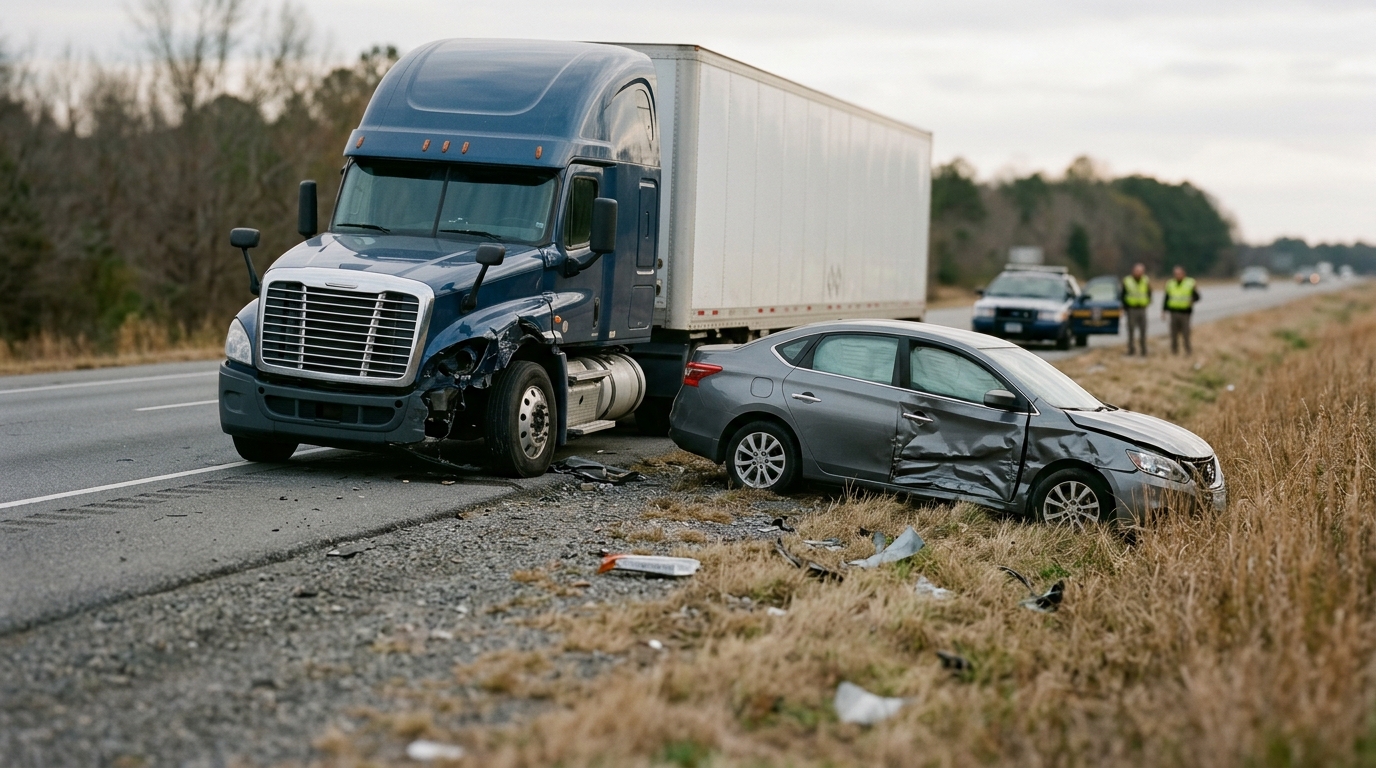
Truck Accident Claims · Florida & Nationwide
Truck Accident Insurance Coverage: What Really Pays
After a catastrophic truck crash, medical bills climb fast. Understanding which policies actually pay victims — and how much coverage the law requires — can change everything for your family.
Why Families Turn to CHG
Nationwide
Catastrophic injury cases handled across the U.S.
Licensed
Attorneys admitted to the Florida Bar
Bilingual
Guidance in English and Spanish
Free
Confidential case evaluations
By CHG Lawyers · Published July 30, 2026
How Insurance Works After a Catastrophic Truck Crash: Commercial Policies & Coverage Limits
A catastrophic truck crash usually involves far more insurance than a car wreck. Often, several commercial policies stack together. Many freight trucks must carry a federal minimum of at least $750,000 in liability coverage under 49 CFR §387.9. Commercial trucks follow strict federal money rules. One crash can start claims against the driver, the trucking company, and other businesses at the same time.
You may be facing a spinal cord injury, paralysis, a brain injury, an amputation, or severe burns. You may have lost someone you love. This page explains, in plain words, what truck insurance may exist. It also shows how families begin to sort through it. We won’t promise a result. We’ll help you understand the moving parts.
Not sure what your next step is?
Talk it through with our team — the first consultation is free, confidential, and carries no obligation.
Why truck crash insurance is different from a car accident
Commercial trucks carry bigger, more complex insurance than regular cars. Florida asks ordinary drivers for only $10,000 in Personal Injury Protection and $10,000 in property-damage coverage (Fla. Stat. §627.736). A federally regulated freight truck’s main liability policy usually starts at $750,000. Often it runs into the millions.
That gap matters because catastrophic injuries cost far more. A spinal cord injury can cause permanent loss of movement and feeling. It can also bring lifelong medical needs, according to the Mayo Clinic. When a crash causes paralysis, a brain injury, or a death, the losses often go past any single policy.
In the truck-crash cases our attorneys handle, families rarely know how much insurance is really in play. Finding every policy early is one of the most important steps.
What truck insurance actually covers
Truck insurance mainly pays through liability coverage. This covers bodily injury and property damage when the driver or company is at fault. It is the main source of money for an injured victim in a serious crash.
Liability coverage is meant to help pay for:
- Emergency and ongoing medical bills
- Long-term care and rehabilitation
- Lost income and lost future earning ability
- Pain and other human losses. In a fatal crash, it can cover the family’s losses through a wrongful-death claim
Not every truck policy helps the victim. Cargo insurance protects the freight. Physical damage coverage pays to repair the truck itself. These can matter to an investigation. But they don’t pay for your injuries.
One plain point: “coverage” is a limit, not a promise. A policy limit is the most an insurer might pay. It is not a guarantee they will pay it. Fault still has to be proven.
Federal minimum coverage limits for commercial trucks
The Federal Motor Carrier Safety Administration (FMCSA) sets rules at 49 CFR §387.9. For-hire trucks over 10,000 pounds that haul general (non-hazardous) freight across state lines usually must carry at least $750,000 in liability coverage.
Trucks hauling certain hazardous materials must carry more. Common amounts are $1,000,000 for many oil and hazardous substances. The most dangerous cargo — such as explosives, poison gas, or large amounts of radioactive material — needs $5,000,000. The heavier and more dangerous the load, the higher the required minimum.
“Minimum” is only a floor. A $750,000 policy can fall far short of the lifetime cost of paralysis, a severe brain injury, or an amputation. Care, equipment, and lost income add up over decades.
State minimums differ for trucks that operate only within one state (intrastate carriers). So the exact rules depend on where and how the truck was operating.
The layers of insurance that may apply after one crash
One truck crash can start several policies at once. This is where a catastrophic case looks very different from a fender-bender.
The driver’s policy vs. the trucking company’s policy
The truck driver may have coverage. The motor carrier almost always carries its own commercial liability policy. Both can come into play. It depends on who was at fault and how the driver was employed.
Excess or umbrella policies
Many trucking companies buy excess or umbrella coverage. This sits above the main policy. If losses go past the first policy’s limit, the umbrella may respond. This is one reason to find every policy early.
Other businesses and their insurers
A crash can involve more than the driver and carrier. A cargo loader, shipper, freight broker, maintenance company, or truck-leasing company may share fault. Each may carry its own insurance. Looking wider for responsible parties can mean more coverage.
The MCS-90 endorsement
The MCS-90 endorsement is a federally required add-on to a motor carrier’s liability policy. In plain terms, it is a money backstop. It can let an insurer pay a judgment to an injured member of the public. It may work even in some cases where the main policy might not respond. The insurer may then seek repayment from the carrier.
Your own coverage
Your own auto policy may help too. Uninsured/underinsured motorist (UM/UIM) coverage can apply when the at-fault party lacks enough insurance. Florida Personal Injury Protection (PIP) pays some early medical costs. But PIP is limited to $10,000. It is rarely enough for a catastrophic injury. Serious cases usually move past PIP into the fault-based system.
To see how a truck case is built overall, read our overview of truck accident claims.
Who actually pays after a catastrophic truck crash?
And fault is often disputed. The trucking company and its insurer may argue the driver wasn’t to blame. They may claim another vehicle caused the crash.
Several parties can share the blame. So there can be several sources of recovery. Investigation connects the dots. Safety violations, driver fatigue, or poor maintenance can widen who is liable. The FMCSA’s Hours of Service rules (49 CFR Part 395) generally limit most property-carrying drivers to 11 hours of driving after 10 hours off duty. Read more on our page about truck driver fatigue and hours-of-service rules.
Keep this in mind: the trucking company’s insurer has a money reason to limit what it pays. Adjusters may move fast to lock in a low value. They may do this before a family understands the full scope of a lifelong injury. That’s why saving evidence and knowing your rights matters early.
Have questions about what happened?
Ask our team directly. The first conversation is free, confidential, and there is no obligation to continue.
Is there an “average” truck accident settlement?
There is no reliable “average” for a catastrophic truck crash. Every serious injury and its life impact is different. Anyone who quotes you a simple average is misleading you. A permanent spinal cord injury and a temporary one are not the same case.
Several honest factors shape what a catastrophic case may be worth:
- The severity and permanence of the injury
- Lifetime medical, care, and equipment costs
- Lost income and lost future earning ability
- The full human impact on the injured person and family
- How much insurance coverage is actually available
That last factor is key. Even when a family’s losses are huge, policy limits can cap what an insurer pays. This is exactly why finding every layer of coverage matters. That means the driver, carrier, umbrella, and third parties.
We can’t and won’t predict a specific dollar result. Florida Bar rules forbid promising outcomes, and no responsible lawyer can. What we can do is explain how value is built. Then we pursue every source of recovery the facts support.
Why coverage limits matter so much in life-altering injury cases
The lifetime cost of a catastrophic injury is often huge. The National Spinal Cord Injury Statistical Center (NSCISC) tracks spinal cord injury data. This includes first-year and recurring lifetime costs that can reach into the millions, depending on injury level and age. An estimated 5.4 million Americans live with some form of paralysis, according to the Christopher & Dana Reeve Foundation.
Doctors rate spinal cord injury severity using the ASIA Impairment Scale, per the American Spinal Injury Association. A “complete” injury and an “incomplete” one carry very different care needs. They also carry very different costs.
Sometimes one policy’s limits are lower than a family’s real needs. Then more policies and parties may need to be pursued. Some recoveries are paid as a structured settlement. This spreads money out over time to help fund decades of care. Learn more on our pages about spinal cord injuries, traumatic brain injuries, amputation injuries, and severe burn injuries.
Insurance issues when a loved one is in a coma or does not survive
This is the scenario most insurance pages and generic firm sites skip. So here it is plainly.
When the injured person can’t act, someone can act for them. A person in a coma or with a severe brain injury may be unable to sign documents. They may not be able to speak with an insurer or make legal decisions. Florida law lets a court appoint a guardian (Fla. Stat. Chapter 744). If the person signed a durable power of attorney earlier, that agent may already have authority. Either way, a representative can protect claims and deal with the insurer. That frees the family to focus on care.
If a loved one did not survive, the same commercial policies still apply. But the claim becomes a wrongful-death case. Under Florida’s Wrongful Death Act (Fla. Stat. §§768.16–768.26), the personal representative of the estate usually brings the claim. They do so for surviving family members, such as a spouse, children, and parents. A death is the most catastrophic outcome there is. The focus shifts to the family left behind and the losses they now carry.
These situations are heavy and time-sensitive. Evidence disappears and deadlines run. Acting early to protect options helps guard the family’s rights while they grieve and plan for the future.
What families can do next
- Preserve evidence quickly. The truck, the driver’s logs, the engine control module and electronic data, and insurance information can vanish. Quick action helps secure them.
- Be careful with the insurer. Don’t give a recorded statement to the trucking company’s insurer before you understand your rights. Early statements can be used to reduce what you recover.
- Get an early investigation. Prompt digging helps find every policy and every responsible party. That is where real coverage is often found.
- Know Florida’s deadlines. Florida generally gives an injured person two years to file a negligence claim for causes accruing on or after March 24, 2023, under Fla. Stat. §95.11. A wrongful-death action generally must be filed within two years of the death under Fla. Stat. §95.11(5)(e). Florida also uses modified comparative negligence. A claimant found more than 50% at fault generally recovers nothing, under Fla. Stat. §768.81.
For more on how these cases are handled, see our catastrophic injury claims overview.
Are you facing a life-altering truck-crash injury or the loss of a loved one? Our licensed attorneys offer a free case evaluation. We’re Florida-based and represent catastrophic-injury families nationwide.
Want to know where you stand?
Tell us what happened and our team will walk you through the options available to you, at no cost.
Frequently asked questions
What does truck insurance actually cover after a serious crash?
Truck insurance mainly pays through liability coverage. This covers bodily injury and property damage when the trucking company or driver is at fault. Cargo and physical-damage policies protect the freight or truck, not the injured victim.
How much liability insurance is a commercial truck required to carry?
Under FMCSA rules (49 CFR §387.9), many for-hire trucks hauling general freight must carry at least $750,000. Trucks carrying certain hazardous materials must carry up to $5,000,000.
Can more than one insurance policy apply to a single truck crash?
Yes. One crash can trigger the driver’s policy, the trucking company’s policy, excess or umbrella coverage, third-party insurers, the MCS-90 endorsement, and even your own UM/UIM coverage.
Is there an average truck accident settlement?
No reliable average exists. Every catastrophic injury and its life impact is different. Value depends on injury severity, lifetime care costs, lost income, and how much insurance coverage is available.
Who can bring a claim when the injured person is in a coma or did not survive?
For someone unable to act, a court-appointed guardian or an agent under a power of attorney can step in. If a loved one dies, the estate’s personal representative brings a wrongful-death claim for surviving family members under Florida’s Wrongful Death Act.
How long do I have to file a truck accident claim in Florida?
Florida generally allows two years for negligence and wrongful-death claims accruing on or after March 24, 2023, under Fla. Stat. §95.11. Acting early also helps preserve evidence.
This page is general information, not legal advice. Speak with a licensed attorney about your specific situation.
The Policies That Can Pay After a Serious Truck Crash
Liability Coverage
The primary source of payment for injured victims. It covers bodily injury and property damage when the trucking company or driver is at fault — and it's often where the real recovery for spinal cord injuries, brain injuries, amputations, and wrongful death comes from.
Cargo & Physical-Damage Policies
These protect the freight and the truck itself — not the person who was hurt. It's important to understand that these dollars are not meant for your medical care or lost future.
Multiple Responsible Parties
A single crash may involve the driver, the motor carrier, a leasing company, a maintenance provider, or a broker — each with separate insurance. Identifying every layer can significantly expand the coverage available.
Federal Minimum Requirements
Federal law sets minimum liability limits for interstate commercial trucks, often far higher than for passenger cars. Catastrophic cases frequently require reaching every applicable policy.
Don't Rely on the Insurer's First Offer
In catastrophic cases, the value of lifelong medical care, lost income, and permanent impairment can far exceed an early settlement figure. Once you accept, you usually cannot reopen the claim. Speak with an attorney before signing anything.
Common Questions About Truck Insurance
What does truck insurance actually cover?
Truck insurance mainly pays through liability coverage for bodily injury and property damage when the trucking company or driver is at fault. Cargo and physical-damage policies protect the freight or truck — not the injured victim.
How much liability must a commercial truck carry?
Federal rules require large interstate trucks to carry minimum liability limits that are typically much higher than passenger-vehicle requirements. The exact amount depends on the truck and what it hauls, which is why an early investigation matters.
Why can multiple policies apply?
Trucking involves many parties — carriers, owners, brokers, and maintenance firms. When more than one is negligent, more than one insurance policy may be available to cover a catastrophic injury or a family's wrongful-death claim.
What if the coverage isn't enough?
Serious, permanent injuries can outstrip a single policy. An experienced attorney investigates every liable party and every layer of coverage to pursue the full support your recovery may require.