

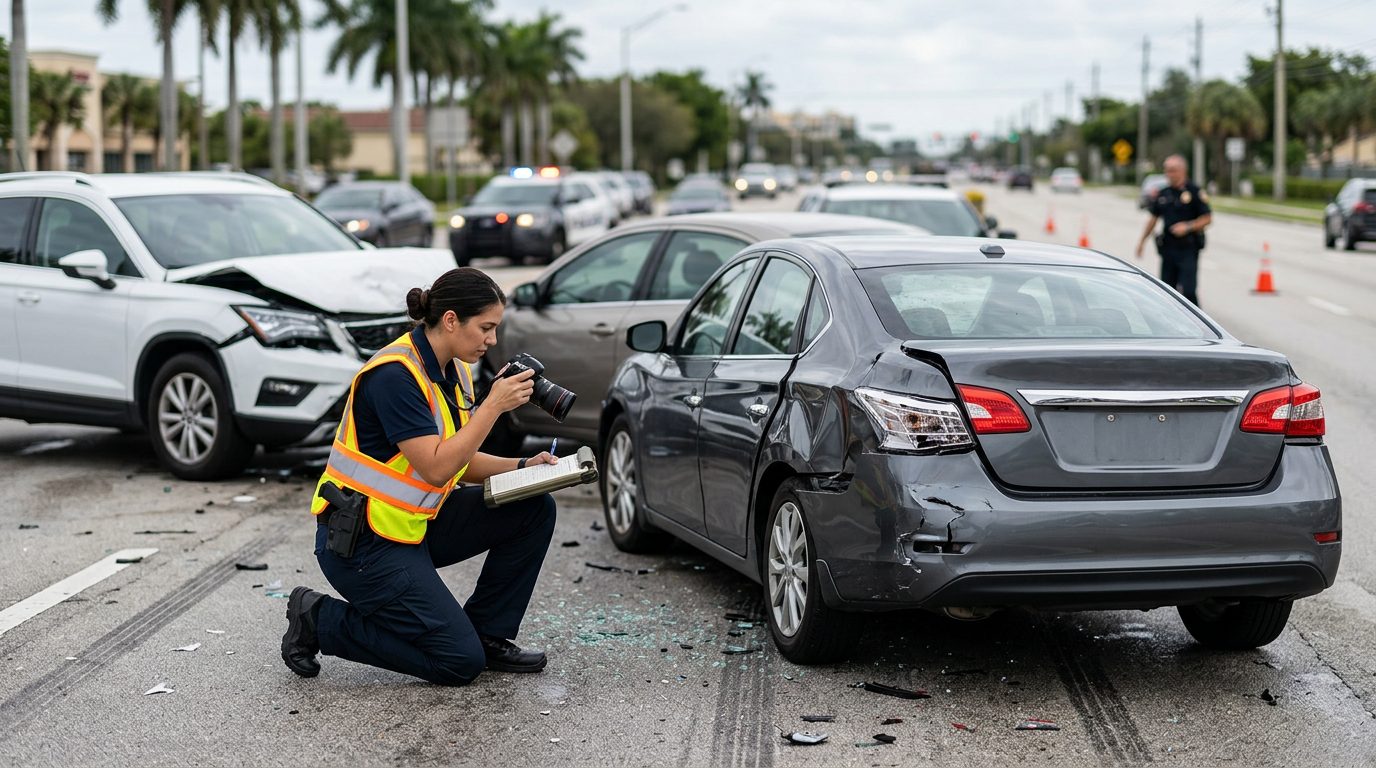
Car Accidents in Pembroke Pines
What You Need to Know After a Car Accident
Your rights, your next steps, and how to protect your claim. Get answers from a Florida personal-injury firm focused on helping accident victims.
By CHG Lawyers · Published September 26, 2026
Car Accidents in Pembroke Pines: What to Do After a Crash
Pembroke Pines is a busy South Florida community where serious car accidents happen regularly. If you’ve been hurt in a crash here, you have legal rights and a limited time to act. This guide explains what to do right after a crash, how to document your claim, and what damages you may recover.

If your injury is permanent, you may recover damages for lost earning capacity over your remaining working years. Talk it through with our team — the first consultation is free, confidential, and carries no obligation.
Pembroke Pines Traffic Crashes: A Local Reality
Pembroke Pines sits in Broward County, one of Florida’s busiest traffic areas. The city’s location on I-75 and its network of busy streets create conditions where serious accidents occur. According to the National Highway Traffic Safety Administration (NHTSA), Florida consistently ranks among the top states for traffic fatalities. Broward County accounts for a significant share.
Some car accidents cause minor injuries. Others cause permanent, life-altering damage: spinal cord injury, traumatic brain injury, amputation, severe burns, or death. If you or a loved one has been in a crash, understanding your next steps and acting quickly can mean the difference between fair recovery and an inadequate settlement.
What to Do in the First Minutes After a Car Accident
Immediate safety and medical response:
Check yourself and your passengers for injuries. If anyone is hurt, call 911 immediately. Do not move an injured person unless there is immediate danger. Emergency responders will assess injuries and transport you to the nearest hospital.
If no one is seriously injured and it is safe, move your vehicle out of traffic. Turn on hazard lights. If you cannot move the vehicle, stay inside with your seatbelt fastened.
Call police and request an official report:
Contact the Pembroke Pines Police Department or Broward County Sheriff’s Office. An official police report is critical evidence for your insurance claim and any legal action. The report documents the scene, statements from drivers and witnesses, and the officer’s preliminary assessment of fault. Request the report number before leaving the scene.
Document the scene with photos and notes:
While waiting for police, use your phone to photograph: – All vehicle damage (wide shots and close-ups) – The accident scene (road conditions, traffic signals, lane markings, weather) – Skid marks, debris, or vehicle positions – Street signs, mile markers, or landmarks identifying the location
Write down the date, time, weather, road conditions, and a brief description of what happened. Do this while it’s fresh in your memory.
Collect information from other drivers and witnesses:
Approach other drivers calmly and ask for: – Full name, phone number, and address – Driver’s license number and state – Vehicle make, model, year, color, and license plate – Insurance company name and policy number
Ask any bystanders who witnessed the crash for their contact information. Do not discuss fault or apologize. Stick to facts: “I was traveling north on Pembroke Road when the other vehicle entered my lane.”
Seek immediate medical attention:
Even if you feel fine, go to an emergency room or urgent-care clinic the same day. Many serious injuries—whiplash, internal bleeding, head trauma, spinal injury—do not show symptoms immediately. A medical record created on the day of the accident is powerful evidence for your claim. Tell the medical provider about all pain, numbness, tingling, headaches, or other symptoms.
Report the accident to your insurance company:
Contact your insurance agent or company within 24 hours. Provide the police report number, the other driver’s information, and a factual description of the accident. Do not speculate about fault or accept a settlement offer at this stage.
Common Types of Car Accidents in Pembroke Pines
Rear-end collisions are frequent at traffic lights and on congested roads like Pembroke Road and Pines Boulevard. The driver who strikes from behind is typically liable. Florida law requires drivers to maintain a safe following distance and be prepared to stop.
Multi-vehicle pile-ups occur especially on I-75 during rush hour. They are often triggered by one driver’s error that causes a chain-reaction crash. Determining fault in these crashes is complex. Multiple drivers may share responsibility, and evidence preservation is critical.
Rollover crashes can occur at high speeds, on curves, or when a vehicle is struck at an angle. Rollovers often cause catastrophic injuries because occupants may be ejected or crushed by the vehicle’s weight.
Intersection collisions result from red-light running, failure to yield, distracted driving, or impaired driving. Traffic signals, witness statements, and police reports help establish which driver violated the right-of-way.
Hit-and-run accidents occur when the at-fault driver leaves the scene. You may still have a claim if you have uninsured motorist (UM) coverage or if police identify the fleeing driver.
Injuries from Car Accidents: Understanding Your Claim
Minor injuries include whiplash, soft-tissue strain, cuts, and bruises. These typically resolve within weeks and involve modest medical bills and lost wages.
Serious injuries include broken bones, internal injuries, head trauma, and lacerations requiring surgery. These injuries demand immediate medical care and substantial medical costs.
Catastrophic injuries permanently alter your life:
- Spinal cord injury can result in paraplegia (paralysis of the lower body) or quadriplegia (paralysis of all four limbs). These require lifelong medical care, adaptive equipment, home modifications, and assistance with daily activities.
- Traumatic brain injury (TBI) causes cognitive impairment, memory loss, personality changes, and difficulty concentrating. Moderate to severe TBI often requires years of rehabilitation.
- Amputation or limb loss from a crush injury requires prosthetics, physical therapy, and permanent lifestyle adjustment.
- Severe burns cause scarring, pain, and infection risk. They often require multiple surgeries and skin grafts.
Catastrophic-injury cases involve years of rehabilitation, ongoing medical treatment, and permanent disability. Damages in these cases reflect lifetime care costs, lost earning capacity, and the profound impact on quality of life.
Wrongful death occurs when a loved one is killed in a crash. Your family may pursue a claim against the at-fault driver or their insurance. You can recover funeral and burial expenses, loss of financial support, loss of companionship, and loss of guidance.
If you've been hurt in a car accident in Pembroke Pines—whether a minor fender-bender or a serious collision—reach out for a free case evaluation. Talk it through with our team — the first consultation is free, confidential, and carries no obligation.
How to Pursue a Car Accident Claim in Pembroke Pines
Step 1: Report to the at-fault driver’s insurance company
Provide the police report number, the other driver’s information, and a factual description of the accident. Do not accept a quick settlement without understanding the full extent of your injuries.
Step 2: Gather and organize documentation
Collect and keep copies of: – Police report – Medical records and bills (emergency room, hospital, physical therapy, doctor visits) – Proof of lost wages (pay stubs, employer letter) – Receipts for accident-related expenses (vehicle repair, transportation, medications) – Photos of injuries and vehicle damage – Journal entries documenting your pain, recovery, and impact on daily life
Step 3: Understand Florida’s statute of limitations
Under Florida Statute § 95.11, you generally have two years from the date of the accident to file a personal-injury claim, although some circumstances can extend this period under Florida Statute § 95.051. If you miss it, you lose your right to sue. Do not delay seeking legal consultation.
Step 4: Negotiate or file a lawsuit
If the insurance company denies your claim or offers too little, you may file a lawsuit in Florida court. Under Florida Statute § 34.01, county courts hear actions at law up to $50,000, so the court depends on the amount of your claim. An attorney will represent you in settlement negotiations and, if necessary, at trial.
Damages You May Recover After a Car Accident
Medical expenses include emergency care, surgery, hospitalization, rehabilitation, and ongoing treatment. In catastrophic-injury cases, lifetime medical costs can be substantial.
Lost wages cover income you missed while recovering or unable to work. If your injury is permanent, you may recover damages for lost earning capacity over your remaining working years.
Pain and suffering compensates you for physical pain, emotional distress, anxiety, depression, and reduced quality of life. The more severe your injury, the higher this award.
Permanent disability or disfigurement reflects lasting impairment from your injury. If you can no longer perform your job or engage in activities central to your life, this is recoverable.
Loss of enjoyment of life applies when the accident prevents you from activities you once loved—sports, travel, socializing, or family involvement.
In wrongful-death cases, damages include funeral and burial expenses, loss of financial support to the family, loss of companionship and guidance, and loss of parental nurturing if a child was killed.
Why Early Legal Consultation Matters
Insurance companies are skilled at minimizing payouts. They have teams of adjusters, lawyers, and investigators working to reduce what they owe you. An early consultation with an attorney levels the playing field.
Evidence preservation: Accident scenes change. Vehicles are repaired or scrapped. Witnesses move away or forget details. Surveillance footage is deleted after 30–90 days. Early legal action ensures critical evidence is preserved through formal requests and investigation.
Determining fault: In multi-vehicle crashes, fault can be complex. Under Florida’s comparative-negligence rule (Fla. Stat. § 768.81), you can recover damages even if you were partially at fault. Under Florida law, you cannot recover any damages if you are found greater than 50 percent at fault for your own harm. An attorney investigates the crash, gathers evidence, and builds a case showing the other driver’s liability.
Calculating true damages: Insurance adjusters’ initial offers rarely reflect long-term costs. An attorney works with medical professionals to project lifetime care needs, lost earning potential, and pain-and-suffering awards.
Meeting legal deadlines: The statute of limitations is unforgiving. An attorney ensures all deadlines are met and all paperwork is filed correctly.
Next Steps: Contact Us for a Free Case Evaluation
If you’ve been hurt in a car accident in Pembroke Pines—whether a minor fender-bender or a serious collision—reach out for a free case evaluation. We focus exclusively on personal-injury cases, including car accidents of all severities, from everyday incidents to catastrophic, life-altering injuries.
We’ll review your case, explain your rights under Florida law, answer your questions, and handle the claim process so you can focus on healing. Learn more about how to document accident claims and personal injury damages to strengthen your case. Contact us today to talk about your rights and your options under Florida law.

Not sure what your next step is?
Talk it through with our team — the first consultation is free, confidential, and carries no obligation.
Frequently Asked Questions
How long do I have to file a car accident claim in Florida?
You have two years from the date of the accident to file a personal-injury claim under Florida Statute § 95.11, although some circumstances can extend this deadline under Florida Statute § 95.051. Do not wait.
What if I was partially at fault for the car accident?
Under Florida’s comparative-negligence rule, you can still recover damages as long as you were 50% or less responsible for the crash.
What should I do if the other driver left the scene (hit-and-run)?
Report the accident to police immediately. Provide a detailed description of the fleeing vehicle and driver. If you have uninsured motorist (UM) coverage, you may file a claim with your own insurance. An attorney can help you pursue all available options.
When should I contact an attorney after a car accident?
As soon as possible. Early consultation can help preserve evidence, protect your rights, and meet legal deadlines. Many accident victims delay seeking help and miss critical opportunities.
How much is my car accident claim worth?
The value depends on the severity of your injury, medical costs, lost wages, permanent disability, and whether your injury is catastrophic. An attorney can evaluate your specific case and explain what damages you may recover.
What if the insurance company denies my claim?
You can file a lawsuit in Broward County Circuit Court. An attorney will represent you in negotiations and, if necessary, at trial to recover the damages you are owed.
What to Do Right After a Car Accident
Check for Injuries
Your health comes first. Call 911 if anyone is hurt. Even if you feel fine, some injuries appear hours or days later. Get medical attention and keep all records.
Document the Scene
Take photos of vehicle damage, road conditions, traffic signs, and the other driver's vehicle and license plate. Get the names, phone numbers, and insurance information of all drivers and witnesses.
Report the Accident
Call the Pembroke Pines Police Department to file an official report. Request a copy of the police report number. Do not admit fault or apologize for the accident.
Notify Your Insurance
Report the accident to your insurance company. Stick to the facts. Do not sign anything or agree to a settlement without understanding your rights.
Time Matters
Florida law sets a deadline for filing a personal-injury claim. The sooner you act, the sooner evidence can be preserved and your claim can move forward. Do not delay.
Common Questions About Car Accidents in Pembroke Pines
What if I was partly at fault?
Florida law allows you to recover damages even if you share some responsibility for the accident, but you cannot recover any damages if you are found greater than 50 percent at fault. What matters is whether the other driver’s negligence caused your injuries.
What damages can I claim?
You may be entitled to recover medical expenses, lost wages, property damage, pain and suffering, and other losses caused by the accident. An attorney can review your specific situation.
Do I need a lawyer?
Insurance companies are skilled at minimizing payouts. An attorney focused on personal-injury claims can protect your rights, handle negotiations, and fight for fair compensation on your behalf.
How much will this cost?
CHG Personal Injury Lawyers handles car-accident claims on a contingency basis: no attorney’s fees unless there is a recovery. You pay nothing upfront.
Why Choose CHG Personal Injury Lawyers
Focused on Personal Injury
Our practice focuses exclusively on personal-injury claims. We know Florida law and how to hold negligent drivers accountable.
Serving Florida Communities
We represent clients across Florida. Whether your accident happened in Pembroke Pines or elsewhere in the state, we can help.
Bilingual Resources
We publish educational content in English and Spanish to help you understand your rights and options.
Free Case Evaluation
Contact us for a free, no-obligation review of your accident and your claim. We answer your questions and explain your options.