

Car Accident Lawyer Serving Plantation, FL
Injured in a car accident? Understand your options.
CHG Personal Injury Lawyers represents people injured in car accidents throughout Florida. We handle everything from minor injuries to catastrophic, life-altering harm—and we're here to help you understand your options.
By CHG Lawyers · Published September 12, 2026
Car Accident Claim in Plantation, FL: Your Rights & Next Steps
If you’ve been in a car accident in Plantation, you’re not alone. You don’t have to figure out your claim by yourself. Whether you were rear-ended on Broward Boulevard, hit at a busy intersection, or injured in a multi-vehicle pile-up, understanding what happens next protects your rights.
This guide walks you through what to do immediately after a crash, how damages are valued under Florida law, and why legal support matters—especially if the other driver was uninsured or underinsured.
If you've been injured in a car accident in Plantation, you may have a claim for damages. Talk it through with our team — the first consultation is free, confidential, and carries no obligation.
What to Do Right After a Car Accident in Plantation
Move to safety if you can.
If your vehicle is drivable and traffic is safe, move it out of the roadway. Turn on your hazard lights. Check yourself and your passengers for injuries.
Call 911 if anyone is hurt or there is significant vehicle damage.
A police report is essential. It creates an official record of who was at fault, vehicle damage, and what witnesses saw. Request the report number before you leave. In Broward County, this report becomes part of the official record and is often critical in determining who was responsible.
Document the scene thoroughly.
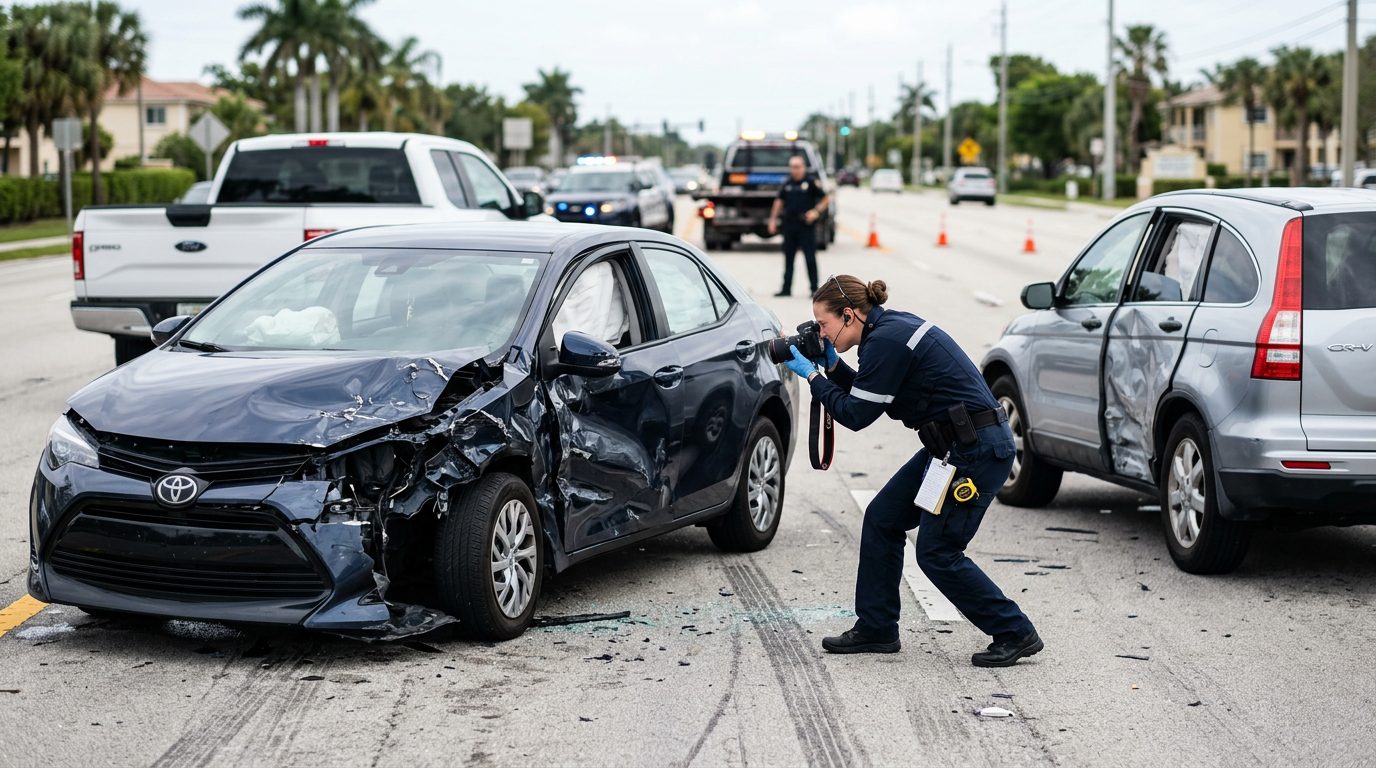
Use your phone to photograph: – Vehicle damage (wide shots and close-ups of all sides) – Road conditions (wet pavement, debris, potholes, poor lighting) – Traffic signs and signals – Weather conditions – The positions of all vehicles involved – Street name and landmarks
Exchange information with the other driver(s).
Get: – Full names and phone numbers – Home and work addresses – Driver’s license numbers – Vehicle make, model, year, color, and license plate – Insurance company name and policy number – Vehicle identification number (VIN)
Get witness contact information.
Ask anyone who saw the crash for their name, phone number, and email. Witness statements can be critical if who was at fault is disputed.
Seek medical attention even if you feel fine.
Some injuries—whiplash, internal bleeding, traumatic brain injury—don’t show symptoms right away. They may appear hours or days later. A medical evaluation creates a documented record linking your injuries to the accident. This record is essential for your claim.
Report the accident to your insurance company promptly.
Provide factual information. Do not admit fault or apologize. Don’t sign anything or agree to a settlement without understanding the full extent of your injuries and damages.
Understanding Liability Under Florida Law
Fault is determined by evidence, not by who called 911 first.
Fault is often assessed using witness statements, traffic laws, and vehicle damage patterns. Under Florida’s modified comparative-negligence rule (Fla. Stat. § 768.81), if you are found to be more than 50% at fault, you generally recover nothing. This is why determining who was at fault is critical—and why early legal guidance can help protect your interests.
Common accident scenarios in Plantation include:
- Rear-end collisions at traffic lights (often caused by distracted or following-too-closely drivers)
- Left-turn accidents at busy intersections where drivers misjudge oncoming traffic
- Multi-vehicle pile-ups during morning and evening commutes when traffic volume peaks on Broward Boulevard and Nob Hill Road
What You Can Recover: Damages Explained
Economic damages (out-of-pocket losses): – Medical bills (emergency care, ongoing treatment, rehabilitation, surgery, physical therapy) – Lost wages and lost earning capacity – Vehicle repair or replacement – Transportation costs during recovery
Non-economic damages (pain and suffering): – Physical pain and suffering – Emotional distress – Reduced quality of life – Permanent disability or disfigurement (in serious cases) – Psychological injuries like PTSD or anxiety
Florida law allows recovery for both categories. The value of your claim depends on how serious your injuries are, how clear the liability is, and what insurance coverage is available.
Not sure what your next step is?
Talk it through with our team — the first consultation is free, confidential, and carries no obligation.
Uninsured and Underinsured Motorist Coverage: What You Need to Know
This is your safety net.
Many drivers in Florida carry minimal liability insurance—or none at all. If the at-fault driver lacks enough insurance to cover your damages, your own uninsured/underinsured motorist (UM/UIM) coverage bridges the gap.
Here’s how it works:
- Uninsured motorist (UM) coverage pays your damages if the at-fault driver has no liability insurance at all.
- Underinsured motorist (UIM) coverage pays the difference if the at-fault driver’s liability limits are too low to cover your full damages.
Example:
You’re injured in a collision. Your medical bills, lost wages, and pain and suffering total $75,000. The at-fault driver has only $25,000 in liability coverage. If you carry $50,000 in UIM coverage, your own policy pays up to $50,000 toward the remaining $50,000 gap.
Check your policy now.
Many Floridians don’t realize they have UM/UIM coverage—or don’t understand its limits. Review your declarations page. If you don’t have it, consider adding it.
UM/UIM claims can be complex.
You may need to file a claim with your own insurer, prove the other driver was at fault, and negotiate the value of your damages. An attorney can help you understand your coverage and work through the claim process.
Common Injuries from Car Accidents
Whiplash and neck injuries
These result from sudden acceleration and deceleration. Soft-tissue damage is often underestimated by insurers, but it can cause chronic pain and require ongoing physical therapy.
Back injuries
These range from muscle strain to herniated discs (a disc that slips out of place in your spine). Some require surgery and extended recovery. Chronic back pain can affect your ability to work and enjoy life.
Head and brain injuries
These include mild concussions and traumatic brain injury (TBI). TBI symptoms may not appear right away. They can include headaches, dizziness, memory problems, mood changes, and difficulty concentrating. A prompt medical evaluation is essential.
Broken bones and fractures
These require surgery, immobilization, and physical therapy. Recovery can take months.
Internal injuries
Bleeding, organ damage, and internal trauma may not be visible externally but can be life-threatening. Emergency medical evaluation is critical.
Psychological injuries
PTSD, anxiety, and depression are real and recoverable. Many accident survivors struggle with fear of driving or being in a car.
Catastrophic injuries
Spinal cord damage, paralysis, amputation, or severe burns occur in high-impact collisions. These life-altering injuries require immediate emergency care and long-term medical support.
Time Limits: Act Quickly
Florida’s statute of limitations for car accident claims is two years from the date of the crash (Fla. Stat. § 95.11). But don’t wait. Acting quickly preserves evidence, keeps witness memories fresh, and prevents your claim from weakening over time.
Mistakes to Avoid After a Plantation Car Accident
Don’t leave the scene or fail to report the accident to police.
Leaving can result in criminal charges. A police report is your foundation.
Don’t admit fault or apologize at the scene.
Let the investigation determine who was at fault. Even a simple “I’m sorry” can be used against you.
Don’t post about the accident on social media.
Insurers and defense attorneys monitor these posts. Anything you write can undermine your claim.
Don’t delay seeking medical care.
Waiting weakens the link between the accident and your injuries.
Don’t sign documents or settle without legal advice.
Insurance companies often offer low initial settlements. You may be entitled to much more.
Don’t communicate directly with the at-fault driver’s insurance adjuster without an attorney.
Adjusters are trained to minimize payouts. An attorney protects your interests.
Don’t discard evidence.
Keep medical records, repair estimates, photos, witness contact information, and all correspondence.
Have questions about what happened?
Ask our team directly. The first conversation is free, confidential, and there is no obligation to continue.
When to Contact an Attorney
Reach out immediately if: – Anyone was injured or there is significant vehicle damage – The other driver was uninsured or underinsured – Who was at fault is disputed or unclear – Your injuries are serious or ongoing – The insurance company denies your claim or offers an unreasonably low settlement – You’re unsure about your rights or claim value – The accident involved a commercial vehicle, rideshare driver, or government vehicle (different liability rules apply)
The sooner you connect with an attorney, the sooner evidence is preserved, witnesses are interviewed, and your claim is protected.
Frequently Asked Questions
How long do I have to file a car accident lawsuit in Florida?
You have two years from the date of the crash under Florida law (Fla. Stat. § 95.11). But acting quickly preserves evidence and witness credibility.
What if the other driver was uninsured or underinsured?
Your own uninsured/underinsured motorist (UM/UIM) coverage can cover your damages if the at-fault driver’s insurance is insufficient or nonexistent. Review your policy to understand your limits.
What damages can I recover from a car accident claim?
Medical bills, lost wages, vehicle damage, and, where the injury meets the threshold set by Fla. Stat. § 627.737, pain and suffering.
How is fault determined in a Plantation car accident?
The police report, witness statements, traffic laws, and vehicle damage patterns all contribute to determining who was at fault under Florida’s comparative-negligence standard.
Should I settle with the insurance company quickly?
No. Initial settlement offers are often low. Consult an attorney to understand the full value of your claim before accepting any offer.
If you’ve been injured in a car accident in Plantation, you may have a claim for damages. Contact us for a free case evaluation to discuss what happened, understand your rights, and learn what your claim may be worth.
What to Do After a Car Accident
Seek Medical Attention
Your health comes first. Even if injuries seem minor, get checked by a doctor right away. Some injuries appear hours or days later. A medical record also documents your injuries for your claim.
Report the Crash
Contact the police and file an accident report. Get the report number and the officer's name. This official record is crucial evidence for your claim.
Gather Information
Collect the other driver's name, phone number, address, insurance details, and license plate. Take photos of vehicle damage, the accident scene, road conditions, and traffic signs. Get contact information from any witnesses.
Notify Your Insurance Company
Report the accident to your insurer promptly. Stick to the facts and avoid admitting fault. Keep copies of all correspondence with your insurance company.
Act Quickly to Protect Your Claim
Under Florida law, you have two years from the date of the crash to file a lawsuit (Fla. Stat. § 95.11(5)(a)). However, waiting longer makes it harder to preserve evidence and locate witnesses. The sooner you contact us, the stronger your case.
Why Choose CHG Personal Injury Lawyers
Focused on Your Recovery
No Attorney’s Fees Unless There Is a Recovery
We work on contingency. You pay nothing upfront, and we only collect a fee if your case results in a recovery. Your financial risk is zero.
Available When You Need Us
Serious injuries are stressful. We're here to answer your questions, explain your options, and guide you through every step of the process.
Florida Focus, Statewide Service
Based in Florida and serving clients throughout the state, we focus on Florida accident laws and insurance practices, and we apply that focus to every case.
Common Questions About Car Accident Claims
What if the other driver was uninsured or underinsured?
Your own uninsured/underinsured motorist (UM/UIM) coverage can help cover your damages if the at-fault driver lacks sufficient insurance. We'll review your policy and pursue every available source of recovery.
How is fault determined in a Florida car accident?
Florida is a comparative fault state. Your recovery may be reduced by your percentage of fault, and in a negligence action to which Fla. Stat. § 768.81 applies, a party found greater than 50 percent at fault for their own harm may not recover any damages. We investigate thoroughly to establish liability.
What damages can I recover?
You may recover medical expenses, lost wages, property damage, pain and suffering, and other losses caused by the accident. The amount depends on the severity of your injuries and the circumstances of your case.
Do I need a lawyer for a car accident claim?
While not required, an attorney protects your rights and helps maximize your recovery. Insurance companies often offer less to unrepresented claimants. We handle negotiations and litigation so you can focus on healing.