

Car Accidents in Pompano Beach
What to Do After a Car Accident: A Step-by-Step Guide
The first hours after a crash are critical. Here's what you need to do to protect your health, your claim, and your rights.
By CHG Lawyers · Published September 12, 2026
Car Accidents in Pompano Beach: What to Do After a Crash
Pompano Beach sits on one of South Florida’s busiest roads. Seasonal tourism, year-round commuter traffic, and construction projects create frequent car accidents. If you’ve been injured in a crash here—on Federal Highway, near the Pompano Beach Pier, or on a major road—you need to know your rights under Florida law, what your insurance covers, and how to get fair compensation. This guide explains what happens after a car accident in Pompano Beach, what injuries matter, and how to protect your claim.
Not sure what your next step is?
Talk it through with our team — the first consultation is free, confidential, and carries no obligation.
Car Accidents Happen on Pompano Beach Roads Every Day
Pompano Beach experiences consistent traffic congestion and frequent collisions. Federal Highway (US-1), Copans Road, Atlantic Boulevard, and Powerline Road see the most crashes, especially during rush hour and tourist season. The reasons are simple: narrow lanes, heavy traffic, seasonal visitors, and construction that reduces driving space and creates hazards.
The most common accident types are:
- Rear-end collisions happen regularly at traffic lights and stop signs, especially during rush hour.
- Intersection crashes occur when drivers misjudge turning lanes or run yellow lights.
- Sideswipe accidents happen on Federal Highway when drivers change lanes without warning.
These aren’t rare—they’re routine consequences of Pompano Beach’s traffic and geography.
What to do immediately after a crash:
- Move to a safe location if vehicles can be driven and no one is seriously hurt.
- Call 911 if anyone is injured or if there’s significant property damage.
- Exchange names, phone numbers, addresses, insurance information, and vehicle details with the other driver.
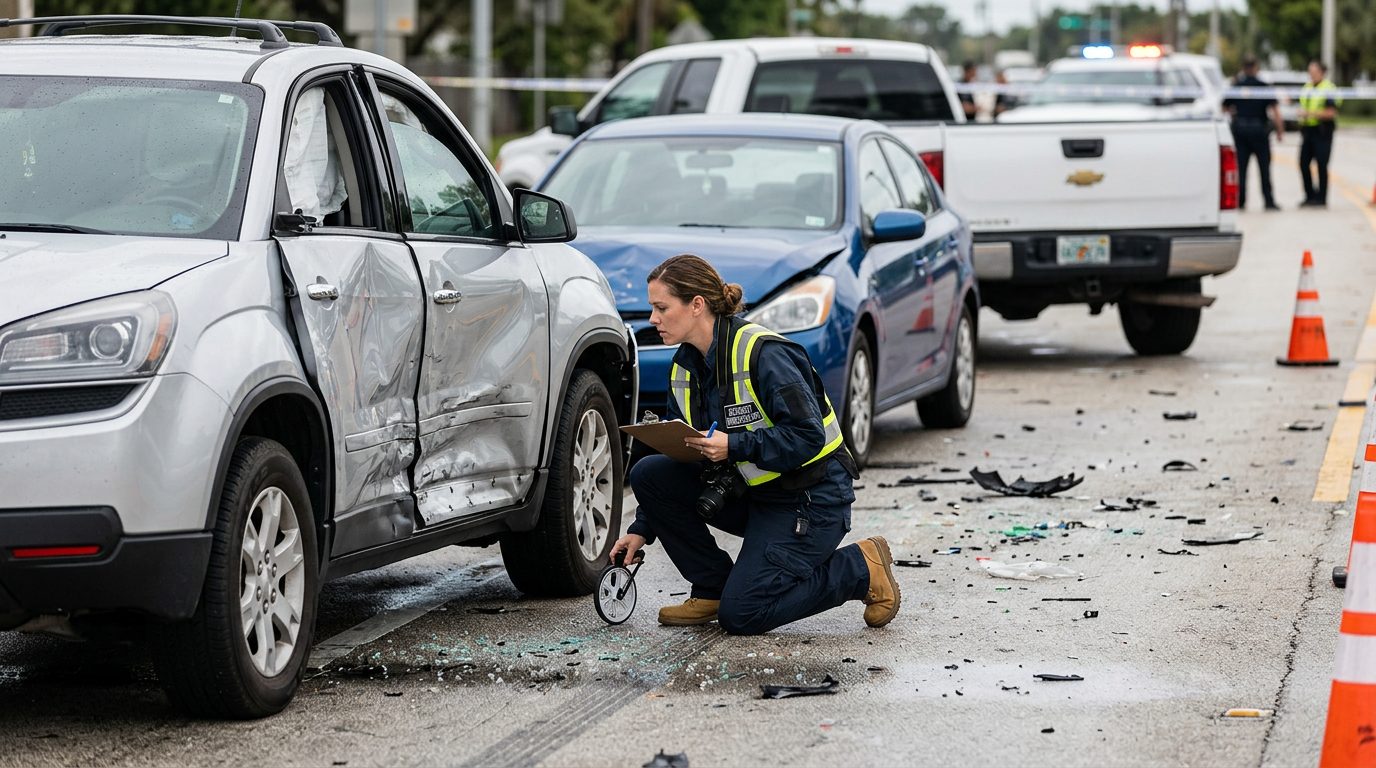
- Take photos of vehicle damage, road conditions, traffic signals, and the scene from multiple angles.
- Get contact information from any witnesses.
- Request a copy of the police report from the Pompano Beach Police Department or Broward County Sheriff’s Office.
- Do not admit fault or apologize for the accident.
- Do not give a recorded statement to the other driver’s insurance company without legal advice.
Injuries from Car Accidents in Pompano Beach
Not all car accident injuries are obvious at the scene. Many people feel fine immediately after a crash, then experience pain, stiffness, or neurological symptoms days or weeks later. This delay doesn’t mean the injury is less serious or less compensable—it’s normal for soft-tissue and internal injuries to develop over time.
Whiplash and delayed symptoms are among the most common car accident injuries. Whiplash occurs when the head and neck are suddenly jerked backward and forward by the force of impact. Symptoms—neck pain, stiffness, headaches, and sometimes numbness or tingling in the arms—can appear hours or days after the accident. Many people ignore early symptoms, thinking they’ll go away. Some do; many don’t. Early medical evaluation is critical.
Other common injuries include:
- Broken bones and fractures in the arms, legs, ribs, or spine.
- Back and neck injuries ranging from muscle strains to disc herniation.
- Head trauma and concussions that may not cause immediate loss of consciousness but can lead to cognitive problems, dizziness, or memory issues.
- Internal injuries such as organ damage or internal bleeding, which may not be apparent without medical imaging.
- Soft-tissue injuries to muscles, tendons, and ligaments that cause pain and limit mobility.
Seek medical attention even if you feel fine. A medical professional can identify injuries you might not notice yourself. Medical records also create a documented timeline linking your injuries to the accident—essential for any insurance claim or lawsuit.
Insurance Claims After a Pompano Beach Car Accident
Florida operates under a no-fault insurance system, which fundamentally changes how car accident claims work compared to other states.
Personal Injury Protection (PIP) coverage is mandatory in Florida. This coverage pays a portion of your medical expenses and 60% of your lost gross income from inability to work caused by the injury, regardless of who caused the accident. You file a claim with your own insurance company first, not the other driver’s. PIP covers reasonable and necessary medical treatment related to the accident.
However, PIP has limits. Coverage is limited to $10,000 per injured person for medical and disability benefits. Once you exhaust PIP, you must rely on health insurance, your own funds, or a claim against the at-fault driver’s liability insurance.
When you can sue the other driver
Under Florida law, you may sue the at-fault driver for pain, suffering, mental anguish, and inconvenience only if your injury meets the statutory serious injury threshold.
Why insurance companies deny or undervalue claims
Insurance adjusters work for the insurance company, not for you. They have financial incentives to minimize payouts. Common denial tactics include:
- Claiming your injury isn’t related to the accident.
- Arguing that your medical treatment was unnecessary or excessive.
- Offering a settlement far below the actual cost of your care and lost income.
- Using recorded statements you gave at the scene against you later.
Never give a recorded statement to the other driver’s insurance company without speaking to a lawyer first. Anything you say can be used to deny or reduce your claim. Insurance companies are skilled at asking questions that elicit statements minimizing your injury or suggesting you were partially at fault.
Have questions about what happened?
Ask our team directly. The first conversation is free, confidential, and there is no obligation to continue.
Liability and Fault in Pompano Beach Car Accidents
Determining who caused the accident is central to your claim. Liability is established through:
- Police reports filed by the Pompano Beach Police Department or Broward County Sheriff’s Office.
- Witness statements from people who saw the crash.
- Accident reconstruction by engineers or accident specialists who analyze vehicle damage, road conditions, and physics to determine how the crash occurred.
- Traffic camera footage from nearby businesses or traffic signals.
- Your own documentation: photos, video, and notes taken at the scene.
Comparative negligence
Under Florida Statute §768.81, if you are found to be more than 50% at fault for the accident, you cannot recover damages at all. If you are 50% or less at fault, your recovery is reduced by your percentage of fault. For example, if you are 20% at fault and your damages total $100,000, you can recover $80,000.
This rule makes early legal review critical. An insurance adjuster may claim you were partially at fault to reduce their payout. A lawyer can challenge that determination with evidence and expert analysis.
Hit-and-run accidents
If the other driver fled the scene, you may not know their identity. In these cases, your own uninsured/underinsured motorist (UM/UIM) coverage can cover your damages if you have it. Report hit-and-run accidents to police immediately and document everything you remember about the other vehicle.
Settlement and Compensation for Car Accident Injuries
Damages in a car accident case cover:
- Medical bills: all reasonable and necessary treatment related to the accident, including emergency care, surgery, physical therapy, and ongoing treatment.
- Lost wages: income you lost because you couldn’t work due to your injuries.
- Pain and suffering: compensation for physical pain, emotional distress, and reduced quality of life.
- Permanent impairment: if your injury causes lasting disability or loss of function.
- Future medical care: ongoing treatment you’ll need for the rest of your life if the injury is permanent.
Insurance companies often offer settlements quickly—sometimes within weeks of the accident. These early offers are almost always too low. They’re calculated to resolve the claim cheaply, not to fully compensate you. Accepting an early offer means you forfeit the right to pursue additional damages later, even if your injuries prove more serious than initially apparent.
A fair settlement accounts for the full scope of your injuries, the cost of all necessary treatment, your lost income, and compensation for pain and suffering. Calculating this requires medical knowledge and an understanding of how similar claims are valued.
Why You Need a Car Accident Lawyer in Pompano Beach
Insurance companies have teams of adjusters, investigators, and lawyers working to minimize payouts. You shouldn’t face that alone. A car accident lawyer levels the playing field by:
- Handling all communication with insurance companies, so you don’t inadvertently say something that damages your claim.
- Investigating the accident thoroughly, gathering evidence, interviewing witnesses, and obtaining expert analysis if needed.
- Negotiating with insurers from a position of strength, backed by evidence and legal knowledge.
- Managing your medical care and ensuring treatment is documented and linked to the accident.
- Calculating fair damages based on your actual medical costs, lost income, and the severity of your injury.
- Protecting your rights under Florida law, including the statute of limitations and comparative negligence rules.
You pay nothing upfront. Most car accident lawyers work on a contingency fee basis, meaning they’re paid only if you recover compensation. Their fee typically comes from your settlement or judgment, not from your pocket.
Want to know where you stand?
Tell us what happened and our team will walk you through the options available to you, at no cost.
Next Steps After Your Pompano Beach Car Accident
Time matters. Florida’s statute of limitations gives you two years from the date of the accident to file a lawsuit. After that deadline, your claim is gone forever.
Take these steps now:
-
Gather and preserve evidence: photos of vehicle damage, the accident scene, road conditions, and traffic signals; contact information for witnesses; medical records; repair estimates; receipts for medical expenses.
-
Document your injuries and recovery: keep records of all medical visits, medications, physical therapy sessions, and time off work. Note your symptoms, pain levels, and how the injury affects your daily life.
-
Avoid social media posts about the accident or your injuries. Insurance companies monitor social media and will use any posts against you.
-
Do not sign anything or agree to a settlement without having a lawyer review it first.
-
Contact a car accident lawyer as soon as possible. The sooner you involve legal counsel, the sooner evidence can be preserved, witnesses can be interviewed, and your rights can be protected.

Frequently Asked Questions
How long do I have to file a car accident claim in Florida?
You have two years from the date of the accident to file a lawsuit. After that, your claim is barred forever.
Can I recover damages if I was partially at fault?
Yes, if you’re 50% or less at fault. Under Florida’s comparative negligence rule, your recovery is reduced by your percentage of fault.
What if the other driver was uninsured?
Your own uninsured motorist (UM) coverage covers your damages if you have it. Report the accident to police and contact your insurance company immediately.
Should I give a recorded statement to the insurance company?
No, not without speaking to a lawyer first. Anything you say can be used against you to deny or reduce your claim.
How much is my case worth?
It depends on your medical costs, lost income, the severity of your injury, and local settlement patterns. A lawyer can evaluate your specific situation and provide an estimate.
If you’ve been injured in a car crash in Pompano Beach and you’re unsure whether you have a claim or what comes next, reach out to our team—people in your situation can contact us, and we’re here to help. Contact us for a free case evaluation.
Immediate Steps After a Car Accident
Check for Injuries & Call 911
If anyone is hurt, call emergency services right away. Even if injuries aren't obvious, some symptoms appear hours or days later. Always get medical attention checked out.
Move to Safety (If Possible)
If vehicles are drivable and it's safe, move them out of traffic to prevent further collisions. Turn on hazard lights. If you can't move the vehicle, stay inside with your seatbelt on until help arrives.
Document the Scene
Take photos and video of vehicle damage, road conditions, traffic signs, and the overall scene. Capture the other vehicle's license plate, make, and model. Note the time, weather, and any visible injuries.
Exchange Information
Get the other driver's name, phone number, address, driver's license number, vehicle identification number (VIN), insurance company, and policy number. Ask for contact information from any witnesses.
Important: Report the Accident to Police
In Florida, you are required to report accidents involving injury or death to law enforcement. A police report creates an official record that protects you and documents what happened while details are fresh.
What to Do in the Days Following the Accident
Seek Medical Care—Even if You Feel Fine
Some injuries, like traumatic brain injury, whiplash, and internal injuries, don't show symptoms immediately. A medical evaluation creates a record linking your injuries to the accident, which is essential for any claim.
Preserve Evidence
Keep all photos, videos, medical records, repair estimates, receipts for expenses, and communications about the accident. Don't post about the accident on social media—anything you share can be used against your claim.
Notify Your Insurance Company
Report the accident to your insurance company promptly. Provide factual information but avoid admitting fault or speculating about what happened. Stick to what you know.
Do Not Accept a Settlement Quickly
Insurance companies may offer a quick settlement before you fully understand the extent of your injuries or losses. Don't sign anything or agree to a figure until you've had time to assess your situation and understand your options.
Why You Need Legal Guidance After a Car Accident
Protect Your Claim
Insurance companies have teams of adjusters and lawyers. An attorney who focuses on personal injury can help protect your rights.
Navigate Complex Rules
Florida's comparative negligence law, insurance requirements, and filing deadlines are complex (Fla. Stat. § 768.81(6)). A lawyer handles the paperwork and legal requirements so you can focus on recovery.
Understand What You're Owed
Damages include medical bills, lost wages, pain and suffering, and future care costs. An attorney calculates the full value of your claim, not just what the insurance company offers.
Handle Negotiations
Insurance adjusters are trained negotiators. An attorney advocates for you, handles all communications, and fights to secure fair compensation for your injuries and losses.
Know Your Filing Deadline
In Florida, you have a limited time to file a lawsuit for a car accident. Waiting too long can result in losing your claim entirely. If you've been injured, don't delay—contact an attorney as soon as possible to understand your options and protect your rights.