
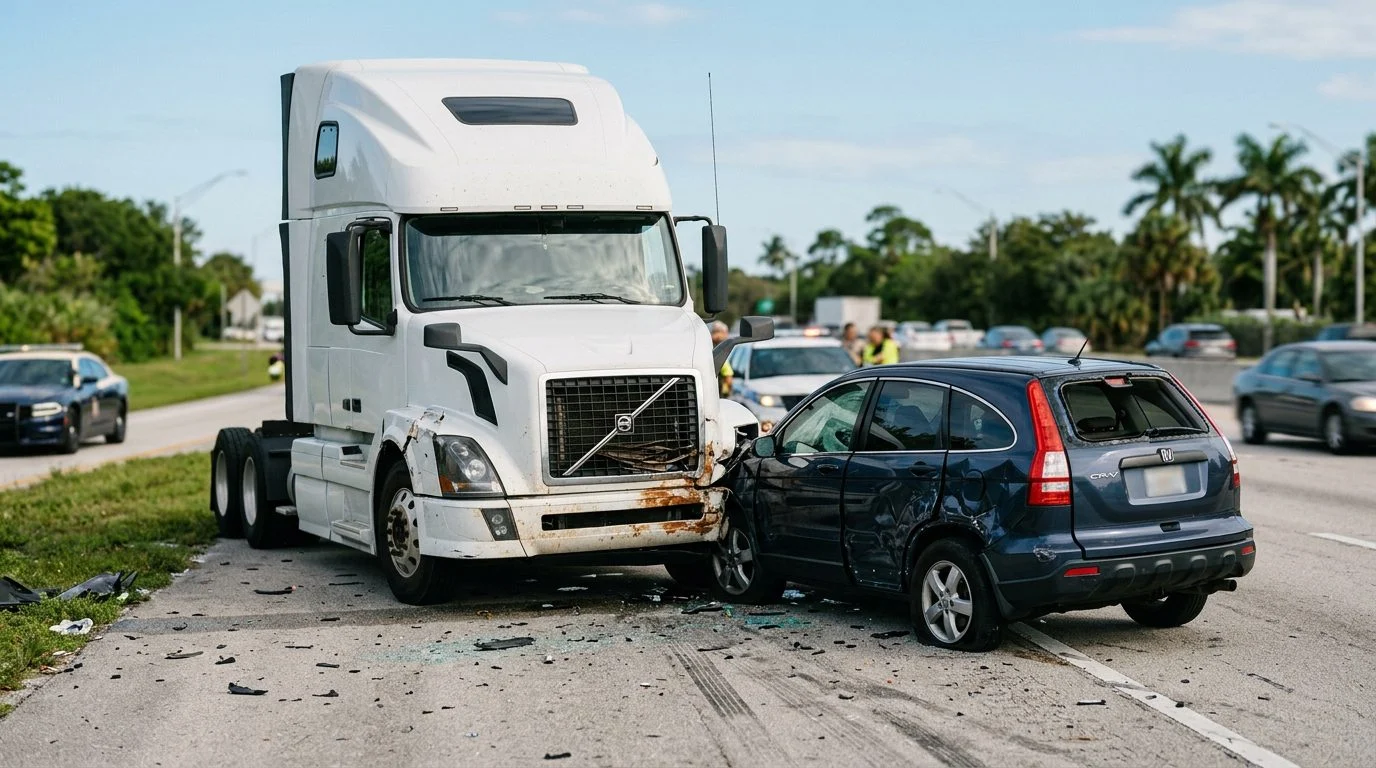
Florida Truck Accident Claims
Truck Crash Claims in Florida Run on a Clock. Know Where You Stand.
After a collision with a commercial truck, the weeks that follow shape what happens next. Here is how timing works and what to do now.
By CHG Lawyers · Published November 9, 2026
Truck and car crash claims in Florida generally share the same legal filing deadline. For most negligence claims, that deadline is two years. The real difference is the practical clock. Trucking records can be purged, and more companies may need to be identified, long before a lawsuit must be filed. If you were hurt in a crash, you did not choose this situation. This page explains the deadline, why truck cases move differently, and what to do now. CHG Personal Injury Lawyers is a Florida-based firm that offers a free, confidential initial consultation.
Florida’s Two-Year Deadline for Truck Accident Claims
Most Florida negligence claims must be filed within two years. That rule covers injuries from a truck crash and a car crash alike.
Florida’s Fla. Stat. § 95.11 says an action founded on negligence must be commenced within two years. The rule is short, but its effects are serious.
A missed deadline can bar your claim entirely. Treat the date as a hard limit, not a target. Talks with an insurance company are separate from any court case, so it is wise to speak with a lawyer early about your situation. Neither do medical appointments or waiting for a settlement offer.
The facts of your case decide which start date applies. Write down these dates today:
- The date and time of the crash
- The date you first learned how badly you were hurt
- The date you first sought medical care
These dates help a lawyer review when the clock began.
If you were hurt in a truck or car crash, you may have a claim, and our team can help you understand the deadline and your options. Talk it through with our team — the first consultation is free, confidential, and carries no obligation.

Truck Accident vs. Car Accident Claims: Same Deadline, Different Clock
For most crashes, the legal filing deadline is the same for a truck crash and a car crash. The real difference is how much work the case takes before a lawsuit is filed.
A typical car crash often involves two drivers and their insurers. A truck crash can involve many more parties and records:
- Parties: the driver, the motor carrier that employs the driver, a freight broker, a maintenance company, a cargo loader, and sometimes a parts or equipment maker.
- Records: electronic logs, engine data, dispatch messages, inspection files, and driver qualification files, in addition to the police report.
- Rules: trucking companies operate under federal safety rules, which create paper and data trails that must be requested and reviewed.
- Time: each party may need its own investigation, so the work often takes longer.
Courts are also clarifying who can be sued. Truck claims can involve more than the driver.
When the Clock Starts in Florida
The two-year period runs from a start date set by the facts of each case. A lawyer should review that date promptly. Several situations need extra attention.
Wrongful death. Under Fla. Stat. § 768.19, when a death is caused by the wrongful act, negligence, default, or breach of contract or warranty of any person, and the injured person could have sued had death not occurred, the party who would have been liable remains liable for damages. Families who have lost a loved one often have questions about their options, and a lawyer can explain them. Their timing may differ from the injured person’s timeline.
Government vehicles. If a state or local government truck caused the crash, Fla. Stat. § 768.28 waives sovereign immunity only to the extent that statute specifies. The state may not pay one person’s claim above $200,000, or total claims from one incident above $300,000, without further legislative action, except that the state or its agency may agree, within the limits of insurance coverage provided, to settle a claim or judgment without further action by the Legislature. Fla. Stat. § 768.28 A judgment may still be rendered above those amounts. These claims carry their own rules, so tell a lawyer early.
Why Truck Evidence Can Disappear Long Before the Deadline
Truck evidence can disappear well before the lawsuit deadline because federal rules set different retention periods for different records. Not every record is kept for the same length of time.
- Driver duty-status logs: under 49 CFR 395.8, drivers must submit their records of duty status to the motor carrier within 13 days. Under 49 CFR 395.8(e)(2), a driver or motor carrier may not disable, deactivate, disengage, jam, or otherwise block or degrade an electronic logging device’s (ELD’s) signal, or alter it in any other way, so that the device does not accurately record and retain required data.
- Drug and alcohol records: under 49 CFR 382.401, some alcohol and drug test records must be kept for at least five years, and negative results for at least one year.
- Driver qualification files: under 49 CFR 391.51, a carrier generally keeps these files while the driver works there, plus three years, but some items in the file, such as annual driving-record checks and medical examiner’s certificates, may be removed three years after they were issued.
- General records: under 49 CFR 379.3, records may be destroyed after the minimum retention periods end, at the discretion of each company’s management, but companies must still maintain records that adequately support financial and operational data required by the Secretary, and this does not excuse compliance with the lawful requirements of any other governmental body prescribing longer retention periods.
A preservation letter asks the company and its insurer to keep relevant records. Records may be kept electronically if they remain accurate and reproducible, under 49 CFR 379.7. Lawyers often send these letters early. Accident reconstruction professionals then analyze the scene, vehicle damage, and data as third-party technical witnesses.
Who Can Be Held Responsible and Why It Affects Timing
Several parties can share responsibility in a truck crash. Identifying each one early protects your options.
Possible responsible parties include:
- The driver
- The motor carrier that employs or contracts with the driver
- A freight broker or shipper that selected the carrier
- A maintenance company or a company that loaded the cargo
- A manufacturer, when a vehicle or part design made injuries worse
Equipment rules matter in some crashes.
Florida also splits fault among parties. Under Fla. Stat. § 768.81, a claimant’s own share of fault reduces the award but does not bar recovery, subject to other limits in the statute. Judgment is entered against each liable party by its percentage of fault. A lawyer can explain how that applies to your facts.
A Step-by-Step Timeline From Crash to Claim
The first steps after a crash are medical care, record keeping, and an early call to a lawyer. Each step builds on the one before it.
- Get medical care. Follow your doctors’ instructions. Your medical records also document the injury.
- Keep records. Save the crash report, photos, witness names, repair estimates, pay stubs, and a written list of symptoms and missed work.
- Request the crash report. Under Fla. Stat. § 316.066, the long-form report must be submitted within 10 days after the investigation ends. Parties, their legal representatives, and their insurers can access it.
- Contact a lawyer early. Early contact allows preservation letters and records requests before data is lost.
- Investigate and negotiate. Truck cases often take months to investigate. Negotiation with insurers and responsible parties may follow.
- File before the deadline. If talks do not resolve the claim, a lawsuit must be filed within the statute’s time limit.
CHG Personal Injury Lawyers is a Florida firm. Responsible lawyer Igor Hernandez works with the firm’s licensed attorneys, who are admitted to The Florida Bar. The initial consultation is free and confidential.
Not sure what your next step is?
Talk it through with our team — the first consultation is free, confidential, and carries no obligation.
Early Questions: Insurance Calls and Settlement Amounts
Be polite with the insurer, share basic facts, and talk to a lawyer before giving a recorded statement. Avoid guessing about fault.
Insurers often make a first offer before the full extent of injuries is known. A lawyer can review whether an offer reflects your full claim. Do not sign medical releases without first speaking with a lawyer.
No one can predict what a particular claim will be worth. Settlement value depends on the injuries, the medical care needed, lost income, the responsible parties, and insurance coverage.
Settlement talks and the filing deadline are separate. An insurance offer can take time to arrive, so it is wise to talk with a lawyer early rather than waiting for one.

Frequently Asked Questions
What is the deadline for a truck accident claim in Florida?
For most negligence claims, Florida law sets a two-year filing period. Wrongful death and government vehicle claims can follow different rules.
Is the deadline different for a truck crash than a car crash?
For most cases, the legal filing deadline is the same. The difference is the evidence and the number of parties involved.
Does an insurance claim affect a lawsuit?
An insurance claim and a lawsuit are separate steps, and a lawyer can explain how they fit together in your case.
Can my family bring a claim after a fatal truck crash?
Florida’s wrongful-death law allows a claim when negligence causes a death. Families should contact a lawyer promptly because timing can differ.
What if I missed the deadline?
A missed deadline can bar a claim entirely. A lawyer can review what options may remain.
What does it cost to talk with CHG?
The initial consultation is free and confidential, with no obligation to continue. CHG charges no attorney’s fees and no case costs unless there is a recovery.
If you are worried about a parent, spouse, child, or your own recovery after a truck crash, you do not have to track the deadlines alone. Contact CHG Personal Injury Lawyers for a free, confidential consultation.
Why Timing Matters After a Truck Crash
Deadlines apply
Every injury claim has filing deadlines. Waiting can limit the options a family has, so early conversations matter.
Records can be lost
Crash reports, driver logs, maintenance records, and vehicle data are not kept forever. Acting early helps preserve them.
Several parties may be involved
A truck crash can involve the driver, the trucking company, a contractor, or a vehicle maker. Each may need to be identified in time.
Your health comes first
Follow your doctors' care and keep every treatment record. Your recovery is the priority, and the claim is built around it.
Do not wait to ask questions
Deadlines apply to truck accident claims, and timing can differ depending on the type of case. Contact the firm promptly.
Steps to Take Early
Get medical care
See a doctor as soon as possible and follow the treatment plan you are given.
Preserve evidence
Keep photos, witness names, medical bills, and any letters from insurers or the trucking company.
Limit statements
Be careful about recorded statements and social media posts about the crash until you have spoken with a lawyer.
Call CHG Personal Injury Lawyers
Our team can review the timing of your case, explain the next steps, and answer your questions in plain language.
Serving Florida families after truck crashes. Your first consultation is free.
Related practice areas
- Catastrophic Truck Accident Injuries
- Truck Accidents in Florida
- Electrocution Injuries in Hialeah Gardens
- Lower Back Pain After Car Accident in Florida