

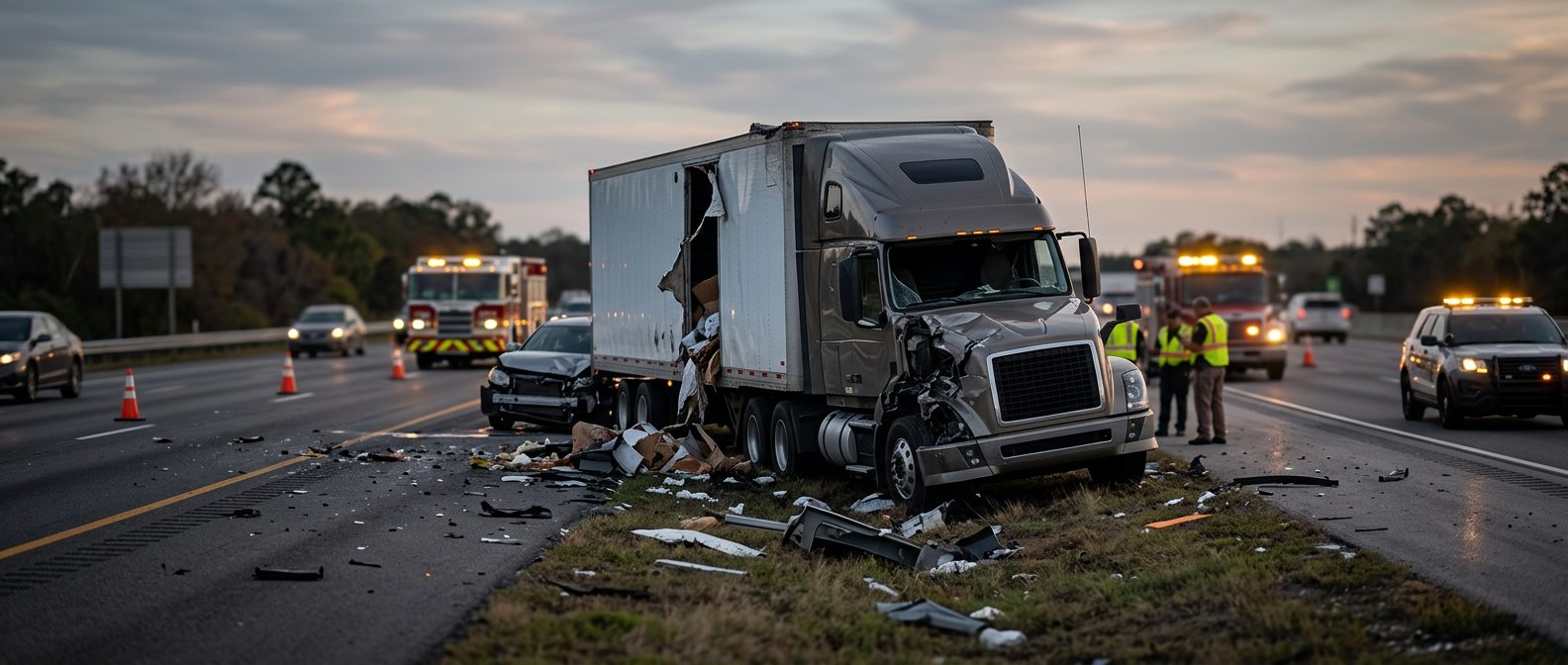
Truck Accident Safety
Dangerous Truck Routes in Florida: High-Risk Highways
Florida's busiest corridors see the highest concentration of catastrophic truck collisions. Understand where the risks are—and what to do if you or a loved one is injured.
By CHG Lawyers · Published August 24, 2026
Dangerous Truck Routes in Florida: High-Risk Highways and Catastrophic Injuries
Florida’s busiest freight corridors—Interstate 4, Interstate 95, and Interstate 75—are also among the deadliest for truck accidents. If you or a loved one was struck by a truck on one of these routes and suffered a spinal cord injury, traumatic brain injury, amputation, severe burn, or other life-altering harm, understanding the risks and your legal rights is essential.
Not sure what your next step is?
Talk it through with our team — the first consultation is free, confidential, and carries no obligation.
Why Certain Florida Highways Are High-Risk for Truck Accidents
Florida’s highways concentrate truck traffic, tourism, weather hazards, and construction in ways that create unique danger. Heavy trucks need longer distances to stop. They are less stable during lane changes or emergency moves. When a loaded truck shares a congested corridor with thousands of passenger vehicles, driver error, mechanical failure, or unsafe practices can cause catastrophic injuries.
Seasonal factors make the risk worse:
- Summer brings heavy tourist traffic to central Florida.
- Hurricane season creates sudden weather changes and hydroplaning conditions.
- Holiday periods surge traffic on I-75 and I-95.
- Construction zones reduce lanes, forcing trucks and cars into tighter merging patterns.
Even small mistakes—a distracted truck driver, a tire blowout, an unsecured load—can trigger multi-vehicle collisions. These crashes leave survivors with permanent paralysis, brain damage, or limb loss.
Which Part of I-95 in Florida Is Considered the Deadliest?
Interstate 95 stretches 530 miles along Florida’s eastern coast. The Miami-Dade to Broward County segment carries some of the highest crash rates in the state. This corridor combines aggressive driving, complex merging patterns, and relentless truck traffic.
The I-95 Express Lanes, designed to reduce congestion, have introduced additional hazards: trucks navigating toll zones, sudden lane shifts, and higher speeds in narrower spaces.
The Jacksonville area of I-95 serves as a major industrial and freight hub. It sees significant truck volume and weather exposure. Tropical storms and heavy rain create hydroplaning conditions that are especially dangerous for large trucks traveling at highway speeds.
Catastrophic injuries are common on I-95 truck collisions. Multi-vehicle pileups result in spinal cord injuries from crush forces and traumatic brain injuries from impact. Amputations occur when vehicles become trapped or crushed.
Underride accidents—where a passenger vehicle slides beneath a truck trailer—are a leading cause of death and severe injury on this corridor.
I-4: Florida’s Most Dangerous Interstate for Truck Crashes
Interstate 4 runs from Tampa to Daytona Beach and was named the most dangerous highway in America in a 2016 report, with 1.41 fatalities per mile over a six-year period. The I-4 corridor combines steep grades, sharp curves, and heavy truck volume in a region where weather can change rapidly.
Loaded trucks on steep grades lose braking power. Sharp curves challenge a truck’s stability, especially when the driver is speeding or fatigued. Jackknife accidents—where the trailer swings out perpendicular to the cab—and rollover crashes are frequent on I-4. When a truck rolls, it can crush or eject nearby vehicles, causing spinal cord injuries, amputations, and severe burns if fuel ignites.
Construction zones on I-4 are nearly constant. Lane reductions force trucks and passenger vehicles into close proximity. Debris from construction, sudden stops, and unpredictable traffic patterns increase collision risk. Catastrophic outcomes include multi-vehicle pileups, crush injuries that result in paralysis, and fires that cause severe burns.
I-75: High-Volume Truck Route with Significant Crash Risk
Interstate 75 runs north-south through Florida and serves as a major freight corridor. The Tampa Bay area, where I-75 intersects with other major routes, creates complex merging and high-speed congestion.
Truck driver fatigue is a significant factor on I-75, especially for long-haul operators pushing to meet delivery deadlines. Fatigued drivers make poor decisions, fail to see hazards, and cannot react quickly to sudden traffic changes.
Weather-related crashes are common: hydroplaning during heavy rain, visibility loss during tropical storms, and sudden wind gusts that destabilize high-profile trucks.
Rear-end collisions are frequent on I-75 when a truck fails to stop in time. Underride accidents occur when a passenger vehicle strikes the rear of a truck trailer and becomes trapped. These collisions often result in catastrophic spinal cord injuries, traumatic brain injuries, and amputations.
State Routes and U.S. Highways: Secondary Dangerous Truck Routes
While the interstates dominate truck traffic, secondary routes carry significant commercial vehicle volume and can be equally dangerous. U.S. Highway 1 spans 530 miles along Florida’s coast and is one of the most dangerous roadways in Florida, especially during summer months. Complex intersections, pedestrian traffic, and mixed commercial zones create unpredictable hazards for trucks.
U.S. Highway 192, State Route 7, and State Route 40 carry regional truck traffic through areas with older infrastructure, fewer safety features, and less enforcement. State Route 60, passing through Tampa at 161 miles long, has around 25 fatal crashes per 100 miles. Secondary routes can be as dangerous as interstates because drivers and trucks encounter unexpected traffic patterns, complex merging, and road conditions that deteriorate faster.
Have questions about what happened?
Ask our team directly. The first conversation is free, confidential, and there is no obligation to continue.
What Is the 51% Rule in Florida?
Florida’s comparative negligence law, codified in Florida Statute §768.81, allows an injured person to recover damages even if they share some fault for the accident—as long as they are less than 51% responsible.
Example: You were injured in a truck collision. A jury determines you were 30% at fault (perhaps for a lane change) and the truck driver and company were 70% at fault (for speeding, poor maintenance, and fatigue). You can still recover 70% of your damages.
The burden of proof lies with you to establish that the truck driver or trucking company was primarily responsible.
In catastrophic truck injury cases, the 51% rule means that even if circumstances were complex or you made a minor error, you may still have a valid claim against the driver, the trucking company, the truck owner, or the maintenance provider.
Where Is Florida’s Ghost Highway?
State Route 809, commonly called Alligator Alley, is a remote, high-speed corridor that crosses the Florida Everglades. It spans roughly 80 miles with few exits, limited emergency services, and long stretches of isolation. Drivers and trucks travel at high speeds on a two-lane road with little margin for error.
Crashes on Alligator Alley are often more severe because emergency responders must travel long distances to reach the scene. Delayed medical care increases injury severity. Wildlife hazards, sudden weather changes, and the road’s remoteness mean that injuries that might be survivable on a well-serviced interstate can become catastrophic or fatal on this route.
What Are the Most Dangerous Roads for Truck Drivers in America?
Florida’s highways rank among the deadliest for truck accidents nationwide. The National Highway Traffic Safety Administration (NHTSA) tracks fatal crash data through the Fatality Analysis Reporting System (FARS). I-95 and I-75 corridors are national hotspots for fatal truck crashes, driven by high traffic volume, aggressive driving, and the concentration of commercial freight movement.
Florida’s specific hazards—tropical weather, seasonal tourism surges, and ongoing construction—compound the risk compared to other high-traffic states. The combination of factors makes Florida’s major corridors particularly dangerous for both truck drivers and the people sharing the road with them.
Common Causes of Catastrophic Truck Crashes on Florida Highways
Catastrophic truck accidents result from multiple causes, often in combination:
Driver error includes speeding, fatigue, distraction (phone use, eating), improper lane changes, and aggressive driving. Truck drivers under pressure to meet tight schedules often ignore hours-of-service regulations designed to prevent fatigue.
Mechanical failure stems from poor maintenance. Brake failure is a leading cause of truck crashes. Tire blowouts, steering problems, and suspension failures can occur when trucking companies cut corners on maintenance to save money.
Unsafe loading occurs when cargo is improperly secured, unevenly distributed, or overweight. Shifting cargo can destabilize a truck, causing rollover or jackknife accidents.
Weather and road conditions create hazards that trucks cannot navigate safely at highway speeds. Hydroplaning, visibility loss during storms, and debris on roadways increase crash risk.
Underride accidents occur when a passenger vehicle strikes the rear or side of a truck trailer and becomes trapped underneath. These collisions often result in severe crushing injuries or death.
Types of Catastrophic Injuries from Truck Accidents on These Routes
Truck accidents on Florida’s high-speed corridors produce life-altering injuries:
Spinal cord injuries and paralysis result from crush forces in multi-vehicle collisions or jackknife accidents. Spinal cord injuries can cause paraplegia (paralysis of the lower body) or quadriplegia (paralysis of all four limbs). Survivors face permanent disability, lifelong medical care, and loss of independence.
Traumatic brain injuries occur from impact, rollover, or ejection. Traumatic brain injury (TBI) can cause cognitive impairment, memory loss, personality changes, and permanent disability.
Amputations and limb loss result from underride accidents, entrapment, or severe crushing. Survivors must adapt to life without a limb, facing prosthetic costs, rehabilitation, and permanent functional loss.
Severe burns occur when fuel tanks rupture or fires ignite following collision. Burn injuries require extensive medical treatment, skin grafts, and lifelong scarring and pain management.
Catastrophic back and neck injuries result from sudden deceleration or impact. These injuries can cause chronic pain, loss of mobility, and permanent disability.
Wrongful death is the most catastrophic outcome. Families lose a loved one and must navigate grief, financial hardship, and the long process of a wrongful-death claim. Under Florida law, family members may pursue a wrongful-death action to recover damages on behalf of the deceased.
What to Do If You or a Loved One Was Injured in a Truck Accident on a Dangerous Florida Highway
Seek immediate medical attention. Document all injuries and treatment. Medical records establish the severity of your injury and link it to the crash.
Preserve evidence. Take photos of the scene, vehicle damage, road conditions, and weather. Note the truck’s license plate, company name, and any visible damage or mechanical issues.
Obtain information. Get the truck driver’s name, license number, and contact information. Request the trucking company’s name, insurance details, and carrier information.
Request the police report. The accident report documents the officer’s findings and may include citations or violations by the truck driver.
Do not accept early settlement offers without legal review. Insurance companies often offer quick settlements far below what a catastrophic injury claim is worth.
Understand your rights. You may have claims against the truck driver, the trucking company, the truck owner, the maintenance provider, or other responsible parties. Under Florida Statute §95.11, you have two years from the date of the accident to file a negligence or personal-injury claim.
Catastrophic truck injury claims are complex. Multiple parties may be liable. Federal trucking regulations, insurance coverage limits, and the severity of your injury all affect the value and strategy of your claim.
Want to know where you stand?
Tell us what happened and our team will walk you through the options available to you, at no cost.
Holding Trucking Companies Accountable for Dangerous Routes and Negligent Practices
Trucking companies are responsible for hiring qualified drivers, providing adequate training, maintaining vehicles properly, and ensuring drivers comply with federal regulations. The Federal Motor Carrier Safety Administration (FMCSA) sets standards for hours of service, vehicle maintenance, and driver qualification. Violations of these standards can constitute negligence.
When a trucking company ignores maintenance, pressures drivers to exceed legal hours, hires unqualified drivers, or fails to secure cargo properly, the company is responsible for injuries that result. Your claim may include damages for medical expenses, lost income, pain and suffering, permanent disability, and the cost of lifelong care.
Dangerous routes persist because trucking companies prioritize profit over safety. They schedule tight deadlines that encourage speeding and fatigue. They defer maintenance to cut costs. They hire drivers without adequate screening. Inadequate enforcement by regulators allows these practices to continue.
FAQ
How long do I have to file a truck accident claim in Florida?
You have two years from the date of the accident to file a negligence or personal-injury claim under Florida law.
Can I recover damages if I was partially at fault in a truck accident?
Yes, under Florida’s 51% rule, you can recover damages as long as you are less than 51% at fault.
What is an underride accident?
An underride accident occurs when a passenger vehicle slides beneath a truck trailer, often causing severe injury or death.
Can I sue the trucking company if the driver was at fault?
Yes, trucking companies are liable for driver negligence, maintenance failures, and violations of federal safety regulations.
What damages can I recover in a catastrophic truck injury claim?
Damages may include medical expenses, lost wages, pain and suffering, permanent disability costs, rehabilitation, and in wrongful-death cases, loss of companionship and funeral expenses.
If you or a loved one was injured in a truck crash on I-4, I-95, I-75, or another dangerous Florida corridor and you’re facing paralysis, brain injury, amputation, or severe burns, you likely have questions about what happened and what your options are. Many people in your situation reach out to discuss their case and learn what recovery and accountability might look like. Contact us for a free case evaluation to talk through your specific circumstances—there’s no obligation, and we’re here to help you understand what comes next.
If You've Been Injured in a Truck Crash
Catastrophic truck accidents—those causing spinal cord injury, paralysis, traumatic brain injury, amputation, severe burns, or death—often involve multiple parties: the truck driver, the trucking company, the vehicle manufacturer, and sometimes third parties. You may have a claim even if the accident happened on a high-risk route. Do not delay in seeking legal guidance.
Why These Routes Are High-Risk
Heavy Traffic Volume
Interstate corridors and major commercial routes carry thousands of trucks daily. More vehicles mean more opportunities for collisions, especially when drivers are fatigued or equipment fails.
Driver Fatigue & Hours Violations
Drivers under pressure to meet tight schedules often violate federal hours-of-service rules. Drowsy driving dramatically increases the risk of loss-of-control crashes and rear-end collisions.
Mechanical Failure & Poor Maintenance
Brake failure, tire blowouts, and coupling failures are more common on heavily traveled routes where trucks operate continuously. Negligent maintenance can turn a routine trip into a catastrophic collision.
Aggressive Driving & Speed
Commercial pressure and tight schedules can lead to speeding, unsafe lane changes, and failure to adjust for weather. A fully loaded truck cannot stop quickly—speed multiplies the severity of impact.
What to Know About Florida's Most Dangerous Truck Corridors
Interstate 75 (Tampa to Miami)
One of Florida's busiest north-south commercial arteries, I-75 carries heavy truck traffic through congested urban areas. Merging, lane changes, and speed differentials create frequent high-impact collisions.
Interstate 95 (Jacksonville to Miami)
The state's primary east-coast corridor experiences constant heavy truck volume, especially near port areas and distribution hubs. Weather events and construction zones compound collision risk.
Interstate 4 (Tampa to Daytona)
I-4 is consistently ranked among the nation's most dangerous highways. Truck accidents here often involve multiple vehicles and result in severe, life-altering injuries.
Florida's Turnpike (Statewide)
High-speed commercial traffic, toll plazas, and limited shoulder space create conditions where truck crashes are particularly catastrophic. Brake failure and jackknifing are common.
Port Access Routes & Distribution Hubs
Areas around Miami, Jacksonville, and Tampa ports see intense truck traffic at all hours. Congestion, fatigue, and pressure to move cargo quickly increase accident frequency and severity.
Weather & Road Conditions
Heavy rain, flooding, and reduced visibility are common in Florida. Trucks traveling at highway speeds cannot brake safely in wet conditions—hydroplaning and loss-of-control crashes are frequent.
After a Catastrophic Truck Accident: Your Next Steps
Seek Immediate Medical Care
If you or a loved one has been injured in a truck crash, emergency medical attention is your first priority. Catastrophic injuries—spinal cord damage, brain injury, amputation, severe burns—require urgent specialized treatment.
Document the Scene & Gather Evidence
If you are able, photograph the accident scene, vehicle damage, road conditions, and any visible truck defects. Note the time, weather, and traffic conditions. Obtain contact information from witnesses and emergency responders.
Report the Accident
File a report with law enforcement and your insurance company. Request a copy of the police report and any citations issued to the truck driver or company.
Consult a Truck Accident Attorney
Truck accident claims are complex and involve federal regulations, multiple defendants, and large insurance policies. An attorney who focuses exclusively on catastrophic injury cases can investigate the accident, identify all liable parties, and protect your rights.
Time Matters
Evidence disappears, memories fade, and witnesses move away. The sooner you contact an attorney, the sooner we can preserve critical evidence—truck maintenance records, driver logs, electronic data from the truck's systems, and more.
Injured in a Truck Accident on a Florida Highway?
Related practice areas
- Catastrophic Truck Accident Injuries: A Guide for Victims and Families
- Trucking Insurance and Why It Fights Catastrophic Injury Claims
- Truck Accidents in Florida
- Truck Accidents in Orlando
- Spinal Cord Injuries From Truck Accidents: What Families Need to Know
- Spinal Cord Injuries: A Guide for Victims and Families Facing Paralysis
- Tetraplegia