


Fatal Truck Accidents · Florida
What to Do After a Fatal Truck Accident in Florida
Losing someone in a truck crash is the most catastrophic loss a family can face. This guide explains, in plain language, the steps that can protect your family and your right to answers.
A firm built for catastrophic and fatal-injury cases
Nationwide
Cases accepted across the U.S.
FL Bar
Florida Bar–admitted attorneys
EN / ES
Bilingual client support
Free
Confidential case evaluation
By CHG Lawyers · Published July 30, 2026
What to Do After a Fatal Truck Accident in Florida
If you are reading this, someone you love may be gone. You are trying to understand what happens now. We are sorry.
This page is written for you — the wife, husband, mother, father, son, or daughter left behind. It is not for someone who walked away from the crash. There is no checklist here that starts with “call 911.” You already know the worst has happened.
What you need instead is a calm, honest explanation. We will cover the few things that are truly time-sensitive. Everything else can wait. You do not have to do it all today. You do not have to do it alone.

If your loved one survived the crash with a life-altering injury, we can help there too. Talk it through with our team — the first consultation is free, confidential, and carries no obligation.
In the First Days: What Actually Has to Happen Now
Grief does not follow a schedule. But two things in a fatal truck case sadly do:
- Evidence on the truck can be erased or thrown away within days or weeks. This happens on the company’s routine schedules — sometimes before a funeral is even planned.
- Florida sets a legal filing deadline. Once you miss it, you usually cannot reopen it.
Almost everything else can wait. The paperwork, the phone calls, the decisions — you can handle them once you have people around you. Below, we separate the human steps from the legal ones so you can breathe.
The human steps (take these at your pace)
- Lean on your people. Family, friends, clergy, or a grief counselor can carry some of the weight. If you need to talk to someone at any hour, the national 988 Suicide & Crisis Lifeline (call or text 988) has trained counselors. They offer Spanish-speaking support too.
- Make sure dependents are cared for. Children, elderly parents, and pets that relied on your loved one come first.
- Handle arrangements when you are ready. Tell close family. Plan the service in your own time.
- Keep every envelope. Save hospital and medical examiner records, the crash report, and any letter from the trucking company or its insurer. They will all matter later. Put them in one box or folder.
The two steps that are urgent
- Ask for the crash report number and the name of the investigating agency. In a death, both law enforcement and the county medical examiner are usually involved. Florida crash reports are filed through the state’s system. You can find them on the FLHSMV crash report portal.
- Do not give a recorded statement to the trucking company’s insurer. Speak with a licensed attorney soon. This helps preserve the evidence below before it disappears. More on both below.
Why a Fatal Truck Crash Is Not an “Ordinary” Car Accident
Large commercial trucks follow federal rules that ordinary drivers never touch. They also create evidence a passenger car simply cannot.
Trucks and their carriers are regulated by the Federal Motor Carrier Safety Administration (FMCSA). Federal rules control how long a driver may drive, how the truck must be maintained, and what records the company must keep.
FMCSA hours-of-service rules (49 CFR Part 395) limit driving time. A property-carrying driver generally may not drive more than 11 hours after 10 hours off duty. They also may not drive past a 14-hour on-duty window. When those limits are broken, the records often show it — if someone saves them in time.
More than one party may share the blame. Depending on the facts, that can include:
- The truck driver
- The trucking company that employed the driver
- A maintenance contractor who serviced the truck
- The company that loaded the cargo
- A parts maker, if equipment failed
There is one more difference families rarely expect. Trucking companies and their insurers often start their own investigation within hours. Sometimes they send a “rapid response” team to the scene the same day. They do this to protect the company. Your family has the same right to investigate and to save evidence.
For a full overview of how these cases work, see our main guide on catastrophic truck accident injuries.
Preserving Evidence Before It Disappears
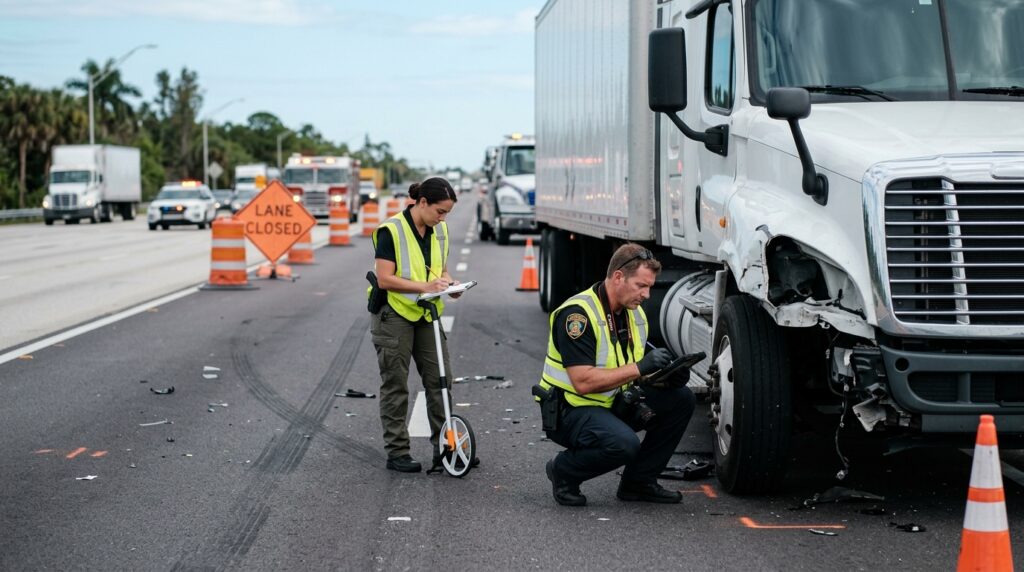
This is the most time-sensitive legal step. Much of the evidence lives on the truck. It can be overwritten or thrown away on normal schedules.
Trucks carry data an ordinary car does not:
- Electronic control module (ECM) data — the truck’s “black box.” It can record speed, braking, and throttle in the seconds before impact.
- Electronic logging device (ELD) records — the driver’s on-duty hours. These show fatigue or broken hours-of-service rules. Federal rules (49 CFR 395.8(k)) require carriers to keep supporting documents for only six months. So waiting can mean losing them.
- Driver logs and trip records
- Maintenance and inspection records
- Dash-camera or fleet-camera footage. Many systems record over old footage within days.
Because these windows are short, an attorney usually sends a preservation letter quickly. It is sometimes called a spoliation letter (a formal notice to keep evidence). It tells the company it must save this evidence. In Florida, a party that destroys evidence after this notice can face consequences from the court.
You can help too. If it is safe and possible, keep or photograph your loved one’s phone, vehicle, and belongings. Write down the names of any witnesses while memories are fresh.
We cannot promise any particular result. But acting early gives your family the best chance to learn what truly happened. To see how often these crashes occur — figures from NHTSA’s Fatality Analysis Reporting System (FARS) — see our page on truck accident fatality statistics and FARS data.
Not sure what your next step is?
Talk it through with our team — the first consultation is free, confidential, and carries no obligation.
Understanding a Florida Wrongful Death Claim
A wrongful death claim is a civil case. It asks the responsible parties to pay for the losses your family suffered. It is separate from any criminal case the state may bring against the driver.
Under Florida’s Wrongful Death Act (Fla. Stat. §§768.16–768.26), the personal representative of the estate files the claim. They file on behalf of surviving family members. Survivors can include a spouse, children, and, in some cases, parents. The exact rules depend on your family’s situation. So this is general information, not legal advice.
In general terms, a family may be able to recover:
- Loss of the deceased’s support and services
- Loss of companionship, guidance, and protection
- Funeral and burial costs
- Medical costs from the final injury
- The estate’s own losses, such as lost net earnings
We do not list dollar amounts. We cannot promise any outcome. Every case is different.
The deadline is the part not to lose track of. For many negligence claims that begin on or after March 24, 2023, Florida’s statute of limitations (the filing deadline) is generally two years under Fla. Stat. §95.11. The exact deadline for a wrongful death claim depends on the facts. Confirm it with a licensed attorney as soon as you can.
Florida also follows a modified comparative-negligence rule under Fla. Stat. §768.81. This means a person found more than 50% at fault generally recovers nothing. You can read the statutes in full on the state’s official site, Online Sunshine.
What Not to Do
The most damaging early mistakes are quiet ones — a phone call, a signature, a social-media post.
- Don’t give a recorded statement to the trucking company or its adjuster before you know your rights. Your words can be used to reduce or deny a claim.
- Don’t accept a quick settlement or sign a release. An early offer rarely reflects the full scope of a catastrophic loss. Signing usually closes the door for good.
- Don’t post about the crash or your loss on social media. Insurers look, and posts get taken out of context.
- Don’t assume fault from an early police report. Investigations change as ECM and ELD data come in.
- Don’t wait so long that evidence is overwritten or a deadline passes.
How Insurance Works in Fatal Truck Cases
Commercial truck insurance is a different world from ordinary auto coverage. Interstate carriers of general freight must follow a federal rule (49 CFR 387.9). It requires at least $750,000 in liability coverage — and far more for hazardous cargo. A single crash may also involve the driver’s coverage, the carrier’s policy, and separate cargo or leasing policies.
Remember one thing. The trucking company’s insurer represents the company, not your family. Its job is to limit what the company pays. Knowing which policies apply helps a family plan for what comes next — funeral costs, lost income, and the care of dependents left behind.
For a deeper look, see our guide on truck accident insurance coverage in catastrophic-injury cases.
Frequently Asked Questions
Who can file a wrongful death claim after a fatal truck crash in Florida?
Under Florida’s Wrongful Death Act, the personal representative of the estate files on behalf of survivors. Survivors can include a spouse, children, and certain parents. The exact rules depend on your situation.
How long do families have to take legal action in Florida?
The deadline is limited. Many negligence claims carry a two-year period under Fla. Stat. §95.11. Confirm the exact date with a licensed attorney.
Is the criminal case the same as our wrongful death claim?
No. The state may charge the driver with a crime. Your family’s civil claim for damages is separate and moves on its own.
What if we don’t have the crash report yet?
That’s fine. You can still speak with an attorney. You can request reports through the FLHSMV portal, and a lawyer can help you get it.
Does the family have to pay upfront to speak with a lawyer?
No. CHG Personal Injury Lawyers offer a free, no-obligation case evaluation. You can ask your questions before you decide anything.
Have questions about what happened?
Ask our team directly. The first conversation is free, confidential, and there is no obligation to continue.
Where Families Can Turn for Help
You should not have to learn any of this during the hardest days of your life. When you are ready, we can carry the legal weight so your family can grieve.
CHG Personal Injury Lawyers are licensed attorneys admitted to the Florida Bar. We handle catastrophic and fatal truck cases for families in Miami, Orlando, Tampa, Jacksonville, across Florida, and nationwide. We help families in English and Spanish — atendemos a las familias en español — so you can speak in the language that feels like home.
If your loved one survived the crash with a life-altering injury, we can help there too. See our resource on long-term care after a truck-accident spinal cord injury.
When you’re ready, you can request a free case evaluation. There’s no cost to talk and no promise of a specific result — just honest answers to help you understand your options.
This page is general information, not legal advice. Every case is different. For guidance about your family’s situation, speak with a licensed attorney.
Act before the evidence disappears
In serious truck cases, critical proof — electronic logging device data, dash-cam footage, driver hours, and maintenance records — can be lost or overwritten within days. A lawyer can send a legal hold letter to preserve it before it's gone.
First steps for grieving families
Get the official crash report
The Florida Traffic Crash Report documents the parties, vehicles, and initial findings. It is a starting point for identifying who may be responsible.
Preserve everything you have
Keep photos, medical records, the vehicle, and any correspondence. Do not repair or dispose of property until it has been evaluated.
Be careful with insurers
Trucking companies and their insurers move quickly. You are not required to give a recorded statement or accept an early settlement offer.
Speak with a lawyer early
A wrongful-death claim has strict deadlines and complex rules. Early guidance helps protect your family's options.
Common questions after a fatal truck crash
Who can file a wrongful-death claim?
Under Florida's Wrongful Death Act, the personal representative of the estate files on behalf of survivors, which can include a spouse, children, and certain parents. The specific rules depend on your family's situation.
How long do we have to act?
Florida law sets a firm deadline for wrongful-death claims. Because evidence fades and time limits can be shorter than families expect, it's wise to ask an attorney about your deadline as early as possible.
What can a claim seek to recover?
Depending on the facts, a claim may address funeral and medical costs, lost support and services, and the family's loss of companionship. An attorney can explain what may apply in your case.
Why are truck cases different?
Multiple parties may share responsibility — the driver, the trucking company, and others — and federal safety rules often apply. These cases require investigation that goes well beyond a typical car crash.