

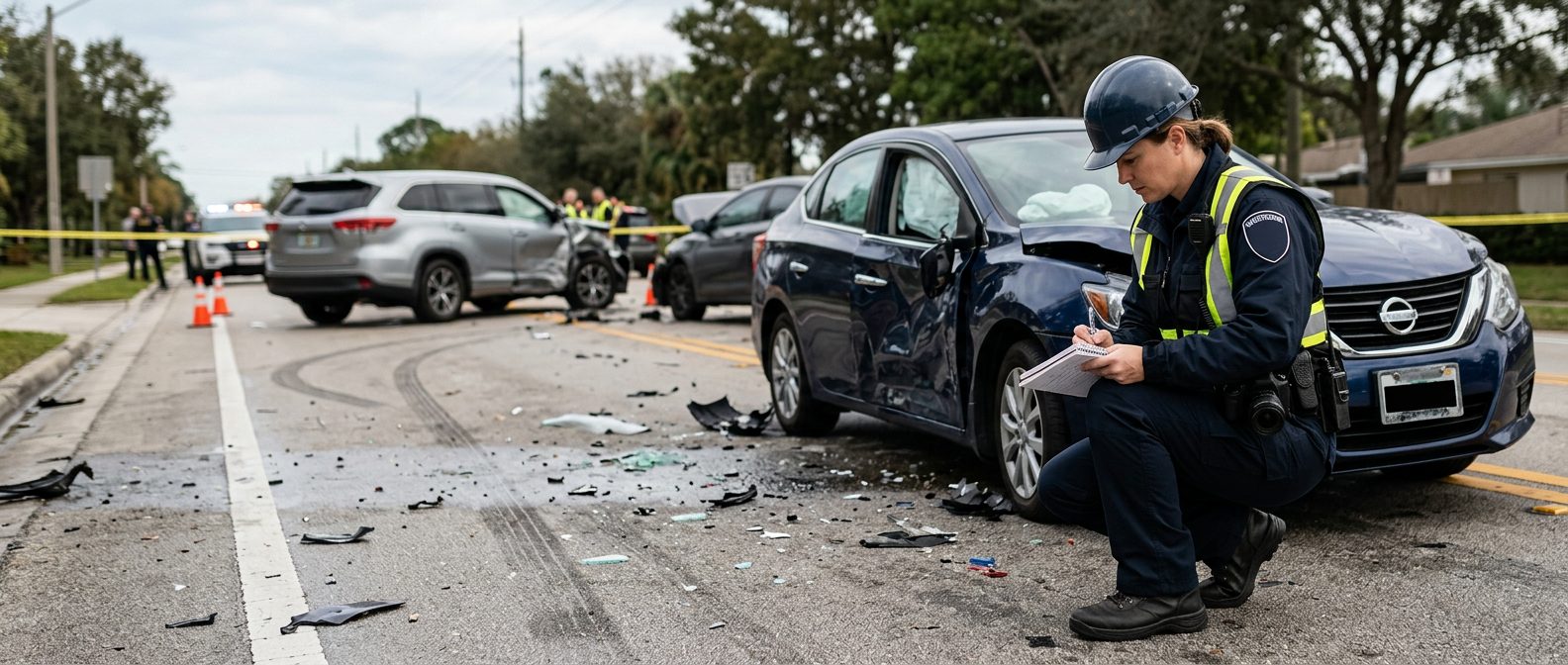
Car Accidents in Greenacres
Hit by a Car in Greenacres? Here's What to Do Next
From the scene to your claim—what you need to know about protecting your rights after a crash.
By CHG Lawyers · Published September 13, 2026
Car Accidents in Greenacres: What to Do Now, Florida’s No-Fault Rules & Your 2-Year Deadline
Greenacres is a quiet residential community in western Palm Beach County. But car accidents happen here too—on local roads and nearby highways. If you’ve been hit and hurt, this guide explains what to do right after a crash, how Florida’s no-fault insurance works, when you have a legal claim, how your own actions affect what you can recover, and the critical two-year deadline you cannot miss.

Not sure what your next step is?
Talk it through with our team — the first consultation is free, confidential, and carries no obligation.
What to Do Right After a Car Accident in Greenacres
First: stay safe and document everything. If anyone is injured, call 911 right away. If the cars can move safely, get them out of traffic to prevent more collisions. Turn on hazard lights.
Once you’re safe:
- Take photos and video: Capture vehicle damage (wide shots and close-ups), road conditions, traffic signals, skid marks, debris, and the overall scene. Include timestamps if possible.
- Get the other driver’s information: full name, phone number, address, driver’s license number, vehicle details (make, model, year, license plate), and insurance company and policy number.
- Collect witness names and phone numbers right away. Witnesses often leave. You’ll need their contact information later.
- Call the Palm Beach County Sheriff’s Office to report the crash. Get the report number and the officer’s name. You’ll need this for your insurance claim and any lawsuit.
- Tell your insurance company promptly, even if you weren’t at fault. Delays can hurt your claim.
Don’t admit fault or apologize at the scene. Even saying “I’m sorry” can be used against you as an admission of blame. Stick to facts: “I was heading north on [street] when the other vehicle entered the intersection.”
Medical Care: Don’t Wait
Many car-accident injuries show up hours or days later. Whiplash, internal bleeding, head trauma, and spinal injuries may not hurt at first. You might feel fine at the scene and wake up in severe pain the next morning.
See a doctor within 24 hours. Go to an emergency room, urgent care, or your regular doctor. Tell them you were in a car accident. Describe all symptoms—even small ones. This creates a medical record that links your injuries to the crash.
Insurance companies and lawyers look for gaps between the accident and your first doctor visit. A long delay weakens your claim. They’ll argue your injuries weren’t serious. Medical records are the proof of your harm. Without them, you have nothing.
How Florida’s No-Fault Insurance System Works
Florida is a no-fault insurance state. Your own auto insurance pays your medical bills and lost wages (up to your policy limits) regardless of who caused the crash. PIP pays 80% of reasonable medical expenses and 60% of lost income, up to the $10,000 policy limit, if you get initial care within 14 days of the crash (Fla. Stat. § 627.736). You don’t have to prove fault to get paid by your insurer.
But you can sue the at-fault driver for pain and suffering only if your injury meets Florida’s “serious injury threshold” under Florida Statute §627.737.
If your injuries don’t meet this threshold, the at-fault driver is exempt from liability for damages only to the extent your no-fault (PIP) benefits are payable for that injury.
Have questions about what happened?
Ask our team directly. The first conversation is free, confidential, and there is no obligation to continue.
Establishing Fault: Evidence and Comparative Negligence
To prove fault, you need evidence. Police reports, witness statements, accident photos, and expert accident reconstruction all help show who caused the crash. Common causes include speeding, distracted driving, failure to yield, running red lights, and impaired driving.
Here’s what matters to you: Florida’s comparative-negligence rule.
Under Florida Statute §768.81, if you are found more than 50% at fault, you cannot recover any money—period.
If you’re 30% at fault and the other driver is 70% at fault, you recover 70% of your damages. If you’re 51% at fault, you recover nothing.
Your own conduct—speeding, distracted driving, failure to yield—directly reduces or eliminates what you recover. Insurance companies and opposing lawyers will argue you were partly or mostly at fault. This is where legal guidance protects your rights and challenges unfair fault claims.
What Compensation May Be Available
The serious injury threshold applies to damages for pain, suffering, mental anguish, and inconvenience, so you may recover those damages only if your injury meets it.
Settlements vary widely based on injury severity, clarity of fault, and insurance limits. There is no “standard” amount. Each case is unique.
Protect Your Claim: Mistakes to Avoid
Small mistakes can cost you thousands:
- Don’t post about the accident on social media. Insurance adjusters monitor Facebook, Instagram, and TikTok. A photo of you at a restaurant or gym can be used to argue you’re not as injured as you claim.
- Don’t give a recorded statement to the other driver’s insurance company without talking to a lawyer first. Adjusters are trained to extract statements that hurt your claim.
- Don’t accept an early settlement without understanding your full injuries. Some injuries worsen over time. Early payment may leave you short.
- Don’t delay seeking medical care or legal help. The longer you wait, the weaker your evidence becomes.
Florida’s Filing Deadline Is Strict
Florida sets a deadline for filing a personal-injury lawsuit, and the length of that deadline depends on the type of claim. Under Florida Statute §95.11, if you miss this deadline, your claim can be barred. A disability or other reason does not pause the deadline except as Florida Statute §95.051 provides.
Many people delay seeking legal help, thinking they have time. They don’t. Insurance negotiations can take months or years. If you do not file a lawsuit before the deadline that applies to your claim, your claim can be barred—even if the insurance company was negotiating unfairly or offered an insulting settlement.
Contact a lawyer well before the deadline. A lawyer can file a lawsuit to protect your rights while settlement talks continue.
Want to know where you stand?
Tell us what happened and our team will walk you through the options available to you, at no cost.
When to Contact a Car Accident Lawyer
Reach out to a lawyer if:
- You suffered a serious injury (permanent scarring, disfigurement, significant loss of function, or death in the family)
- The other driver was uninsured or underinsured
- Liability is unclear or disputed
- The insurance company denies your claim or offers an unreasonably low settlement
- You’re unsure whether your injuries meet Florida’s serious injury threshold
- You’re approaching the two-year statute-of-limitations deadline
Early legal guidance prevents costly mistakes and protects your rights.
How CHG Personal Injury Lawyers Can Help
Our firm focuses exclusively on serious personal-injury cases, including car accidents that cause lasting harm. We serve Florida residents, including people in Greenacres.
Here’s what we do:
- Free case evaluation: We review your accident, injuries, insurance situation, and medical records at no cost. We answer your questions and explain your options.
- Investigation: We gather police reports, witness statements, medical records, and accident-reconstruction evidence to build a strong case.
- Negotiation: We handle all communication with insurance companies and opposing counsel, so you don’t have to.
- Litigation: If a fair settlement cannot be reached, we are prepared to take your case to trial.
- Contingency fee model: You pay nothing upfront. We recover our fees only if we recover compensation for you. This removes the financial barrier to legal consultation and aligns our interests with yours.

Frequently Asked Questions
How long do I have to file a car accident lawsuit in Florida?
Florida sets a deadline for filing a personal-injury lawsuit under Florida Statute §95.11, and the length of that deadline depends on the type of claim. Missing this deadline can bar your claim.
What counts as a “serious injury” in Florida?
Serious injury includes significant and permanent loss of an important bodily function, permanent injury within a reasonable degree of medical probability (other than scarring or disfigurement), significant and permanent scarring or disfigurement, or death. Injuries that do not meet these criteria do not meet the serious injury threshold.
Can I recover if I was partially at fault?
Yes, if you’re 50% or less at fault (Fla. Stat. § 768.81(6)). You’ll recover a percentage of damages equal to the other driver’s fault. If you’re more than 50% at fault, you cannot recover anything.
Should I post about my accident on social media?
No. Insurance adjusters monitor social media and use posts and photos to argue you’re not injured or are exaggerating your claims.
What should I do if the insurance company denies my claim?
Contact a lawyer. You may have grounds to appeal or pursue a lawsuit against the at-fault driver directly.
What if a family member was killed in the crash?
Surviving spouses, children, and parents may pursue a wrongful-death claim. This is a catastrophic outcome, and Florida law recognizes the family’s right to recover for their loss and funeral expenses. Contact a lawyer immediately—the two-year deadline applies to wrongful-death claims as well.
If you’ve been injured in a car accident in Greenacres and aren’t sure whether your injuries qualify for a claim, how the two-year deadline affects you, or how your own conduct might affect recovery, reach out for a free case evaluation. People in your situation can contact us—and we’re here to help you understand your rights and next steps.
What to Do Right After a Car Accident
Check for Injuries & Call 911
Your safety and the safety of others comes first. If anyone is hurt, call emergency services immediately. Even if injuries aren't obvious, some symptoms appear hours or days later.
Document the Scene
Take photos of vehicle damage, road conditions, traffic signals, and the accident location. Get the names, phone numbers, and insurance details of the other driver(s) and any witnesses.
Report the Accident
File a police report if there are injuries or significant damage. Get the report number. Notify your own insurance company promptly, but keep your description factual and brief.
Seek Medical Attention
See a doctor even if you feel fine. Some injuries—whiplash, internal bleeding, traumatic brain injury—aren't immediately obvious. Medical records are crucial evidence for your claim.
Important: Florida’s Filing Deadline
Florida law sets a deadline for filing a personal-injury lawsuit, and the length of that deadline depends on the type of claim. Missing this deadline means losing your right to recover damages permanently. Don't wait.
Why Your Car Accident Claim Matters
You May Recover Damages
Medical bills, lost wages, property damage, pain and suffering, and other losses caused by the crash may be recoverable from the at-fault driver's insurance or through a lawsuit.
Evidence Fades Fast
Witness memories dim, road conditions change, and security camera footage is often deleted after 30 days. The sooner you act, the stronger your claim.
Insurance Tactics Matter
Insurers often minimize payouts or deny claims outright. Having an attorney on your side levels the playing field and protects your interests.
You Don't Pay Unless There's a Recovery
We handle car accident claims on a contingency basis—no attorney’s fees unless there is a recovery. You focus on healing; we handle the legal work.
Common Questions About Car Accidents in Florida
What counts as a 'serious injury' in Florida?
Serious injury includes permanent scarring or disfigurement, significant and permanent loss of bodily function, or permanent injury. Many car accident injuries qualify, even if they don't seem 'catastrophic' at first.
Who pays for my medical bills if I'm injured?
In Florida, your own auto insurance’s Personal Injury Protection (PIP) coverage pays medical expenses up to your policy limit, regardless of fault. PIP pays 80% of reasonable medical expenses and 60% of lost income, up to the $10,000 policy limit, if you get initial care within 14 days of the crash (Fla. Stat. § 627.736). After PIP is exhausted, the at-fault driver's liability insurance may cover additional damages.
Can I recover if I was partially at fault?
Yes. Florida's comparative negligence rule allows you to recover damages even if you were partly responsible—as long as you were not more than 50% at fault (Fla. Stat. § 768.81(6)). Your recovery is reduced by your percentage of fault.
What if the other driver was uninsured?
Your own Uninsured Motorist (UM) coverage protects you. If you don't have UM coverage or it's insufficient, other options may be available depending on the circumstances of the crash.