

Car Accidents in Dania Beach
Hit by Another Driver in Dania Beach? Know Your Rights Under Florida Law
You may be entitled to compensation for medical bills, lost wages, and pain and suffering. CHG Personal Injury Lawyers handles car accident claims and can help you understand your options.
By CHG Lawyers · Published September 29, 2026
Car Accidents in Dania Beach: Florida Law, Liability & Your Rights
Drivers in Dania Beach share Broward County’s major roads, including I-95, US-1, and Sunrise Boulevard. These three major roads funnel traffic through Broward County every day. I-95 alone carries heavy daily traffic through South Florida. Crashes here are often severe: multi-vehicle pileups at highway speed, head-on impacts at busy intersections, vehicles leaving the road.
The Broward County Sheriff’s Office and Florida Highway Patrol respond to serious car accidents in Dania Beach regularly. Many result in spinal cord injuries, traumatic brain injuries, amputations, permanent disability, or death. If you’ve been injured in a car accident in Dania Beach, understanding your legal rights matters. Acting quickly directly affects your recovery and financial security.
Not sure what your next step is?
Talk it through with our team — the first consultation is free, confidential, and carries no obligation.
Why the First Hours After a Dania Beach Car Accident Matter
Your immediate actions preserve evidence, protect your health, and protect your legal claim.
1. Call 911 if anyone is injured or damage is significant. Do not move anyone with a suspected spinal or neck injury unless immediate danger exists. Spinal injuries worsen with movement and can cause permanent paralysis.
2. Move to safety if possible. If your vehicle works, move it out of traffic safely. Turn on hazard lights. Stay away from the roadway.
3. Report to law enforcement. Contact the Broward Sheriff’s Office or Florida Highway Patrol. Request a police report. Write down the report number, officer’s name, and badge number. This official report is critical evidence.
4. Exchange information with the other driver(s): – Full name, phone number, home address – Driver’s license number and state – Vehicle make, model, year, color, license plate – Vehicle Identification Number (VIN) – Insurance company name and policy number
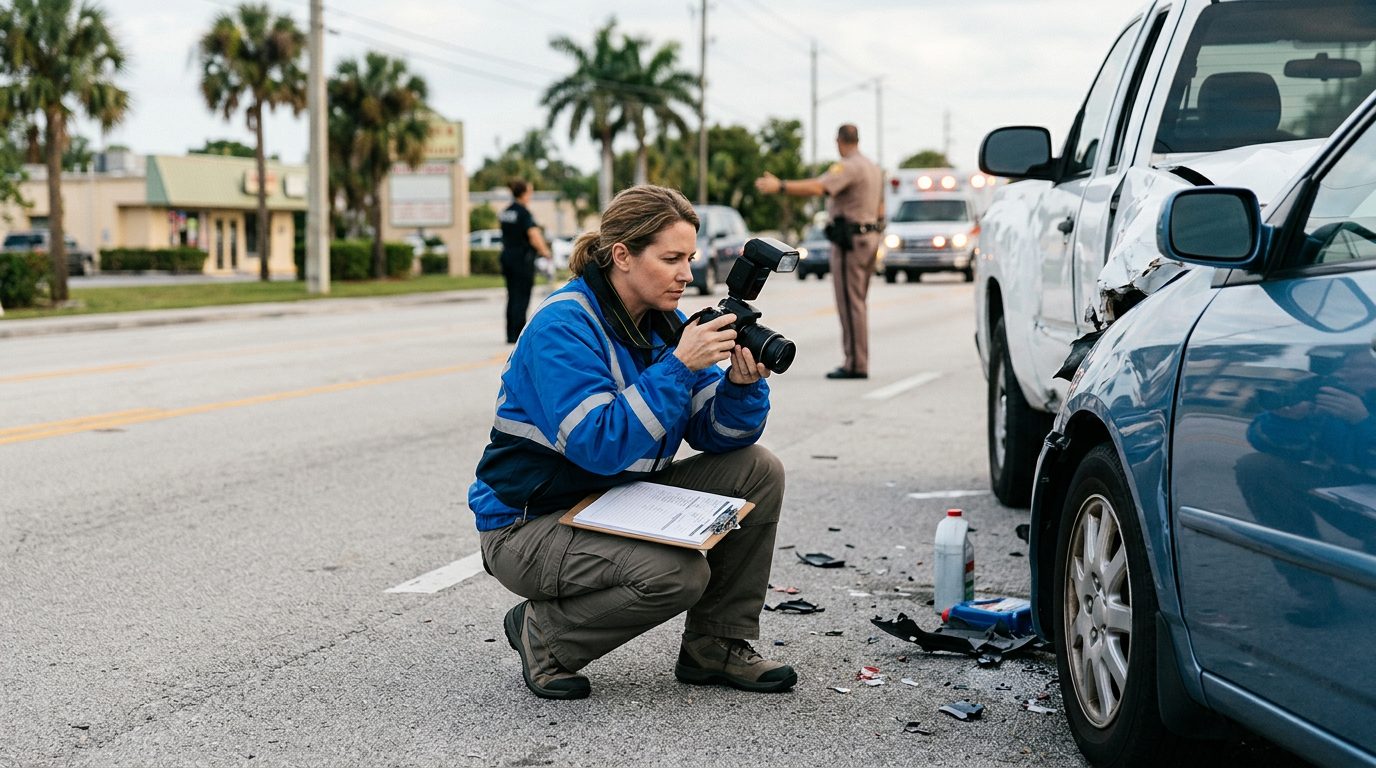
5. Photograph the scene immediately. Photos taken at the scene are far more credible than those taken later. Capture: – All vehicle damage (wide shots and close-ups) – Road conditions, traffic signals, lane markings – Skid marks, debris, point of impact – Weather and lighting conditions – Street signs and landmarks showing location – The other driver’s vehicle and license plate
Smartphone photos automatically embed timestamp data—powerful evidence of when you took them.
6. Collect witness names and contact information. Witness statements are powerful evidence if liability is disputed. Do not rely on the other driver to provide witness names.
7. Seek medical attention immediately, even if you feel fine. Many serious injuries—whiplash, spinal injuries, internal bleeding, traumatic brain injury—do not produce immediate symptoms. Some appear hours or days later. A medical record created soon after the accident proves the injury came from the crash. This is crucial evidence for your claim.
8. Do not admit fault, apologize, or sign anything except police reports and medical documents. Do not post about the accident on social media. Statements you make can be used against you later.
9. Keep detailed records: – Medical bills, receipts, prescription records – Physical therapy and rehabilitation records – Repair estimates and invoices – Proof of lost wages (pay stubs, employer statements) – Police report – Insurance correspondence – Journal entries documenting pain, limitations, recovery progress
Serious Injuries from Car Accidents in Dania Beach
Car accidents on I-95, US-1, and Sunrise Boulevard cause injuries ranging from minor to catastrophic.
Spinal cord injuries and paralysis are among the most severe outcomes. A spinal cord injury can result in paraplegia (paralysis of the lower body) or quadriplegia (paralysis of all four limbs). These cause permanent impairment and require lifelong medical care, specialized equipment, home modifications, and attendant care.
Traumatic brain injuries (TBI) can cause cognitive, physical, and behavioral changes that may be permanent. TBI survivors may experience memory loss, difficulty concentrating, mood changes, loss of balance, chronic headaches, and reduced ability to work or live independently.
Amputations and limb loss result from crushing injuries or severe trauma. These injuries require surgery, prosthetics, rehabilitation, and lifelong adaptation.
Severe burns can occur if a vehicle catches fire. Burn injuries require intensive medical care, multiple surgeries, skin grafts, and often result in permanent scarring, disfigurement, contractures, and chronic pain.
Catastrophic back and neck injuries may result in chronic pain, loss of function, and permanent disability that prevents work or enjoying life as before.
Wrongful death is the most catastrophic outcome. Fatal crashes leave families grieving and facing financial hardship. Families of deceased crash victims can pursue wrongful-death claims against the at-fault driver or responsible party.
Florida Law: Liability, Comparative Negligence & the Serious Injury Threshold
Who Is Liable?
The at-fault driver is typically liable for injuries and damages caused by the crash. Liability is determined by negligence: the at-fault driver failed to exercise reasonable care, that failure caused the accident, and the accident caused your injuries.
Liability may extend beyond the driver to: – An employer if the driver was working at the time of the crash – A vehicle manufacturer if a defect caused or contributed to the crash – A property owner if a road hazard or unsafe condition contributed to the accident – A government entity if a dangerous road condition, missing signage, or poor traffic control contributed to the crash
Florida’s Modified Comparative-Negligence Rule
Florida is a modified comparative-negligence state. Under Florida Statute § 768.81, if you are more than 50% at fault, you generally cannot recover damages. If you are 50% or less at fault, you can recover—but your compensation is reduced by your percentage of fault.
Example: If a jury determines you are 20% at fault and the other driver is 80% at fault, and your total damages are $100,000, you can recover $80,000.
Florida’s No-Fault Auto Insurance System & the Serious Injury Threshold
Florida is a no-fault auto insurance state. Through Personal Injury Protection (PIP) coverage, your own auto insurance pays part of your medical bills and lost wages regardless of who caused the accident. PIP pays 80% of reasonable medical expenses and 60% of lost income, up to the $10,000 policy limit, if you get initial care within 14 days of the crash (Fla. Stat. § 627.736). The full $10,000 in medical benefits is available only if a qualified provider finds an emergency medical condition; otherwise, medical benefits are capped at $2,500 (Fla. Stat. § 627.736(1)(a)).
The serious injury threshold includes:
- Permanent injury or disfigurement
- Significant and permanent loss of an important bodily function
Some catastrophic injuries meet this threshold, depending on whether they cause a permanent injury, a significant and permanent loss of an important bodily function, or significant and permanent scarring or disfigurement. An attorney can help you determine whether your injuries meet the threshold and what damages you can pursue.
Have questions about what happened?
Ask our team directly. The first conversation is free, confidential, and there is no obligation to continue.
The Critical Statute of Limitations: Two Years to File
This is critical: Under Florida Statute § 95.11, you generally have two years from the date of the accident to file a lawsuit. If you wait longer, you lose your right to sue, even if you have a valid claim.
Do not wait to seek legal help. The sooner you contact an attorney: – Evidence can be preserved (surveillance footage degrades or is deleted; witnesses move or forget details) – Witnesses can be interviewed while memories are fresh – Your claim can be investigated thoroughly – Your attorney can begin negotiating with insurance companies immediately
Car Accident Claims: Settlement vs. Trial
A settlement is an agreement in which the at-fault party or their insurance company pays you money in exchange for your agreement not to pursue further legal action. Settlements can cover medical expenses, lost wages, pain and suffering, permanent disability, future medical care, and other damages.
Insurance companies often make low initial settlement offers, hoping you’ll accept quickly without understanding the full value of your claim. An attorney negotiates on your behalf to ensure you receive fair compensation based on:
- The severity of your injuries and permanent effects
- Your medical expenses (past and future)
- Lost income and lost earning capacity
- Pain and suffering
- Loss of enjoyment of life
- The clarity of liability
- The strength of your evidence
If a settlement cannot be reached, your case may go to trial, where a judge or jury will decide liability and damages.
How an Attorney Can Help Your Claim
Going up against an insurance company alone is like trying to negotiate a multi-million-dollar contract without legal counsel. Insurance companies employ teams of adjusters, nurses, and lawyers whose job is to minimize what they pay.
An attorney working on your behalf:
- Understands Florida law and investigates accidents thoroughly, including obtaining police reports, surveillance footage, and expert analysis
- Gathers evidence to prove liability: police reports, witness statements, photographs, medical records, accident reconstruction experts if needed
- Handles all communication with insurance companies and the other party, protecting your rights and preventing statements that weaken your claim
- Accurately calculates the full value of your claim, including damages you might not realize you’re entitled to
- Files a lawsuit if the insurance company refuses to offer fair compensation
- Works on contingency, meaning you pay no attorney fees upfront and nothing unless your case is resolved and you receive compensation
Frequently Asked Questions
What should I do if the at-fault driver was uninsured or underinsured?
UM coverage pays for your injuries if the at-fault driver has no insurance. UIM coverage pays the difference if the at-fault driver’s insurance limits are insufficient. Your attorney can help you file a claim under your UM or UIM coverage.
Can I recover damages if I was partially at fault?
Yes, under Florida’s comparative-negligence rule, as long as you are 50% or less at fault (Fla. Stat. § 768.81(6)). Your recovery is reduced by your percentage of fault.
What if I can’t afford an attorney?
Most personal injury attorneys work on a contingency-fee basis. You pay no attorney fees upfront and nothing unless we recover compensation for you.
What if the accident caused a death in my family?
Wrongful-death claims are brought by the decedent’s personal representative, who recovers for the benefit of the decedent’s survivors and estate. These claims seek compensation for funeral and burial expenses, lost financial support the deceased would have provided, loss of companionship and society, and other damages. An attorney can help your family understand your rights and pursue a wrongful-death claim.

Want to know where you stand?
Tell us what happened and our team will walk you through the options available to you, at no cost.
Contact CHG Personal Injury Lawyers
If you’ve been injured in a car accident in Dania Beach—whether a routine collision or a catastrophic, life-altering crash—contact an attorney immediately. CHG Personal Injury Lawyers focuses exclusively on personal injury cases, including car accidents of all severity levels.
We’re based in Florida and handle cases nationwide.
We offer a free case evaluation to discuss your accident, your injuries, and your legal options. There’s no obligation, and you won’t pay any attorney fees unless we recover compensation for you.
Contact CHG Personal Injury Lawyers for your free case evaluation.
Why Choose CHG for Your Dania Beach Car Accident Claim
Florida-Based Personal Injury Law Firm
We focus exclusively on car accidents and catastrophic injury claims. Our attorneys understand Florida's negligence laws and how to build a strong case on your behalf.
No Attorney’s Fees Unless There Is a Recovery
We work on contingency. You pay nothing upfront, and we only collect a fee if your case results in a settlement or judgment in your favor.
Free Consultation
Call us to discuss what happened, your injuries, and the next steps. There's no obligation—just honest guidance about your claim.
Representation Throughout Florida
We represent people injured in car accidents throughout Florida.
Act Quickly After a Car Accident
Florida law sets time limits on how long you have to file a personal injury lawsuit. Gathering evidence, medical records, and witness statements early strengthens your claim. Contact us as soon as possible after your accident.
Common Questions About Car Accidents in Dania Beach
What if the Other Driver Was Uninsured or Underinsured?
UM coverage pays for your injuries if the at-fault driver has no insurance. UIM coverage covers the gap if their insurance limits are too low. Your attorney can help you file a claim under your UM or UIM coverage.
How Is Fault Determined in a Florida Car Accident?
Florida is a comparative negligence state (Fla. Stat. § 768.81(6)). Your recovery may be reduced if you are found partially at fault. Police reports, witness statements, photos, and medical records all help establish who caused the accident. An experienced attorney can navigate this process and advocate for your interests.
What Damages Can I Recover?
You may be entitled to compensation for medical expenses, lost wages, property damage, pain and suffering, and other losses caused by the accident. The amount depends on the severity of your injuries, the clarity of fault, and the at-fault driver's insurance limits.
Do I Need an Attorney for My Car Accident Claim?
While not required, an attorney can help you understand your rights, negotiate with insurance companies, and maximize your recovery. Insurance adjusters often offer less than a claim is worth. Having legal representation levels the playing field.