

Car Accidents in Deerfield Beach
After a Car Accident: Know Your Rights and Next Steps
If you've been injured in a crash in Deerfield Beach, you may have the right to recover compensation. CHG Personal Injury Lawyers focuses exclusively on car accidents and serious injuries. Get a free case evaluation.
By CHG Lawyers · Published October 01, 2026
Car Accidents in Deerfield Beach: Your Rights & Recovery Steps
A car accident can happen in seconds. You’re driving on Atlantic Boulevard, Federal Highway, or through a busy intersection. Some crashes cause minor damage. Others cause permanent paralysis, traumatic brain injury, amputation, or death.
If you’ve been hurt in a car accident in Deerfield Beach because someone else was negligent, Florida law gives you the right to recover damages. But you have a limited window to act. Insurance companies will work to minimize what you receive. Understanding what to do immediately after a crash, how Florida’s legal system works, and when to contact an attorney can mean the difference between fair compensation and financial hardship.
If you've been injured in a crash in Deerfield Beach, you may have the right to recover compensation. Talk it through with our team — the first consultation is free, confidential, and carries no obligation.
What to Do in the First Minutes After a Car Accident
The steps you take immediately after a crash create the foundation for your claim.
Call 911 if anyone is injured or traffic is blocked.
Emergency responders will arrive, assess injuries, and create an official incident record. Tell paramedics about all pain or discomfort—even symptoms that seem minor. Head injuries, internal bleeding, and spinal injuries can worsen hours or days after impact.
Move to safety if possible.
If you can safely exit your vehicle and traffic allows, move to the sidewalk or a safe area. If you cannot move, stay in your vehicle with hazard lights on.
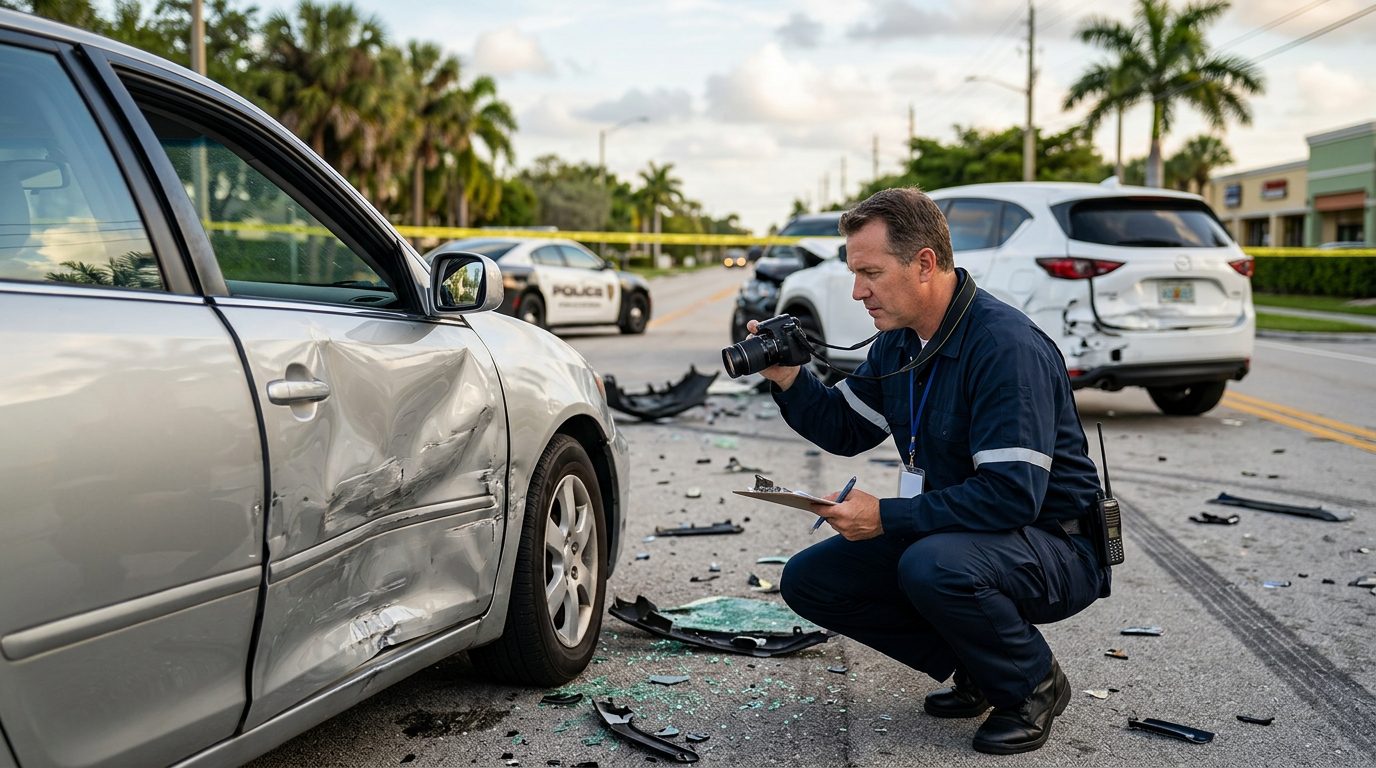
Document the scene with photos and video.
Use your phone to photograph: – All vehicle damage (close-ups and wide shots) – The accident location, road markings, and traffic signals – Weather conditions and road surface – Skid marks or vehicle positions – Any visible injuries – Street signs and mile markers
These images are evidence and cannot be recreated later.
Get the other driver’s information.
Record their name, phone number, address, driver’s license number, vehicle details, license plate, and insurance information. Do not discuss fault or sign anything except your insurance claim form.
Collect witness contact information.
Ask anyone who saw the accident for their name and phone number. Witnesses often disappear. Their statements become invaluable if the case goes to trial.
Report the accident to your insurance company promptly.
Provide factual details but do not speculate about fault. Say: “I was hit by a vehicle at [location] on [date/time].” Stick to observable facts only.
Seek medical evaluation even if you feel fine.
Adrenaline masks pain. Whiplash, concussion, and internal injuries often emerge hours or days later. A medical record created at the scene documents your injuries and links them to the accident.
Keep all receipts and records.
Save documents for medical treatment, prescriptions, transportation, lost wages, and any other accident-related expense. These receipts prove your damages.
Understanding Florida’s Statute of Limitations: Your 2-Year Window
If you do not file within that window, you lose the right to sue permanently.
This deadline is not a suggestion—it is a legal requirement. Many people delay seeking legal help, thinking they have time. By the time they contact an attorney, months have passed. Evidence has been lost. Memories have faded. Witnesses move away. Surveillance footage is deleted.
Contact an attorney within weeks of your car accident in Deerfield Beach, not months or years later. Even if you are still in treatment or unsure whether you have a claim, an early consultation protects your legal rights and ensures evidence is preserved.
How Fault Is Determined: Florida’s Comparative Negligence Rule
Florida uses a “comparative negligence” system. Under Florida Statute § 768.81, you can recover damages even if you were partially at fault—as long as you were 50% or less responsible for the accident. Your recovery is reduced by your percentage of fault.
Example: You are injured in a crash. Investigation shows the other driver ran a red light (80% at fault) but you were slightly speeding (20% at fault). You can recover 80% of your damages. If your total damages are $100,000, you receive $80,000.
If you are found 51% or more at fault, you cannot recover anything. This is why investigation and evidence matter. Insurance companies will try to shift blame to you. An attorney investigates thoroughly—gathering police reports, witness statements, surveillance video, and accident reconstruction—to establish the other driver’s fault.
Not sure what your next step is?
Talk it through with our team — the first consultation is free, confidential, and carries no obligation.
Hit-and-Run Accidents: Criminal Penalties and Your Recovery Options
A hit-and-run occurs when a driver leaves the scene without providing their name, contact information, or insurance details. In Florida, this is a crime.
If you are hit by a driver who flees, report it to the Deerfield Beach Police Department or Broward Sheriff’s Office immediately. Provide as much detail as you can: vehicle color, make, model, partial or full license plate, direction of travel, and any witness information.
Your uninsured motorist (UM) coverage can help. If the hit-and-run driver is never found, your own auto insurance UM coverage is designed to pay for your injuries. An attorney can help you file a police report, preserve evidence, and pursue your UM claim.
Catastrophic Injuries from High-Impact Crashes
Not all car accidents are minor. High-speed collisions, multi-vehicle pileups, and crashes involving large trucks can cause permanent, life-altering injuries.
Spinal Cord Injuries & Paralysis
A spinal cord injury can result in partial or complete paralysis. Paraplegia (paralysis of the lower body) and quadriplegia (paralysis of all four limbs) are permanent. According to the Christopher & Dana Reeve Foundation, approximately 18,000 new spinal cord injuries occur in the United States each year.
These injuries require emergency surgery, intensive rehabilitation, and lifelong medical care. Home modifications cost tens of thousands of dollars. Lost earning capacity and reduced quality of life are immeasurable.
Traumatic Brain Injury (TBI)
Traumatic brain injury is damage to the brain caused by external force. TBI ranges from mild concussion to severe diffuse axonal injury. Symptoms include loss of consciousness, memory loss, confusion, difficulty concentrating, and mood changes.
Moderate to severe TBI often requires hospitalization, ICU care, neurosurgery, and long-term cognitive rehabilitation. Many TBI survivors never fully recover and face permanent cognitive or physical deficits.
Amputation & Limb Loss
Crush injuries and traumatic amputation require emergency surgery and prosthetic fitting. Prosthetics are expensive—a high-function prosthetic leg can cost $100,000 or more—and must be replaced as the body changes.
Severe Burns
Burn injuries from vehicle fires cause severe pain, scarring, and psychological trauma. They require emergency treatment, skin grafting, infection control, and years of reconstructive surgery.
Internal Organ Damage
Blunt-force trauma from high-impact crashes can rupture the spleen, liver, kidneys, or other organs. This requires emergency surgery and intensive care.
These injuries are financial catastrophes. Lifetime medical costs for severe spinal cord injury can be substantial. When negligence causes these injuries, the at-fault party is liable for all past and future damages—medical bills, lost wages, pain and suffering, and permanent disability.
Insurance companies will fight hard to minimize these claims. A personal injury attorney can help you identify the damages you may be able to pursue. See our guide on personal injury claims to understand the full process.
Settlements vs. Litigation: What You Need to Know
A settlement is an agreement to resolve your claim without trial. The at-fault driver’s insurance company offers a lump sum to compensate you. You sign a release, and the case closes.
Advantages of settlement: – Faster resolution (weeks to months vs. years) – Certainty about what you’re receiving – Lower legal costs – Avoids the stress of trial
Disadvantages: – Insurance companies often lowball initial offers – Once you sign a release, you cannot pursue additional claims – You may not receive full compensation for future medical needs
A litigation approach means filing a lawsuit and taking the case to trial if settlement fails. This allows you to: – Conduct thorough discovery of the other driver’s records and evidence – Depose witnesses and the at-fault driver under oath – Hire expert witnesses to testify – Present your case to a jury, which may award more than an insurance offer
Why insurance companies underpay:
Insurance adjusters are trained to minimize claims. They may: – Dispute the severity of your injuries – Argue that pre-existing conditions caused your symptoms – Claim your medical treatment was unnecessary – Undervalue pain and suffering and future damages – Delay responding, hoping you’ll accept less out of frustration
An attorney evaluates settlement offers against the true value of your claim. If an offer is unfair, we advise you to reject it and prepare for litigation. If a fair settlement is offered, we recommend accepting it to avoid trial risk.
Fatal Car Accidents: What Families Need to Know
When a car accident results in death, the family left behind faces overwhelming grief, financial hardship, and an uncertain future. The deceased’s income is gone. Funeral costs mount. The family loses not only a loved one but also their financial security.
A wrongful-death claim seeks damages for: – Economic losses: Medical bills, funeral and burial expenses, lost income the deceased would have earned, and loss of financial support the family relied on – Non-economic losses: Loss of companionship, emotional suffering, loss of guidance and advice, and the family’s mental anguish
Wrongful-death claims are subject to a filing deadline, and missing it can bar the family’s right to recover.
Families who have lost someone in a fatal crash should contact an attorney immediately. We can investigate the crash, gather evidence, calculate the full value of the family’s claim, and pursue fair compensation. Learn more about wrongful death claims and your family’s legal options.
Grief is overwhelming. Legal matters can wait a few weeks while you grieve. But do not wait months or years. Evidence deteriorates, witnesses move away, and the statute of limitations approaches. An early consultation protects your family’s legal rights and financial future.

Have questions about what happened?
Ask our team directly. The first conversation is free, confidential, and there is no obligation to continue.
Frequently Asked Questions
How long do I have to file a claim after a car accident in Florida?
You have 2 years from the date of the accident to file a personal-injury lawsuit under Florida Statute § 95.11. For wrongful-death claims, you have 2 years from the date of death. Missing that deadline can bar your lawsuit, although some exceptions may apply.
What if I was partially at fault for the accident?
Under Florida’s comparative-negligence rule (Florida Statute § 768.81), you can recover damages even if you were partially at fault—as long as you were 50% or less responsible. Your recovery is reduced by your percentage of fault. If you are found 51% or more at fault, you cannot recover anything.
What is uninsured motorist (UM) coverage?
UM coverage on your own auto insurance policy pays for your injuries if the at-fault driver is uninsured, underinsured, or never identified. UM coverage is designed for exactly these situations. Check your policy to see what coverage limits you have.
Should I talk to the other driver’s insurance company?
No. Do not speak to the other driver’s insurance adjuster without an attorney present. Anything you say can be used against you to minimize your claim. Let your attorney handle all communication with the other driver’s insurance company.
What if the other driver doesn’t have insurance?
Your own UM coverage can help pay for your injuries. An attorney can also investigate other sources of liability—the driver’s employer, a vehicle manufacturer, or a property owner.
How much is my case worth?
The value of your case depends on the severity of your injuries, clarity of fault, medical expenses, lost wages, pain and suffering, and any permanent disability. An attorney can evaluate your case and estimate its value based on comparable cases. Insurance companies will often offer far less than fair value.
If you’ve been hurt in a car accident in Deerfield Beach—whether a minor fender-bender or a serious, life-altering crash—or if you’ve lost a loved one in a fatal accident, reach out for a free case evaluation. Contact our Coral Gables office today. We’re here to help you understand your rights and pursue the compensation you and your family deserve.
What to Do After a Car Accident
At the Scene
Check for injuries. Call 911 if anyone is hurt. Move to safety if possible. Exchange names, phone numbers, addresses, insurance information, and vehicle details with the other driver. Take photos of vehicle damage, the accident scene, and road conditions. Get contact information from witnesses.
Seek Medical Care
Even if you feel fine, see a doctor soon after the accident. Some injuries—like whiplash, internal bleeding, or traumatic brain injury—may not be obvious right away. Medical records create a clear link between the accident and your injuries, which is crucial for your claim.
Report to Police
Request a copy of the police report, which will include the accident details and the officer's observations.
Preserve Evidence
Keep all medical records, bills, receipts, photos, and communications related to the accident. Do not repair your vehicle until the insurance company has inspected it. Document your injuries and recovery with photos and notes about pain, limitations, and treatment.
Why CHG Personal Injury Lawyers
Focus on Serious Injuries
We focus exclusively on personal-injury cases, from everyday car accidents to catastrophic, life-altering injuries. We understand the full scope of your damages and fight for fair compensation.
Thorough Case Investigation
We gather police reports, medical records, witness statements, and accident reconstruction evidence. We identify all liable parties and hold them accountable.
Plain-Language Guidance
We explain your rights and options in clear, everyday language—not legal jargon. You'll understand what's happening at every step.
No Attorney’s Fees Unless There’s a Recovery
We work on a contingency basis: you pay no attorney’s fees unless there is a recovery. You focus on healing; we handle the legal work.
Time Matters
Florida law sets strict deadlines for filing a personal-injury lawsuit after a car accident. The sooner you contact us, the sooner we can protect your rights and begin building your case.