

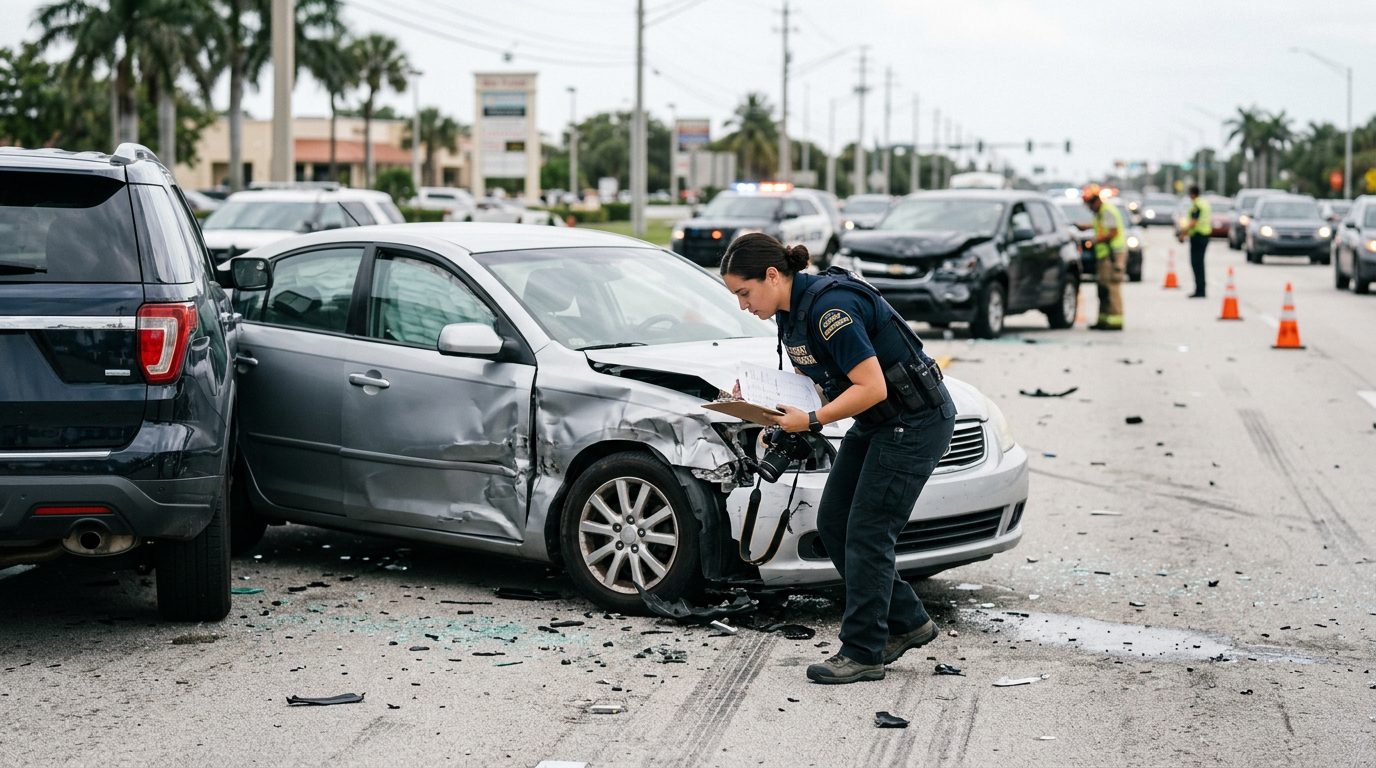
Car Accidents in Delray Beach
After a Car Accident: Your Next Steps Matter
Get the guidance you need to protect your rights and your recovery. CHG Personal Injury Lawyers is here to help.
By CHG Lawyers · Published September 26, 2026
Car Accidents in Delray Beach: Your Legal Options After a Crash
Delray Beach sits where major highways meet busy city streets. Interstate 95, Atlantic Avenue, U.S. 441, State Road 7, and the Florida Turnpike all pass through the area. That means traffic is constant, speeds are high, and car accidents in Delray Beach range from minor fender-benders to life-altering injuries and wrongful deaths. Some crashes are preventable. Many leave families grieving or facing permanent disability. If you’ve been in a collision or lost someone you love, knowing what to do next matters.
Not sure what your next step is?
Talk it through with our team — the first consultation is free, confidential, and carries no obligation.
Car Accidents Are Common in Delray Beach—and Some Are Catastrophic
Delray Beach experiences frequent collisions on its major corridors. The area has documented fatal multi-vehicle pile-ups on I-95, rollover crashes on the Turnpike, pedestrian accidents on Atlantic Avenue, and high-speed collisions on U.S. 441.
Not every accident results in serious injury. Many people walk away with minor cuts or whiplash. But others suffer permanent damage: spinal cord injuries that cause paralysis, traumatic brain injuries that change memory and personality, amputations, severe burns, or death.
A single moment on a Delray Beach highway can reshape a family’s entire future. Medical bills mount. Lost wages pile up. A person who was independent may need round-the-clock care. A family loses a breadwinner forever.
That’s why understanding your legal options matters—and why acting quickly is critical.
High-Risk Roads and Intersections in Delray Beach
Certain roads in and around Delray Beach see more serious crashes than others.
Interstate 95 North and South is a high-speed corridor. Multi-vehicle pile-ups, rollover crashes, and tractor-trailer collisions happen regularly here. The on-ramps and off-ramps near Linton Boulevard and Atlantic Avenue are particularly dangerous during rush hour.
Atlantic Avenue runs through the heart of Delray Beach. Pedestrian crashes, train-vehicle collisions, and intersection accidents are crash types that drivers in busy areas should be prepared to avoid. The combination of pedestrian traffic, traffic signals, and cross-traffic creates complexity that drivers sometimes misjudge.
U.S. Route 441 and State Road 7 see speed-related crashes, especially involving young or reckless drivers. These roads carry heavy traffic and have multiple intersections where drivers fail to yield or misjudge speed.
Military Trail has been the site of high-speed crashes with serious injuries. Drivers often travel well above the posted speed limit.
Florida’s Turnpike experiences rollover accidents and multi-vehicle incidents, particularly during heavy traffic or bad weather.
Why are these roads dangerous? High traffic volume, aggressive driving, complex intersections, distracted drivers, and sometimes poor road maintenance all play a role. Many crashes are entirely preventable.
Types of Car Accidents in Delray Beach
Car accidents in Delray Beach take many forms:
- Multi-vehicle collisions on highways and major roads, often involving three or more vehicles
- Rollover crashes, especially on the Turnpike and I-95, where vehicles flip and occupants are thrown or crushed
- Single-vehicle crashes into canals, barriers, trees, or buildings
- Pedestrian and cyclist accidents at intersections where drivers fail to see or yield to foot traffic
- Train-vehicle collisions on Atlantic Avenue where crossing gates fail or drivers ignore warnings
- Speed-related crashes involving young drivers, street racing, or reckless acceleration
- Accidents caused by distracted driving, impaired driving, or mechanical failure
Each type carries different injury risks and liability questions.
Injuries from Car Accidents in Delray Beach
Car accident injuries range widely in severity.
Minor injuries include whiplash, cuts, bruises, and soft-tissue damage. These may heal in weeks or months.
Serious injuries involve broken bones, internal bleeding, head trauma, or organ damage. They require hospitalization and extended recovery.
Catastrophic injuries are permanent and life-altering. They include:
- Spinal cord injuries and paralysis: damage to the spine that results in partial or complete loss of movement and sensation below the injury site. Paraplegia (paralysis of the lower body) and quadriplegia (paralysis of all four limbs) require lifelong care, adaptive equipment, and home modifications.
- Traumatic brain injuries: damage to the brain that affects memory, cognition, personality, balance, speech, or vision—sometimes permanently.
- Amputation: loss of a limb due to crushing or severing in the accident. This requires prosthetics, rehabilitation, and lifelong adaptation.
- Severe burns: thermal injuries that cause scarring, infection risk, and pain. They often require multiple surgeries and skin grafts.
- Wrongful death: a fatal crash that leaves family members grieving and facing financial hardship.
Long-term consequences of catastrophic injury include chronic pain, permanent disability, lost income, mounting medical bills, psychological trauma, and lost quality of life.
What to Do Immediately After a Car Accident in Delray Beach
If you’re in a car accident, these steps protect your safety and your legal rights:
- Check for injuries and call 911 if anyone is hurt. Do not move an injured person unless there’s immediate danger.
- Move to safety if possible. Turn on hazard lights and move vehicles out of traffic lanes if they’re drivable.
- Call the Delray Beach Police Department (non-emergency: 561-243-7800) or Florida Highway Patrol if the accident is on a highway. File an official police report.
- Document the scene: Take photos of all vehicle damage, road conditions, traffic signs, weather, skid marks, and debris. Photograph the other driver’s license plate and vehicle.
- Get information from other drivers: names, phone numbers, addresses, driver’s license numbers, insurance company names and policy numbers, and vehicle identification numbers (VINs).
- Get witness contact information: names and phone numbers of anyone who saw the accident.
- Do not admit fault or apologize for the accident. Stick to facts: “I was traveling north on Atlantic Avenue when the other vehicle crossed the center line.”
- Seek medical attention even if you feel fine. Some injuries (internal bleeding, spinal damage, head trauma) don’t show symptoms immediately. A medical record created soon after the accident also strengthens your claim.
- Report the accident to your insurance company, but do not sign anything or give a recorded statement without consulting an attorney first.
Have questions about what happened?
Ask our team directly. The first conversation is free, confidential, and there is no obligation to continue.
Fatal Car Accidents in Delray Beach
Delray Beach has experienced multiple fatal crashes in recent years. Some involved tourists; others, local residents or young drivers. Fatal accidents often involve high speed, multiple vehicles, or vulnerable road users like pedestrians and cyclists.
When a death occurs, the family of the deceased may have a wrongful-death claim against the at-fault driver or other responsible parties. Under Florida law, wrongful-death claims seek compensation for:
- Funeral and burial expenses
- Lost income the deceased would have earned
- Loss of companionship and society
- The family’s pain and suffering
Wrongful-death cases are emotionally complex and legally demanding. If a loved one was killed in a car accident in Delray Beach, it is critical to act quickly. Evidence disappears, witnesses move away, and Florida’s statute of limitations for personal-injury actions—including wrongful-death claims—is 2 years from the date the cause of action accrues. That deadline is strictly enforced.
Who Is Liable for a Car Accident in Delray Beach?
Determining fault requires investigation and evidence.
The at-fault driver is the person whose negligence or recklessness caused the crash. This includes speeding, running a red light, failing to yield, driving drunk, texting, or falling asleep at the wheel.
Multiple drivers may share fault in a multi-vehicle accident. Under Florida’s comparative-negligence rule (Fla. Stat. §768.81), a claimant who is more than 50% at fault cannot recover damages. If you’re 40% at fault and the other driver is 60% at fault, you can recover 60% of your damages.
The vehicle owner may be liable if they negligently entrusted the vehicle to an unsafe driver. For example, lending a car to someone they knew had a suspended license or was intoxicated.
A commercial entity may be liable if a truck driver, rideshare driver, delivery driver, or other employee caused the crash while working. The employer may be responsible for the employee’s negligence.
Under Florida law, government decisions not to install traffic control devices, not to upgrade an existing road or intersection, and how to align a road are treated as judgmental, planning-level functions, and absolute immunity attaches to them.
Determining liability often requires accident reconstruction, witness testimony, police reports, medical records, and expert analysis.
Car Accident Claims and Settlements in Delray Beach
After a car accident, you typically file a claim with the at-fault driver’s insurance company. Your own insurance may also cover your medical bills and vehicle damage, depending on your policy (collision coverage, medical payments coverage, or uninsured/underinsured motorist coverage).
A settlement compensates you for:
- Medical expenses (emergency care, surgery, hospitalization, rehabilitation, ongoing treatment)
- Lost wages and loss of earning capacity
- Vehicle repair or replacement
- Pain and suffering
- Permanent disability or disfigurement
- Future care needs (for catastrophic injuries)
Settlement amounts depend on the severity of your injury, the clarity of fault, the at-fault driver’s insurance policy limits, and the strength of your evidence. Many claims settle without trial; others require litigation.
An attorney can negotiate on your behalf and pursue fair compensation, rather than accepting a lowball offer from an insurer trying to minimize payout.
Why You Need an Attorney After a Car Accident in Delray Beach
Insurance companies are skilled at minimizing payouts or denying claims altogether. They have teams of adjusters and lawyers working to protect their bottom line, not your recovery. An attorney protects your rights.
For serious and catastrophic injuries, an attorney coordinates expert medical testimony, life-care planning, and damage calculations. These reflect the true cost of your injury—not just immediate medical bills, but lifelong care, lost earning potential, and pain and suffering.
In complex accidents—multi-vehicle collisions, high-speed crashes, or accidents on highways—liability may be unclear. An attorney investigates, obtains evidence, interviews witnesses, and may hire accident reconstructionists to establish who was at fault.
For wrongful-death claims, an attorney guides your family through a process that is both legally technical and deeply personal. You’re grieving while also pursuing justice and financial recovery for your family’s loss.
An attorney handles all communication with insurers, opposing counsel, and the court. You don’t have to negotiate with the insurance adjuster or worry about saying something that hurts your case. If a settlement cannot be reached, an attorney is prepared to take your case to trial.
Want to know where you stand?
Tell us what happened and our team will walk you through the options available to you, at no cost.
Next Steps: Getting Help After a Car Accident in Delray Beach
If you’ve been in a car accident in Delray Beach—whether it was minor or catastrophic—here’s what to do:
- Seek immediate medical care for any injuries, even if you feel fine.
- Gather and preserve evidence: photos of the scene and vehicle damage, the police report, witness contact information, medical records, and any correspondence with insurance companies.
- Do not sign anything or make statements to insurance companies without legal advice. Insurance adjusters may try to get you to admit fault or accept a low settlement.
- Contact an attorney as soon as possible. The sooner you act, the better your case. Evidence is fresher, witnesses are easier to locate, and you have more time to build a strong claim.
- An attorney will review your accident, investigate liability, obtain the police report and medical records, and advise you on your legal options. See our car accident claim process guide to understand what happens next.
- Most car-accident claims are handled on a contingency-fee basis: you pay no attorney fees unless you recover compensation. If you win or settle, the attorney’s fee comes from your recovery.

Frequently Asked Questions
What’s the time limit to file a car-accident claim in Florida?
Under Florida law, you have 2 years from the date of the accident to file a personal-injury lawsuit. This deadline is strictly enforced, so don’t delay.
What if I was partially at fault for the accident?
Florida’s comparative-negligence rule allows you to recover damages even if you were partially at fault—as long as you were 50% or less at fault. Your recovery is reduced by your percentage of fault.
What injuries qualify as catastrophic?
Catastrophic injuries are permanent and life-altering: spinal cord damage and paralysis, traumatic brain injury, amputation, severe burns, or fatal outcomes. These injuries require lifelong care and significantly reduce quality of life.
Do I need an attorney for a minor car accident?
For minor injuries and clear liability, you may settle directly with insurance. But if the other driver disputes fault, your injuries are serious, or the insurance company lowballs you, an attorney protects your rights.
How much can I recover in a settlement?
Recovery depends on injury severity, medical costs, lost income, pain and suffering, and the at-fault driver’s insurance limits.
What should I do if the other driver doesn’t have insurance?
If the at-fault driver is uninsured, your own uninsured motorist coverage (if you have it) may cover your damages. An attorney can help you pursue this claim or identify other liable parties.
If you or a family member were hurt in a car accident in Delray Beach—whether it was a minor fender-bender or a life-altering catastrophic injury—you may have a claim against the at-fault driver or other responsible parties. Contact our legal team to discuss your situation with an attorney who focuses exclusively on personal-injury cases. People in your situation can contact us to understand their legal options and move forward.
What to Do Right After a Car Accident
Check for Safety & Injuries
Move to a safe location if possible. Call 911 if anyone is injured. Do not leave the scene.
Document the Scene
Take photos of vehicle damage, road conditions, traffic signs, and the other driver's vehicle. Note the date, time, and weather.
Exchange Information
Get the other driver's name, phone number, address, insurance details, and vehicle information. Ask for a police report number.
Seek Medical Attention
See a doctor even if you feel fine. Some injuries appear hours or days later. Keep all medical records and receipts.
Don't Wait—Time Limits Apply
Florida law sets a deadline for filing a personal-injury lawsuit after a car accident. The sooner you act, the better your chances of preserving evidence and protecting your claim.
Why You Need a Personal-Injury Lawyer
We Handle the Legal Work
Dealing with insurance companies, gathering evidence, and negotiating claims is complex. We focus exclusively on personal-injury cases and know how to build a strong claim.
Protect Your Rights
Insurance adjusters work for the other side. An attorney ensures you're not pressured into accepting less than you deserve.
No Attorney’s Fees Unless There’s a Recovery
We work on a contingency basis—you pay nothing upfront. Our fees come only if we recover compensation for you.
We Understand Your Situation
Car accidents cause real pain, lost wages, and mounting bills. We listen, we care, and we fight for fair compensation.
Common Questions After a Car Accident
What if I was partially at fault?
Under Florida’s comparative-negligence law, the amount of your recovery may be reduced by your percentage of fault, and if you are found greater than 50 percent at fault for your own harm, you may not recover any damages.
What damages can I recover?
You may be entitled to compensation for medical bills, lost wages, pain and suffering, property damage, and ongoing care costs. An attorney can evaluate your specific situation.
Should I talk to the other driver's insurance company?
Be cautious. Anything you say can be used against you. It's wise to consult an attorney before giving a recorded statement or signing anything.
How long does a car-accident claim take?
Every case is different. Some settle quickly; others require more time to gather medical evidence and negotiate fairly. We'll keep you informed every step of the way.
Ready to Protect Your Rights?
Related practice areas
- Was there an accident on I-95 in Brevard County today?
- Car Accidents in Florida
- Car Accidents in Miami
- Was there a fatal car accident in Broward County today?
- How much should I settle for a neck injury?
- What is the most common neck injury in a car accident?
- How much can you claim for a neck injury?
- How much is a neck strain worth?