


Amputation & Limb Loss Injuries
Levels of Amputation Explained: Above vs. Below the Knee
Losing a limb changes everything. Understanding where an amputation happens — and why that matters for your recovery and your future — can help you and your family plan the road ahead.
Serious Injuries. Serious Representation.
Nationwide
Catastrophic injury cases accepted
Florida Bar
Licensed, admitted attorneys
EN / ES
Bilingual client resources
Free
Case evaluations
By CHG Lawyers · Published August 01, 2026
Above-Knee vs. Below-Knee Amputation: What Each Level Means for Your Life and Your Claim
The “level” of an amputation is how much of the limb was lost and where — and it matters because the higher the level, the more it changes daily movement, prosthetic options, and lifetime cost. A below-knee amputation keeps the knee joint. An above-knee amputation removes it. That one difference shapes how you walk, how much rehabilitation you face, and what your future care may cost.
Most pages that explain amputation levels are written for clinicians. This one is written for you — the person who lost a limb, or the family standing beside them — after a serious accident. We connect the medical detail to something the clinical pages leave out: how the level of your amputation becomes documented, provable loss in a catastrophic-injury claim. This page is educational only. It is not medical or legal advice.
Not sure what your next step is?
Talk it through with our team — the first consultation is free, confidential, and carries no obligation.
Levels of Amputation Explained: A Plain-Language Overview
The amputation level is the point on the limb where the body part was removed or lost, and it directly affects the remaining limb’s function and prosthetic options, as Össur explains.
The level drives four things:
- Mobility — how you move and how much energy that takes.
- Prosthetic options — what kind of artificial limb can help.
- Rehabilitation — how long and how hard recovery is.
- Lifetime needs — future care, replacement components, and support.
Amputation covers everything from the loss of part of a finger to loss at the hip, per the University of Washington Orthopaedics. This page focuses on catastrophic, permanent limb loss. Below, we map the levels from foot to hip so you can find your situation.
The Main Lower-Limb Amputation Levels, From Foot to Hip
Lower-limb amputations follow a ladder, and each step higher generally means a bigger impact on movement.
Partial foot and ankle (Syme)
A partial foot amputation removes part of the foot but keeps the ankle. A Syme amputation removes the foot at the ankle. Many people at these levels keep good weight-bearing and mobility.
Below-knee (transtibial)
An amputation through the shin bone, below the knee. The medical name is transtibial. The knee joint stays — a major advantage for walking.
Through-knee (knee disarticulation)
The limb is separated at the knee joint itself; the thigh bone stays whole. This level sits between below-knee and above-knee.
Above-knee (transfemoral)
An amputation through the thigh bone. The medical name is transfemoral. The knee joint is gone, so a prosthetic must replace the knee too.
Hip disarticulation and hemipelvectomy
The highest lower-limb levels. A hip disarticulation removes the leg at the hip joint; a hemipelvectomy removes part of the pelvis as well. These levels involve the most complex rehabilitation and prosthetics.
The everyday words — below-knee and above-knee — matter most. But you’ll see the medical terms on your records, so it helps to know both.
Below-Knee (Transtibial): What It Means Day to Day
A below-knee amputation preserves the natural knee, so your own muscles and joint do part of the work. That generally lowers the energy needed to walk compared with higher levels.
Day-to-day life at this level often centers on:
- Socket fit — the prosthetic socket must fit the residual limb (the remaining part of the leg) well. A poor fit causes pain and skin breakdown.
- Residual-limb care — daily cleaning, checking the skin, and watching for pressure spots.
- Activity range — many people below-knee return to a wide range of activities over time.
Recovery is still hard work — rehabilitation, patience, and adjustment. Every person’s path differs, and no page can promise a specific result. But keeping the knee is one reason below-knee amputees often adapt more readily than those at higher levels.
Above-Knee (Transfemoral): What It Means Day to Day
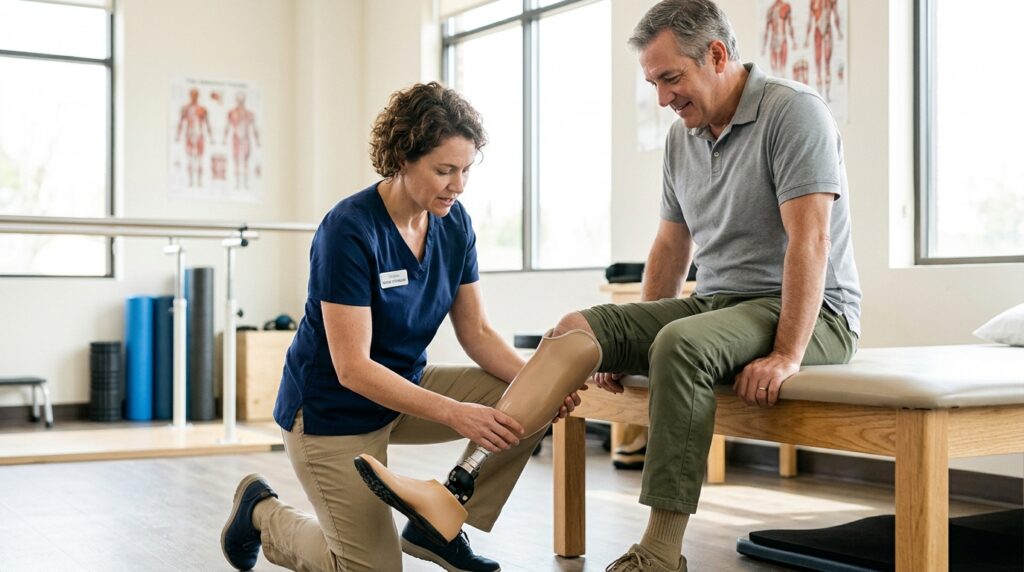
An above-knee amputation removes the natural knee, so the prosthetic must replace the knee joint as well as the lower leg. That single fact changes a lot.
Walking without your own knee takes more energy and more concentration. A prosthetic knee has to bend, support your weight, and stay stable — everything your body once did automatically. Some people rely on microprocessor-controlled knees (advanced components that adjust in real time), which cost far more than a basic mechanical knee and still need periodic replacement.
The broader effects often include:
- Balance — standing and shifting weight demand more control.
- Stairs and slopes — harder, and requiring practice.
- Long distances — fatigue sets in sooner.
Higher levels usually mean longer, more intensive rehabilitation. This is not about willpower — it’s about anatomy. Losing the knee removes a joint your whole body depended on.
Above-Knee vs. Below-Knee: Side-by-Side
The core difference is the knee: below-knee keeps it, above-knee loses it, and that shapes prosthetics, energy, and mobility.
| Factor | Below-knee (transtibial) | Above-knee (transfemoral) |
|---|---|---|
| Natural knee | Preserved | Lost |
| Prosthetic | Replaces lower leg/foot | Must also replace the knee joint |
| Energy to walk | Generally lower | Generally higher |
| Balance & stairs | Often easier | Often harder |
| Rehabilitation | Usually shorter | Usually longer, more intensive |
| Lifetime care & cost | Significant | Generally greater |
Individual results vary widely. Age, overall health, and the cause of the injury all matter — two people at the same level can have very different outcomes. Still, one pattern holds: a higher amputation level generally means greater lifetime care and cost. That’s not a judgment; it’s a practical reality families must plan for.
Have questions about what happened?
Ask our team directly. The first conversation is free, confidential, and there is no obligation to continue.
A Note on Arm and Hand (Upper-Limb) Levels
Upper-limb amputations follow their own ladder, from partial finger up to the shoulder, and some people lose more than one limb, as Arm Dynamics describes.
- Below-elbow (transradial) — the elbow is preserved.
- Above-elbow (transhumeral) — the elbow is lost.
- Shoulder-level (shoulder disarticulation) — the highest level.
Hands do fine, precise tasks — gripping, typing, holding a child. Prosthetic hands and arms work very differently from prosthetic legs, and adapting is its own journey. If your loss is upper-limb, a case evaluation can help you understand your specific needs.
Why the Level Matters to a Catastrophic-Injury Claim
This is the part the clinical pages leave out. The amputation level directly shapes your medical needs, prosthetics, and lifetime cost — and those are exactly what a catastrophic-injury claim seeks to recover. A higher level usually means more complex prosthetics, more frequent replacements, and more care over a lifetime.
A claim may address several categories of loss:
- Medical care — surgery, hospital stays, and ongoing treatment.
- Future prosthetic replacements — prosthetic limbs don’t last forever; components wear and must be replaced across a lifetime.
- Lost earning capacity — if the injury changes what work you can do.
- Home and vehicle modifications — ramps, controls, and accessibility.
- Pain and suffering — the human toll of a life-altering injury.
Here is the through-line: documentation turns anatomy into damages. A level like “transfemoral” means nothing to an insurer by itself. What makes it recoverable is a life-care plan — a detailed, expert-prepared projection of every future need tied to that level: replacement schedules for prosthetic components, physical therapy, socket refittings as the residual limb changes, home modifications, and medical equipment, priced over your life expectancy. Combined with your medical records and, often, an economist’s calculation of lost earning capacity, the life-care plan is what converts “above-knee” into a specific, provable future cost. The higher the level, the more line items that plan tends to carry.
That is why we ask, early, for every record — because in these cases the paper trail is the case. To see how these costs accumulate, read our resource on the lifetime cost of amputation and prosthetics.
No one can promise a specific result. Every case is evaluated on its own facts.
When a Limb Loss May Be Someone Else’s Legal Responsibility
If your limb loss came from someone else’s carelessness, that person or company may be legally responsible. Common catastrophic causes include truck crashes, dangerous machinery, and other severe accidents.
Consider a situation many people don’t realize is a claim. Say you were attacked, robbed, shot, or assaulted on someone else’s property — an apartment complex, a parking garage, a hotel, a gas station, or a store — and the property had broken gates, no working locks, dark parking lots, or no security when there should have been. If that failure helped the attack happen, the property owner may share responsibility. Lawyers call this negligent security (an inadequate-security premises claim). Learn more on our negligent security resource.
Truck crashes are another frequent cause of traumatic limb loss. Our truck accidents resource explains how fault is investigated.
There’s a difference between a traumatic amputation (the limb is lost in the accident) and a surgical amputation (doctors remove it later because of the injury). Both can support a claim — the cause is what matters.
When a catastrophic limb-loss injury is fatal, the family may have a wrongful-death claim. That is the most catastrophic outcome of all, and we handle these cases with care for the family left behind.
Two Florida rules matter here. Most negligence claims that accrued on or after March 24, 2023 must be filed within two years, under Fla. Stat. §95.11. And Florida uses modified comparative negligence: a person found more than 50% at fault generally recovers nothing, under Fla. Stat. §768.81.
Talk to a Catastrophic-Injury Attorney About Your Situation
If you or a loved one lost a limb in a serious accident, you can talk to a lawyer for free with no obligation. We serve clients in English and Spanish — because these decisions are hard enough without a language barrier.
Let someone who understands these cases explain your options in plain language. To start, request a free case evaluation. You can also explore our full amputation injuries resource and our overview of catastrophic injury claims.

Want to know where you stand?
Tell us what happened and our team will walk you through the options available to you, at no cost.
Frequently Asked Questions
What is the difference between an above-knee and below-knee amputation?
A below-knee amputation keeps the knee joint; an above-knee amputation removes it. Keeping the knee generally makes walking with a prosthetic easier and less tiring.
What do transfemoral and transtibial mean?
Transtibial is the medical term for a below-knee amputation. Transfemoral is the term for an above-knee amputation, through the thigh bone.
Why does the amputation level affect walking and prosthetics?
Higher levels remove more joints and muscle, so the body does less of the work. That generally means more energy to walk and more complex prosthetic components, as Össur explains.
How does the amputation level affect an injury claim?
The level shapes medical needs, prosthetics, and lifetime cost — the core of documented damages. A life-care plan and medical records translate the level into specific, provable future needs. Higher levels often involve greater lifetime care, but every claim depends on its own facts.
How long do I have to file a limb-loss claim in Florida?
Most negligence claims accruing on or after March 24, 2023 must be filed within two years, under Fla. Stat. §95.11. Talk to a lawyer promptly to protect your rights.
Understanding the Two Most Common Leg Amputation Levels
Below-Knee (Transtibial)
The amputation occurs on the shin, below the knee joint — and the knee is preserved. Because the natural knee remains, many people find walking with a prosthetic easier and less physically demanding.
Above-Knee (Transfemoral)
The amputation occurs through the thigh, removing the knee joint. Learning to walk again often requires more energy and rehabilitation, since a prosthetic knee must do the work a natural joint once did.
Why the Level Matters
The level of amputation shapes prosthetic options, rehabilitation, mobility, and long-term care needs. It directly affects the true, lifelong cost of the injury — something an accurate claim must account for.
The Terms You May Hear
Doctors often use medical language: 'transtibial' means below-knee and 'transfemoral' means above-knee. These are simply clinical labels for the same everyday distinction.
Future Costs Are Easy to Undervalue
Prosthetics wear out and must be replaced over a lifetime, and rehabilitation and care needs can grow over time. A settlement that only covers today's bills can leave families short. Before accepting any offer, make sure the full lifelong cost of limb loss has been calculated.
When Someone Else's Negligence Caused the Loss
Truck & Serious Crash Injuries
Crushing forces in large-truck and high-impact collisions can lead to traumatic or surgical amputation.
Negligent Security
If you were shot or violently attacked on a property that failed to provide reasonable security — and lost a limb as a result — the property owner may be responsible.
Full-Life Impact
We look beyond medical bills to lost income, home modifications, prosthetic replacement, and the daily reality of living with limb loss.
For Families, Too
When a catastrophic injury or fatal outcome affects a whole family, we help you understand what comes next with compassion and clarity.
Facing life after limb loss? Let us help you understand your options.
Related practice areas
- Amputation & Limb Loss Injury Claims: A Complete Guide for Victims and Families