


Amputation & Limb Loss Injuries
Amputation Recovery and Rehabilitation: What to Expect
Losing a limb changes your life in an instant. Here is a plain-language look at the healing, rehabilitation, and long-term needs ahead — and how a legal claim can help pay for them.
By CHG Lawyers · Published August 01, 2026
What to Expect During Recovery and Rehabilitation After an Amputation
Amputation recovery happens in stages. Most people underestimate how long the whole journey takes.
Wound healing takes weeks. Learning to move again with a prosthesis takes months. Rebuilding your life takes years. That means your work, driving, sleep, and sense of self.
This page follows that journey in four stages. They are immediate post-surgical care, early rehabilitation, prosthetic fitting, and long-term adjustment.
Then it does something most medical pages skip. It shows the legal and financial planning that runs beside each stage. A prosthesis wears out. You will replace it every few years for life. That is not a one-time cost. And when someone else’s carelessness caused the injury, you should not carry that bill alone.
This is general educational information, not medical advice. Your surgical and rehab team directs your care.
If your amputation resulted from someone else's carelessness, we're here to talk. Talk it through with our team — the first consultation is free, confidential, and carries no obligation.
The four stages at a glance
| Stage | Typical timing | Medical focus | Parallel legal/financial task |
|---|---|---|---|
| Immediate post-surgical | Days 0–~6 weeks | Wound healing, pain control, limb shaping | Preserve evidence; document everything |
| Early rehabilitation | ~2 weeks–several months | PT/OT, strength, balance, “pre-prosthetic” work | Track costs; identify at-fault parties |
| Prosthetic fitting | Once healed, often 6 weeks–3+ months | Socket casting, gait training | Build the lifetime-cost picture |
| Long-term adjustment | Ongoing, for life | Device replacement, mental health, return to life | Value future care; watch legal deadlines |
Timelines vary a lot. A below-knee (transtibial) amputation often heals faster than an above-knee (transfemoral) one. Recovery from arm loss differs from recovery from leg loss.
Your age, your circulation, and other injuries from the same accident all affect the timeline. So do complications. Setbacks happen. A wound may heal slowly. A fitting may be delayed. These are part of the process, not proof it has failed.
Stage 1: Immediate post-surgical recovery (days to about six weeks)
In the first days, the team focuses on healing the wound and controlling pain. They also work to prevent problems like infection and blood clots. Nurses control swelling with compression. They also keep the limb raised.
Limb shaping starts now. The team often uses an elastic shrinker or a firm dressing. A well-shaped residual limb fits a socket better later. Early movement and positioning also prevent contractures. A contracture is joint stiffness. It can permanently limit what a prosthesis can do.
The emotional weight lands here, too. Shock and grief are normal in week one. Mental-health support belongs at the start, not months later. Ask for it.
What to do on the legal side, right now. Evidence disappears fastest in the first weeks. Say a truck crash caused the injury. The truck’s electronic control module and the driver’s logs can be erased. A lawyer can send a spoliation letter to stop that. A spoliation letter is a formal request to save this evidence.
Maybe the injury happened during a violent attack. Perhaps it was on someone else’s property. Think of an apartment complex, parking garage, hotel, or store. Maybe that place failed to provide working locks, lighting, cameras, or security. If so, note that security footage is often erased on a 30-to-90-day loop.
Ask a family member to help. Have them photograph the scene and save every bill. Have them keep a simple notebook of dates and symptoms. This record later proves the true cost.
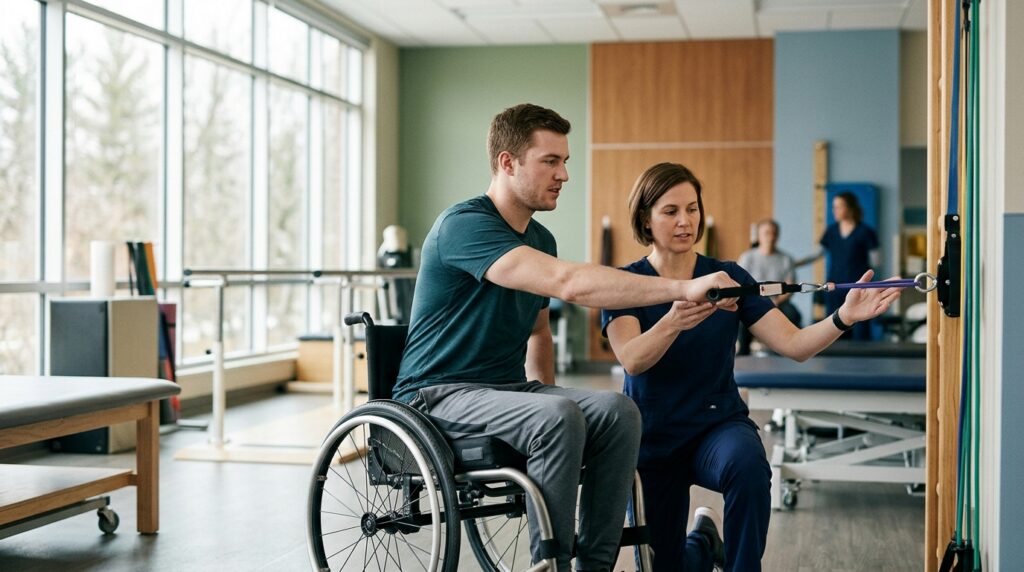
Stage 2: Early rehabilitation (physical and occupational therapy)
Rehab often begins in the hospital within days. It then continues in an inpatient or outpatient program. Two types of therapy carry it.
Physical therapy (PT) rebuilds the body’s mechanics. That means core strength, balance, endurance, and safe transfers. Transfers are moves like bed to chair, or chair to standing. For lower-limb amputees, PT sets the stage for walking practice later.
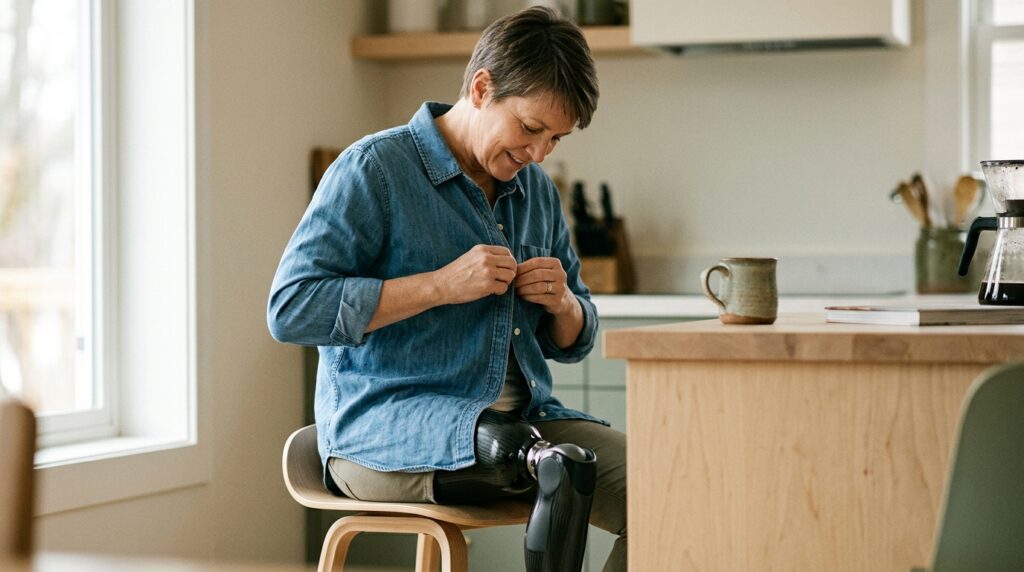
Occupational therapy (OT) rebuilds daily life. That means dressing, cooking, and bathing. For upper-limb amputees, OT is the center of recovery and independence.
You won’t do this alone. A typical team includes:
- A physiatrist—a doctor in physical medicine and rehabilitation (PM&R)—who leads the plan.
- Physical and occupational therapists.
- A prosthetist, who designs and fits the device.
- Nurses and mental-health providers.
Knowing who does what helps you speak up. Maybe no one has addressed your mental health. That is a gap you can name and ask to fill.
Phantom limb pain is real and treatable. Two things are common. Phantom limb sensation is feeling the limb is still there. Phantom limb pain is pain that seems to come from the missing part. These happen because the nervous system is reorganizing. They are not imagined.
Teams treat them with medication, desensitization, and nerve-directed treatments. They also use mirror therapy. Mirror therapy uses a mirror reflection of the intact limb. This helps the brain “see” the missing limb move. Report pain early and clearly. Pain that goes unspoken goes untreated.
On the legal side: now is the time to find out who is responsible. Early rehab reveals how big the loss really is. In our attorneys’ catastrophic cases, an amputation rarely comes alone. The same truck crash or attack often brings burns, a traumatic brain injury, or a spinal cord injury. Each added injury lengthens recovery and raises the cost. Each may point to a different responsible party.
How long does it take to heal from an amputated leg?
Surgical wounds from a leg amputation usually close over about four to eight weeks. Full functional recovery—walking with a prosthesis—commonly takes six months or more.
Things that lengthen the timeline:
- Infection at the surgical site.
- Poor circulation, which slows healing.
- Revision surgery to reshape the limb.
- Other injuries from the same accident.
Stage 3: Getting fitted for a prosthesis
Fitting usually begins once the residual limb has healed and the swelling has settled. This is often several weeks to a few months after surgery.
The prosthetist casts or scans the limb and builds a socket. The socket is the piece that connects your body to the device. Early sockets almost always need adjustment. The limb keeps changing shape (“shrinking”) as it heals. So the fit changes too. Many patients use a temporary (preparatory) prosthesis before a permanent one.
Once the device fits, gait training begins for leg amputees. This means standing, weight-shifting, and walking, in small repeated steps.
Here is the fact medical pages gloss over: prosthetics wear out. They are not lifetime devices. It depends on your activity level and parts. But many need replacement about every three to five years. Children need new devices as they grow.
The U.S. Government Accountability Office studied this. In report GAO-10-905, it found that advanced prosthetic limbs can cost from several thousand dollars to more than $50,000 each. That expense repeats across a lifetime. This recurring cost is the single most important number to get right in an injury claim. That is why you build the lifetime-cost picture at this stage, not after.
Not sure what your next step is?
Talk it through with our team — the first consultation is free, confidential, and carries no obligation.
Stage 4: Long-term adjustment—and life reopening
Emotional recovery is as real as physical recovery. Grief, anxiety, and depression after limb loss are common and valid. Counseling helps. So does peer support.
The Amputee Coalition runs a national peer-support program and a helpline (1-888-267-5669). Talking with someone who has walked this road makes the invisible parts of recovery less lonely.
Life does reopen. People return to work, driving, hobbies, and relationships. It’s rarely a straight line. It often looks different than before. That’s adaptation, not failure.
Practical changes are usually part of it. You may need home changes like ramps, grab bars, or a first-floor bedroom. You may need vehicle changes to drive again. These are real costs. They are part of the true price of the injury. That brings us to the planning most pages ignore.
The lifelong cost of amputation care—and who should pay for it
Add up what this journey really involves over a lifetime:
- Initial surgery and any revision surgeries.
- Prosthetics replaced every few years—possibly a dozen or more devices over a lifetime.
- Ongoing physical and occupational therapy.
- Home and vehicle changes.
- Lost income and reduced earning ability.
- Pain, and the loss of the life you had before.
These fall into two legal categories. Economic damages cover the costs you can measure and document. That means medical bills, future care, prosthetic replacements, and lost wages. Serious cases often use a life care plan. A rehabilitation expert prepares this document. It projects the full cost of care across the injured person’s expected lifetime.
Non-economic damages cover pain and suffering. They also cover the human loss no receipt captures. See our guide to pain and suffering and limb-loss damages.
When the injury happened on someone else’s unsafe property
Maybe you were assaulted, shot, or attacked—and hurt—on a property that failed to provide reasonable security. Think of a broken gate, a dark parking lot, no working cameras, or promised guards who weren’t there.
If so, you may have a claim against the property owner, not just the attacker. Lawyers call this negligent security. It is a type of premises-liability claim. Our page on negligent security explains how it works in plain language.
Two Florida rules that shape every claim
Florida law sets real limits, and they carry hard deadlines.
- Shared fault. Under Fla. Stat. § 768.81, Florida follows modified comparative negligence. Your recovery is reduced by your share of fault. And a person found more than 50% at fault generally cannot recover at all. (This changed in March 2023, when Florida moved from a “pure” to a “modified” system.)
- Deadline to file. Under Fla. Stat. § 95.11, most negligence claims that started on or after March 24, 2023 must be filed within two years. Miss it, and the claim is usually barred no matter how strong it was.
Deadlines and fault rules get complicated fast. This is especially true when several parties and several injuries are involved. That’s why the legal work belongs alongside the medical stages—not after.
How CHG Personal Injury Lawyers can help
If your amputation resulted from someone else’s carelessness, we’re here to talk. There is no pressure and no cost to start.
CHG Personal Injury Lawyers represents people and families facing catastrophic limb loss. We are based in Florida, and we take these cases nationwide. Our attorneys are licensed and admitted to the Florida Bar.
We can’t and don’t promise any specific result. Here is what we do. We help you understand the full lifetime cost of the injury. We help find who may be responsible. We preserve the evidence before it disappears. And we explain your options in plain language.
If the injury came from a crash, see truck accidents. For the bigger picture, see catastrophic injury claims.
Ready to talk? Request a free case evaluation.
Frequently asked questions
How long does it take to heal from an amputated leg?
Surgical wounds usually close in about four to eight weeks. But learning to walk again with a prosthesis often takes six months or more. It depends on the level of amputation and any complications.
How painful is losing a limb?
It is painful at the surgical site. Many people also feel phantom limb pain from the missing part. Medication, desensitization, nerve treatments, and mirror therapy can manage it. Report pain early and clearly.
When can I get fitted for a prosthesis?
Usually once the residual limb has healed and the swelling has settled. This is often several weeks to a few months after surgery. Early sockets need frequent adjustment as the limb changes shape.
How much does a prosthetic limb cost over a lifetime?
Advanced prosthetic limbs can range from a few thousand dollars to more than $50,000 each (GAO-10-905). Because devices wear out every few years, the lifetime cost is far higher. A life care plan helps project the full amount.
Can I recover the cost of prosthetics and future care if someone else caused my accident?
If another party’s carelessness caused your amputation, you may be able to recover economic costs like future prosthetics. You may also recover non-economic damages like pain and suffering. Every case is different.
How long do I have to file an injury claim in Florida?
Under Fla. Stat. § 95.11, most negligence claims starting on or after March 24, 2023 must be filed within two years. Ask a lawyer promptly, because evidence and deadlines both run out.
Have questions about what happened?
Ask our team directly. The first conversation is free, confidential, and there is no obligation to continue.
Related resources
- Amputation and limb-loss injury claims (pillar)
- Who is liable for an amputation injury?
- Steps to take after a loved one’s amputation
- Pain and suffering and limb-loss damages
The costs of limb loss last a lifetime
Prosthetic devices wear out and must be replaced every few years, and lifetime care can reach into the millions. If someone else's negligence caused your injury, don't accept an early settlement before you understand the full, long-term cost of your recovery.
What Recovery Often Involves
Surgical Healing
Surgical wounds usually close in about four to eight weeks, though timelines vary with the level of amputation and any complications.
Pain Management
Many people feel pain at the surgical site and phantom limb pain in the missing limb. A care team can help manage both as you heal.
Prosthetics & Mobility
Being fitted for and learning to use a prosthesis takes time. Learning to walk again with a leg prosthesis often takes six months or more.
Rehabilitation & Support
Physical therapy, occupational therapy, home modifications, and emotional support all play a role in rebuilding daily independence.
How CHG Personal Injury Lawyers Can Help
Focused on catastrophic injuries
We concentrate on life-altering harm — amputation and limb loss, spinal cord injuries, brain injuries, severe burns, and more.
Building the full picture of your future needs
We work to document lifetime costs, from prosthetic replacements to therapy, so a claim reflects what your recovery truly requires.
Licensed Florida attorneys
Our attorneys are admitted to the Florida Bar and handle catastrophic injury cases across Florida and nationwide.
Bilingual, plain-language guidance
We explain your options clearly in English and Spanish, so you and your family understand every step.