

Severe Burn Injuries
Skin Graft Surgery for Burns: What to Expect
If you or someone you love is facing skin graft surgery after a severe burn, understanding the process can ease some of the fear. Here is a plain-language look at what happens, how healing works, and where a claim may fit in.
By CHG Lawyers · Published July 31, 2026
Skin Graft Surgery for Severe Burns: Timing, Types, Recovery, and Your Rights
A skin graft is surgery in which a surgeon takes healthy skin from one part of your body and places it over a deep burn that can no longer heal on its own. For deep burns, it is the standard way to close the wound, block infection, and begin recovery.
Most of the top pages you’ll find on this topic are written for parents of injured children or read like a surgical checklist. This guide is written for the injured adult and the family standing beside them — the people making hard decisions in a burn unit, worrying about work, and wondering what the next year looks like. It answers the questions people actually search for, in plain language, and it explains what to do if someone else caused the burn.
This article is educational. It is not medical or legal advice.
Not sure what your next step is?
Talk it through with our team — the first consultation is free, confidential, and carries no obligation.
What is a skin graft?
A skin graft is the transfer of healthy skin to cover a burn wound that can no longer heal by itself. The surgeon takes skin from a healthy area (the donor site) and attaches it to the cleaned burn site (Cleveland Clinic).
Deep burns destroy the skin’s ability to regrow. Your skin protects you from germs and holds in fluid and body heat. When a burn reaches the deeper layer (the dermis), the body cannot rebuild that barrier on its own. Grafting closes the wound quickly, which speeds healing, guards against infection, and helps your body hold in heat and fluid (Children’s Mercy).
This is a well-established, everyday part of severe-burn care. It is not experimental.
What kind of burn requires a skin graft?
Deep partial-thickness (deep second-degree), full-thickness (third-degree), and fourth-degree burns usually need a skin graft. Shallow burns often heal on their own.
Burn depth matters most:
- Superficial and superficial partial-thickness burns damage the top layers and tend to heal naturally.
- Deep burns destroy the dermis your skin needs to regrow. Once that layer is gone, grafting is often the only way to close the wound.
Two other factors drive the decision:
- Size. Doctors measure a burn as a percentage of your total body surface area (TBSA). Larger burns are more likely to need grafting.
- Location. Burns on the hands, face, feet, or over joints often need grafts to protect movement and appearance, even when they aren’t large.
Here’s something many families don’t expect: burns can look worse over the first few days. Surgeons often wait and reassess because a wound “declares” its true depth over 48–72 hours. A burn that looked survivable without surgery can convert to a deeper injury that needs grafting. So the plan can change.
Different causes damage skin differently. To understand how they compare, see our guide on chemical, electrical, and thermal burn injury claims.
How long after a burn can a skin graft be done?
A skin graft is done once the wound is stable, free of infection, and has healthy tissue to receive the new skin. There is no single deadline — timing depends on the burn.
First comes debridement: removing dead or damaged tissue so the graft can attach and survive (StatPearls, NCBI Bookshelf). A graft cannot take hold on dead or infected tissue.
From there, burn teams generally follow one of two approaches:
- Early excision and grafting — removing dead tissue and placing grafts within days of the injury. For many large or deep burns, this has become the preferred strategy because it lowers infection risk and shortens hospitalization.
- Delayed grafting — waiting for the wound to settle and declare its depth before operating.
Both are valid. Your burn team makes the call based on your specific wound, your overall health, and infection risk.
Very large burns often can’t be covered in one operation. There simply isn’t enough healthy donor skin available at once, and the donor site needs time to heal before it can be reused. In these cases, surgeons plan several grafting operations over weeks or months. That staging is one reason severe burns are so hard on patients and families — and one reason the true cost stretches far beyond the first surgery.
Types of skin grafts used for burns
The two main types are split-thickness and full-thickness grafts. Both typically use the patient’s own skin — an autograft — which is the standard for permanent coverage (StatPearls, NCBI Bookshelf).
Split-thickness skin graft (STSG)
Takes the top layer of skin plus part of the dermis. Used to cover larger areas. Surgeons can mesh the graft — cutting tiny slits so it stretches to cover more surface and lets fluid drain. Meshed grafts often heal with a net-like pattern.
Full-thickness skin graft (FTSG)
Takes the top layer and the entire dermis. Used for smaller areas that need better function and appearance, such as the hands or face. It tends to give a smoother, more natural result but covers less area.
Temporary coverings
When a wound needs protection before the patient’s own skin is ready, surgeons may use temporary coverings — donor skin from a tissue bank (allograft) or biologic and synthetic dressings. These buy time and protect the wound until permanent autografting.
The donor site — a second wound
The donor site is where the healthy skin is taken from. It becomes a wound of its own that must heal (North Bristol NHS Trust). Many patients tell their teams the donor site is one of the sorest spots during recovery. It is a real second wound, not just a “harvest,” and it deserves the same attention as the graft.
Have questions about what happened?
Ask our team directly. The first conversation is free, confidential, and there is no obligation to continue.
How skin graft surgery is performed
Skin graft surgery follows a clear sequence under anesthesia:
- Anesthesia. You’re asleep and won’t feel the surgery.
- Preparing the wound. The surgeon cleans and excises the burn, removing dead tissue so the graft can attach.
- Harvesting the graft. Healthy skin is taken from the donor site.
- Placing the graft. The new skin is laid over the wound and secured with staples, sutures, or specialized dressings (Cleveland Clinic).
After surgery, the graft needs to “take.” Over the first several days, tiny new blood vessels grow up into the graft from the wound bed below. That new blood supply is what keeps the graft alive — which is exactly why the area is kept still early on.
How long is the hospital stay after a skin graft for burns?
There is no fixed length of stay. It depends on burn size, depth, location, whether more than one operation is planned, and whether complications arise. A small, localized graft may involve a short stay or even outpatient care. Extensive burns can mean weeks in a burn unit — sometimes longer when multiple staged grafting operations are needed.
A widely cited rule of thumb among burn clinicians is roughly one day of hospitalization per one percent of TBSA burned, though this is only a general estimate and real stays vary widely with the patient’s age, health, and course of healing. What lengthens a stay:
- Multiple staged surgeries for large burns.
- Infection or a graft that fails and must be repeated.
- Inhalation injury or other complications requiring intensive care.
- Rehabilitation needs before it’s safe to go home.
Ask your burn team for a plan specific to your injury — it’s the most reliable answer you’ll get.
Recovering from skin graft surgery
Recovery ranges from a few days to several weeks or longer for extensive burns. Every burn is different.
Early on, the grafted area is kept still so the new skin can attach. Expect dressing changes, pain medicine, and close monitoring to confirm the graft is taking. Moving too soon can shift or shear a fresh graft.
Both the graft and the donor site heal over time. The donor site usually heals within about two weeks, though timelines vary. The graft continues to settle and strengthen over weeks and months.
Recovery is far more than the surgery itself. Most patients need:
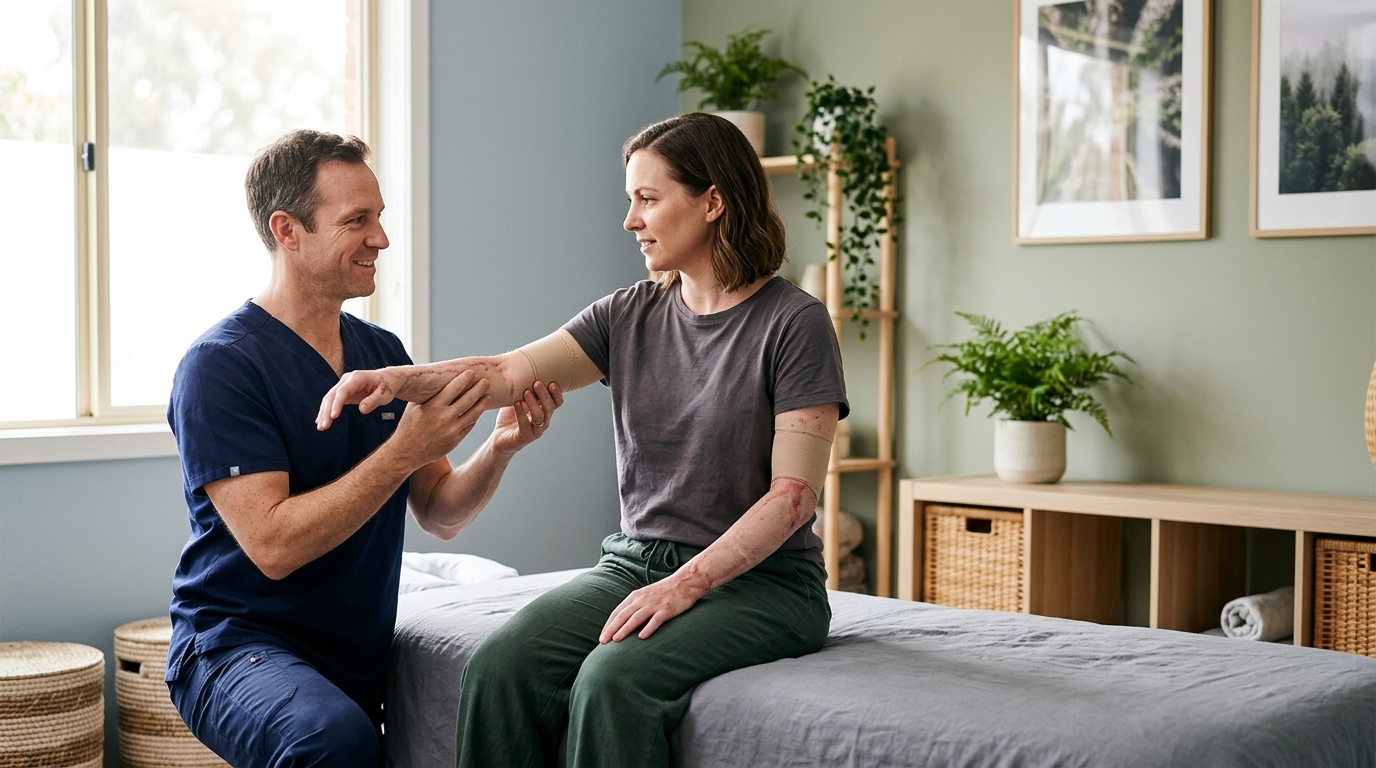
- Physical and occupational therapy to keep joints moving and rebuild function.
- Scar management, including pressure/compression garments to help flatten and soften scars.
- Range-of-motion work so tight, healing skin doesn’t restrict movement (a contracture).
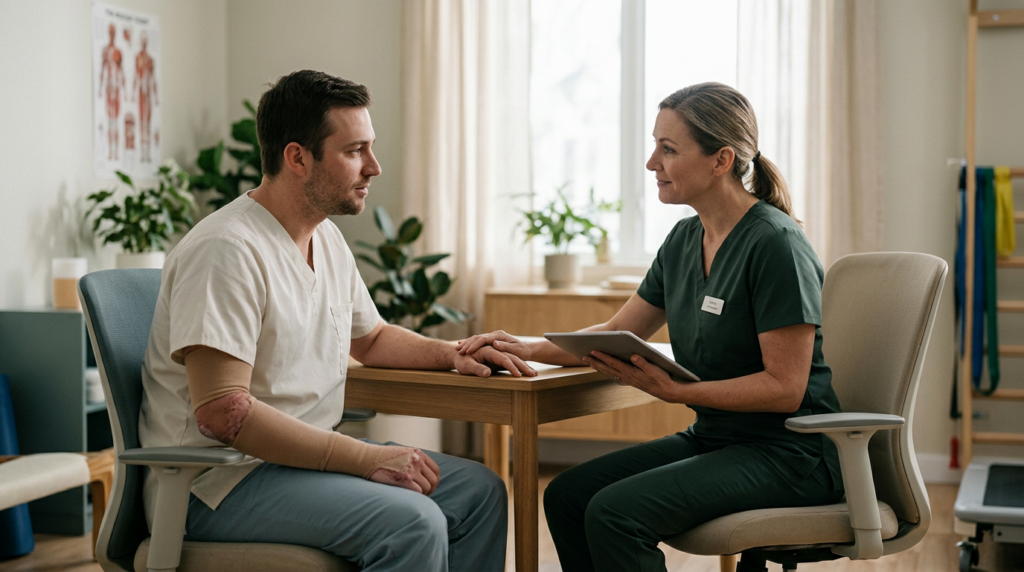
Emotional recovery matters, too. A severe burn changes how you look, feel, and move. Anxiety, grief, and depression are common. Mental-health support is a legitimate part of healing — not a sign of weakness.
What is the success rate of skin grafts for burns?
Skin grafts generally have a high take rate when the wound is clean, has good blood supply, and stays still while it heals. But outcomes depend on many factors, and no ethical source promises a specific result for any one person.
What affects whether a graft succeeds:
- Infection, which can destroy a new graft.
- Movement or shear, which can shift the graft before it attaches.
- Blood supply to the wound bed.
- Fluid collection (a hematoma or seroma) lifting the graft off the bed.
- Burn size and the patient’s overall health, age, and nutrition.
If a graft only partly takes, or fails, surgeons may need to repeat the operation. This is one more reason severe burns often mean several surgeries. Treat this as general clinical information — not a prediction for your case.
Want to know where you stand?
Tell us what happened and our team will walk you through the options available to you, at no cost.
Life after severe burns and skin grafts
Life after a severe burn often includes permanent scarring, changes in sensation, and sometimes reduced function. Many survivors become more sensitive to heat, cold, and sunlight in grafted areas and need to protect that skin for life.
Care frequently continues for years. Survivors may need reconstructive surgeries, scar revision, laser treatment, and ongoing therapy. Skin grafting is rarely the last surgery for a catastrophic burn — it’s usually one step on a long road.
There is a social and emotional side, too. Adjusting to changes in appearance, returning to work, and rebuilding daily routines all take time and support. Healing the whole person matters as much as healing the skin.
When a severe burn happened because of someone else
Many catastrophic burns come from unsafe conditions someone else created — workplace hazards, defective products, building and apartment fires, and chemical, electrical, or crash-related injuries.
When another party’s carelessness caused the burn, the injured person or family may be able to seek compensation for medical bills, future surgeries, lost income, and the pain of the injury. Because grafting is rarely the final surgery, the true lifetime cost of severe-burn care can be enormous — and it deserves to be counted fully.
To go deeper, see our guides on the common causes of catastrophic burn injuries and the lifetime cost of a severe burn injury.
Two Florida legal points matter if this happened here:
- Deadline to file. For most negligence claims with a cause of action arising on or after March 24, 2023, the deadline is generally two years (Fla. Stat. § 95.11). Deadlines differ by case type, so confirm yours.
- Shared fault. Florida uses a modified comparative negligence rule: a person found more than 50% at fault generally cannot recover damages (Fla. Stat. § 768.81).
If you’re unsure where you stand, you can talk with our licensed, Florida Bar–admitted attorneys in a free case evaluation. No pressure and no guaranteed outcome — just clear answers about your options.

Frequently asked questions
How long does a skin graft take to heal?
A donor site often heals within about two weeks, while the graft itself continues settling and strengthening over weeks to months. Timelines vary by person and burn size.
Is skin graft surgery painful?
The surgery is done under anesthesia, so you won’t feel it, and medication helps manage pain afterward. Many patients find the donor site is the sorest area during recovery.
Will the graft look like normal skin?
A graft usually differs in color and texture from surrounding skin and may leave scarring. Scar management — compression garments, laser treatment, and reconstructive care — can improve appearance over time.
How many surgeries might a severe burn require?
Severe burns often need several staged operations over weeks or months, plus reconstructive procedures for years afterward. One skin graft is rarely the end of treatment.
Where can I learn more?
Read our main guide on severe burn injuries for a fuller picture of causes, care, and legal options after a catastrophic burn.
The Skin Graft Process, Step by Step
Preparing the Wound
Before a graft, the burned area is cleaned and dead tissue is removed so healthy skin has a stable surface to attach to. This step is critical to giving the graft the best chance to take.
Taking the Donor Skin
Healthy skin is taken from another part of the body, often the thigh or back. This spot is called the donor site, and it becomes a wound of its own that needs care while it heals.
Placing the Graft
The surgeon secures the new skin over the burn. Surgery is done under anesthesia, so you won't feel it, and medication helps manage pain afterward as the area settles.
Healing and Follow-Up
A donor site often heals within about two weeks, while the graft strengthens over weeks to months. Timelines vary by person and burn size, and some patients need more than one procedure.
Severe Burns Often Mean More Than One Surgery
Catastrophic burns can require multiple grafts, scar-revision procedures, physical therapy, and long-term care. Keep every medical record and bill. These documents help show the full, lasting cost of your injury if someone else's negligence caused it.
How CHG Personal Injury Lawyers Can Help
We Focus on Life-Altering Injuries
Severe burns, spinal cord injuries, traumatic brain injuries, and amputations demand experienced advocates who understand what long-term recovery truly costs.
We Build the Full Picture
From skin grafts to future scar revisions and rehabilitation, we work to document the complete impact of a catastrophic burn on your life.
Licensed and Accountable
Our attorneys are admitted to the Florida Bar and take catastrophic injury cases nationwide.
English and Spanish
We publish clear, bilingual guidance and speak with you in the language you're most comfortable using.