

Severe Burn Injuries
Skin Graft Surgery After a Severe Burn: What to Expect
If you or someone you love suffered a serious burn, skin graft surgery is often part of the long road to recovery. Here is a plain-language look at how it works — and how the costs may be recovered when someone else's negligence caused the injury.
By CHG Lawyers · Published August 02, 2026
Skin Grafts and Reconstructive Surgery After a Severe Burn: What to Expect
Skin graft surgery moves healthy skin from one part of the body to permanently cover a deep burn that can’t heal on its own. For a severe burn, this is rarely one operation. It is usually a series of surgeries and treatments that can stretch over months or even years.
This page explains that journey in plain language, written for burn survivors and the families helping them. It covers what a graft is, when it is needed, how long healing takes, and how much it hurts — and why the first surgery is rarely the last.
This is general education, not medical advice for any one person’s care. Your burn team knows your situation best. Near the end, we explain how these ongoing costs can matter if someone else’s negligence caused the burn, and the Florida deadlines that quietly govern that decision.
Not sure what your next step is?
Talk it through with our team — the first consultation is free, confidential, and carries no obligation.
What skin graft surgery after a burn injury actually is
A skin graft transfers healthy skin from one part of the body to cover a wound that can’t heal by itself. Surgeons use it for skin damaged by burns, injuries, disease, or infection (Cleveland Clinic).
Minor burns heal on their own because the skin regenerates. Deep burns often can’t. When a burn destroys the full thickness of the skin, the body has no healthy tissue left to rebuild that spot (Regions Hospital Burn Center).
That is where grafting comes in. Surgeons harvest healthy skin from another area of the same patient and use it to close the wound. This is called an autograft, and using the patient’s own skin remains the standard of care in burn surgery (StatPearls, NIH).
For a severe burn, expect a chapter, not a single event. In the catastrophic burn cases our attorneys see, survivors often move through several procedures — with recovery and setbacks in between — before their care is complete.
When does a burn patient need a skin graft?
Burn depth drives the decision more than anything else. Superficial burns usually heal without surgery. Deep partial-thickness and full-thickness burns typically need grafting to close the wound (Frontiers for Young Minds).
Two other factors shape the plan:
- Burn size. Doctors measure the total body surface area (TBSA) the burn covers. A larger burn needs more coverage and far more planning.
- Burn location. Burns over the hands, face, and joints demand special care because they govern movement and appearance. Surgeons often prioritize these areas even when they are smaller.
The team first stabilizes the patient and studies the wound over the initial days, watching which areas will heal and which need permanent coverage. Grafting is decided only after that.
How long after a burn can a skin graft be done?
Grafts are often done within days of the injury — sometimes 1 to 5 days after the burn, or once the wound is free of dead tissue (Nationwide Children’s Hospital). The exact timing depends on the person.
Before a graft can attach, the wound must be clean. Surgeons remove dead and damaged tissue — called eschar — in a step called debridement. Healthy skin cannot attach to eschar, so it has to go first.
While the wound and patient stabilize, the team may apply temporary coverings to protect the area and lower infection risk until permanent grafting is safe. Timing ranges from days to a few weeks; infection, burn size, and the patient’s overall health all play a role.
Types of skin grafts used for burns
The two main types are split-thickness and full-thickness grafts. Both close the wound and can improve function and appearance (Pittsburgh Hand & Nerve).
Split-thickness skin grafts
A split-thickness graft takes the top layer of skin plus a little beneath it. Because it is thin, it can cover large areas — so surgeons rely on it for extensive burns. It can also be meshed (perforated and stretched) to cover more surface with less donor skin.
Full-thickness skin grafts
A full-thickness graft takes a deeper layer. It is typically used for smaller areas where appearance and movement matter most, like the face and hands, and it tends to look and function more like normal skin.
The donor site
The spot where surgeons take the healthy skin is the donor site. With a split-thickness graft, it heals much like a bad scrape — usually in about ten to fourteen days (North Bristol NHS).
When donor skin is limited
Very large burns create a hard problem: there may not be enough healthy skin left to harvest. In these cases, burn centers may use skin substitutes or lab-grown (cultured) skin to help close the wound, with autografts used whenever possible (StatPearls, NIH).
Have questions about what happened?
Ask our team directly. The first conversation is free, confidential, and there is no obligation to continue.
How skin graft surgery is performed and how the graft heals
Surgery is done under anesthesia. The graft then heals as new blood vessels grow into it — a process surgeons call the graft “taking.”
During surgery, the team prepares the wound, places the healthy skin, secures it, and covers it with dressings. The first few days are the most important: if blood vessels grow in, the graft survives and attaches. The team keeps the area still and protected, because movement can shift a graft before it takes hold, and they watch closely for infection or graft loss — either of which can mean another surgery.
The graft itself often settles over the first couple of weeks, while full maturation continues for months. The donor site usually heals in about ten to fourteen days (North Bristol NHS). Everyone heals at their own pace.
How painful is skin graft recovery?
Recovery is painful, especially early on — but pain control is a core part of good burn care, not an afterthought.
Many patients find the donor site more uncomfortable than the graft at first, because that raw area behaves like a large scrape. Both spots can itch and feel sensitive as the skin knits together. Teams manage this with medication, careful dressing changes, and treatment for itching.
The toll isn’t only physical. Long recoveries wear on people emotionally, and anxiety, low mood, and trauma are common after a severe burn. Accredited burn centers build counseling and mental-health support into treatment, because healing the mind matters as much as healing the skin.
Reconstructive surgery: why one graft is rarely the end
For a severe burn, the first grafts close the wound; later reconstructive surgery often restores movement and appearance. These are two different goals with two different timelines.
Early, acute grafting saves life and function. Later reconstruction addresses problems that surface as the skin matures. The biggest of these is scar contracture — burn scars tighten and pull, limiting joints like elbows, hands, and knees. Contracture release surgeries loosen that tissue and restore motion. Children face this repeatedly, because tight scars don’t grow with them and may require operations across years.
Reconstruction can include staged surgeries, laser treatments, and scar revisions spread across a long horizon. To understand how these scars affect daily life over the years, see our guide on the long-term impact of burn scars and disfigurement.
Rehabilitation and long-term care after grafting
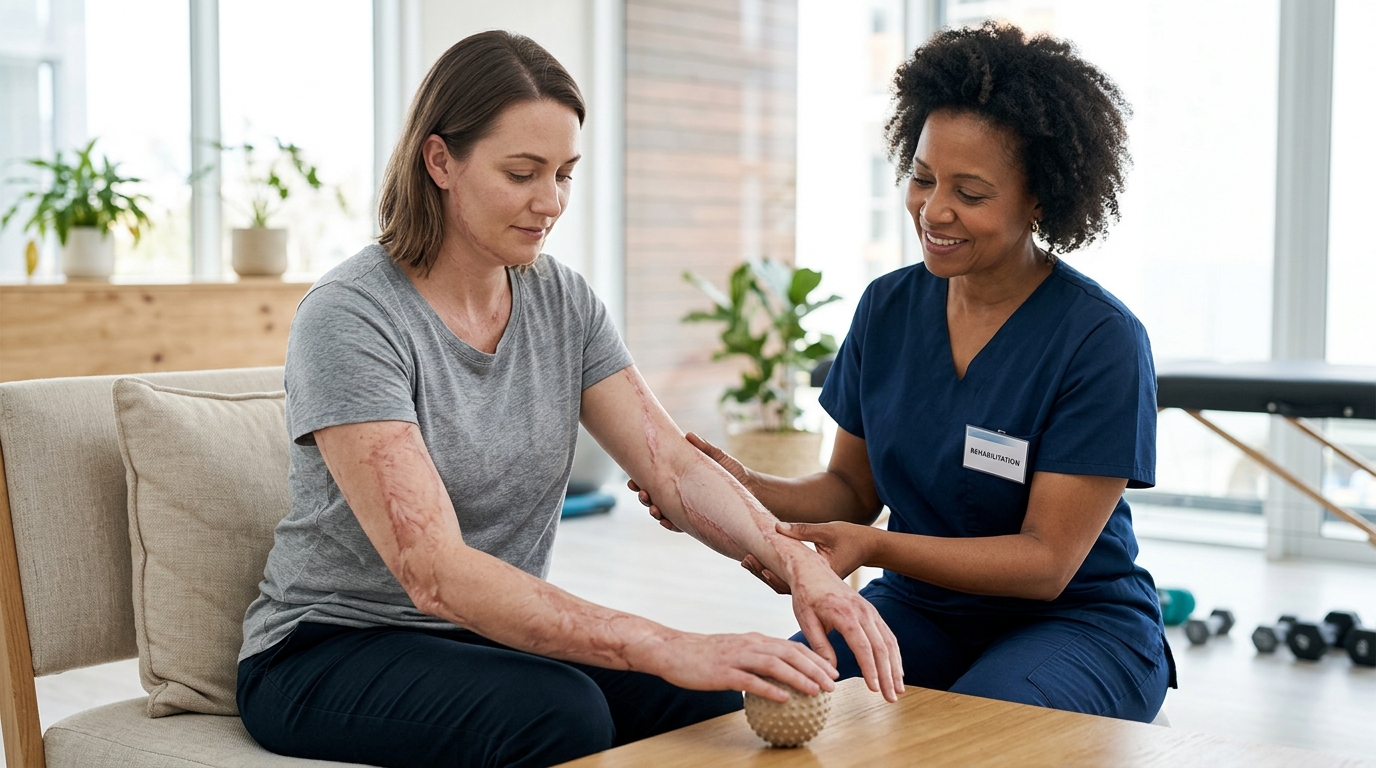
Recovery leans heavily on rehabilitation, which continues long after the surgeries end. Grafts close the wound; therapy helps a survivor use their body again.
Common parts of long-term care include:
- Physical and occupational therapy to rebuild strength and range of motion.
- Pressure garments worn — often for many months — to help flatten and soften scars.
- Splinting to hold joints in good positions while healing.
- Ongoing wound and scar care that can last months or years.
Mental-health care belongs on this list too. Living with a changed body and a long recovery affects mood, relationships, and confidence. Support and counseling are part of quality burn care, not extras.
The honest reality is that a severe burn is often a lifetime-of-care situation, not a single event you recover from and forget. Planning for that future matters.
Want to know where you stand?
Tell us what happened and our team will walk you through the options available to you, at no cost.
The true cost of grafts and reconstruction after someone else’s negligence
The lifetime cost of grafts and reconstruction can be enormous. Repeated surgeries, therapy, pressure garments, medications, travel to specialized burn centers, and lost income all accumulate. Families often focus only on bills already paid — but future, anticipated surgeries and reconstruction can also be documented and valued by a claim, not just past expenses.
Many severe burns trace back to another party’s failure to act safely: a truck crash, a defective product, a fire, or an explosion. Some happen when a violent attack occurs on a property the owner failed to secure — poor lighting, broken locks or gates, no working cameras or guards — and someone is burned in an assault the owner should have guarded against. In plain terms, if you were hurt on someone else’s property because it wasn’t kept reasonably safe, you may have a claim against that owner. Lawyers call this negligent security (a form of premises liability).
Two Florida rules shape whether and when you can act:
- The deadline to file. For most negligence claims accruing on or after March 24, 2023, the statute of limitations is two years (Fla. Stat. § 95.11). Miss it, and the claim can be lost regardless of how serious the burn is.
- Shared fault. Florida follows modified comparative negligence — your recovery is reduced by your share of fault, and a person found more than 50% at fault generally recovers nothing (Fla. Stat. § 768.81).
No honest firm can promise a specific result, and we don’t. But CHG Personal Injury Lawyers’ Florida-licensed attorneys handle catastrophic burn cases nationwide and can explain your options at no cost. You can request a free case evaluation.
Frequently asked questions
Can burn victims always get a skin graft?
Not always. It depends on burn depth, size, and the patient’s overall health. Very large burns may require skin substitutes or cultured skin when donor skin is limited.
How long after a burn is a skin graft done?
Often within days — sometimes 1 to 5 days after the injury, or once the wound is free of dead tissue (Nationwide Children’s).
Is skin graft recovery painful?
Yes, especially at the donor site early on — but burn teams manage pain with medication, careful dressing changes, and treatment for itching.
Will I need more than one surgery?
Often, yes. Severe burns usually involve staged surgeries: early grafts to close the wound, then later reconstruction to restore movement and appearance.
Should I keep records of all my surgeries?
Yes. Detailed records of every procedure, therapy, and cost help document future medical needs — which matters if you pursue a claim after someone else’s negligence, and given Florida’s two-year filing deadline, sooner is better than later.
Common Questions About Skin Grafts
Can every burn victim get a skin graft?
Not always. Whether a graft is possible depends on the burn's depth and size and the patient's overall health. When a burn is very large and donor skin is limited, doctors may turn to skin substitutes or cultured skin instead.
How soon after a burn is a graft done?
Grafting often happens within days of the injury — sometimes within one to five days — or once the wound is clear of dead tissue and ready to heal. The exact timing is a medical decision made by the burn care team.
What is recovery like?
Healing from a severe burn and its grafts can take months and may involve multiple surgeries, pain management, physical therapy, and treatment for scarring. Many survivors face permanent impairment and lasting effects.
Who pays for all of this?
When a burn was caused by someone else's negligence — an unsafe property, a defective product, or a serious crash — the responsible party may be accountable for medical bills, lost income, and the harm you have suffered.
Keep Your Medical Records
Every surgery, follow-up, and therapy session documents the true cost of a catastrophic burn. Hold on to bills, discharge papers, and photographs — they can matter a great deal if you decide to pursue a claim. Speak with an attorney before accepting any settlement.
How CHG Personal Injury Lawyers Can Help
We focus on catastrophic injuries
Severe burns are life-altering. We represent survivors and families dealing with permanent scarring, impairment, and long-term care needs.
We build the full picture of your losses
From grafts and future surgeries to lost income and pain, we work to account for the true, long-term cost of your injury.
Licensed, Florida Bar–admitted attorneys
Our lawyers are licensed to practice and handle serious injury cases in Florida and nationwide.
Bilingual support
We provide guidance in English and Spanish so you and your family understand every step.