

Truck Accidents
Why Truck Accident Injuries Are So Catastrophic
The physics of a collision between a car and a commercial truck explain why these crashes cause life-altering harm.
By CHG Lawyers · Published August 21, 2026
Why Truck Accident Injuries Are So Severe
A fully loaded commercial truck weighs up to 80,000 pounds. A typical passenger car weighs around 4,000 pounds. When these two vehicles collide, the car and its occupants absorb almost all the force. That’s why truck accident injuries are so often catastrophic and life-altering.
This page explains the physics behind severe truck accident injuries, the crash types that cause the worst harm, and the permanent injuries that follow. These are not minor bumps or bruises—they are spinal cord injuries, brain damage, amputations, and death.
If you or someone you love was hurt in a crash with a semi, 18-wheeler, or other large truck, you deserve clear answers. Our attorneys handle catastrophic truck accident injuries in Florida and nationwide. For the full overview, see our truck accident resource.
Not sure what your next step is?
Talk it through with our team — the first consultation is free, confidential, and carries no obligation.
Why Truck Accident Injuries Happen: The Physics
Size, weight, and speed multiply the force in a crash. A car simply isn’t built to survive that impact.
Force builds from mass and speed. A heavier object moving at highway speed carries enormous energy. When that energy transfers into a smaller vehicle, it crushes the car’s frame and throws occupants violently.
Three factors make truck accident injuries worse than ordinary car crashes:
- Weight mismatch. An 80,000-pound truck against a 4,000-pound car is not a fair fight. The car absorbs most of the force.
- Longer stopping distance. Loaded trucks need much more room to brake. When a truck can’t stop in time, it often hits at higher speed.
- Height mismatch. A truck’s frame sits high off the road. It can strike above a car’s crumple zones and airbags—the parts designed to protect you.
In 2024, 5,218 large trucks were involved in fatal crashes, according to the National Safety Council Injury Facts. That’s about a 30% increase over the last 10 years.
Do You Survive Better in a Bigger Vehicle?
Yes. Occupants of the larger, heavier vehicle generally fare better. People in the smaller vehicle absorb most of the force.
This is basic physics. The heavier vehicle pushes through the crash. The lighter vehicle stops suddenly and takes the impact. That’s why passenger-car occupants in truck accident injuries suffer far more severe and often fatal outcomes.
A “minor-looking” crash can still be catastrophic for the person in the car. The truck may drive away with a scratch. The car may be destroyed with someone trapped inside.
Crash Types That Cause the Worst Truck Accident Injuries
Certain truck crash types cause catastrophic harm because they strike the passenger compartment or crush the smaller vehicle.
Underride Crashes
An underride crash happens when a car slides beneath the truck’s trailer. The trailer can shear off the top of the car and strike the passenger compartment directly. These crashes cause severe head and neck injuries and are often fatal. Missing or defective underride guards make them far worse.
Jackknife Accidents
A jackknife happens when the trailer swings out at a sharp angle. The trailer can sweep across several lanes and crush anything in its path.
Rollovers
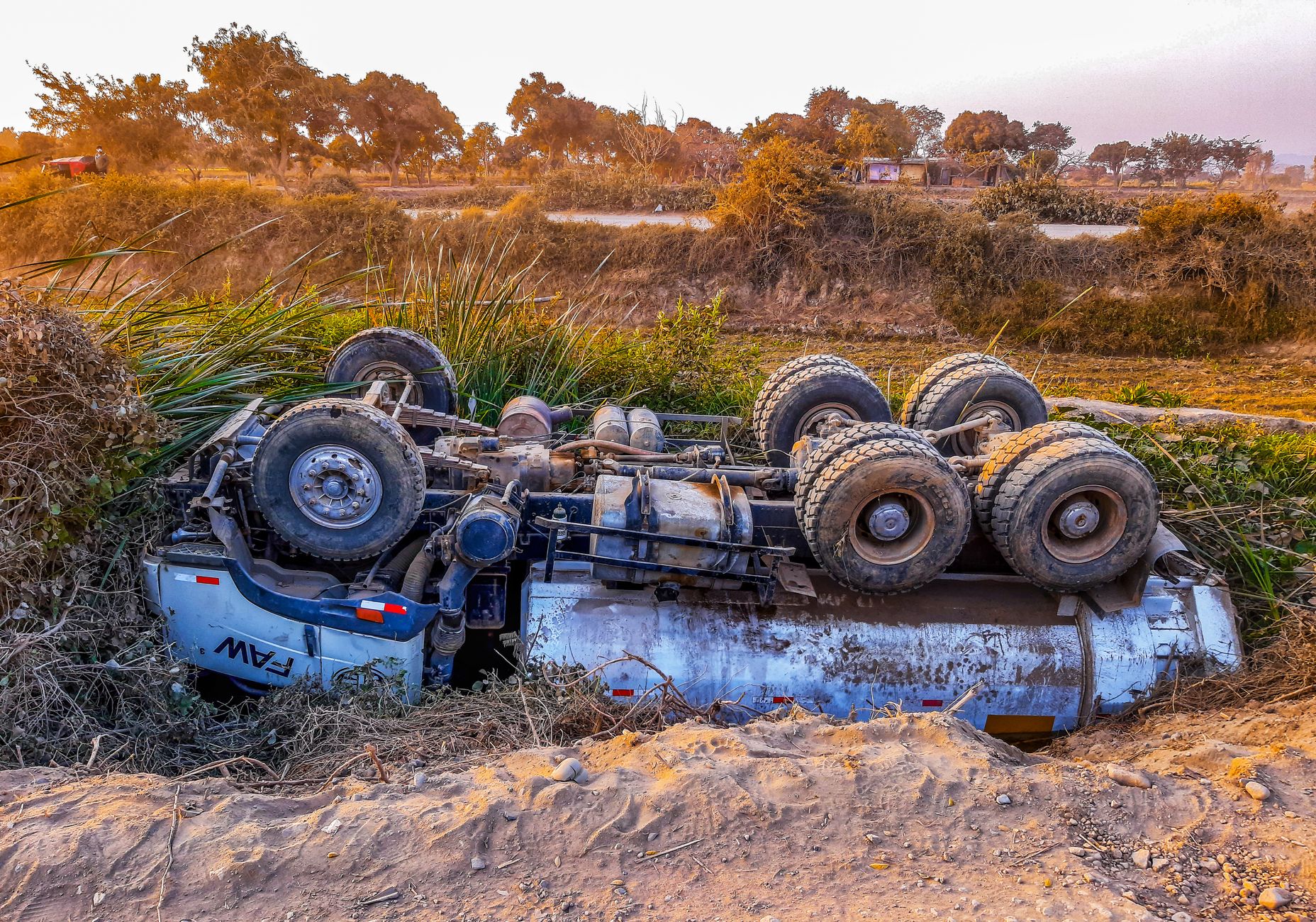
A loaded trailer can tip over onto smaller vehicles. The weight and height make a rollover especially deadly for nearby cars.
Rear-End and Override Crashes
Trucks need so much room to stop that they can slam into stopped or slowing traffic. In an override crash, the truck rides up over the smaller vehicle instead of stopping behind it. Both cause crushing, high-force injuries.
Safety failures often make these crashes worse. Poorly secured cargo, worn brakes, and missing guards can turn a survivable event into a fatal one.
Have questions about what happened?
Ask our team directly. The first conversation is free, confidential, and there is no obligation to continue.
Catastrophic Injuries from Truck Accident Injuries
Truck crashes commonly cause spinal cord injuries, brain injuries, amputations, severe burns, and death. These are permanent, life-altering injuries—not minor harm.
Spinal cord injuries and paralysis. Violent force on the spine can damage the spinal cord and cause paralysis. This may be paraplegia (loss of function in the legs) or quadriplegia (loss of function in all four limbs). The Mayo Clinic explains that spinal cord injury can cause permanent loss of function below the injury, with lifelong complications. Motor vehicle crashes are a leading cause, according to the National Spinal Cord Injury Statistical Center. Learn more on our spinal cord injury page.
Traumatic brain injuries (TBI). A sudden impact or rapid stop can slam the brain against the skull. The result can be permanent changes to thinking, memory, and behavior. See our traumatic brain injury resource.
Amputations and crush injuries. The crushing force of a truck can sever limbs or damage them beyond saving. Read about amputation and limb loss claims.
Severe burns. When fuel leaks and ignites, a crash can turn into a fire. Severe burns cause deep tissue damage, scarring, and long, painful recovery. See our severe burn injury page.
Catastrophic back and neck injuries. Beyond the spinal cord, the bones, discs, and nerves of the back and neck can suffer permanent damage. Learn more about catastrophic back and neck injuries.
Wrongful death. In the worst cases, families lose a loved one. Our wrongful death resource explains a family’s options.
More than 5 million Americans live with some form of paralysis, according to the Christopher & Dana Reeve Foundation. Behind each number is a person and a family whose lives changed in an instant.
What Causes Most Trucking Accidents?
Driver-related factors are the most common critical reason assigned to large-truck crashes, according to federal research.
The FMCSA’s Large Truck Crash Causation Study points to driver factors most often. It highlights fatigue, drinking alcohol, and speeding—including driving too fast for conditions—as major factors.
Common causes we investigate include:
- Driver fatigue and hours-of-service violations
- Impaired or distracted driving
- Speeding and driving too fast for the road
- Poor training and unsafe hiring
- Bad maintenance and brake failures
- Overloaded or poorly secured cargo
Many truck crashes trace back to human choices and safety failures. When a driver, trucking company, or maintenance contractor cuts corners, that negligence may support a claim.
Why Severe Truck Accident Injuries Matter for Your Claim
Catastrophic injuries change everything about a claim because losses are lifelong, not short-term. The stakes and the evidence are simply different.
A permanent injury often means surgeries, long-term care, lost income, and major changes to your home and life. The value of a case reflects those real, ongoing costs.
Evidence disappears fast in truck cases. A truck’s black box (electronic control module) can record speed and braking before impact, but that data can be lost. Violations of federal safety rules can also strengthen a claim.
Timing matters too. In Florida, the deadline to file most injury lawsuits is generally two years for claims accruing on or after March 24, 2023, under Fla. Stat. §95.11. Florida also follows modified comparative fault under Fla. Stat. §768.81. A person found more than 50% at fault generally can’t recover damages.
Every case is different. Only a review of your specific facts can tell you what your options are.
Talk With a Catastrophic Truck Accident Attorney
The injuries from a truck crash can reshape a family’s entire future. You shouldn’t have to face that alone or guess at your rights.
CHG Personal Injury Lawyers focuses exclusively on catastrophic, life-altering injuries. Our licensed, Florida Bar–admitted attorneys handle truck cases across Florida—including Miami, Orlando, Tampa, and Jacksonville—and nationwide. We offer bilingual support in English and Spanish.
If you want to understand why your truck accident caused such serious injuries and what you can do next, request a free case evaluation. For more reading, visit our main truck accident resource.
Want to know where you stand?
Tell us what happened and our team will walk you through the options available to you, at no cost.
Frequently Asked Questions
Why do truck accident injuries happen more often than in car accidents?
A loaded truck can weigh 20 to 30 times more than a car. The car and its occupants absorb almost all of the crash force.
Are you more likely to survive a crash in a bigger vehicle?
Generally yes. Occupants of the heavier vehicle absorb less force while the smaller vehicle takes the brunt of the impact.
What is an underride crash?
An underride crash is when a car slides beneath a truck’s trailer, striking the passenger compartment and causing severe or fatal head and neck injuries.
What is the number one cause of trucking accidents?
Federal research from the FMCSA points to driver-related factors most often, including fatigue, alcohol, and speeding.
How long do I have to file a truck accident claim in Florida?
For most injury claims accruing on or after March 24, 2023, the deadline is generally two years under Fla. Stat. §95.11. Confirm your deadline promptly with an attorney.
The Physics Behind Truck Crash Severity
Weight Disparity
A loaded commercial truck weighs 20 to 30 times more than a passenger car. When a truck and car collide, the car absorbs nearly all of the crash force, while the truck's occupants experience far less deceleration.
Energy Transfer
The heavier the vehicle, the more kinetic energy it carries at any given speed. That energy must go somewhere in a crash—and in a truck-versus-car collision, it transfers into the smaller vehicle and its occupants.
Structural Vulnerability
Passenger cars are designed to crumple in a controlled way to absorb impact. A truck's frame and mass mean it remains largely rigid, transferring the full force of the collision to whatever it hits.
Injury Severity
The result is spinal cord injuries, traumatic brain injuries, amputations, severe burns, and catastrophic back and neck damage—injuries that permanently alter or end lives.
Why These Injuries Are Life-Altering
Permanent Impairment
Catastrophic truck crash injuries often result in permanent disability. Paralysis, brain injury, and limb loss require lifelong medical care, adaptive equipment, and home modifications.
Emotional and Financial Burden
Survivors and their families face not only the trauma of the injury itself, but also mounting medical bills, lost wages, and the cost of ongoing care and rehabilitation.
Negligence Often Plays a Role
Many truck crashes result from driver fatigue, inadequate maintenance, overloading, improper cargo securement, or violations of safety regulations—all forms of negligence that can be held accountable.
You May Have a Claim
If you or a loved one suffered a catastrophic injury in a truck accident, the truck driver, the trucking company, the vehicle manufacturer, or other parties may be legally responsible. An attorney can investigate what happened and help you understand your options.