
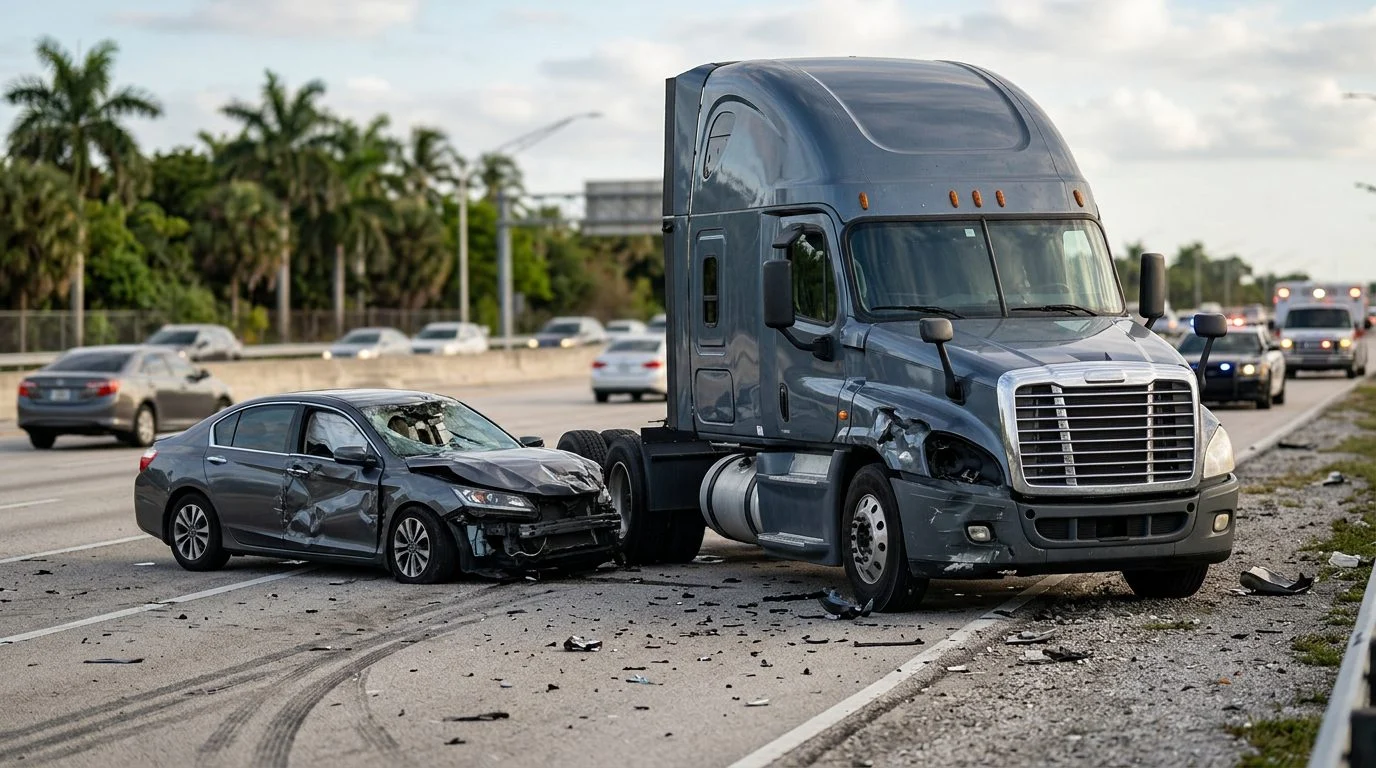
18-Wheeler Accidents
18-Wheeler Accident Lawyer in South Florida
Catastrophic injuries from truck crashes demand immediate legal action. Our attorneys work to hold trucking companies, drivers, and other liable parties accountable for the damage they cause.
By CHG Lawyers · Published September 28, 2026
18-Wheeler Accident Lawyer in South Florida: Liability, Damages & Your Claim
An 18-wheeler accident can leave you with catastrophic injuries and crushing medical bills. Multiple parties—the truck driver, the trucking company, maintenance contractors, and cargo shippers—can be held liable. Florida law has specific rules about fault and filing deadlines. Understanding these factors helps you know if you have a claim.
Not sure what your next step is?
Talk it through with our team — the first consultation is free, confidential, and carries no obligation.
Who Can Be Held Liable in an 18-Wheeler Accident
Multiple parties often share responsibility for an 18-wheeler accident.
The truck driver may be liable for speeding, fatigued driving, following too closely, or driving under the influence. Improper cargo loading also falls on the driver.
The trucking company can be held liable for negligent hiring, failure to train drivers, failure to maintain the truck, or violating federal hours-of-service rules. Pressuring drivers to meet unsafe schedules is negligence.
The truck owner (if different from the operator) must maintain the vehicle. Faulty brakes, worn tires, or mechanical failures caused by neglect trigger liability.
Maintenance contractors hired to service the truck can be liable for defective repairs. An improperly installed brake line or replaced tire can cause a crash.
The cargo shipper or loader may be responsible if cargo was loaded improperly, causing instability or a rollover.
Third parties, such as other drivers or those who created road hazards, can also share liability.
In many cases, multiple parties are liable in a single accident.
Florida’s 51% Rule: Can You Recover If You’re Partially at Fault?
Florida’s comparative negligence rule lets you recover damages even if you bear some responsibility—but only if you’re not the primary cause (Fla. Stat. § 768.81(6)).
Under Fla. Stat. § 768.81, you can recover if you are 50% or less at fault. If you are found more than 50% at fault, you cannot recover any damages.
Here’s how it works: if a jury finds you 20% at fault and the truck driver 80% at fault, your recovery is reduced by 20%. If your total damages are $100,000, you’d recover $80,000.
This rule matters because even if you made a mistake—failing to see the truck or making an unsafe lane change—you may still have a valid claim as long as the truck driver or company bears more responsibility than you do.
What Determines Your 18-Wheeler Accident Claim Value
Claim value depends on injury severity, liability clarity, and the at-fault party’s insurance limits.
Medical expenses are the foundation: emergency care, hospitalization, surgery, ongoing treatment, rehabilitation, and future medical care. Catastrophic injuries like spinal cord damage, traumatic brain injury, amputation, or severe burns can total hundreds of thousands of dollars.
Lost wages and lost earning capacity are significant, especially in catastrophic cases. You can recover for past wages and future lost income.
Property damage covers repair or replacement of your vehicle.
Pain and suffering compensates you for physical pain, emotional distress, and loss of enjoyment of life. Florida has no statutory cap on pain-and-suffering damages.
Permanent disability or disfigurement increases claim value. So does the need for ongoing care, assistive devices, or home modifications.
Wrongful death damages apply if the accident was fatal. Families can recover for the deceased’s medical and funeral expenses, lost financial support, and loss of companionship.
Punitive damages may be available in cases of gross negligence or willful misconduct—for example, if a trucking company knowingly ignored safety violations or a driver was operating under the influence.
Insurance policy limits often cap recovery. Many commercial trucks carry $750,000 to $1,000,000 in liability coverage, though some carry more.
How Much Can You Recover for Pain and Suffering?
Florida does not cap pain-and-suffering damages. The amount depends on injury severity, recovery time, and how the injury affects your daily life.
Catastrophic injuries—spinal cord injury, traumatic brain injury, amputation, or severe burns—typically result in higher awards because they cause permanent impairment and lifelong suffering.
Attorneys and juries often use two methods to calculate pain and suffering:
The multiplier method applies a factor (usually 1.5 to 5, or higher for severe injuries) to your medical expenses. If your medical bills total $200,000 and the multiplier is 3, pain and suffering could be $600,000.
The per diem method assigns a daily rate for pain and suffering and multiplies it by the number of days you suffered. If you’re in pain for two years at $500 per day, that’s $365,000.
Juries have discretion to award what they believe is fair based on evidence and injury severity. In catastrophic truck accident cases, pain-and-suffering awards often exceed $500,000.
Have questions about what happened?
Ask our team directly. The first conversation is free, confidential, and there is no obligation to continue.
How Long After an Accident Can You Sue?
Time is critical: Florida’s statute of limitations sets a hard deadline to file a lawsuit.
For personal injury claims, you have two years from the date of the accident to file a lawsuit. (This applies to accidents occurring on or after March 24, 2023; older claims had four years.)
For wrongful death claims, the deadline is also two years from the date of death.
If you miss this deadline, your claim is barred forever. You lose the right to sue, no matter how strong your case is.
Contact an attorney immediately. Evidence degrades over time, witnesses move or forget details, and insurance companies often settle claims faster early on. The sooner you act, the better your position.
Federal and State Regulations That Impact Your Case
Truck accidents are governed by strict federal and state safety regulations. Under Florida law, a violation of these rules is evidence of negligence, not conclusive proof of it.
Electronic logging devices (ELDs) are federally required to track driver hours automatically. ELD data can show that a driver exceeded hours-of-service limits, which is evidence of negligence but not conclusive proof of it.
Black box event data recorders in modern trucks capture speed, braking, acceleration, and steering inputs at the moment of the crash. This data is powerful evidence of what the driver was doing.
Truck maintenance records are required by federal law to be maintained and produced by carriers. Missing or falsified records, or evidence of ignored maintenance issues, demonstrate negligence.
Evidence that a carrier or driver did not follow these rules may be relevant to what happened in a truck accident case.
What Is the Average Settlement for a Truck Accident in Florida?
There is no single “average” settlement for truck accidents in Florida. Settlements vary widely based on injury severity, liability clarity, and insurance limits.
Minor injuries (soft tissue damage, minor fractures): typically $5,000–$25,000.
Moderate injuries (significant fractures, multiple surgeries, extended recovery): $25,000–$100,000 or more.
Catastrophic injuries (spinal cord injury, traumatic brain injury, amputation, severe burns): $250,000–$1,000,000 or more. These cases demand expert medical testimony, life-care planning, and often go to trial.
Wrongful death: $500,000–$2,000,000 or more, depending on the deceased’s age, earning potential, and family circumstances.
Insurance policy limits often cap recovery. Many commercial trucks carry $750,000–$1,000,000 in liability coverage; some carry more. If your damages exceed the policy limit, you may pursue the trucking company’s personal assets, though this is complex.
Your case is unique. Settlement depends on your specific injuries, liability evidence strength, and the defendant’s resources. An attorney can evaluate your claim and explain what’s realistic in your situation.
Why You Need an 18-Wheeler Accident Lawyer
Trucking companies and their insurers have experienced defense teams and substantial resources. They investigate accidents quickly, preserve evidence in their favor, and often try to shift blame to you or minimize damages.
Commercial truck accidents involve complex federal and state regulations. Understanding FMCSA rules, ELD data, black box evidence, and maintenance records requires technical knowledge that most people don’t have.
Multiple liable parties mean thorough investigation and evidence gathering. You need to identify all responsible parties and prove each one’s negligence.
Catastrophic injuries demand expert medical testimony, life-care planning, and vocational rehabilitation experts. These experts are expensive and require careful coordination.
Insurance adjusters often undervalue claims or deny liability improperly. An attorney levels the playing field and protects your right to fair compensation.
Personal injury attorneys work on contingency: you pay nothing upfront, and we recover a fee only if we win your case or reach a settlement. You can afford skilled legal help without financial risk.
Want to know where you stand?
Tell us what happened and our team will walk you through the options available to you, at no cost.
Get a Free Case Evaluation
If you’ve been injured in an 18-wheeler accident in South Florida, contact CHG Personal Injury Lawyers for a free, confidential case evaluation. We focus on catastrophic personal injury claims, including spinal cord injuries, traumatic brain injuries, amputation, severe burns, and truck accidents.
Bring your accident report, medical records, insurance information, and any photos or videos if you have them.
We’ll review your case, explain your rights under Florida law, discuss who may be liable, and give you an honest assessment of what your claim may be worth. There’s no obligation and no cost unless we recover for you.
People who’ve been hit by commercial trucks and suffered serious injuries can reach out to us because they need someone who understands the complexity of these cases and will fight to hold the trucking company and driver accountable. Get your free case evaluation today.
Why You Need a Truck Accident Attorney
Multiple Liable Parties
The truck driver, trucking company, maintenance contractors, cargo shippers, and others may all share responsibility. We identify every party and pursue full compensation.
Complex Federal & State Rules
18-wheeler accidents involve federal trucking regulations, state negligence law, and strict filing deadlines.
Catastrophic Injury Recovery
Spinal cord injuries, traumatic brain injuries, amputations, and severe burns from truck crashes demand aggressive representation and substantial compensation for lifelong care.
No Attorney’s Fees Unless There Is a Recovery
We work on contingency. You pay nothing upfront, and we only collect a fee if we recover compensation for you.
Who Can Be Held Liable in an 18-Wheeler Accident
The Truck Driver
Speeding, drowsy driving, distracted driving, improper lane changes, and failure to maintain safe following distance are common causes of liability.
The Trucking Company
Negligent hiring, inadequate training, failure to maintain the vehicle, pushing drivers to violate hours-of-service rules, and ignoring safety protocols create employer liability.
Maintenance & Repair Contractors
Faulty repairs, failure to inspect brakes or tires, and negligent maintenance of the rig can cause accidents and create liability.
Cargo Shippers & Loaders
Improper loading, overloading, or failure to secure cargo can cause the truck to tip, jackknife, or lose control.
Act Quickly
Evidence disappears fast. Truck companies preserve their own records and may pressure witnesses. The sooner you contact us, the sooner we can secure evidence, interview witnesses, and protect your claim.
Types of Damages in Truck Accident Claims
Medical Expenses
Emergency care, surgery, hospitalization, rehabilitation, ongoing therapy, adaptive equipment, and future medical treatment for permanent injuries.
Lost Income & Earning Capacity
Wages lost during recovery and reduced earning potential if catastrophic injury prevents you from returning to work or earning at the same level.
Pain, Suffering & Loss of Life Quality
Compensation for physical pain, emotional trauma, loss of enjoyment of life, and the permanent impact of catastrophic injury on your daily existence.
Wrongful Death
If a loved one was killed, surviving family members may recover funeral costs, lost financial support, and compensation for the loss of companionship and guidance.