

Wrongful Death · Truck Accidents · Florida
When a Truck Crash Takes Someone You Love
A plain-language guide for Florida families facing the most catastrophic outcome of all — helping you understand your rights, the deadlines that matter, and what to do next.
Guidance You Can Rely On
Nationwide
Cases accepted across the U.S.
FL Bar
Licensed, admitted attorneys
Bilingual
English & Spanish resources
No Fee
Free, no-obligation case review
By CHG Lawyers · Published August 04, 2026
Wrongful Death After a Fatal Truck Crash: A Family’s Options in Florida
First, we’re sorry. Maybe you’re reading this because a truck crash took someone you love. No set of instructions can meet a loss that size. This page won’t try to.
It exists to answer the questions families quietly search for at 2 a.m. — about deadlines, money, and what happens next. When you’re ready, you can make choices with clear facts, not pressure.
Nothing here asks you to act today. Take what’s useful. Leave the rest.
When you’re ready, Florida law gives certain close family members a path forward after a fatal truck crash. Below, we explain how that path works in plain language. We cover who can file, what families can recover, the deadlines, and honest money answers — including the ones we won’t fake with a made-up number.
This is general information, not legal advice. Every family’s situation is different.
Not sure what your next step is?
Talk it through with our team — the first consultation is free, confidential, and carries no obligation.
Where families can start
You don’t need to know legal terms to begin. You need one fact. Florida law gives surviving relatives a way to seek accountability and financial support after a fatal truck crash caused by someone else’s carelessness.
In the fatal truck cases our attorneys handle, families are usually managing a lot at once. They face grief, funeral costs, and phone calls from an insurance adjuster — often within days. That is normal, and it is a lot. You do not have to make any big decision now.
One thing is worth knowing early. A wrongful death claim is a civil case. It is completely separate from any criminal charges against the driver. It exists so the people who depended on your loved one aren’t left carrying the money weight of someone else’s mistake.
What a wrongful death claim is — and what it is not
A wrongful death claim is a civil case a family brings when someone dies because of another party’s negligence, recklessness, or wrongful act. Florida sets out these rights in the Florida Wrongful Death Act, Fla. Stat. §§ 768.16–768.26.
Here’s a point many pages skip. The civil claim stands on its own, apart from any criminal case. A driver may be charged, cleared, or never charged at all. None of that decides whether your family can file.
The reason is the burden of proof — how strong the evidence must be. A criminal case must prove guilt “beyond a reasonable doubt.” A civil claim uses a lower standard — “the greater weight of the evidence.” So a family can often pursue and win a civil claim even when prosecutors never file a single charge.
A wrongful death claim cannot bring your loved one back. But it can hold the responsible parties accountable. It can also provide financial support for those who depended on the person who died.
Who can file in Florida
Yes, you can bring a wrongful death claim in Florida. But there’s a specific rule about who files.
Under the Act, the lawsuit is filed by the personal representative of the deceased person’s estate (Fla. Stat. § 768.20). This person is usually named in a will or appointed by the probate court. They file on behalf of everyone.
The family members who may recover are called “survivors.” Florida law generally recognizes:
- The surviving spouse
- Children of the person who died
- Parents of the person who died
- Certain blood relatives or adoptive siblings who depended, in whole or in part, on the deceased for support or services
Who qualifies shifts with each family. Whether a child is a minor or an adult can change what that child recovers. Whether there is a surviving spouse can affect a parent’s claim. If you’re unsure who qualifies in your family, a lawyer can sort that out under your specific facts.
Why fatal truck crashes are their own category
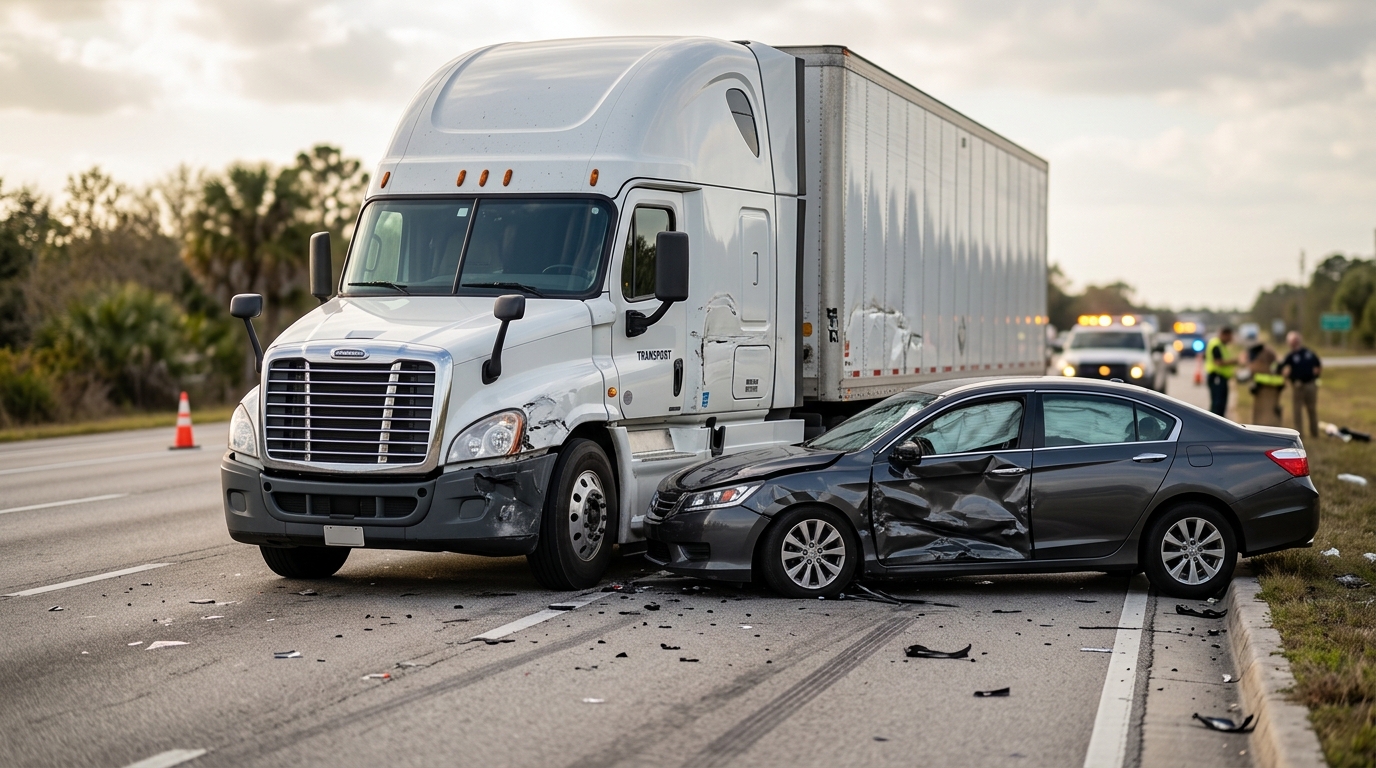
Fatal truck crashes are not just bigger car crashes. Two things set them apart: the physics, and the number of parties who may share the blame.
A loaded tractor-trailer can weigh up to 80,000 pounds. That’s roughly 20 to 30 times a typical passenger car. When that mass hits a smaller vehicle, the result is often catastrophic or fatal. Some survivors of the same crash live with a traumatic brain injury or a spinal cord injury and paralysis.
The scale matters. Federal crash data (NHTSA, Traffic Safety Facts) has consistently shown one thing. In fatal crashes between a large truck and a passenger vehicle, the people who die are overwhelmingly in the smaller vehicle. That imbalance is part of why these cases are treated so seriously.
More than the driver may be responsible. In the truck cases our attorneys handle, the parties who may share the blame can include:
- The truck driver
- The trucking company (motor carrier)
- The company that loaded the cargo
- A maintenance contractor
- The truck or parts manufacturer
- A freight broker
Trucking is heavily regulated by the Federal Motor Carrier Safety Administration (FMCSA). It sets rules on driver hours, vehicle maintenance, and driver qualifications. Breaking those rules can be strong evidence of negligence.
Trucks also carry evidence ordinary cars don’t. This includes electronic logging device (ELD) hours-of-service data, engine “black box” records, driver logs, and inspection reports. That evidence can be erased or lost within weeks if no one moves to protect it. That is the single most practical reason early legal help matters in a truck case.
What a family must prove
A family generally must prove four things:
- A duty of care
- A breach of that duty
- That the breach caused the death
- Real losses to the survivors
In plain terms, someone acted carelessly, and that carelessness caused the death.
Common examples of negligence in truck crashes:
- Fatigued driving after breaking hours-of-service rules
- Distracted driving or texting
- Speeding or driving too fast for conditions
- Improper or overloaded cargo
- Poor maintenance — worn brakes, bald tires
- Negligent hiring of an unqualified or unsafe driver
Florida uses a modified comparative negligence rule under Fla. Stat. § 768.81. This means fault is shared by percentage. A person found more than 50% at fault generally recovers nothing. Otherwise, recovery is reduced by that person’s share of fault. So even if your loved one may have been partly at fault, your family may still have a claim. It depends on the facts and is worth a lawyer’s review.
Have questions about what happened?
Ask our team directly. The first conversation is free, confidential, and there is no obligation to continue.
What damages can a family recover?
Florida splits recovery into survivor damages and estate damages. What each person can recover depends on their relationship to the deceased (Fla. Stat. § 768.21).
Survivor damages may include:
- Lost support and services the loved one provided
- Loss of companionship, guidance, and protection
- Mental pain and suffering (this varies by survivor — the law treats spouses, minor children, and parents differently)
Estate damages may include:
- Lost earnings and future net savings
- Medical expenses paid by the estate
- Funeral expenses
In rare cases involving gross negligence, punitive damages may be possible. These punish especially reckless conduct. They depend on the facts and are never guaranteed.
For more on how compensation is figured in these cases, see our guide on the truck accident wrongful death claim.
Is there an “average” wrongful death settlement?
No. There is no reliable “average” settlement for a Florida wrongful death case. Any single figure you see online is misleading.
We won’t quote a number we can’t stand behind. The rules for Florida lawyers don’t allow it. A confident-sounding figure sets false hopes at the worst possible moment. Here’s what actually drives the value of a case:
- Available insurance coverage and the assets of the responsible parties
- The strength of the evidence on fault
- The deceased’s income and role in the family
- The number and type of surviving beneficiaries
- Shared fault, if any applies
Two families with nearly identical losses can see very different outcomes because of these factors. A real answer requires a look at your facts, not a generic average.
“What are the odds of winning?”
No honest lawyer can quote your odds or promise a result. Every case turns on its own evidence and liability. Anyone who guarantees a win is a warning sign, not a good sign.
That said, some things tend to make a case stronger:
- Clear, well-documented liability
- Preserved evidence — ELD and black-box data secured early
- Documented losses — income records, bills, funeral costs
- Timely action before records disappear
Many wrongful death cases end in a settlement rather than a trial. That can spare a grieving family the strain and delay of a courtroom. But that outcome depends on the other side and is never guaranteed.
Deadlines: Florida’s statute of limitations
Florida generally gives families two years from the date of death to file a wrongful death claim. The limitations period for these claims is set out in Fla. Stat. § 95.11.
Exceptions and complicating facts can apply. Don’t assume your deadline from a general rule. Missing it usually ends the claim for good.
There is a second, earlier clock that matters just as much. Truck evidence — driver logs, ELD data, the engine’s black-box records — can be lost or overwritten within weeks. Acting early helps protect the case long before any filing deadline arrives.
Steps a family can take now
The most useful early steps are simple. None require legal knowledge:
- Keep documents — the crash report, medical bills, funeral expenses
- Don’t sign any release or settlement offer from an insurer without legal advice
- Write down what you remember while it’s fresh
- Ask the probate court to appoint a personal representative if there isn’t one yet
An attorney can also send a spoliation (evidence-preservation) letter to the trucking company. This is a formal demand that they save ELD data, driver logs, and maintenance records before those items disappear. In our experience, sending that letter promptly is one of the highest-value things done in the first weeks of a truck case.
Our firm is based in Florida and admitted to The Florida Bar. We handle catastrophic and fatal truck cases throughout Florida, with bilingual (English and Spanish) support.
We handle these cases on a contingency-fee basis. In plain terms, you don’t pay attorney’s fees up front. Fees come only out of a recovery, and only if there is one. That structure lets families pursue a claim during a hard financial stretch. No outcome is ever promised.
Want to know where you stand?
Tell us what happened and our team will walk you through the options available to you, at no cost.
Talk to a wrongful death truck accident attorney
You don’t have to navigate this alone. If your family lost a loved one in a truck crash, you may have options under the Florida Wrongful Death Act. You deserve clear, honest answers.
Our attorneys are licensed and admitted to The Florida Bar. We represent families in catastrophic and fatal truck cases throughout Florida.
Request a free, confidential case evaluation. We’ll listen, explain your options in plain language, and help you understand your next steps — on your timeline, not ours.
For more on serious and fatal truck crashes, see our pillar guide on catastrophic truck accident injuries.
This page is educational information, not legal advice. It does not create an attorney-client relationship. No result is guaranteed. Every case is different.

Frequently asked questions
Can you sue for wrongful death in Florida?
Yes. Florida allows a wrongful death claim when someone dies because of another party’s negligence or wrongful act. The estate’s personal representative files it on behalf of the surviving family.
Who can file a wrongful death claim in Florida?
The personal representative of the deceased person’s estate. Survivors — a spouse, children, parents, and certain dependent relatives — may recover under the Florida Wrongful Death Act.
What is the statute of limitations for a wrongful death claim in Florida?
Generally two years from the date of death, under Fla. Stat. § 95.11(4). Exceptions apply, so ask a lawyer quickly.
Is a wrongful death claim the same as the criminal case against the driver?
No. It’s a separate civil case. Your family can often pursue it whether or not the driver is charged or convicted.
Can I still recover if my loved one was partly at fault?
Possibly. Under Florida’s modified comparative negligence rule, recovery is reduced by the fault percentage. A person more than 50% at fault generally recovers nothing.
Time Limits Apply
Florida sets strict deadlines for filing a wrongful death claim, and critical evidence from a truck crash — driver logs, black-box data, and dash-cam footage — can be lost quickly. Speaking with an attorney early helps protect your family's rights.
Common Questions From Grieving Families
Can you sue for wrongful death in Florida?
Yes. Florida allows a wrongful death claim when someone dies because of another party's negligence or wrongful act. The estate's personal representative files it on behalf of the surviving family.
Who can file the claim?
The personal representative of the deceased person's estate files the claim. Surviving family members — such as a spouse, children, and parents — may be entitled to recover as survivors under Florida law.
What can a claim address?
Depending on the case, a claim may address the loss of support and companionship, funeral and medical expenses, and other losses the family has suffered. An attorney can explain what may apply to your situation.
Why truck crashes are different
Truck cases often involve trucking companies, insurers, and federal safety rules. Multiple parties may share responsibility, which makes early investigation and legal guidance especially important.
How We Support Families
Compassion First
We handle every conversation with dignity and patience, centered on your family and what you're going through.
Careful Investigation
We work to preserve and gather evidence — from crash data to safety records — while it is still available.
Clear Communication
We explain your options in plain language, in English or Spanish, so you understand each step.
Licensed Advocates
Our attorneys are admitted to the Florida Bar and handle catastrophic and fatal-injury cases nationwide.