
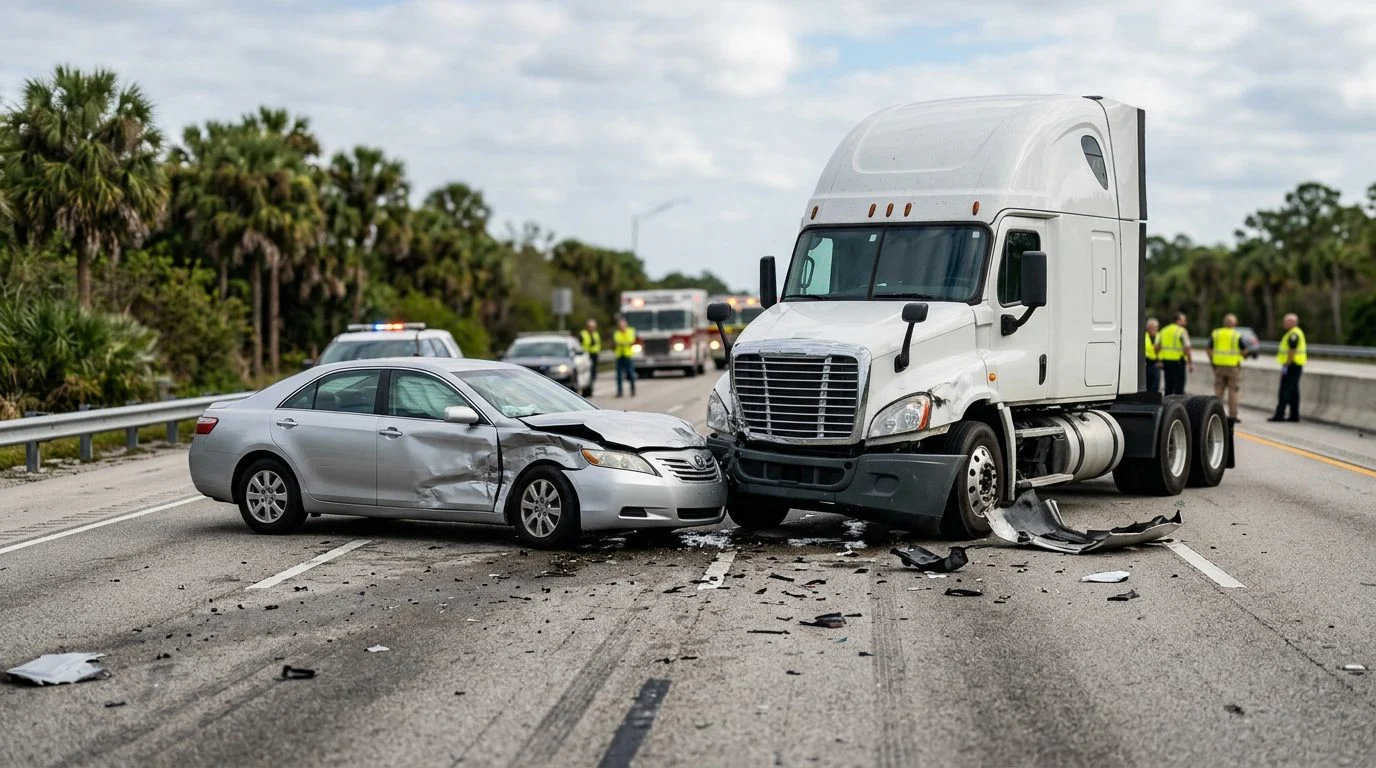
Truck Accidents | Florida
Behind the Numbers: What Federal Crash Data Means for Florida Families
Federal crash statistics show how often large trucks are involved in serious crashes. Here is what the data says, what it does not say, and how CHG Personal Injury Lawyers can help a Florida family after a truck crash.
About CHG Personal Injury Lawyers
Florida
Florida-based firm serving clients throughout the state
Licensed
Attorneys admitted to The Florida Bar
Free
First consultation, confidential and without obligation
By CHG Lawyers · Published October 31, 2026
Truck accident statistics show how many people die when large trucks are involved in crashes. Two safety organizations report that 5,340 people died in crashes involving large trucks in 2024. The National Safety Council is one of them. Those totals describe a large group of crashes. They can’t tell a family what happened in their own case. This guide explains where the numbers come from, what they show, and what they leave out, with a focus on Florida families.
What the Federal Truck Crash Data Measures
Federal truck crash data counts crashes and deaths, and most of it starts with police reports. Two sources publish most of the figures you’ll see.
The first is the Fatality Analysis Reporting System, or FARS. The National Highway Traffic Safety Administration keeps this federal database of fatal traffic crashes. The second is the Large Truck and Bus Crash Facts report from the Federal Motor Carrier Safety Administration. It is a yearly report with statistics on fatal and injury crashes.
In these reports, “large truck” means a big commercial truck, the kind that hauls freight on highways. A crash counts when one is involved, even when most of the people who died were in another vehicle.
Every figure also comes with a delay. Crash reports are filed, reviewed, and published over time. That is why each number needs its year and its source. A 2024 total is a different measure than a figure from an older report, so check the year before you repeat it.
Not sure what your next step is?
Talk it through with our team — the first consultation is free, confidential, and carries no obligation.
Fatal Large Truck Crashes Over Recent Years
In 2024, 5,340 people died in crashes involving large trucks, according to the IIHS large-truck fatality data and the National Safety Council.
The trend has two parts, and they point in different directions. The National Safety Council reports that 2024 deaths fell 2.5% from 2023. Over the last ten years, though, the count is up 30%.
Read the two numbers together. The one-year drop is small next to the longer climb. A single year can look better or worse than the trend behind it. Truck accident statistics like these are most useful for showing direction over time.
Behind each total is a family. A parent, spouse, child, or friend is no longer there. Crash figures can also change as reports are finalized, so a year’s number may be updated later.
Who Is Killed in Large Truck Crashes
Most people killed in large truck crashes are not the truck’s occupants. IIHS reports that in 2024, 17% of these deaths were truck occupants, and 62% were passenger-vehicle occupants.
Think about what that means on an ordinary drive. A family in a sedan, a rider on a motorcycle, or a person walking near a busy road may be the one who dies. They never climbed into the cab. They were simply sharing the road.
This matters for families. Many of the people who die in these crashes had no say in the route, the schedule, or the truck. Their loss is no less heavy because they were not in the big vehicle.
It also matters when families look for answers. The question often reaches beyond the driver. It is about how the whole crash happened, from the road and the other vehicles to the company that sent the truck on that trip.
Where and When Fatal Truck Crashes Happen
Federal datasets sort crashes by time of day, day of the week, and type of road. Those groupings help planners and safety researchers see patterns across many crashes.
Averages describe a group of crashes. They do not tell you the odds for one trip, and they do not say who was at fault. Use them as background, not as proof of what happened.
Florida drivers know these roads well. Interstates such as I-95, I-75, I-4, and I-10 carry heavy traffic through Miami, Fort Lauderdale, Tampa, Orlando, and Jacksonville. Trucks move freight on these corridors every day, and cars and trucks share the same lanes.
Crashes in busy city areas and on surface streets matter too. Cars turn, merge, and stop in dense traffic. When a crash happens, the place and time are written into the police report, which is often one of the first records anyone looks at.
If you’re trying to understand a crash that hurt someone you love, pattern data is only background. The details of that day are what matter most.
Common Crash Patterns and Circumstances in the Data
Federal reports group crashes by how the vehicles collided and by conditions recorded at the scene. These groupings show what kinds of crashes are common. They are not findings about blame.
Three kinds of records often matter most after a truck crash: the police crash report, vehicle and electronic data, and the driver’s own records.
Federal rules require drivers to record their duty status. Motor carriers must keep those records for not less than six months from the date of receipt. 49 C.F.R. § 395.8 sets that rule: a motor carrier must require each driver used by the motor carrier to record the driver’s duty status for each 24-hour period. That short window is one reason to act early.
Federal rules also require employers to test surviving drivers for alcohol and drugs after certain crashes. 49 C.F.R. § 382.303 sets those testing rules. The rules set time limits, and an employer that misses them must keep a written record of why.
Those details can shape a claim, so families should ask about them early.
Florida in the Federal Data
Florida has its own rules for these crashes. Under Fla. Stat. § 316.066, a crash report must be completed and submitted to the state within 10 days after the investigation ends. That applies when a crash results in death, personal injury, or any indication of complaints of pain or discomfort by any of the parties or passengers involved in the crash, when a vehicle is rendered inoperable to a degree that required a wrecker to remove it from the scene of the crash, when a crash involves a violation of s. 316.061(1) or s. 316.193, or when a crash involves a commercial motor vehicle.
That access is one reason families should ask for the report early.
The federal figures describe Florida roads too. Major interstates and city corridors in Miami, Orlando, Tampa, and Jacksonville carry the same kinds of truck traffic described above.
For a Florida family, a drive on the interstate or a trip through a busy surface street can put a car beside a large truck. Knowing that doesn’t make a crash less painful. It does help families see why records from the day matter.
Have questions about what happened?
Ask our team directly. The first conversation is free, confidential, and there is no obligation to continue.
The Injuries That Fatality Counts Do Not Capture
Fatality counts leave out the people who survive. A death total counts deaths. It does not count the injuries that people live with afterward.
Some survivors face spinal cord injuries, paralysis, traumatic brain injuries, amputations, severe burns, or serious back and neck injuries. Each can change daily life for a long time, and some changes are permanent.
Survivors and their families often face long medical care, rehabilitation, time away from work, and changes at home. They may need help with everyday tasks or a home that works differently now.
These costs are real, and they often last well beyond the first hospital stay. None of them show up in a death count, which is one more reason the numbers are only part of the story.
If you’re recovering from a crash, follow your doctors’ care. Keep copies of bills, reports, and receipts, and tell your medical team about every symptom, even small ones.
What the Numbers Can and Cannot Tell You
Truck accident statistics describe groups of crashes. They cannot tell you what happened in one crash or who was responsible for it.
There are three main limits. First, the data starts with a police report. Under Florida law, the officer must complete a long-form crash report only for listed crashes, such as those involving death or personal injury; for other crashes that occur on the public roadways of this state, the law enforcement officer shall complete a short-form crash report or provide a driver exchange-of-information form, to be completed by all drivers and passengers involved in the crash, so the details depend on what was documented at the scene.
Second, FARS tracks fatal crashes. It does not count crashes where no one died, so it cannot show how many truck crashes caused injuries alone.
Third, a statistic cannot decide fault. Florida law divides fault by percentage.
Fault is decided on the facts of one crash. The police report, witness statements, photos, and records from the trucking company are the kinds of evidence that matter for a single claim.
Families Left Behind: Wrongful Death and Florida Time Limits
When a death is caused by another’s negligence, the person responsible can be liable for damages. The Florida Wrongful Death Act governs these claims.
The law defines survivors. They include the spouse, children, and parents. Certain blood relatives and adoptive brothers and sisters can count too, if they depended on the person for support or services. Fla. Stat. § 768.18 defines those terms.
A personal representative brings the case for the survivors and the estate. Fla. Stat. § 768.20 explains that role.
Damages depend on who survived, as specified in Fla. Stat. § 768.21. A surviving spouse may recover for lost companionship and protection, and for mental pain and suffering. Minor children may recover for lost parental companionship, instruction, and guidance. Fla. Stat. § 768.21 lists these categories.
Florida sets filing deadlines in its statutes, and they can be short. See Fla. Stat. § 95.11. Deadlines depend on the facts, so families should contact a lawyer promptly.
While a family is grieving, some steps protect the record. Request the crash report, save photos and witness contact information, and keep receipts for medical and funeral costs. These steps don’t promise a result, but they help preserve evidence a claim may need.
Next Steps After a Truck Crash in Florida
The first steps after a truck crash are to get medical care, protect your records, and talk with a lawyer about your deadlines.
Start with medical care and follow your doctors’ care plan. Write down what you remember while it’s fresh, and keep a file of bills, pay stubs, and missed work.
The emotional toll can be as real as the physical injuries. Many people describe trauma, nightmares, or trouble sleeping after a serious crash. Tell your doctor about these changes, too, because they belong in your care.
Families who lose someone face a different kind of weight. Grief, funeral decisions, and questions about the law can arrive all at once. You don’t have to sort them out alone.
If a truck crash in Florida hurt someone you love or took a life, and you’re deciding whether to talk with a lawyer, contact CHG Personal Injury Lawyers for a free, confidential first consultation with no obligation to continue. Igor Hernandez is the responsible lawyer for this page, and CHG Personal Injury Lawyers is a Florida-based firm. CHG charges no attorney’s fees and no case costs unless there is a recovery.

Want to know where you stand?
Tell us what happened and our team will walk you through the options available to you, at no cost.
Frequently Asked Questions
How many people die in truck accidents each year in the United States?
Each year, thousands of people die in crashes involving large trucks, according to crash data from the National Highway Traffic Safety Administration (NHTSA). Most of those killed are occupants of passenger vehicles, not truck drivers.
Why do truck accident statistics differ from one source to another?
Different sources count different things, such as fatal crashes only, all crashes with injuries, or crashes reported to police. Totals also change from year to year, so check the year and how the source defines a “truck crash.”
Does a truck being in a crash mean the truck driver caused it?
No. Crash statistics usually count a truck as “involved” when it was part of the crash, which does not show who was at fault. Fault depends on what happened, and it is decided by the facts of each case.
What should a family do if a loved one was hurt or killed in a truck crash?
Statistics describe general patterns, not an individual case. Get medical care right away and follow your doctors’ advice. CHG Personal Injury Lawyers offers a free, confidential initial consultation with no obligation to continue, so you can contact the firm to talk through your situation.
How to Read Truck Crash Statistics
Statistics describe patterns, not individual cases
Crash data shows trends across thousands of crashes. It cannot tell the full story of one crash, one driver, or one family.
Different sources count differently
Totals can vary depending on how a report defines a truck, a crash, or a fatality, and on when the data was compiled.
Behind every number is a person
Each figure represents people who were hurt or lost, and the loved ones who carry those losses forward.
Data can point toward useful questions
Knowing how truck crashes happen can help families ask the right questions about what occurred on the road.
A Note on Crash Data
Federal crash figures describe large populations of crashes. They do not decide any single claim and they do not predict how a particular case will turn out. If someone you love was hurt or killed in a truck crash, the specific facts of that crash matter most.
Steps Families Often Take After a Truck Crash
Put medical care first
Follow your doctors' care and keep records of every appointment, treatment, and bill. Health comes before everything else.
Preserve the details
Write down what you remember, and keep photos, police report numbers, and the names and contact details of anyone who saw the crash.
Speak with a lawyer early
Our attorneys can review the facts of your crash and explain the options that may be available under Florida law.
Ask your questions at no cost
Your first consultation is free, confidential, and without obligation. CHG charges no attorney's fees and no case costs unless there is a recovery.