

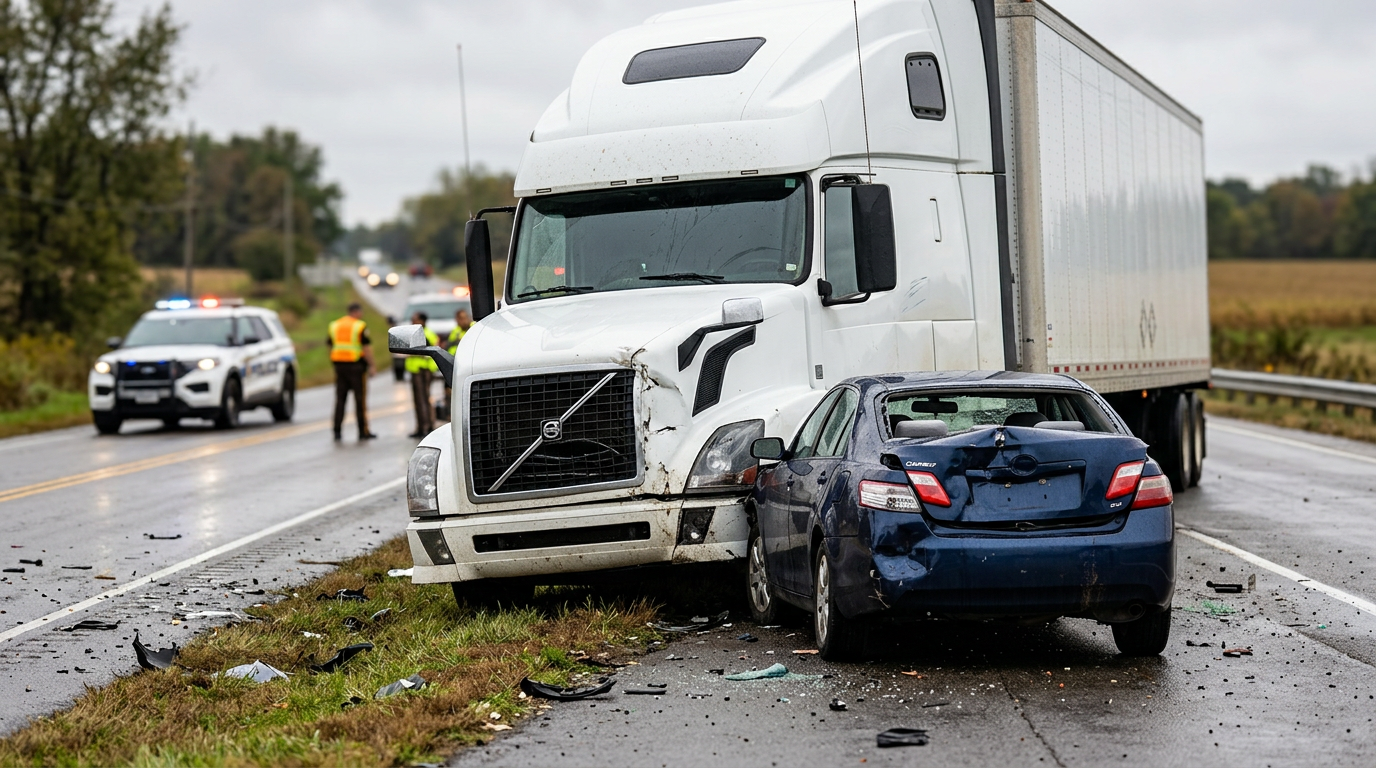
Truck Accidents · Florida & Nationwide
When Safety Rules Are Broken, Families Pay the Price
Federal trucking regulations exist to prevent catastrophic crashes. When a company ignores them and someone suffers a life-altering injury, those violations can help prove negligence. Learn what to look for and how the law protects you.
Why Families Turn to CHG Personal Injury Lawyers
Licensed
Attorneys admitted to the Florida Bar
Catastrophic
Focused on serious, permanent injuries
Nationwide
We take truck cases across the U.S.
Bilingual
Resources in English and Spanish
By CHG Lawyers · Published July 30, 2026
Federal Trucking Safety Rules: How FMCSA Violations Strengthen a Catastrophic Injury Claim
When a trucking company breaks a federal safety rule, and that failure causes a crash, the violation can be strong proof of fault. It can support your injury or wrongful-death claim. A documented Federal Motor Carrier Safety Administration (FMCSA) violation links the company’s wrongdoing to the harm you or your family suffered.
The physics are unforgiving. Federal law lets a loaded tractor-trailer weigh up to 80,000 pounds. That is about 20 times the weight of a typical car. And no overweight permit is needed. When that much weight fails to stop or stay in its lane, the results are severe. Survivors often live with a spinal cord injury, paralysis, a traumatic brain injury (a serious brain injury), an amputation, or severe burns.
In 2022, large trucks were involved in crashes that killed 5,936 people. That figure comes from the NHTSA / FMCSA “Large Truck and Bus Crash Facts” report. Because the stakes are so high, federal law holds trucking companies to strict, written safety standards.
This page explains those rules. It also shows how breaking them can help prove fault. We write for injured people and grieving families, not for lawyers. In the catastrophic truck cases our attorneys handle, these federal rules often decide who is responsible — and who pays for a lifetime of care.

Not sure what your next step is?
Talk it through with our team — the first consultation is free, confidential, and carries no obligation.
If your family lost someone in a truck crash
If you are reading this after a death, we are sorry. A fatal crash is the most catastrophic outcome there is. No legal page can soften that.
Here is what we can tell you plainly. The same federal safety rules apply whether a crash caused a permanent injury or a death. The same evidence trail applies too.
A wrongful-death claim is brought by the surviving family. It uses the driver’s logs, the maintenance records, and the company’s safety history. These records help answer the question families need answered most: was this preventable, and who allowed it to happen?
In Florida, the personal representative of the estate brings the wrongful-death case for the survivors. This is set out in the Florida Wrongful Death Act, Fla. Stat. §768.16–768.26. You do not have to understand that law today. You only need to know one thing. The evidence below matters just as much in a death case. And it can disappear just as quickly.
Why federal trucking rules matter after a catastrophic crash
Federal rules set a safety line a trucking company must not cross. Crossing it can prove a crash was preventable.
Car crashes are among the leading causes of spinal cord injury in the United States, according to the Mayo Clinic. A high injury at the neck can affect all four limbs. It can cause permanent loss of movement and feeling.
The logic is simple. A tired driver, worn brakes, or an overloaded trailer can turn a routine trip into a disaster. When a company ignores a rule made to prevent that harm, its choice becomes central to a claim.
What is the FMCSA, and what are the federal trucking safety rules?
The FMCSA is the U.S. Department of Transportation agency that sets and enforces safety rules for commercial trucks and buses. Its rules are called the Federal Motor Carrier Safety Regulations (FMCSRs). They appear in Title 49 of the Code of Federal Regulations, Parts 350–399.
These rules bind two parties. One is the driver. The other is the motor carrier — the trucking company that employs the driver or owns the truck. The rules cover how long a driver may drive. They also cover who is qualified to drive, drug and alcohol testing, vehicle upkeep, and how cargo is loaded and secured.
Because these are federal standards, the same rulebook often applies. That is true whether your crash happened in Miami, Orlando, Tampa, or Jacksonville.
Common FMCSA violations that matter in a truck accident claim
The violations we see most often involve driver fatigue, fake logs, unqualified drivers, skipped drug tests, delayed repairs, and unsafe cargo. Each can point to negligence.
Hours-of-service violations and driver fatigue
Federal hours-of-service (HOS) rules limit driving time. Under 49 CFR §395.3, a driver hauling property may not drive past the 11th hour of driving. They also may not drive after being on duty for 14 hours without the required rest.
When a driver goes past those limits, fatigue often follows. A drowsy driver reacts slower and can miss a stopped vehicle. Logs that show too many hours, or that were faked, are strong evidence in a fatigue crash.
Electronic logging device (ELD) problems
Most interstate trucks must record driving hours automatically. They use an electronic logging device (ELD). Tampering with, disabling, or faking ELD data is a serious violation. When a company changes those records, the change itself can suggest it was hiding an unsafe practice.
Driver qualification and negligent hiring
Under 49 CFR Part 391, a carrier must check a driver before putting them on the road. That means checking the driver’s commercial driver’s license (CDL), driving history, medical fitness, and past violations.
Hiring or keeping an unfit driver can be its own act of negligence, separate from the crash. That includes a driver with a poor record or an untreated medical condition.
Drug and alcohol testing failures
Federal rules require several types of drug and alcohol tests. These happen before hiring, at random, on reasonable suspicion, and after a crash. Skipping a required test is a major violation. So is ignoring a positive result. Either can point straight to a preventable crash.
Inspection, repair, and maintenance failures
Trucks must be inspected regularly and kept in safe working order. Worn brakes, bald tires, and dead lamps cause crashes that never had to happen. Skipped inspections and ignored repair orders are common failures. They are also easy to prove. Brake problems are among the defects most often cited in roadside inspections.
Cargo securement and weight-limit violations
Cargo must be secured and within legal weight limits. An overloaded, unbalanced, or shifting load can cause a rollover or a sudden loss of control. When the load caused the crash, the shipper or loading company may share the blame.
How FMCSA violations can help prove negligence
Under Florida law, breaking a safety rule made to protect the public is evidence of negligence, but it is not conclusive evidence of negligence. See the Florida civil jury instructions.
A violation also connects the wrongdoing to the injury. Picture a driver who blew past the 11-hour limit, fell asleep, and caused a catastrophic crash. The log showing too many hours ties that choice to the harm that followed.
Violations can also widen who is responsible. Beyond the driver, a claim may reach the carrier. That could be for negligent hiring, poor supervision, or delayed repairs. This matters. Companies usually carry far larger insurance policies than individual drivers. Federal minimums for many for-hire carriers start at $750,000 under 49 CFR §387.9. They are often much higher.
We can’t promise any particular result. Every case turns on its own facts and evidence. But a clear, well-documented violation is often one of the strongest pieces of proof in a catastrophic truck claim.
Have questions about what happened?
Ask our team directly. The first conversation is free, confidential, and there is no obligation to continue.
What crashes are FMCSA reportable?
An FMCSA-reportable crash involves a death, an injury treated away from the scene, or a vehicle towed away because of disabling damage. Carriers must keep a record of these crashes for three years. This record is called an Accident Register, under the FMCSA Accident Register requirement (49 CFR §390.15).
That definition matters twice over. First, the register itself can be important evidence. Second, the crashes this firm handles — fatal wrecks and serious-injury wrecks — are exactly the ones that trigger this reporting duty. If your crash was reportable, the company was required to log it.
How to check a trucking company’s FMCSA safety record
You can check a carrier’s record for free using FMCSA’s public tools. The SAFER Company Snapshot shows a company’s basic safety profile. That includes its DOT number, fleet size, and crash and inspection totals.
The Safety Measurement System (SMS) shows inspection and violation history over time. It groups that history into categories FMCSA calls BASICs, such as Unsafe Driving and Vehicle Maintenance. Anyone can search both tools.
These tools give a useful starting picture, but not the whole one. The key records usually stay inside the company. These include ELD data, the driver qualification file, maintenance logs, and internal emails. An attorney can force the company to hand them over. This happens through a formal legal process called discovery.
Timing is critical. ELD data, driver logs, and inspection reports can be overwritten, deleted, or lost as weeks pass. Acting quickly helps save the proof before it disappears. In Florida, an injury or wrongful-death case for a cause arising on or after March 24, 2023 generally must be filed within two years under Fla. Stat. §95.11.
Can a trucking company fight or dispute an FMCSA violation?
Yes. A carrier can challenge a recorded violation through FMCSA’s DataQs system. This lets it ask the government to review or remove a citation. A reduced or erased violation can make a claim harder.
This is exactly why the citation alone is never the whole case. If a company gets a violation removed, your claim still needs its own proof. That is where other evidence comes in. It includes crash reconstruction, black-box (engine control module) and ELD data, and maintenance records. Strong cases rest on many sources of evidence, not a single citation.
An attorney can gather and protect that broader evidence. So even if a carrier fights a violation, the facts about what really happened can still come to light.
Preserving evidence after a catastrophic truck crash
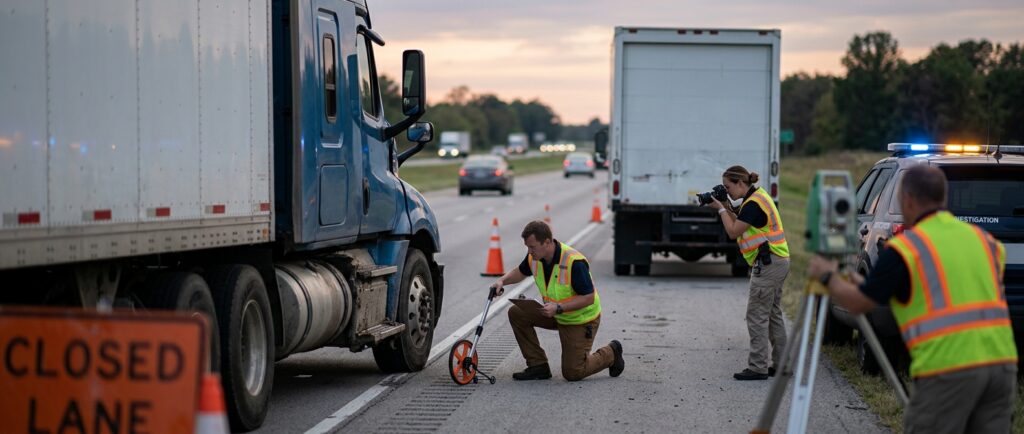
Saving evidence early is one of the most important steps after a serious truck crash. Key records can be destroyed within weeks. The evidence that matters most includes:
- ELD and hours-of-service logs
- Maintenance and inspection records
- The driver qualification file
- Drug and alcohol test results
- Dashcam and forward-facing camera footage
- Dispatch and load records
Attorneys often send a spoliation letter. This is a formal notice telling the company to preserve records and not destroy them. It creates a legal hold. If a company destroys evidence after getting that notice, a court can penalize it. A judge may even tell the jury to assume the missing records were bad for the company.
For families and injured victims, the practical step is simpler: get help quickly. Save any photos, medical records, and the crash report you already have. And don’t give a recorded statement to the trucking company’s insurer before you understand your rights. This is general information, not legal advice for your situation.
Keep in mind that Florida follows a modified comparative-fault rule. Under Fla. Stat. §768.81, a person found more than 50% at fault generally recovers nothing. Solid evidence helps protect you against unfair blame-shifting.
Want to know where you stand?
Tell us what happened and our team will walk you through the options available to you, at no cost.
Talk to a catastrophic truck accident attorney
Maybe you’re facing a permanent injury. Maybe you’ve lost someone you love. Either way, you don’t have to sort through federal trucking rules alone. These cases are complex, and the evidence is time-sensitive. Getting answers early can make a real difference.
Our attorneys are licensed and admitted to The Florida Bar. We handle catastrophic truck cases nationwide. We can’t promise a specific outcome — no honest lawyer can. What we can do is investigate the crash, move to preserve the evidence, and pursue every party that shares the blame.
To learn more, see our main guide on catastrophic truck accident injuries. You may also want to read about spinal cord injuries, traumatic brain injuries, and amputation injuries.
Ready to talk? Request a free case evaluation today. There’s no cost to learn where you stand.
Frequently asked questions
What are the most common FMCSA violations in truck accidents?
The most common involve driver fatigue and hours-of-service, faked logs, unqualified drivers, skipped drug tests, delayed repairs, and unsafe cargo. Any of these can point to negligence.
Can an FMCSA violation prove a trucking company was negligent?
A documented FMCSA violation can be strong evidence of negligence. Breaking a public-safety rule can show fault by itself (negligence per se). No violation guarantees a result, and every case depends on its own facts.
What crashes are FMCSA reportable?
A reportable crash involves a death, an injury treated away from the scene, or a vehicle towed away due to disabling damage. Carriers must keep these records for three years under 49 CFR §390.15.
How do I check a trucking company’s FMCSA safety record?
Use FMCSA’s free SAFER Company Snapshot and Safety Measurement System (SMS). An attorney can obtain deeper records — like ELD data and driver files — through discovery.
How long do I have to file a truck accident claim in Florida?
For causes arising on or after March 24, 2023, a Florida injury or wrongful-death claim generally must be filed within two years under Fla. Stat. §95.11. Deadlines vary by state, so ask an attorney about yours.
This article is general information, not legal advice.
Common FMCSA Violations Behind Serious Truck Crashes
Driver Fatigue & Hours of Service
Federal rules limit how long a driver can be behind the wheel. When companies push drivers past those limits, exhaustion can lead to devastating collisions.
Falsified or Missing Logs
Faked logbooks or manipulated electronic records can hide how long a driver was really working. Missing records can itself be a warning sign of a violation.
Unqualified Drivers & Skipped Testing
Companies must screen, license, and drug-test drivers. Hiring unqualified operators or skipping required tests can point directly to negligence.
Delayed Maintenance & Unsafe Cargo
Ignored brake repairs, worn tires, or improperly secured loads can turn a truck into a hazard. Inspection and repair records often tell the story.
How a Violation Helps Prove Negligence
It Sets a Clear Standard
FMCSA rules define what a responsible trucking company is supposed to do. A documented breach shows where that standard was not met.
It Can Be Strong Evidence
A recorded violation, tied to the cause of the crash, can be powerful proof that a company or driver acted carelessly.
It Connects Cause and Harm
The goal is to link the violation to the crash and to the injury it caused, building a clear picture of what went wrong.
It Can Reach the Company
Violations often trace back beyond the driver to the trucking company's own decisions, hiring, scheduling, or maintenance practices.
Evidence Can Disappear Fast
Electronic logs, inspection records, and truck data are not kept forever, and some can be overwritten within weeks. Acting quickly to preserve this evidence is often critical after a catastrophic truck crash. Speaking with an attorney early can help protect it.