


Truck Accident Amputation · Florida & Nationwide
When a Truck Crash Costs You a Limb, You Deserve Answers and Advocacy
Losing an arm or leg in a commercial truck collision changes life permanently. CHG Personal Injury Lawyers helps amputation victims and their families pursue full accountability from trucking companies and their insurers.
Focused on Catastrophic Injury Claims
Free
Confidential case evaluation
$0
Upfront — contingency fee representation
FL Bar
Licensed, admitted attorneys
Bilingual
English & Spanish support
By CHG Lawyers · Published July 26, 2026
Truck Accident Amputation Lawyer: Help After Traumatic Limb Loss
Maybe you woke up in the hospital. A doctor told you they couldn’t save your leg. Maybe the limb was already gone at the crash scene, before help arrived. Maybe you’re reading this for someone you love who can’t read it yet.
Whatever brought you here, the loss is permanent. And you’re trying to figure out what to do next.
This page explains how truck-crash amputation claims really work. Who can be held responsible. How much time you have. What your case can seek to recover. And the hard questions families ask before they call anyone. Plain language. No sales pitch.
Request a free, confidential case evaluation. There’s no cost to talk. And there’s no attorney’s fee unless we recover money for you.
Not sure what your next step is?
Talk it through with our team — the first consultation is free, confidential, and carries no obligation.
Two Ways a Truck Crash Takes a Limb
Doctors and lawyers talk about limb loss in two ways. Which one applies to you changes how your case is built.
- Traumatic amputation — the force of the crash cuts off the limb at the scene.
- Surgical amputation — the limb is whole after the crash, but surgeons remove it later. This can happen hours, days, or even weeks later. Reasons include crush injuries, broken bones that can’t be fixed, infection, or loss of blood flow (called ischemia). Often it’s a series of steps: doctors try to save the limb, do repeat surgeries, and finally amputate.
Both are catastrophic. Both can support a claim. A surgical amputation is not a “smaller” case just because it happened in an operating room instead of on the highway. The crash is still the cause. The medical timeline shows exactly how severe the original trauma was.
How Truck Crashes Cause Limb Loss
A passenger vehicle weighs about 4,000 pounds. A loaded tractor-trailer can legally reach 80,000 pounds on interstate highways (FMCSA gross vehicle weight limits). That huge weight gap is why truck crashes so often cause injuries a car crash would not.
Here are the specific failures we investigate:
- Underride and override collisions — a smaller vehicle slides under a trailer or is crushed beneath it. Rear and side underride are among the most severe crash types. That’s why the National Highway Traffic Safety Administration (NHTSA) has studied underride guard rules.
- Improperly secured or shifting cargo that changes how the truck handles or spills onto the road.
- Driver fatigue and hours-of-service violations — federal rules usually cap driving at 11 hours after 10 hours off duty (FMCSA Hours of Service).
- Distracted driving and unsafe lane changes.
- Neglected maintenance — brake failures, worn tires, and equipment defects.
- Speeding and impairment by commercial drivers.
How the injury happened matters legally. It proves fault. It also proves how severe your loss really is. That’s why we reconstruct the crash instead of guessing at it.
Who Can Be Held Responsible
A truck crash usually has more than one responsible party. Each one may carry its own insurance. That matters. A single small policy is rarely enough to cover a lifetime of amputation care.
- The truck driver, for negligent or unsafe driving.
- The trucking company (motor carrier). It can be liable for its driver’s conduct. It can also be liable for its own negligent hiring, weak training, poor supervision, or pushing drivers to skip required rest.
- Cargo loaders and shippers, for loading a trailer the wrong way.
- Maintenance contractors and truck or parts manufacturers, for defective or neglected equipment.
Interstate carriers must carry minimum liability insurance. It’s usually $750,000. It rises to $1,000,000 or more for trucks hauling certain hazardous materials, under 49 C.F.R. §387.9. When a motor carrier breaks the Federal Motor Carrier Safety Regulations, that violation can help prove negligence.
What Your Claim Can Seek to Recover
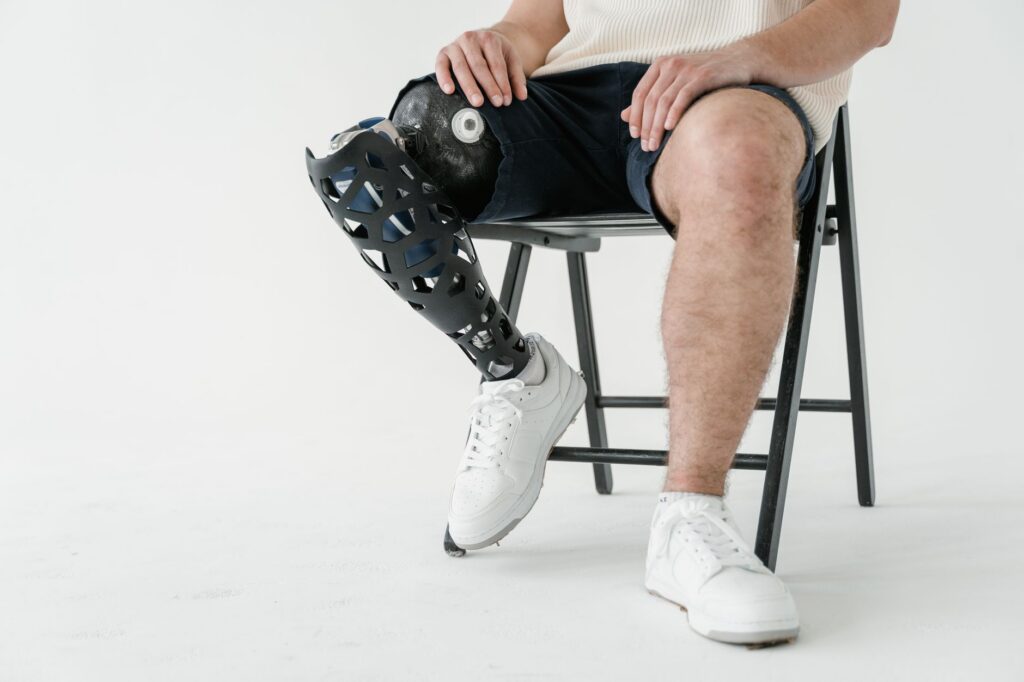
A modern prosthetic limb is not a one-time buy. A computer-controlled prosthetic knee or a myoelectric arm can cost tens of thousands of dollars. It must be repaired, refitted, and fully replaced about every three to five years — for the rest of your life. That one fact reshapes what a serious amputation claim must account for.
Your claim can seek money for:
- Medical care — emergency treatment, the amputation and repeat surgeries, and hospital stays.
- Prosthetic devices — including decades of replacements and maintenance.
- Rehabilitation — physical therapy, occupational therapy, and mental-health support. (Phantom limb pain and depression are real, documented, and can be part of your claim.)
- Home and vehicle changes and assistive equipment.
- Lost wages and reduced future earning power.
- Pain, suffering, disfigurement, and loss of enjoyment of life.
To document lifetime costs credibly, we work with your treating doctors and with certified life-care planners. They project your care needs year by year. We can’t promise a specific dollar figure — no honest lawyer can. But we build the full, evidence-backed picture of what you will really need.
If a Family Member Did Not Survive
Some truck crashes are fatal. No article can soften that. If you’re reading this after losing someone, we’re sorry.
Under Florida’s Wrongful Death Act, Fla. Stat. §§768.16–768.26, a wrongful-death claim is usually brought by the personal representative of the estate. They bring it for surviving family members — a spouse, children, and parents. It can seek the value of lost support and services, loss of companionship and guidance, the survivors’ mental pain and suffering, and certain medical and funeral costs. Florida sets a two-year deadline for most wrongful-death claims under Fla. Stat. §95.11(5)(e).
You don’t need to understand any of that before you call. We handle these cases quietly and with dignity. We explain each step as it comes.
Have questions about what happened?
Ask our team directly. The first conversation is free, confidential, and there is no obligation to continue.
How the Process Works
- Free case evaluation. We listen, answer your questions, and explain your options at no cost.
- Rapid evidence preservation. We send spoliation (preservation) letters to secure key records. These include the truck’s electronic control module (“black box”) data, electronic logging device (ELD) records, dispatch and maintenance files, and dashcam footage. We act before they can be erased or the truck is repaired.
- Investigation. We reconstruct the accident, interview witnesses, and find every responsible party and insurer.
- Building the damages picture. We work with your medical providers and life-care planners to document lifetime costs.
- Negotiation and, if needed, litigation. We negotiate with the insurers. We file suit when that’s the right move.
- Resolution. The case ends in a settlement or a verdict. Then the money is paid out.
Why Speed Matters: Truck Evidence Disappears
- ECM and ELD data can be overwritten during normal use, sometimes within days.
- Trucks get repaired and put back on the road, erasing physical evidence.
- The trucking company’s insurer and investigators often start work within hours of a crash. You deserve someone moving just as fast for you.
- Deadlines are strict. Florida’s baseline for most injury lawsuits is two years under Fla. Stat. §95.11 (shortened from four years by a 2023 law change). Deadlines differ in other states. Missing yours can bar your claim entirely.
Contact CHG now to protect the evidence in your case.
Why Choose CHG Personal Injury Lawyers
- Our attorneys are licensed and admitted to The Florida Bar. You can review consumer guidance from The Florida Bar.
- We’re Florida-based and handle catastrophic cases throughout Florida.
- We focus on catastrophic, permanent injuries — amputation and limb loss, spinal cord injury, traumatic brain injury — not routine claims.
- We handle complex commercial-truck cases with several defendants and layered insurance.
- We offer bilingual English/Spanish support at every stage — ofrecemos apoyo en español.
- We work on a contingency fee: no attorney’s fee unless we recover money for you.
We make no guarantees about results. And we don’t claim to be “the best.” We commit to working hard and communicating clearly.
Frequently Asked Questions
How much does it cost to hire a truck accident amputation lawyer?
Nothing upfront. We work on a contingency fee. You owe no attorney’s fee unless we recover money for you. The first case evaluation is free. Ask us to explain how case costs are handled before you sign anything.
How long will my case take?
Serious cases usually take longer than minor ones. There is far more to prove — liability, federal-rule violations, and decades of future care. Some cases settle in negotiation. Others need litigation. We can give you a realistic timeline once we understand the facts.
What if the amputation was done by surgeons after the crash, not at the scene?
A surgical amputation caused by crash injuries is still tied to the crash. It can support a claim. If the medical care itself was mishandled, a separate medical negligence issue may also apply.
Can I still recover if I was partly at fault?
Possibly. Under Florida’s modified comparative negligence rule, Fla. Stat. §768.81, you generally cannot recover if you are more than 50% at fault. Any award is reduced by your share of fault.
How is a truck case different from a car case?
Truck cases involve federal safety rules, corporate defendants, higher insurance limits, and evidence that disappears faster. So they demand earlier, deeper investigation.
Do you handle cases outside Florida?
Yes. We take catastrophic-injury cases nationwide while staying a Florida-based firm.

Want to know where you stand?
Tell us what happened and our team will walk you through the options available to you, at no cost.
Talk to a Truck Accident Amputation Lawyer Today
You’re facing a hard road. You shouldn’t walk it alone. A truck accident amputation lawyer at CHG can carry the legal fight. You can focus on healing and your family.
The conversation is free. There’s no obligation. We offer bilingual support. You pay no fee unless we recover money for you.
Request your free, confidential case evaluation now.
Related reading: amputation and limb loss, truck accidents, catastrophic injury claims, and negligent security.
Why Amputation Cases Demand a Serious Legal Team
Trucking Evidence Moves Fast
Black-box data, driver logs, and maintenance records can be lost or overwritten. We act quickly to preserve what matters.
We Understand the Stakes
Amputation means lifelong medical care, prosthetics, and lost earning power. We build claims that reflect the true cost of your future.
Built for Families
When a loved one suffers a catastrophic injury or does not survive a crash, we stand with the family through every step.
Florida Roots, Nationwide Reach
Based in Florida and serving clients across Miami, Orlando, Tampa, Jacksonville, and beyond.
Be Careful With Insurance Adjusters
A trucking company's insurer may contact you early with a quick settlement. Amputation injuries carry decades of costs. Before you sign or give a recorded statement, talk to a lawyer who can explain your options.
Common Questions About Truck Accident Amputation Claims
What does it cost to hire us?
Nothing upfront. We work on a contingency fee — you owe no attorney's fee unless we recover money for you. Your first case evaluation is free, and we'll explain how case costs are handled before you sign anything.
How long will my case take?
Serious cases generally take longer than minor ones because the injuries and losses are more complex. We work to move efficiently while making sure your future needs are fully documented.
What if a loved one did not survive?
A fatal truck crash is the most catastrophic outcome there is. Families may bring a wrongful-death claim. We handle these matters with dignity and focus on what you can do next.
Who can be held responsible?
Depending on the facts, the truck driver, the trucking company, a maintenance provider, or others may share responsibility. We investigate to identify every accountable party.