

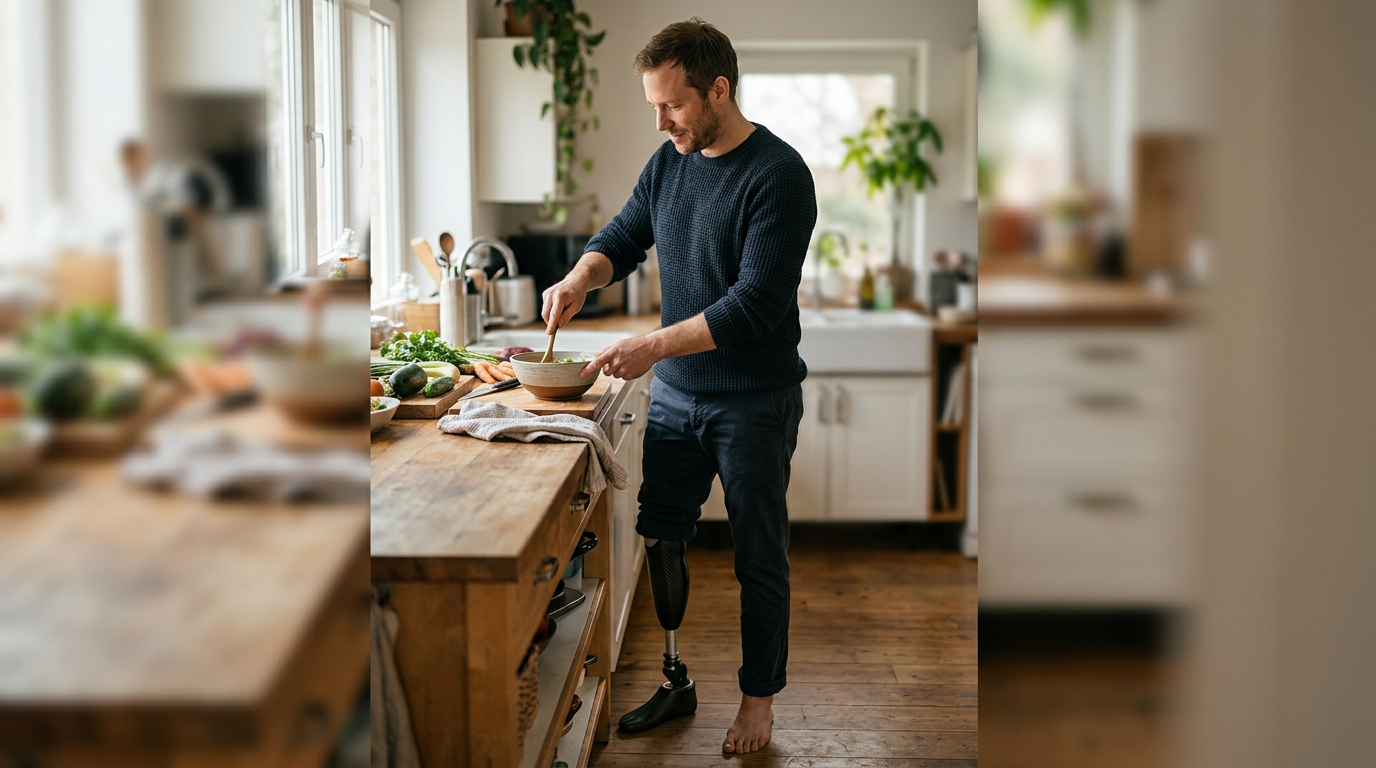
Amputation & Limb Loss Claims
Upper-Limb vs. Lower-Limb Amputation & Your Claim
Losing an arm, hand, leg, or foot changes daily life permanently. Where the limb is lost shapes your medical needs, your prosthetics, and the full value of your claim. Here's what families should understand.
Focused on Catastrophic Injury
Nationwide
Cases accepted across the U.S.
Florida
Bar-admitted attorneys
Bilingual
English & Spanish support
No Fee
Unless we recover for you
By CHG Lawyers · Published August 12, 2026
Upper-Limb vs. Lower-Limb Amputation: How the Injury Type Affects a Claim
Upper-limb amputation means losing part of the arm, hand, or fingers. Lower-limb amputation means losing part of the leg, foot, or toes. Both are catastrophic, permanent injuries. But they affect your body, your work, and your future costs in very different ways. Those differences matter a lot in a personal-injury claim.
This page explains the medical and practical differences in plain words. Then it links those differences to what shapes a fair recovery. That means lifetime prosthetic and care costs, lost earning power, and the human losses that don’t show up on a receipt.
These injuries often follow serious accidents. In the catastrophic-injury cases our attorneys handle, limb loss usually comes from truck crashes, crush and machinery injuries, fires, and violent attacks on property that failed to keep people safe.

Not sure what your next step is?
Talk it through with our team — the first consultation is free, confidential, and carries no obligation.
Upper-limb vs. lower-limb amputation: the short answer
The key difference is what each limb does. Your upper limbs grasp, hold, and handle fine tasks. Your lower limbs carry your weight and let you stand and walk. So the two kinds of loss create very different daily challenges. They need different prosthetics. They carry different lifetime costs.
That’s why the difference is not just medical. It drives real numbers in a claim. Think of the prosthetic you’ll replace for life, the therapy you’ll need, the home or vehicle changes, and the job you may no longer be able to do. Either type of amputation can end a career and reshape a family’s future.
What is the difference between upper limb and lower limb?
The upper limb runs from the shoulder to the fingertips. The lower limb runs from the hip to the toes. Each supports very different jobs.
The upper limb includes the shoulder, arm, forearm, wrist, hand, and fingers. It handles grasping, fine tasks, and even communication through gestures. The lower limb includes the hip, thigh, knee, lower leg, ankle, foot, and toes. It handles standing, balance, walking, and carrying your body weight.
Losing each one creates different problems. Upper-limb loss can make dressing, eating, typing, and driving hard. Lower-limb loss affects moving around, getting in and out of a chair or bed, and the risk of falls. Neither is “better” or “worse.” Both change everyday life in serious, lasting ways.
Amputation levels: how surgeons describe where a limb is lost
Doctors describe amputations by level. Level means how much of the limb is gone. The rule is simple. The higher the amputation, the more function is lost. The prosthetic and rehab also get more complex.
Upper-limb levels
Upper-limb loss can happen anywhere between the fingertips and the top of the shoulder. Every residual limb is unique, according to Arm Dynamics. Common levels, from lowest to highest, include:
- Finger or partial hand
- Wrist disarticulation (through the wrist)
- Below-elbow, called transradial
- Above-elbow, called transhumeral
- Shoulder disarticulation (removing the arm at the shoulder)
A shoulder disarticulation removes the full upper limb and shoulder joint, per NIH StatPearls.
Lower-limb levels
Lower-limb levels, from lowest to highest, include:
- Toe or partial foot
- Ankle, called a Syme’s amputation
- Below-knee, called transtibial
- Above-knee, called transfemoral
- Hip disarticulation
A “major” lower-limb amputation usually means one above the ankle, per the American Academy of Physical Medicine and Rehabilitation (AAPM&R). Keeping the knee joint matters a lot. Walking with a below-knee prosthetic takes far less energy than walking above the knee.
What body part is most commonly amputated?
Lower-limb amputations are the most common overall in the United States. But most of those follow disease, such as vascular disease or diabetes—not accidents.
The picture flips for limb loss from trauma. Trauma causes most upper-limb amputations. It causes only a small share of lower-limb amputations, per Physiopedia. Fingers and hands are often lost in machinery and crush injuries. Upper-arm amputation is also far less common overall. It affects roughly 41,000 people—about 3% of U.S. amputees, per ScienceDirect.
Why does this matter? Because accident-related limb loss is exactly the category behind an injury claim. Want the difference between a limb crushed in a crash and one removed by a surgeon later? See our page on traumatic vs. surgical amputation.
How upper-limb loss affects recovery and daily life
Upper-limb loss is often harder to adapt to than people expect. Hands and arms do fine, coordinated work. That work is tough to replace with any device.
Upper-limb prostheses come in two main types. Body-powered ones move by cables and body motion. Myoelectric ones move by muscle signals. Both are technically complex. In fact, upper-limb prostheses are often called “tools.” Lower-limb prostheses are called “replacements,” per the Amputee Coalition. That word choice tells you a lot. Many people find an arm or hand device harder to get used to than a leg.
The impact goes beyond tasks. Upper-limb loss affects independence, communication, and a person’s sense of self. Higher-level losses, like above-elbow or shoulder, make all of this harder. A lost hand can end a skilled trade or a job that needs fine hand control. For a claim, these losses mean adaptive equipment, occupational therapy, and home or vehicle changes.
Have questions about what happened?
Ask our team directly. The first conversation is free, confidential, and there is no obligation to continue.
How lower-limb loss affects recovery and daily life
Lower-limb loss centers on mobility, balance, and weight-bearing. Getting up, standing, and walking safely are the main challenges.
The level of the amputation shapes recovery. As noted above, a below-knee loss takes far less energy to walk with than an above-knee loss. Lower-limb prosthetics need gait training and repeated fitting adjustments over time. The socket must fit well, or the skin breaks down.
There are also long-term risks. Amputees face falls, skin problems, and strain on the rest of the body. People with lower-limb loss have a 2-to-4-times higher risk of upper-limb overuse injury one year after amputation, per the Physical Therapy Journal. At higher levels, a person may need a wheelchair for part of daily life. All of this shapes lifetime care planning in a claim.
Pain and psychological effects common to both
Both upper- and lower-limb amputees can develop phantom limb pain. This is pain or feeling that seems to come from the limb that’s gone. It’s a known medical complication after amputation, no matter which limb is lost.
The emotional toll is just as real. After a sudden crash or a violent attack, many people face grief, depression, and post-traumatic stress. These harms are not “extra.” They belong in a full accounting of what was lost. To learn more, see our page on phantom limb pain.
How the type of amputation affects a personal-injury claim
The type and level of amputation directly shape the money value of a claim. Different limbs mean different prosthetics, different replacement schedules, and different care needs over a lifetime.
Economic damages include the prosthetic and its lifetime replacements, rehab, home and vehicle changes, and attendant care. Costs add up over decades. For a closer look, see our page on prosthetic limb cost and lifetime replacement.
Lost earning capacity depends heavily on the person’s job. A lost hand may end the career of a surgeon or an electrician. A lost leg may end the work of a firefighter or a delivery driver. The same injury hits two people very differently.
Non-economic damages apply to both types of loss. These cover pain, loss of independence, disfigurement, and loss of enjoyment of life. Every case is different, and damages are figured out one at a time. We cannot and do not promise any specific result.
When someone else’s negligence caused the amputation
You may have a claim when someone else’s carelessness caused your limb loss. Common causes include truck and commercial-vehicle crashes, crush and machinery injuries, fires and burns, and violent attacks.
Here’s a scenario we see often. A person is shot, robbed, or assaulted in a dark parking garage, an apartment complex, or a store. The property owner had no working locks, no lighting, no cameras, and no guards. When a property owner fails to provide reasonable security, and someone gets hurt because of it, the injured person may have a claim against that owner. Lawyers call this a negligent security claim. If this describes your situation, see our page on negligent security claims.
Proving these cases takes work. It means showing who was at fault. It also means documenting a lifetime of needs with medical and vocational experts. And when a catastrophic injury is fatal, the family may bring a wrongful death claim. We handle these cases with care for the people left behind.
Two Florida rules matter here. Most negligence claims for causes on or after March 24, 2023 must be filed within two years, per Fla. Stat. §95.11. Florida also uses a shared-fault rule. A person found more than 50% at fault generally recovers nothing, per Fla. Stat. §768.81.
Talk with a catastrophic-injury attorney about your situation
You don’t need to know any legal terms to reach out. Just tell us what happened. Our team will explain your options in plain words.
CHG Personal Injury Lawyers offers a free, confidential case evaluation. We’re a Florida-based firm serving Miami, Orlando, Tampa, and Jacksonville. We take catastrophic-injury cases nationwide. Our licensed attorneys are admitted to the Florida Bar and focus on serious, life-altering injuries. We serve clients in both English and Spanish.
Contact us for a free case evaluation. To learn more about these injuries, visit our amputation and limb loss resource page.

Want to know where you stand?
Tell us what happened and our team will walk you through the options available to you, at no cost.
Frequently asked questions
What is the difference between upper-limb and lower-limb amputation?
Upper-limb amputation removes part of the arm, hand, or fingers. Lower-limb amputation removes part of the leg, foot, or toes. Each affects different functions and needs different prosthetics.
What body part is most commonly amputated?
Lower-limb amputations are the most common overall, but most follow disease. Trauma from accidents more often causes upper-limb loss, especially of the fingers and hands.
Which limb are you most likely to lose in an accident?
Trauma causes most upper-limb amputations. So accident-related limb loss often affects the arm, hand, or fingers, per Physiopedia.
How does the type of amputation affect a personal-injury claim?
It shapes prosthetic and lifetime care costs. It also affects lost earning capacity based on your job. A lost hand and a lost leg impact different careers in different ways.
How long do I have to file an amputation injury claim in Florida?
Most Florida negligence claims for causes on or after March 24, 2023 must be filed within two years, per Fla. Stat. §95.11. Talk to an attorney quickly to protect your rights.
Why the Location of the Amputation Matters to Your Claim
Different Lifetime Costs
Upper-limb and lower-limb amputations require different prosthetics, therapies, and home or vehicle modifications. Each carries its own long-term price tag that must be documented.
Different Impact on Work
Loss of a dominant hand can end a career that depends on fine motor skills, while lower-limb loss may affect mobility-dependent jobs. Lost earning capacity is a central part of the claim.
Different Daily Realities
Dressing, driving, walking, and caring for family are affected in distinct ways depending on which limb is lost. These human losses deserve to be counted, not overlooked.
Expert Medical Proof
Fully valuing limb loss usually requires input from prosthetists, life-care planners, and physicians. We work to build that record so the full extent of your losses is clear.
Don't Guess What Your Claim Is Worth
Insurers may offer a quick settlement before the true lifetime cost of an amputation is known — prosthetic replacements alone can recur for decades. Talk with a lawyer before you sign or accept anything.
Upper-Limb vs. Lower-Limb: A Plain-Language Comparison
Upper-Limb Amputation
Involves loss of part of the arm, hand, or fingers. It affects grip, fine motor control, and countless daily tasks. Prosthetics for the upper limb are complex, and dominant-hand loss can be especially disabling for work and independence.
Lower-Limb Amputation
Involves loss of part of the leg, foot, or toes. It affects standing, walking, and balance, and often requires mobility aids, gait training, and ongoing prosthetic care. Lower-limb amputations are the most common type overall.
What Both Have in Common
Both are permanent, life-altering injuries with real medical, financial, and emotional costs. When negligence caused the injury, families may be able to pursue compensation for both types.
How Losses Are Measured
Whether upper or lower, a claim looks at medical care, future prosthetics, lost income, home modifications, pain, and reduced quality of life — built on medical and vocational evidence.