


Motorcycle Accident Amputation Lawyer
Limb Loss in a Motorcycle Crash: You Have Options
If you lost a limb or suffered severe amputation in a motorcycle accident caused by someone else's negligence, CHG Personal Injury Lawyers can help you pursue the compensation you need for lifelong care and recovery.
By CHG Lawyers · Published September 28, 2026
Motorcycle Accident Amputation & Limb Loss: Legal Options in Florida
Losing a leg, arm, foot, or hand in a motorcycle crash changes everything. You’re learning to move, dress, and work in a body that no longer does what it did before — often while medical bills pile up and an insurance adjuster is calling.
If that’s where you are now, this page is for you. So is it for families whose loved one did not come home.
We wrote this to answer the real questions riders and families ask. It’s for people who suffered a traumatic or surgical amputation in a motorcycle crash, and for families of a loved one who did not survive. Motorcycle accident amputation claims are complex, but you don’t have to navigate them alone.
CHG Personal Injury Lawyers handles catastrophic-injury cases in Florida and nationwide. When you’re ready, a conversation with us is free and puts you under no obligation.

If you lost a limb in a motorcycle crash, you may be entitled to recover for lifetime care, lost income, and the toll on your life. Talk it through with our team — the first consultation is free, confidential, and carries no obligation.
What Counts as a Motorcycle Accident Amputation or Limb-Loss Injury
An amputation means losing all or part of a limb — either torn away in the collision or removed later by surgeons. The two paths matter for your claim:
- A traumatic amputation happens at the scene when the limb is severed in the crash itself.
- A surgical amputation happens in the hospital when a crush injury, infection, or loss of blood flow makes the limb impossible to save.
Levels of loss generally include:
- Fingers, hand, or below-elbow
- Above-elbow or full-arm
- Foot or below-knee
- Above-knee or full-leg
- Loss of more than one limb (multi-limb)
Riders face a danger drivers don’t: no metal cage, no seatbelt, no crumple zone. In a collision, your arms and legs make direct contact with vehicles, pavement, and guardrails. This is why motorcycle crashes so often cause limb loss rather than lesser injuries.
This is a catastrophic-injury practice. We don’t handle minor cuts or sprains. Learn more on our amputation and limb loss hub.
How Motorcycle Crashes Cause Amputations
Most amputations come from high-energy impacts where a limb is crushed, pinned, or torn. A few patterns come up again and again:
- Left-turn collisions. A driver turns across your path and fails to yield — one of the most common ways riders are struck.
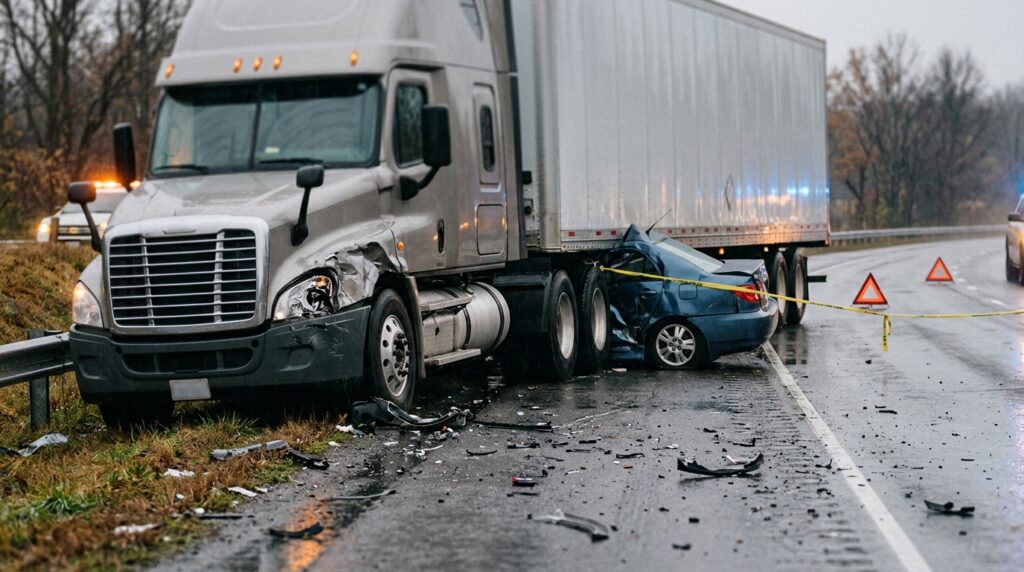
- Truck and large-vehicle crashes. The mass of a heavier vehicle turns a leg or arm injury into an unsalvageable one.
- Being pinned or dragged. A rider trapped under a car or dragged along the road can suffer damage no surgeon can reverse.
- Delayed amputation. Sometimes the limb survives the crash but must come off days later — from compartment syndrome (swelling that cuts off blood flow), infection, or tissue death. A delayed amputation is still a crash injury, and your claim should reflect it.
Some riders do not survive. When that happens, the family may bring a wrongful-death claim. We handle those cases with care, centered on the family and what they can do next.
What a Motorcycle Accident Amputation Claim Can Cover
A limb-loss claim seeks money for what you’ve already lost and what you will need for the rest of your life. Because these injuries are permanent, future costs usually dwarf today’s bills.
A claim may include:
- Past and future medical care — emergency surgery, hospital stays, rehabilitation, wound care, and revision surgeries
- Lifetime prosthetic costs — often the single largest number in the case. A prosthetic limb is not a one-time purchase: sockets, components, and the device itself wear out and are replaced repeatedly over decades. Advanced myoelectric limbs cost far more than basic ones.
- Lost wages and lost future earning capacity — including a forced career change when you can no longer do your job
- Home and vehicle modifications — ramps, wheelchair access, adapted driving controls, and in-home care
- Pain and suffering — including phantom-limb pain and the emotional toll of losing a limb
- Loss of enjoyment of life — and the strain on your family and relationships
Every case is different. No honest lawyer can promise a dollar figure. What we can do is document your true lifetime needs so nothing is overlooked or undervalued.
How Much Is an Amputated Leg Worth?
People search for this exact question, and they deserve a straight answer instead of a billboard number. Here it is: there is no fixed price for a leg or an arm. Anyone who quotes you a figure before reviewing your medical records and available insurance is not being honest.
What we can do is explain plainly what drives the value of a motorcycle accident amputation case like yours.
The factors that move the number most:
- The level and number of amputations. An above-knee loss carries higher lifetime prosthetic and mobility costs than a below-knee loss. Losing more than one limb raises them further.
- Your age and occupation. A younger person, or someone whose work is physical, generally faces larger future losses. Those losses stretch across more working years.
- Documented lifetime care. A life-care plan prepared by a certified planner, paired with an economist’s projection, turns “future costs” into concrete, defensible numbers.
- Fault. How the crash happened and who was responsible.
Florida uses a modified comparative-negligence rule under Fla. Stat. § 768.81. In plain terms: if you share some blame for the crash, your recovery is reduced by your percentage of fault. As amended in March 2023, the statute bars recovery entirely if you are found more than 50% at fault. So if a jury values your losses at $1,000,000 and assigns you 20% of the fault, you would recover $800,000 — but at 51% fault, you recover nothing. That is precisely why how fault gets investigated and argued matters so much.
Not sure what your next step is?
Talk it through with our team — the first consultation is free, confidential, and carries no obligation.
How the Process Works, Step by Step
- Free case evaluation. We listen, review what happened, and explain your options in plain language.
- Investigation. We gather the crash report, witness statements, photos, vehicle and scene evidence, and your medical records — often with crash-reconstruction experts.
- Building your damages. We work with your treating physicians, a life-care planner, and an economist to document your lifetime needs.
- Handling the insurers. We take over the calls and negotiations so you don’t have to.
- Settlement or lawsuit. We negotiate for a fair resolution. If the insurer won’t offer one, we are prepared to file suit and litigate.
Catastrophic cases take time. Settling before your future prosthetic and care needs are known almost always undervalues them. But deadlines still apply. Under Fla. Stat. § 95.11, most negligence claims arising on or after March 24, 2023 must be filed within two years. A wrongful-death claim also carries a two-year limit. Different deadlines can apply to claims involving a government vehicle or entity. It’s worth confirming yours early — waiting also lets evidence disappear.
You pay nothing upfront. We work on a contingency fee, which means our fee typically comes from the recovery — and if there is no recovery, you generally owe no attorney’s fee.
Why Work with CHG Personal Injury Lawyers
Amputation and limb loss is a core part of our catastrophic-injury practice, not an afterthought.
- Catastrophic-injury focus. We handle spinal cord injuries, traumatic brain injuries, severe burns, and limb loss.
- Licensed and admitted. Our attorneys are licensed and admitted to The Florida Bar.
- Florida-based, nationwide reach. We serve Miami, Orlando, Tampa, Jacksonville, and clients across the country.
- Bilingual service. We work in English and Spanish so families understand every step.
- Expert coordination. We build damages with medical and financial experts who quantify lifetime costs.
What Not to Do — and What to Do Next
The single biggest mistake is talking to the other driver’s insurer before you get legal advice.
- Don’t give a recorded statement to the other driver’s insurer before speaking with a lawyer.
- Be honest, and don’t guess. If you’re unsure of a detail, say so rather than filling gaps.
- Don’t accept a quick settlement before your full future medical and prosthetic needs are known.
- Preserve evidence. Keep the motorcycle, your gear, and every photo and medical record.
- Watch the deadline. Time limits are strict and vary by state.
Frequently Asked Questions
How much compensation can I get for losing a limb in a motorcycle accident?
There’s no set amount. It depends on the level and number of amputations, your documented lifetime costs, your share of fault, and the available insurance. We can’t promise a figure, but we can walk you through the factors that decide it.
Do I still have a case if the crash was partly my fault?
Possibly. Under Fla. Stat. § 768.81, your recovery is reduced by your percentage of fault. You generally can’t recover if you’re found more than 50% at fault.
What does it cost to hire a motorcycle accident amputation lawyer?
Nothing upfront. We work on a contingency fee, so our fee typically comes from any recovery. The case evaluation is free.
How long do I have to file a claim?
In Florida, most negligence claims are now subject to a two-year deadline under Fla. Stat. § 95.11. Wrongful-death claims carry a two-year limit. Deadlines vary by state and by who caused the crash — contact us to confirm yours.
Can you help if my family member died from their injuries?
Yes. Families can bring a wrongful-death claim, and we handle these cases with dignity and care.
Do you only take cases in Florida?
No. We’re Florida-based but represent clients nationwide, with bilingual English and Spanish support.
Have questions about what happened?
Ask our team directly. The first conversation is free, confidential, and there is no obligation to continue.
Talk to a Motorcycle Accident Amputation Lawyer
If you lost a limb in a motorcycle crash, you may be entitled to recover for lifetime care, lost income, and the toll on your life. You don’t have to face the insurance companies alone.
Your case evaluation is free, confidential, and comes with no obligation and no upfront cost. We serve riders and families in English and Spanish.
Contact CHG Personal Injury Lawyers for your free case evaluation, or learn more on our amputation and limb loss resource hub.
Act Quickly
Motorcycle accident claims are subject to strict time limits. The sooner you reach out, the sooner we can gather evidence, preserve witness statements, and build your case. Don't wait.
Why CHG Personal Injury Lawyers
Focused on Catastrophic Injury
We focus exclusively on severe and life-altering injuries—including amputation, spinal cord damage, and traumatic brain injury. We understand what you're facing and what recovery truly costs.
Thorough Case Investigation
We reconstruct accident scenes, review police reports, obtain medical records, and work with accident reconstruction professionals to establish liability and document the full scope of your injuries.
National Reach, Local Knowledge
No Attorney’s Fees Unless There Is a Recovery
We take cases on contingency. You pay nothing upfront, and we only collect a fee if we recover compensation for you.
Common Questions About Motorcycle Amputation Claims
How much compensation can I receive?
There's no fixed amount. Compensation depends on the severity and number of amputations, your documented lifetime medical and care costs, your share of fault (if any), and the available insurance coverage. We'll walk you through each factor and pursue the maximum recovery the facts support.
Can I still have a case if I was partly at fault?
Yes. Florida allows you to recover even if you share some responsibility for the crash—as long as you were not more than 50% at fault (Fla. Stat. § 768.81(6)). We'll investigate the full circumstances and defend your rights.
What if the other driver was uninsured?
You may have a claim under your own uninsured motorist (UM) coverage, or we can pursue other liable parties. We'll explore every avenue to secure the resources you need.
How long does a case like this take?
Every case is different. Some settle within months; others require litigation. We'll keep you informed every step and work at the pace that serves your interests best.