


Amputation & Limb Loss — Florida & Nationwide
Recovery After Amputation & Prosthetic Rehab: A Plain-Language Guide
Losing a limb changes your life, but it does not have to define your future. Here is what to expect from healing and prosthetic rehabilitation — and how to protect your right to recover the cost of a lifetime of care.
Guidance You Can Rely On
Licensed
Florida Bar–admitted attorneys
Nationwide
We take catastrophic-injury cases across the U.S.
Bilingual
Resources in English & Spanish
No Fee
Free, no-obligation case review
By CHG Lawyers · Published July 27, 2026
Prosthetics, Rehabilitation & Recovery After Losing a Limb: What to Expect
Recovery after an amputation happens in stages. It takes months and years, not one single event. First your body heals. Then you rebuild strength. Only later are you fitted for a prosthesis and taught to use it. Knowing this order in advance can make the road ahead feel less overwhelming.
This guide is for the injured person and the family beside them. It does two things most pages don’t do together. It walks through the medical recovery honestly. And it connects that recovery to the money and legal reality of a lifetime of care.
Every path is different. Your timeline depends on the cause of the amputation. It also depends on the level (below or above the knee or elbow), your age, and your overall health.
One important note: we are attorneys, not doctors. This page is general education, not medical advice. Every treatment choice here belongs to your care team. We defer to them throughout, and so should you. (CHG publishes this resource in English and Spanish so families can read it in the language they know best.)
If your amputation resulted from someone else's negligence, you may be able to seek compensation. Talk it through with our team — the first consultation is free, confidential, and carries no obligation.
What amputation recovery actually involves
Recovery is a long process with clear phases. Each phase has its own goals. The main phases usually look like this:
- Healing. The surgical wound closes and swelling goes down.
- Early rehab. You rebuild strength and learn to move safely.
- Prosthetic fitting. A specialist measures and builds a custom device.
- Training. You learn to stand, walk, or grasp with the prosthesis.
- Long-term adjustment. You return to daily life and fine-tune your care.
In the catastrophic-injury cases our attorneys handle, families are often surprised by two things. First, how long this takes. Second, how much of the cost repeats for the rest of a person’s life. Setting honest expectations early is not pessimism. It’s how you plan.
The early healing phase: the first days and weeks
The first days after surgery focus on wound care, pain control, and watching for infection. This time is usually spent in the hospital.
The part of the limb that remains is called the residual limb (older sources say “stump”). Your team works to reduce swelling and shape it. They use compression wraps called shrinker dressings or an elastic bandage. Good shaping now means a better prosthetic fit later. That small detail quietly decides how comfortable the next two years will be.
Doctors watch for problems. These include infection, poor wound healing, and blood clots (deep vein thrombosis). This is why follow-up visits matter. Missed visits can set the whole timeline back.
The emotional impact is real and expected. Grief, anxiety, and fear about the future are normal after limb loss. The Amputee Coalition — a national nonprofit — runs a Certified Peer Visitor program. It connects new amputees with trained volunteers who have lived it. Asking for that connection early is a sign of strength, not weakness.
Phantom limb sensation and pain
Phantom limb sensation is the feeling that the missing limb is still there. Phantom limb pain is when that feeling hurts. Both are common. Research summarized by the National Institutes of Health reports that most people feel phantom sensations after amputation. Neither one means something has gone wrong.
Many people feel tingling, itching, or temperature changes. Some feel like they can still move toes or fingers that are gone. For some, this turns into pain. That’s because the nerves and brain are adjusting to the change.
Care teams manage phantom pain in several ways. These may include medication, mirror therapy, gentle desensitizing of the residual limb, TENS, and nerve treatments. Which one fits you is your doctor’s decision, not ours. If the pain is severe or lasting, tell your team. They have options, and there’s no reason to suffer in silence.
Early rehabilitation: rebuilding strength before a prosthesis
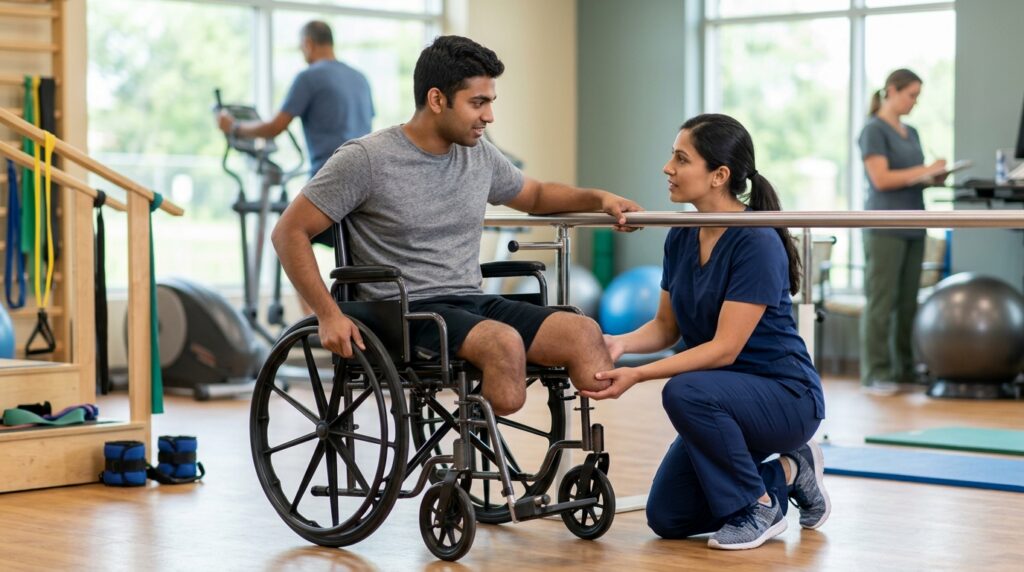
Rehabilitation usually begins within days of surgery, long before any prosthesis. Early physical therapy focuses on range of motion, strength, and balance.
A key early goal is preventing joint contractures. This is when a joint stiffens and gets stuck in one position. It can make a prosthesis harder or impossible to use. Simple daily stretches and good positioning keep the joint flexible.
You’ll also learn to move safely with a wheelchair, walker, or crutches. Occupational therapy helps you handle daily tasks again, like dressing, bathing, and cooking. The goal is rebuilding independence at home.
Your rehabilitation team may include:
- A physiatrist — a physician who leads rehabilitation care.
- A physical therapist — movement, strength, and walking.
- An occupational therapist — daily-living skills.
- A prosthetist — designs and fits the prosthesis.
- A mental health professional — emotional recovery.
The prosthetic fitting process: how and when
Fitting usually happens only after the residual limb has healed and its shape has settled. Rushing this leads to a poor fit and more problems. So patience really pays off.
A prosthetist handles the fitting. They measure and cast the residual limb to build the socket. The socket is the part that connects the device to your body. Socket fit is the foundation of everything else. A bad socket makes even the best parts uncomfortable.
Most people start with a preparatory (temporary) prosthesis. That’s because the limb keeps changing shape in the early months, so the device needs frequent adjustment. Later, once the limb is stable, you move to a definitive (permanent) prosthesis.
Components vary widely. Some focus on function, some on appearance. Some, called myoelectric devices, use muscle signals to control movement. Your prosthetist matches components to your goals and lifestyle.
Here’s a reality many people don’t expect: a prosthesis does not last forever. Devices wear out. They must be repaired, adjusted, or replaced throughout your life. Children need new ones as they grow. Adults commonly replace a prosthesis about every three to five years. This repeating need is central to the true cost of limb loss. And it’s exactly the part insurance often underestimates.
Not sure what your next step is?
Talk it through with our team — the first consultation is free, confidential, and carries no obligation.
Learning to use a prosthesis: gait training and functional recovery
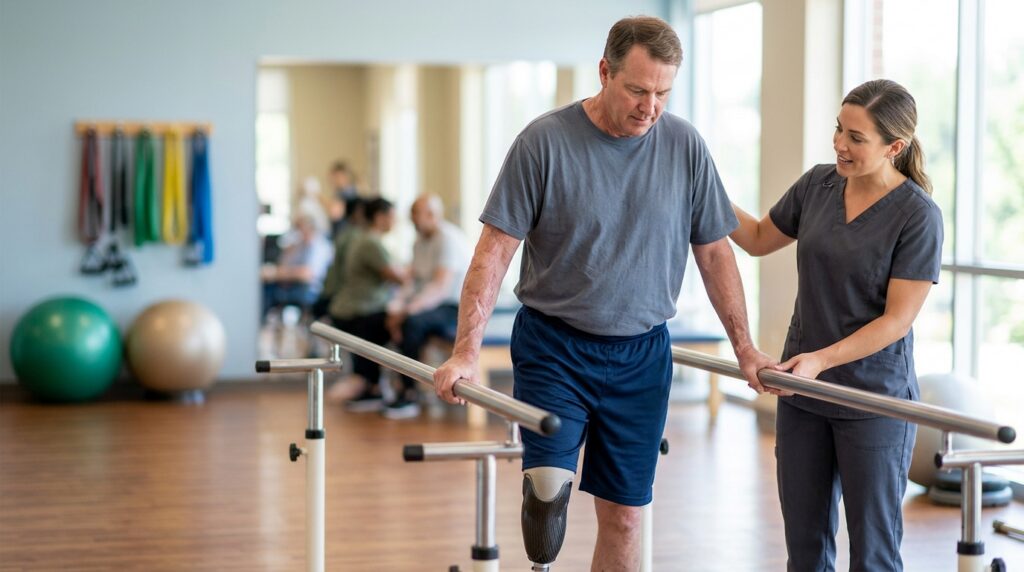
Once you have a prosthesis, you’ll train to use it. For a lower-limb device, this is called gait training — relearning how to stand, balance, and walk. For an upper-limb device, training focuses on grasping and handling objects again. Either way, it takes repeated practice with your therapy team.
You’ll build wear tolerance slowly. You start with short periods, then go longer as the skin adjusts. Daily skin care on the residual limb prevents sores and the setbacks they cause.
Progress varies. Some people walk with a prosthesis within a few months. Others need much longer. This is especially true after an above-knee amputation. There, the missing knee joint means the body must relearn and power more of the work of walking. Realistic goals and small milestones keep you moving. Here, patience isn’t optional. It’s part of the treatment.
A general recovery timeline: month by month
These are general ranges, not promises. Your care team sets your actual schedule.
- First few weeks: Wound healing, pain control, and gentle early rehab in and around the hospital.
- Weeks to a few months: Strength building, residual-limb shaping, and preparing for a prosthesis.
- A few months in: Fitting and the start of gait or functional training.
- Longer term: Ongoing adjustment, refinement of the device, and return to daily life.
Recovery is rarely a straight line. A setback can extend the timeline. This could be an infection or a revision surgery — a second operation to fix or improve the limb. That’s frustrating but common. It doesn’t mean you’re doing anything wrong.
Life after amputation: long-term adjustment and independence
Life after amputation can include work, driving, hobbies, and a full social life. Often this comes with adaptations that make daily activities possible again.
Long-term needs are real and recurring. They often include:
- Replacement prostheses and repairs over a lifetime.
- Physical-therapy tune-ups as your body changes.
- Home changes — ramps, grab bars, wider doorways.
- Vehicle changes so you can drive safely.
- Assistive technology and adaptive equipment.
Mental-health support and peer connection stay important long after surgery. And the caregiving side deserves to be named, not buried in a footnote. Loved ones often reshape their own careers, schedules, and finances to help. That work is real. It has value. It belongs in any honest count of what an amputation costs a family. Caregiver support resources exist. Using them protects everyone’s well-being.
The lifetime cost — and why it matters if someone else caused the injury
The lifetime cost of amputation recovery is large. Prosthetics, therapy, and ongoing care repeat for the rest of a person’s life. This is where the medical reality and the legal reality meet. It’s also where too many families are caught off guard.
A single advanced prosthesis can cost tens of thousands of dollars. You may need many over a lifetime. Add years of therapy, home and vehicle changes, lost income, and medical care. The total climbs into the hundreds of thousands or more. Private insurance often caps or excludes prosthetic coverage. That leaves families exposed to costs they never chose.
If your amputation resulted from someone else’s negligence, you may be able to seek compensation. Causes we see in catastrophic cases include:
- A truck crash caused by a negligent driver or trucking company. See our truck accidents page.
- A dangerous or defective product that failed and caused serious harm.
- A violent attack on property that wasn’t kept reasonably safe. Maybe you or a loved one was assaulted, shot, or attacked at an apartment complex, parking lot, garage, hotel, gas station, or business. If broken locks or gates, burned-out lighting, missing cameras, or absent security guards left you exposed, you may have a claim against the property owner. In legal terms this is called negligent security. Our negligent security page explains it in plain language.
Documenting your full course of treatment and future needs matters enormously. A detailed record shows a court or insurer what recovery truly requires. Experts often organize it into a life-care plan. This plan projects the cost of every future prosthesis, therapy session, and home change. Without it, decades of future cost can simply be left off the table.
Florida law also sets rules that affect these claims:
- Deadline to file. For most negligence claims arising on or after March 24, 2023, the statute of limitations is generally two years under Fla. Stat. §95.11. Missing it can end a valid claim before it starts.
- Shared fault. Florida follows modified comparative negligence under Fla. Stat. §768.81. A person found more than 50% at fault generally recovers nothing. Any recovery is otherwise reduced by their share of fault.
To learn more, visit our main amputation injuries page and our overview of catastrophic injury claims. A Spanish-language version of our amputation resources is available for Spanish-speaking families.
Have questions about what happened?
Ask our team directly. The first conversation is free, confidential, and there is no obligation to continue.
How CHG Personal Injury Lawyers can help
If your limb loss was caused by someone else’s negligence, CHG Personal Injury Lawyers offers a free case evaluation. It helps you understand your options. We focus on catastrophic-injury cases. We take cases nationwide from our Florida base, in English and Spanish.
Our team includes licensed attorneys admitted to The Florida Bar. We cannot promise a specific result — no ethical lawyer can. But we can listen, explain the process, and help you plan for the long road of recovery.
You’re facing enough already. Let us handle the legal questions while you focus on healing.
Contact us for a free case evaluation.
Frequently asked questions
How long does recovery take after an amputation?
Recovery generally takes several months to a year or more. Wound healing comes first, in the early weeks. Then prosthetic training follows over the coming months. Adjustment can continue for years. Your timeline depends on the amputation level, your health, and any complications. Your care team sets your actual schedule.
When can you be fitted with a prosthesis after amputation?
Most people are fitted only after the residual limb heals and its shape settles. This is often within a few weeks to a few months. Your prosthetist and doctor decide when you’re ready.
What is phantom limb pain?
Phantom limb pain is pain felt in the part of the limb that’s no longer there. It’s common and doesn’t mean something is wrong. It may be managed with medication, mirror therapy, and other treatments your doctor recommends.
How often do prosthetic limbs need to be replaced?
Adults commonly replace a prosthesis about every three to five years as it wears out. Children need new ones more often as they grow. This lifelong, repeating cost is a key part of the true expense of limb loss.
Can I file a claim if my amputation was caused by someone else’s negligence?
You may be able to. This applies if a truck crash, a defective product, or an attack a property owner failed to prevent caused your amputation. Contact a lawyer promptly. Florida generally sets a two-year deadline for most negligence claims under Fla (Fla. Stat. § 95.11(5)(a)). Stat. §95.11.
Does a below-knee amputation recover faster than an above-knee amputation?
Often, yes. People with a below-knee amputation may regain mobility sooner. The knee joint is preserved, so less walking function has to be relearned. Still, every recovery is different. Your care team guides your progress.
What Recovery Usually Looks Like
Wound Healing First
The early weeks focus on healing the surgical site, managing pain, and preventing infection. Your care team monitors the limb closely before any prosthetic work begins.
Prosthetic Fitting
Once the residual limb has stabilized and swelling settles, your team evaluates you for a prosthesis. Some patients start with a temporary device before a permanent one is fitted.
Prosthetic Training
Over the following months, physical and occupational therapists help you build strength, balance, and the skills to use your device in daily life.
Long-Term Adjustment
Adjustment — physical, emotional, and financial — can continue for years. Ongoing care, device replacements, and support are part of the journey, not a sign of failure.
A Prosthesis Is Not a One-Time Cost
Prosthetic devices wear out and need replacement over a lifetime, and your care needs can change. Before you accept any insurance settlement, talk with an attorney — a payout that ignores decades of future care can leave you paying out of pocket for the rest of your life.
How a Catastrophic-Injury Firm Can Help
Full Cost of Future Care
We work with medical and vocational experts to document the true long-term cost of your care, prosthetics, therapy, and lost earning capacity.
Holding the Right Party Accountable
Whether your limb loss followed a truck crash, another serious accident, or medical negligence, we investigate who was responsible.
Support for the Whole Family
Amputation affects everyone at home. We handle the legal work so you can focus on healing and rebuilding.
Straight Answers, No Jargon
We explain your options in plain language and never pressure you. You decide what happens next.