


Negligent Security · Florida & Nationwide
Lost a Limb After an Attack on Someone Else's Property?
If you were shot, assaulted, or attacked on a property that failed to keep you safe — and the injury cost you an arm, leg, hand, or foot — the owner may be legally responsible. Learn what your options are.
Why Families Turn to CHG
Licensed
Attorneys admitted to the Florida Bar
Nationwide
We take catastrophic cases across the U.S.
Bilingual
Guidance in English and Spanish
Free
Confidential case evaluation
By CHG Lawyers · Published August 16, 2026
Amputation Negligent Security Claim: Your Options After an Attack
Did you lose a limb in a violent attack on someone else’s property? You may have an amputation negligent security claim against the property owner — not just the attacker. A shooting, stabbing, or beating can happen at a place that failed to keep people reasonably safe. When that happens, the owner may share legal blame for what you lost.
You were hurt somewhere that wasn’t yours. An apartment complex. A parking garage. A hotel, bar, gas station, store, or ATM. The attack cost you an arm, a leg, a hand, a foot, or fingers or toes. That is a life-altering loss. You deserve real answers.
Here’s what many survivors never learn. The criminal who hurt you is responsible for the crime. But the property owner may also be responsible under civil law. This kind of case is called a negligent security (or inadequate security) claim. It is a type of premises liability. You don’t need to know these terms to start.
Request a free, confidential case evaluation »
Not sure what your next step is?
Talk it through with our team — the first consultation is free, confidential, and carries no obligation.
Who This Page Is For
This page is for people who survived a violent attack that caused amputation or limb loss. It is also for families acting on their behalf.
You may find this helpful if:
- You suffered a traumatic amputation (a limb cut off in the attack), a surgical amputation, or a crush or blood-flow injury that led to limb loss.
- You’re a family member acting for a loved one who lost a limb — or who died from injuries in the attack.
- The attack happened at an apartment complex, parking lot or garage, hotel or motel, bar or nightclub, gas station, store, or ATM.
- You’re not sure whether the property owner could share blame. That’s exactly what a case review is for.
CHG Personal Injury Lawyers is based in Florida. We handle catastrophic-injury cases nationwide.
When Is a Property Owner Legally Responsible for an Attack?
A property owner may be legally responsible when they failed to take reasonable steps to keep the property safe — and that failure helped the attack happen.
Owners who invite the public onto their property have a duty of care. That means they must take reasonable steps to protect people from foreseeable violent crime.
“Foreseeable” sounds like a legal word. But the idea is simple. Was the crime the kind of thing the owner should have seen coming? Signs of foreseeability include:
- Past crimes on or near the property.
- A location in a known high-crime area.
- Warnings or complaints the owner ignored.
Common security failures that can support a claim include:
- Broken or missing gates and locks.
- No security cameras, or cameras that didn’t work.
- Burned-out or missing lighting.
- No security guards where they were clearly needed.
- Propped-open doors or unlocked entry points.
- Ignored tenant or customer complaints about safety.
To prove this type of case in Florida, you generally must show four things. A duty existed. The owner failed to provide reasonable security. The harm was foreseeable. And that failure was a big factor in your injury.
Here is one Florida detail worth knowing. A 2023 law, Fla. Stat. §768.0706, gives owners of apartment-style properties a presumption against liability if they meet certain security measures. These include security lighting in parking lots and walkways, a peephole in each unit, and a crime-prevention assessment. Whether a property met those standards is a fact question a lawyer investigates. Every case turns on its own facts, and no outcome is ever guaranteed.
What an Amputation Negligent Security Claim Can Cover
An amputation negligent security claim can seek money for the full, lifelong cost of your injury. With limb loss, “lifelong” is the key word.
That may include:
- Medical costs: emergency care, surgeries, hospital stays, revision surgeries (later operations to reshape the limb), and rehab.
- Prosthetics over a lifetime (see below).
- Future care and support: ongoing treatment, home and vehicle changes, and assistive technology.
- Lost income: past lost wages and reduced future earning ability.
- Human losses: pain, suffering, disfigurement, and loss of enjoyment of life.
The honest truth about lifetime costs
Many pages quote a neat dollar figure for “the cost of an amputation.” We won’t invent one. Your number depends on your age, your limb, your work, and your health. An honest lifetime estimate is built by an economist and a physiatrist (a doctor who treats physical rehab needs). They review your records — not a chart.
Here is what we can tell you plainly, from how these cases are really valued:
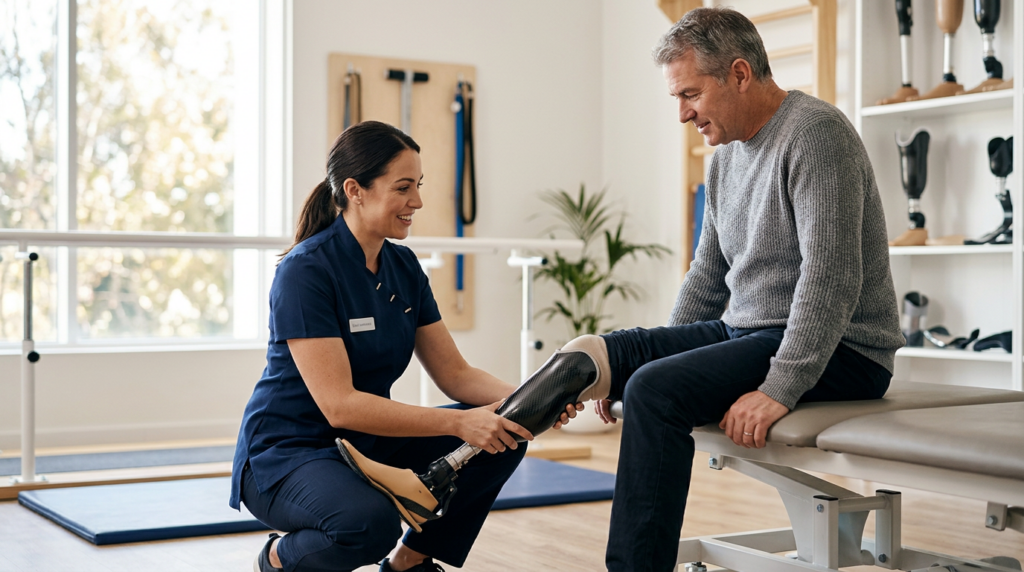
- A prosthetic limb is not a one-time purchase. Devices wear out. They are usually replaced every few years for the rest of your life. A child needs extra replacements simply from growing. Over decades, that means many devices, not one.
- The advanced device is often not the covered device. Microprocessor knees, myoelectric hands, and running or work-specific limbs often cost more than insurance pays. A claim can help cover that gap.
- The limb is only part of the bill. Sockets need refitting. The limb needs ongoing skin and pain care. Many amputees develop other issues too — for example, strain on the remaining limb from overuse.
- Your home and vehicle may have to change. Ramps, wider doorways, roll-in showers, and hand controls are real, repeating costs, not luxuries.
Getting this right is careful work. That’s why documentation matters so much. Learn more on our amputation and limb loss claims page.
If a loved one died from the attack, eligible family members may recover funeral costs, lost support, and loss of companionship. This is done through a wrongful-death claim under Florida’s Wrongful Death Act, Fla. Stat. §§768.16–768.26.
How the Process Works: What to Expect
- Free case evaluation. You tell us what happened. We listen and explain your options. It’s confidential, with no obligation.
- Investigation. We move fast to save evidence — security footage, incident and police reports, past-crime history for that address, and lighting and access conditions.
- Building the claim. We find every responsible party (owner, property manager, security contractor). We document your injuries and future needs with medical and economic experts.
- Demand and negotiation. We show the insurers and defendants the full picture of your harm.
- Litigation if needed. If no fair result comes, we can file suit and prepare the case for trial.
These cases take time, so act early. Evidence disappears, and legal deadlines apply.
Most personal-injury cases run on a contingency fee. In plain terms, that usually means no fee unless there’s a recovery. Legal fees come out of any recovery, not out of your pocket up front. The exact terms are set out in a written agreement. You can confirm them in your free consult.
Have questions about what happened?
Ask our team directly. The first conversation is free, confidential, and there is no obligation to continue.
Act Quickly: Why Timing Matters
The proof that supports your claim can vanish within days.
- Surveillance video is often deleted or recorded over on a short cycle — sometimes 30 days or less. An early preservation (“spoliation”) letter can save key footage.
- Witnesses move and memories fade. Broken locks and dim lighting get repaired, erasing the scene.
- Legal deadlines are strict. In Florida, a general negligence claim that starts on or after March 24, 2023 must usually be filed within two years under Fla. Stat. §95.11. Deadlines vary by state and situation.
The sooner we investigate, the more we can protect your claim. Contact us today.
Why Families Choose CHG Personal Injury Lawyers
Families choose our firm because we focus on catastrophic, life-altering injuries — including amputation and limb loss — not routine cases.
- Our attorneys are licensed and admitted to The Florida Bar. We handle catastrophic cases nationwide.
- We work with medical and economic experts to document lifetime needs. That puts the true cost of limb loss on the table.
- We offer support and communication in both English and Spanish.
- We give caring, plain-language guidance. We handle the legal fight so you can focus on healing.
We can’t promise a specific result. No honest firm can, and Florida Bar rules forbid it. What we commit to is preparing your case thoroughly. If a medical error added to the loss of your limb, our medical negligence amputation page may also help.
Frequently Asked Questions
Can I sue the property owner if the attacker was never caught?
Yes. The owner’s civil responsibility is separate from the criminal case. So you can still pursue a claim even if the attacker is unknown or never arrested.
What if I was partly at fault?
You may still have a claim. Under Fla. Stat. §768.81, Florida uses modified comparative negligence. If you are found more than 50% at fault, that usually bars recovery. A smaller share only reduces it.
How much does it cost to hire you?
Most cases are handled on contingency. That usually means no fee up front. The exact terms are in a written agreement you can review in a free consult.
How long do I have to file?
Deadlines are strict and vary by state. Contact us promptly so you don’t lose your rights.
What if my family member died from the attack?
Eligible family members may be able to file a wrongful-death claim under Fla. Stat. §768.21. We handle these cases with care and dignity.
Do you only take Florida cases?
No. The firm is Florida-based, but we represent catastrophic-injury clients nationwide.
What should I bring?
Any police report, medical records, witness names, and the address of the attack. Don’t worry if you don’t have everything — we can help gather it.

Talk to a Catastrophic-Injury Lawyer — Free and Confidential
An amputation after an attack changes everything. If unsafe property made that attack possible, the owner may owe you answers and accountability.
Your case review is confidential. It comes with no obligation and no up-front cost in most cases. We’re ready to listen in English or Spanish.
You Can Act Even If No One Was Arrested
A property owner's civil responsibility is separate from any criminal case. You may still have a claim even if the attacker was never caught or identified. Speak with an attorney before deadlines pass.
What a Safe Property Should Have Had
Working Locks and Gates
Broken entry gates, propped doors, and failed locks let dangerous people into places where you had a right to feel safe.
Adequate Lighting
Dark parking lots, garages, and walkways hide threats. Lighting is one of the most basic security measures owners are expected to maintain.
Cameras and Monitoring
Missing, broken, or unmonitored cameras can signal that an owner ignored known risks on the property.
Security Personnel
In places with a history of crime, reasonable security can mean guards or patrols. When owners cut corners, people get hurt.
Want to know where you stand?
Tell us what happened and our team will walk you through the options available to you, at no cost.
Common Questions After an Amputation Injury
The attacker was never caught
You can still pursue a claim against the property owner. Their duty to provide reasonable security does not depend on an arrest.
You were partly at fault
Under Florida's modified comparative negligence law (Fla. Stat. §768.81), you may still recover, though your share of responsibility can reduce the award.
What 'negligent security' means
It is the legal term for a property owner failing to provide reasonable protection against foreseeable crime — so a preventable attack led to a life-altering injury.
Life after limb loss
Amputation brings prosthetics, rehabilitation, home modifications, and lost income. A claim can seek to account for those lifelong costs.
Understand Your Options — With No Pressure and No Cost
Related practice areas
- Amputation & Limb Loss Injuries: Your Legal Rights After a Catastrophic Accident
- Workplace & Machinery Amputations: Recovering Beyond Workers’ Comp
- Surgical & Medical Negligence Amputation Claims
- How Much Is an Amputation Injury Claim Worth? Lifetime Cost Explained
- The Lifetime Cost of a Prosthetic Limb: Planning for Future Care