

Amputation & Limb Loss Injuries
Recovery After Traumatic Amputation: What to Expect
Losing a limb changes life in an instant. Understanding the road ahead — from surgery through long-term rehab — can help you and your family plan for what comes next.
Catastrophic Injury Representation You Can Rely On
Licensed
Florida Bar-admitted attorneys
Nationwide
We take serious injury cases across the U.S.
Bilingual
English & Spanish resources
Free
No-cost case evaluation
By CHG Lawyers · Published August 05, 2026
What to Expect After a Traumatic Amputation: Recovery, Rehabilitation, and Your Legal Rights
A traumatic amputation is one caused by an accident. It is not a planned operation for a slow illness like diabetes or cancer. It throws a family into a recovery no one prepared for.
There was no consult. There was no scheduling. There was no time to adjust. One moment life was ordinary. The next, a truck crash, a machine, or a violent attack took a limb.
This page is written for that person and that family. It gives you an honest, step-by-step map of what usually comes next. It also explains, in plain words, what the law lets you do when someone else’s carelessness caused the injury.
This is educational information, not medical advice. It is meant to support your surgical and rehab team, never to replace them. Every choice about your care belongs to you and your doctors. For the bigger legal picture, see our main guide on amputation and limb-loss injury claims.
Not sure what your next step is?
Talk it through with our team — the first consultation is free, confidential, and carries no obligation.
Why “traumatic” changes everything
Most articles about amputation are written for planned surgery. They speak to a patient who knew it was coming. That patient had weeks to prepare. Your situation is different in ways that matter, both medically and legally:
- The wound is dirty or crushed. After a crash or machine injury, surgeons often can’t close the wound cleanly the first time. Several cleaning surgeries are common. So are staged closures.
- There was no time to prepare emotionally. You are grieving a sudden loss while still in the ICU.
- Someone may be legally responsible. A planned surgery usually has no at-fault party. A traumatic amputation from a truck crash, faulty equipment, or an unsafe property often does. That changes who should pay for the decades of care ahead.
Keep that last point in mind through every stage below. The costs that follow are not “just medical bills.” When carelessness caused the injury, they are the measure of a legal claim.
Stage 1 — The hospital phase: surgery and stabilization
The trauma team’s first job is to save your life and stop the bleeding. After that, surgeons work to prevent infection. They save as much healthy tissue as they safely can. What remains is called the residual limb (the part of the limb that is left). Its length and shape decide how comfortably you can wear a prosthesis later.
Traumatic amputations often need more than one operation. First, surgeons remove tissue that can’t be saved. Then, days later, they do a revision or closure surgery once the wound is stable. The Cleveland Clinic notes that surgical wounds usually take about two to three months to heal and for swelling to go down. That is only the beginning.
The level of the amputation shapes the whole road ahead. A below-knee (transtibial) amputation keeps the knee joint. This usually makes walking with a prosthesis easier and less tiring than an above-knee (transfemoral) amputation. Losing an upper limb brings its own challenges with grip and fine tasks. From day one, a team of trauma surgeons, nurses, and therapists works together on your care.
Stage 2 — Rehabilitation: mobilization to reintegration
Lower-limb recovery often moves through three overlapping phases: wound healing, mobilization, and reintegration. The prosthetics resource Össur uses this framework to describe the journey.
Mobilization
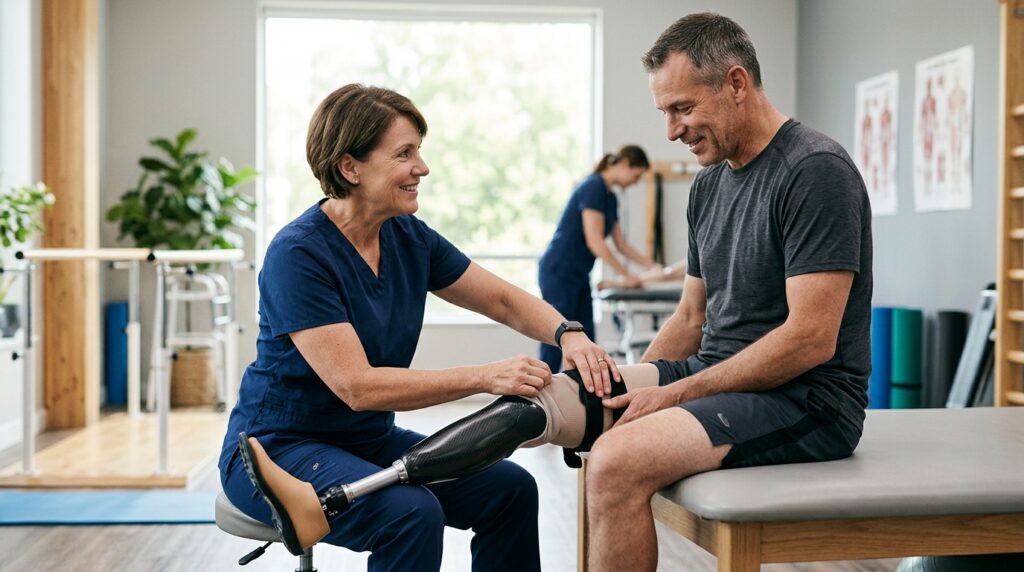
Once the wound is closing, the focus turns to movement. This means careful wound care. It means shaping and shrinking the residual limb with compression, such as shrinker socks or elastic wrapping. It also means early physical therapy to rebuild strength, balance, and stamina. Johns Hopkins Medicine is honest that this stage is long. It takes real effort from both the patient and the care team.
Prosthetic fitting
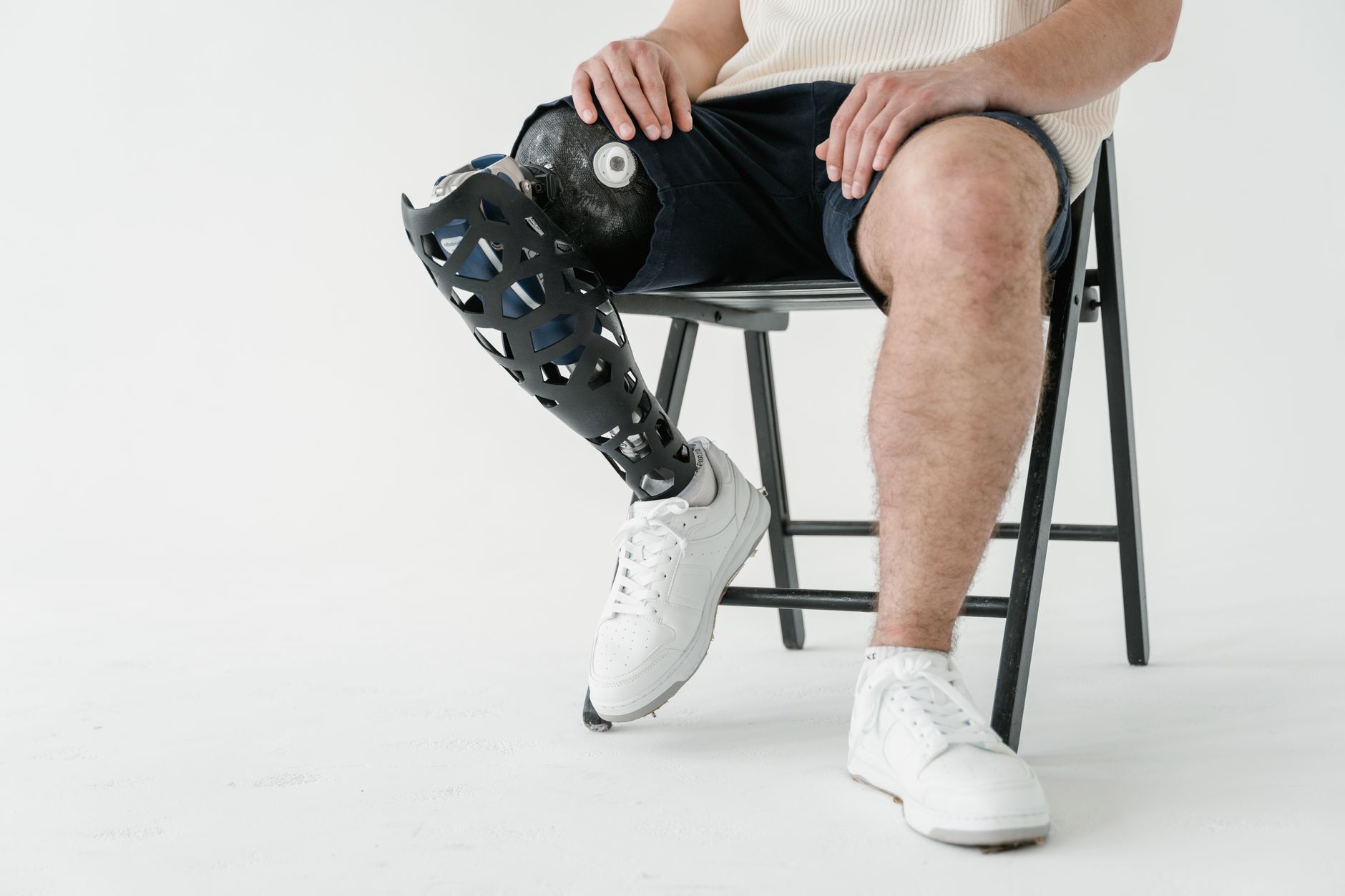
When healing allows, you may get a temporary (interim) prosthesis while the limb is still changing shape. Its size can shift for many months as swelling goes down. A definitive (long-term) prosthesis comes later. It is custom-fitted to the mature limb. Learning to use it is a skill you relearn. First comes sitting balance, then standing, then walking between parallel bars, and finally walking on your own.
Reintegration
The final phase is about your actual life: dressing, cooking, bathing, and moving safely through your home. Occupational therapists (specialists who help you do daily tasks) suggest home changes and new techniques. As NHS Inform explains, rehab is central to recovery. Many people go on to return to work and activities.
Here is one honest truth most pages leave out: rehab never fully ends. Prosthetic sockets need adjustment as your body changes. Devices wear out and must be replaced. We return to this reality when we talk about lifetime cost.
Managing pain, including phantom limb sensations
Phantom limb pain is real, not imagined. Many people feel pain, tingling, or other feelings that seem to come from the limb that is gone. It is one of the most common experiences after amputation. It is nothing to be embarrassed about.
Care teams use several tools. These include medication, desensitization and physical therapy techniques, mirror therapy, and treatments aimed at the nerves. What works varies from person to person. So this is general information, not a treatment plan.
Tell your team about every kind of pain, even the ones that are hard to describe. They can only treat what they know about. Pain management is often a long-term part of recovery. It affects sleep, mood, and daily comfort.
The emotional and mental-health side of sudden limb loss
Grief, anxiety, and depression are normal responses to losing part of your body without warning. Anger, fear, and low mood are not signs of weakness. They are human responses to a life that changed in an instant.
Mental-health support matters as much as physical care. Counseling helps. So does peer support: talking with other amputees who truly understand can lift a weight that clinical care alone cannot. Family members and caregivers carry their own exhaustion and grief. They deserve support too.
When carelessness caused the injury, this emotional harm is a legitimate, compensable part of a legal claim. It is often called pain and suffering, and it is not a side note. In the catastrophic cases our attorneys handle, the toll on the whole family is real and lasting.
Have questions about what happened?
Ask our team directly. The first conversation is free, confidential, and there is no obligation to continue.
Returning to work and daily life
Whether you return to work depends on your job, your amputation level, and how recovery goes. There is no single answer. Many people do return, sometimes to the same role and sometimes to a new one. Families often explore:
- Modified duties or lighter tasks at the current employer
- Workplace accommodations, such as adaptive tools or a reconfigured workspace
- Retraining for a different role through vocational rehabilitation
- Adaptive technology for driving, hobbies, and daily tasks
Some people fully return to their old work. Others cannot return to the same job or earn what they once did. That lost earning capacity (the money you can no longer earn) is a core part of what a legal claim addresses when someone else caused the injury. Documenting it properly often requires a vocational expert.
The lifelong cost — and why it drives the legal case
The true cost of a traumatic amputation is measured in decades, not in a hospital stay. Naming these categories is the first step to protecting your family’s future:
- Surgeries — usually more than one, plus later revisions
- Acute hospital care and early recovery
- Rehabilitation — physical and occupational therapy over time
- Prosthetics — costly devices that must be replaced from time to time for the rest of your life
- Home and vehicle modifications — ramps, wider doorways, hand controls
- Ongoing care — mental-health support and pain management
- Lost income and reduced earning power
Here is the point health and prosthetics vendors rarely make about the law: prosthetic limbs wear out, and insurance rarely covers the full lifetime cost. A young amputee may need dozens of replacement devices over a normal life span. Each one has its own fitting and therapy. That gap between what insurance pays and what a lifetime really costs is exactly why the legal claim exists.
When another party’s carelessness caused the amputation, the law lets the injured person seek compensation for these documented current and future costs. For local guidance, see our pages for Florida and Miami.
Your legal rights after a negligence-caused amputation
If someone else’s careless or unsafe conduct caused your amputation, you may have the right to seek compensation. The law calls a failure to act with reasonable care negligence. Common situations include:
- Truck and commercial-vehicle crashes, where a driver or trucking company was at fault — see our truck accidents guide.
- Dangerous machinery or defective products that fail and cause a crushing injury
- Unsafe property conditions that lead to a serious accident
- Medical negligence during care
A situation many people don’t realize is a claim: suppose you were attacked, robbed, shot, or assaulted on someone else’s property. This could be an apartment complex, a parking lot or garage, a hotel, a gas station, or a store. And suppose the injury cost you a limb.
If the property owner failed to provide reasonable security, you may have a claim against that owner. Reasonable security means things like working locks and gates, good lighting, security cameras, or guards. Lawyers call this negligent security (a type of premises liability for poor security). Our negligent security guide explains it in plain language.
A claim may seek medical costs, future care, lost earnings and earning power, and pain and suffering. No one can promise a specific outcome. Every case turns on its own facts.
Deadlines matter. In Florida, the deadline to file most negligence lawsuits is generally two years for claims that arose on or after March 24, 2023. This is under Fla. Stat. § 95.11. We handle cases nationwide, and deadlines vary by state, so ask a lawyer early.
Florida also follows a modified comparative-negligence rule. This means fault is shared. Under Fla. Stat. § 768.81, a person found more than 50% at fault generally recovers nothing.
Sometimes an amputation-related complication becomes fatal. If that happens, the family may have a wrongful-death claim. Our family guide to death from amputation complications explains those rights with care.
Whatever your situation, keep records of the injury, your care, and every expense. Those records tell your story when it matters.
How CHG Personal Injury Lawyers can help
CHG Personal Injury Lawyers carries the legal weight so your family can focus on recovery. We investigate what happened. We preserve evidence before it disappears. And we work with medical and vocational experts to put real numbers to your lifetime needs — future surgeries, prosthetic replacements, therapy, and lost earning power. That way, a claim reflects the full decades of cost, not just today’s bills.
Our firm is made up of licensed attorneys admitted to the Florida Bar. We handle serious catastrophic-injury cases nationwide, from truck crashes to negligent-security attacks.
Reaching out costs nothing and creates no obligation. A free case evaluation helps your family understand your options in plain language. We can’t promise a specific result. But we can help you see the road ahead clearly.

Want to know where you stand?
Tell us what happened and our team will walk you through the options available to you, at no cost.
Frequently asked questions
How long does it take to recover after a traumatic amputation?
Surgical wounds usually take about two to three months to heal, according to the Cleveland Clinic. But full rehab lasts much longer. It varies by amputation level and overall health.
What are the stages of amputation rehabilitation?
Recovery usually moves through wound healing, mobilization (building strength and shaping the residual limb), and reintegration (returning to daily life). Prosthetic fitting and gait or function training follow.
Is phantom limb pain normal after amputation?
Yes. Phantom limb pain and sensations are common and real, not imagined. Care teams use medication, physical therapy, mirror therapy, and nerve-directed treatments to help manage them.
Will I be able to return to work after losing a limb?
Many people return to work after rehab, though it depends on the job, amputation level, and recovery. Options include modified duties, workplace accommodations, and vocational retraining.
Who can be held responsible when an accident causes an amputation?
An at-fault driver, trucking company, product manufacturer, medical provider, or a property owner who failed to provide reasonable security may be legally responsible, depending on the facts.
How long do I have to file a legal claim after a traumatic amputation in Florida?
In Florida, most negligence claims arising on or after March 24, 2023 must be filed within two years under Fla. Stat. § 95.11. Deadlines vary by state.
Can my family file a claim if an amputation complication becomes fatal?
Yes. When an amputation-related complication causes death, the family may have a wrongful-death claim. A catastrophic-injury attorney can explain those rights.
Recovery after a traumatic amputation is one of the hardest journeys a family can face. You don’t have to face the legal side alone. Contact CHG Personal Injury Lawyers for a free case evaluation to understand your options.
Watch for Warning Signs During Healing
Increased pain, swelling, fever, or unusual drainage at the surgical site can signal infection or other complications. Contact your surgical team right away — catching problems early protects both your recovery and your future mobility.
The Stages of Amputation Recovery
Wound Healing
Surgical wounds generally take about two to three months to heal, according to the Cleveland Clinic. Timing varies by amputation level and overall health.
Mobilization
As the wound heals, therapy focuses on rebuilding strength, balance, and range of motion so the body can adapt to its new reality.
Prosthetic Fitting
Once the residual limb has stabilized, many patients are fitted for a prosthesis and begin learning to use it under a rehabilitation team's guidance.
Long-Term Rehab
Full recovery lasts far longer than wound healing — often extending into ongoing physical, occupational, and emotional support for months or years.
How a Catastrophic Injury Attorney Can Help
Account for Lifetime Costs
Traumatic amputation often means a lifetime of prosthetics, therapy, home modifications, and lost earning power. We work to document the full scope of your losses.
Investigate What Went Wrong
Whether your injury came from a truck crash, another serious accident, or a preventable failure by someone else, we investigate how it happened and who may be responsible.
Focus on the Whole Family
Life-altering injuries affect everyone at home. We handle the legal burden so you can focus on healing and adjusting to a new normal.
Answer Your Questions
You don't need legal vocabulary to reach out. We explain your options in plain language, in English or Spanish.