
Airplane Crash Injury Claims | Jacksonville, Florida
Hurt in an Airplane Crash? You Do Not Have to Face the Claim Alone
Aviation accidents involve investigators, airlines, aircraft owners, manufacturers, and insurers, all at once. CHG Personal Injury Lawyers, a Florida firm, helps injured people and families understand their options and what can come next.
Why Families Contact CHG
Florida
Serving injured people and their families throughout Florida
Free
Confidential first consultation, with no obligation to continue
No fees
No attorney's fees or case costs unless there is a recovery
By CHG Lawyers · Published November 10, 2026
Airplane Crash Injury Claims in Florida, Including Jacksonville
Airplane crashes are rare. But the harm they cause can be severe. Survivors may face spinal cord damage and paralysis, traumatic brain injuries, amputations, or severe burns. Other families lose someone they love.
If you or your family was hurt in an aviation accident, you need lawyers who can do two things. They need to explain the medical reality of a catastrophic injury. They also need to explain the legal rules that apply to aviation claims.
CHG Personal Injury Lawyers is based in Florida. The firm handles personal injury claims of every severity. It represents clients throughout Florida, including Jacksonville.
Igor Hernandez, one of the firm’s lawyers, is the responsible lawyer for this page. The firm’s lawyers are licensed to practice in Florida.
We work to preserve evidence. That means keeping important proof safe. We work to identify every party that may be responsible. We pursue the compensation your injury or loss deserves.
Not sure what your next step is?
Talk it through with our team — the first consultation is free, confidential, and carries no obligation.
Why Aviation Claims Are Different
Aviation claims are not like car or truck accidents. They can involve:
- Federal rules
- Several defendants (the people or companies being sued)
- International treaties, when a flight crosses borders
- Evidence that can disappear quickly
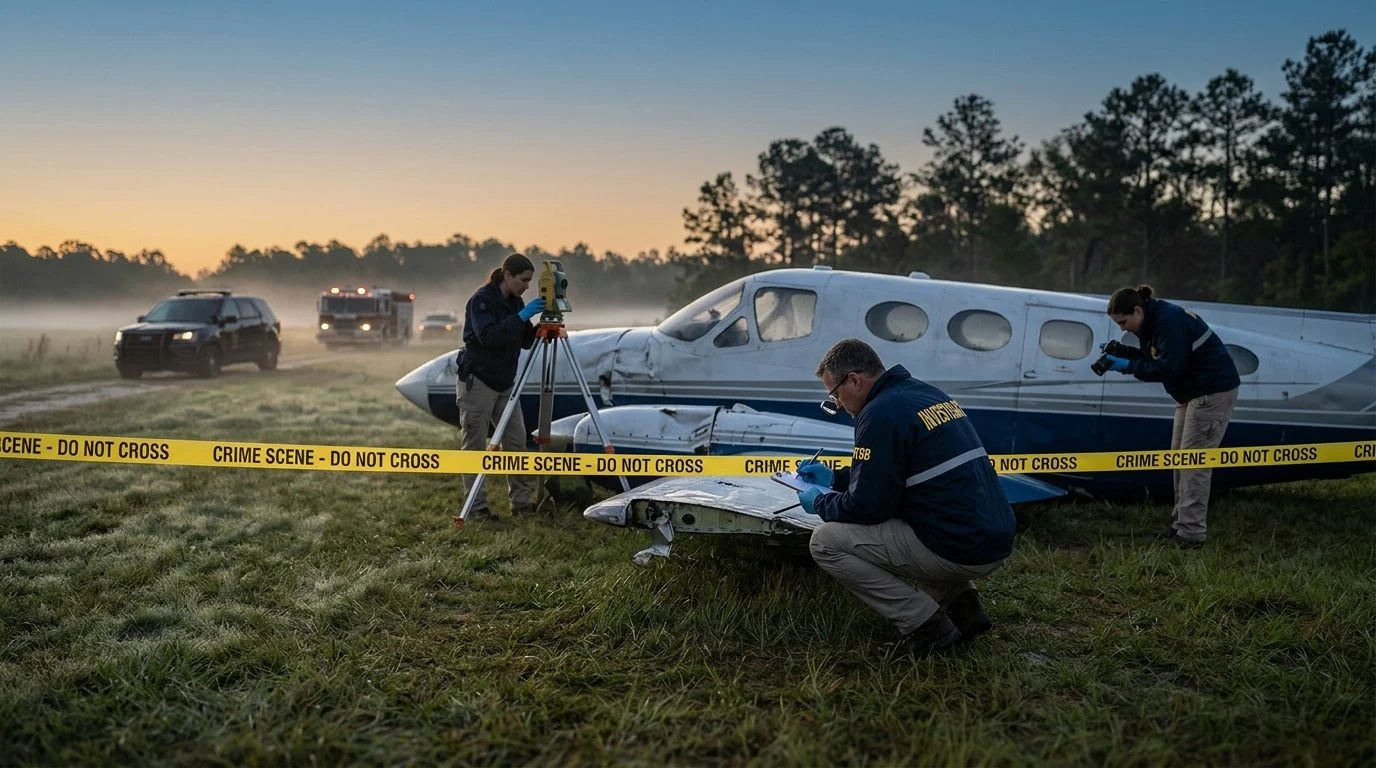
When an airplane crashes, the National Transportation Safety Board (NTSB) opens its own investigation. The NTSB is a federal agency. Its investigation can take months or years. It looks at:
- Mechanical failures
- Pilot error
- Maintenance problems
- Air traffic control mistakes
- Design defects
A civil claim can move at the same time. A civil claim is a lawsuit for money damages. We work to protect your rights while the facts are still available.
An airplane crash often involves many possible defendants. This is different from a two-car collision. These can include:
- The airline
- The aircraft manufacturer
- Maintenance contractors
- Component suppliers
- Pilots
- Air traffic control, where negligence contributed
Each one must be identified and examined.
Where the Accident Happened Matters
The location of a fatal crash can change which federal rules apply. For a death caused by a commercial aviation accident on the high seas, 46 U.S.C. § 30307 draws a line at 12 nautical miles from the shore of the United States.
- Beyond 12 nautical miles: Additional compensation can be recovered for nonpecuniary damages. These are damages for loss of care, comfort, and companionship. Punitive damages, which are meant to punish the wrongdoer, are not recoverable.
- 12 nautical miles or less from shore: The federal chapter does not apply.
For Florida’s coastal families, including those in Jacksonville, distance from shore can change what a family may recover. The investigation and the evidence establish that distance. It is not assumed from news reports.
Who This Page Is For
This page is for you if:
- You survived an airplane crash and suffered a permanent, life-altering injury.
- You lost a loved one in an aviation accident and are considering a wrongful death claim.
- You were hurt on the ground by an aircraft or debris from a crash.
- You want a Florida lawyer to explain your rights under Florida and federal law.
What We Handle in Airplane Crash Claims
Catastrophic injuries from aviation accidents:
- Spinal cord injuries and paralysis (paraplegia and quadriplegia)
- Traumatic brain injuries (TBI)
- Amputations and limb loss
- Severe burns
- Catastrophic back and neck injuries
- Wrongful death claims brought by family members
Types of aviation accidents:
- Commercial airline crashes and accidents
- Small aircraft and private plane crashes
- Accidents caused by pilot error, mechanical failure, maintenance negligence, or air traffic control mistakes
- Product defects, design flaws, or manufacturing failures in aircraft or aircraft parts
Florida focus: We represent people throughout Florida, including Jacksonville. If you were hurt in an airplane crash in Florida, contact us. We will talk through your options with you.
How an Airplane Crash Claim Moves Forward
Investigation and evidence. Aviation accidents trigger federal NTSB investigations. We work to preserve evidence and secure witness statements. We also work to protect your rights before others lose or control important information. Evidence can degrade. Memories fade. Defendants act quickly.
Identifying liable parties. Liable means legally responsible. We investigate to find every responsible party. Multiple defendants can mean multiple sources of recovery.
Technical questions. We work with independent engineers and medical professionals. They help us understand what went wrong. They also help us understand how it affected your health. Their findings help show how liability may be proven under federal aviation law and Florida personal injury law.
Negotiation and litigation. Negotiation means talking with the other side to reach a settlement. Litigation means taking the case to court. We pursue a fair settlement when possible. If defendants refuse reasonable compensation, we are ready to take the case to federal or state court.
Timeline. Aviation claims are complex. They can take several years. The time depends on:
- The NTSB investigation
- The number of parties
- Whether the case settles or goes to trial
We keep you informed at every stage.
Not sure what your next step is?
Talk it through with our team — the first consultation is free, confidential, and carries no obligation.
What You Must Show: Causation and Damages
Causation means the link between what someone did wrong and your harm. Florida negligence claims require “a reasonably close causal connection between the conduct and the resulting injury” and “actual loss or damage” (Clay Electric Cooperative, Inc. v. Johnson, Fla. 2003).
Florida’s standard civil jury instruction describes legal cause this way. Under Florida’s standard civil jury instruction on legal cause, “Negligence is a legal cause of loss, injury, or damage if it directly and in natural and continuous sequence produces or contributes substantially to producing such loss, injury, or damage, so that it can reasonably be said that, but for the negligence, the loss, injury, or damage would not have occurred.”
In plain terms, the link between a failure and your harm must be provable.
Understanding Florida Law in Aviation Injury Claims
Comparative fault: the 50 percent rule. Fault means responsibility for what happened. Under Florida Statute §768.81, fault chargeable to you reduces the damages awarded in a negligence case. The reduction matches your share of fault. But it does not, by itself, bar recovery.
The same statute says that, in a negligence action to which the section applies, a party found more than 50 percent at fault for his or her own harm may not recover any damages. This does not apply to an action for damages for personal injury or wrongful death arising out of medical negligence pursuant to chapter 766.
How fault is assigned depends on the facts of each case. This page does not predict how that rule would apply to your situation.
Damages you may recover. Damages are the money awarded for your losses.
- Medical expenses, past and future
- Lost wages
- Pain and suffering
- In wrongful death cases: funeral expenses and the family’s loss of companionship and support
Wrongful death claims. If your loved one died in the crash, Florida Statute §768.21 controls the damages available. Key points:
- All possible beneficiaries, including the decedent’s estate, must be named in the complaint. The decedent is the person who died. The complaint is the document that starts the lawsuit. Each beneficiary’s relationship to the decedent must also be stated.
- A surviving spouse may recover for loss of the decedent’s companionship and protection. A spouse may also recover for mental pain and suffering from the date of injury.
- Minor children may recover for lost parental companionship, instruction, and guidance. They may also recover for mental pain and suffering. If there is no surviving spouse, all children may recover these damages.
- Each parent of a deceased minor child may recover for mental pain and suffering.
When the injured person dies, a surviving spouse does not bring a separate loss of consortium claim. Loss of consortium means loss of the marriage relationship. The spouse’s damages are recovered in the wrongful death action under § 768.21(2).
The Florida Supreme Court also held that the “marriage before injury” rule does not bar that recovery (Ripple v. CBS Corp., Fla. May 9, 2024).
Under Florida Statute §768.25, while a wrongful death action is pending, a settlement as to amount or apportionment among the beneficiaries is not effective unless the court approves it, if any survivor objects to it or if it affects a survivor who is a minor or an incompetent. While an action under this act is pending, a settlement as to amount or apportionment among the beneficiaries that is objected to by any survivor, or that affects a survivor who is a minor or an incompetent, is not effective unless the court approves it.
- A survivor objects to the amount or to how money is split among beneficiaries. Fla. Stat. § 768.25 reads: “While an action under this act is pending, no settlement as to amount or apportionment among the beneficiaries which is objected to by any survivor or which affects a survivor who is a minor or an incompetent shall be effective unless approved by the court.”
- The settlement affects a minor or an incompetent survivor.
In those cases, the settlement is not effective unless the court approves it.
International treaties and liability limits. International flights follow the Montreal Convention. A treaty is an agreement between countries. Its liability rules can differ from U.S. personal injury law.
Under the Convention, the carrier cannot exclude or limit liability for a passenger’s death or bodily injury up to 151,880 SDR (about US$202,500), as of 28 December 2024. The carrier is the airline. SDR, or Special Drawing Rights, is an international unit of value. This figure comes from the International Civil Aviation Organization (ICAO).
Above that amount, the carrier may avoid liability only by proving certain things.
Under Article 35 of the Montreal Convention, the right to damages ends if a lawsuit is not brought within two years. The two years are reckoned from the date of arrival at the destination, or from the date on which the aircraft ought to have arrived, or from the date on which the carriage stopped.
- The date of arrival at the destination
- The date the aircraft ought to have arrived
- The date the carriage stopped
The law of the court where the case is heard decides how that period is calculated. We review how these rules may apply to your claim.
Filing deadlines. Under Florida Statute §95.11, a negligence action must start within 2 years. A statute of limitations is the deadline for filing a lawsuit.
The same statute sets a two-year period for an action founded on negligence. Under § 95.11(3)(d), an action for injury to a person founded on the design, manufacture, distribution, or sale of personal property that is not permanently incorporated in an improvement to real property, including fixtures, must be brought within two years. The property must not be permanently built into real estate.
Which period applies depends on the claim. Do not assume the longer one applies. Deadlines apply, so contact us promptly.
Cockpit Recordings and Why Early Contact Helps
People often talk about cockpit voice recordings after a crash. A cockpit voice recording captures what the pilots say. But federal law limits how these recordings can be obtained in a lawsuit.
Under 49 U.S.C. § 1154, a party in a lawsuit may not use discovery to get a cockpit recording. Discovery is the formal process of exchanging evidence before trial.
A court may allow this kind of discovery in limited cases. First, the judge must listen to the recording privately.
- The public parts must not give the party enough information for a fair trial.
- The extra material must be necessary for that purpose.
When a court does allow it, the court must issue a protective order. A protective order limits how the recording may be used. Its use is limited to the lawsuit.
Because access to a recording is restricted, a court may allow discovery of it only after an in camera review, and only if discovery is necessary to provide the party with sufficient information for the party to receive a fair trial.
- Medical records
- Photographs and videos
- Communications with the airline or airport
- Maintenance and inspection records
- Witness accounts
These sources can be lost or changed over time. That is why early contact matters.
CHG does not hold any cockpit recording. Nothing on this page means we do.
Why Choose CHG for Your Airplane Crash Claim
Catastrophic injuries and personal injury claims. CHG focuses on catastrophic injuries from serious accidents, including airplane crashes. The firm also handles personal injury claims of every severity.
Florida-based, serving Florida. CHG is based in Florida. Its lawyers are licensed to practice in Florida. We represent people throughout Florida in aviation injury claims.
Early action on evidence. Aviation claims move quickly. We work promptly to preserve evidence. We also work to protect your rights before critical deadlines pass.
Plain-language guidance. We explain aviation regulations and legal concepts in terms you can use. We treat your injury or loss with the dignity it deserves.
No upfront costs. CHG charges no attorney’s fees and no case costs unless there is a recovery.
Frequently Asked Questions About Airplane Crash Injury Claims
How much can I recover for pain and suffering in an airplane crash case?
The amount depends on several things. These include:
- The severity of the injury
- Your age
- Your life expectancy
- How the injury affects your daily life
In catastrophic cases, such as paralysis, severe brain injury, or amputation, pain and suffering is an important part of the claim. We work with treating physicians and independent medical professionals to document it.
Who can be liable in an airplane crash?
Liability depends on the cause. Possible defendants include:
- The airline, for example for pilot error, negligent maintenance, or inadequate training
- The aircraft manufacturer, for a design or manufacturing defect
- Component suppliers
- Maintenance contractors
- Air traffic control, where negligence contributed
We investigate to identify every responsible party.
How long does an airplane crash claim take?
Aviation claims are complex. They can take several years or longer. The NTSB investigation alone can take months or years. We work efficiently. We do not rush the investigation or preparation that a strong claim requires.
What if the crash happened outside the United States?
International aviation claims may be governed by treaties such as the Montreal Convention. Treaty rules can differ from Florida law. Contact us early.
What should I do right after an airplane crash to protect my claim?
Keep all records. These include:
- Medical records
- Photographs and videos
- Communications with the airline or airport
- Names and contact details of witnesses
Talking with the airline, the manufacturer, or their insurers can affect your claim. Let a lawyer handle those communications. Contact us as soon as possible.
Not sure what your next step is?
Talk it through with our team — the first consultation is free, confidential, and carries no obligation.

Get Your Free Case Evaluation Today
If you or a loved one suffered a catastrophic injury in an airplane crash, or lost someone in an aviation accident, you deserve answers. You deserve lawyers who take these claims seriously.
We offer a free, confidential first consultation, with no obligation to continue. We will listen to what happened. We will explain your rights under Florida and federal law. We will discuss how we can help you move forward.
Contact CHG today. Get your free case evaluation now.
This page is the responsibility of Igor Hernandez, one of the lawyers at CHG Personal Injury Lawyers.
How the Firm Helps After an Airplane Crash
Looking Beyond the Obvious
Aviation cases can involve the flight crew, aircraft maintenance, parts makers, air traffic control, or airport conditions. We review every possible source of responsibility.
Gathering the Records
Accident reports, maintenance logs, and other records can be difficult to obtain on your own. We work to request and preserve them for your case.
Support for Families
When a loved one has died or is facing a lifelong injury, families need clear answers. Our team explains each step in plain language.
Direct Conversation
Call CHG Personal Injury Lawyers to talk through what happened and learn how the firm may be able to help.
Protect Your Claim: Act Promptly
Deadlines apply to injury and wrongful death claims, and aviation cases can involve additional agencies and rules. Contact the firm as soon as you can so that evidence and records are not lost.
Questions Families Often Ask First
What should I do first?
Get medical care and follow your doctors' instructions. Keep any tickets, letters, photos, and notices you have received about the accident.
Who may be responsible?
Depending on the facts, responsibility may involve an operator, a maintenance provider, a manufacturer, or another party. Each case is different, and the firm reviews the details with you.
Can our family get answers?
Families often want to understand what happened. An attorney can help you request information and explain what the investigation records mean for your situation.