
Wrongful Death | Oakland Park, Florida
When a Florida Family Loses a Loved One, Clear Answers Matter
Grief comes first, but questions about responsibility, paperwork and money often follow. This guide explains what families can do next.
By CHG Lawyers · Published November 18, 2026
Losing someone you love is hard, and a wrongful death in Oakland Park can bring up questions about money and deadlines before you feel ready to answer them. Many families in Oakland Park and across Broward County want two answers first. Who can file a claim? How much time do they have?
If someone died because another person or company was careless, Florida law may let certain family members seek compensation. The claim is brought by the person appointed to handle the deceased person’s estate. It is brought for the benefit of the survivors and the estate.
Wrongful Death in Oakland Park: What Florida Law Provides
Florida law lets families seek compensation when someone else’s wrongful act or negligence causes a death. The rules are in the Florida Wrongful Death Act. It covers sections 768.16 through 768.26 of the Florida Statutes.
Under Fla. Stat. § 768.19, a person whose wrongful act, negligence, default, or breach of contract or warranty causes a death can be liable for damages, if the event would have entitled the person injured to maintain an action and recover damages if death had not ensued. This is true even though the person who was hurt has died.
Many families do not expect the next point. The claim does not belong to the person who died. Under Fla. Stat. § 768.20, the personal representative brings the claim. The claim is for the survivors and the estate. The same statute says that when a personal injury to the decedent results in death, no injury lawsuit survives the death, and any such case pending at the time of death ends. An injury case still pending when the person dies ends.
If your loved one started an injury case before the death, bring every document from that file to your first conversation. A lawyer can review what it means for your family’s next steps.
Not sure what your next step is?
Talk it through with our team — the first consultation is free, confidential, and carries no obligation.
Who Can Bring a Wrongful Death Claim in Florida
The personal representative brings the claim. It is for the survivors and the estate. Families often have questions about who handles a loved one’s affairs after a death. Families who lose a loved one often have questions about what they can do next.
Who counts as a survivor? Under Florida law, survivors include the decedent’s spouse, children, and parents and, when they were partly or wholly dependent on the decedent for support or services, certain blood relatives and adoptive brothers and sisters. Blood relatives and adoptive brothers and sisters can also qualify. They qualify only if they were partly or wholly dependent on the decedent for support or services. The statute treats children under 25 as minor children. That age rule matters for the damages discussed below.
Some families have less common relationships. Others shared support in unusual ways. These details can change who qualifies. Do not assume the answer before the facts are reviewed. Bring the full picture of your family to your consultation. Every family’s situation is different.
Fatal Crashes on Oakland Park Roads
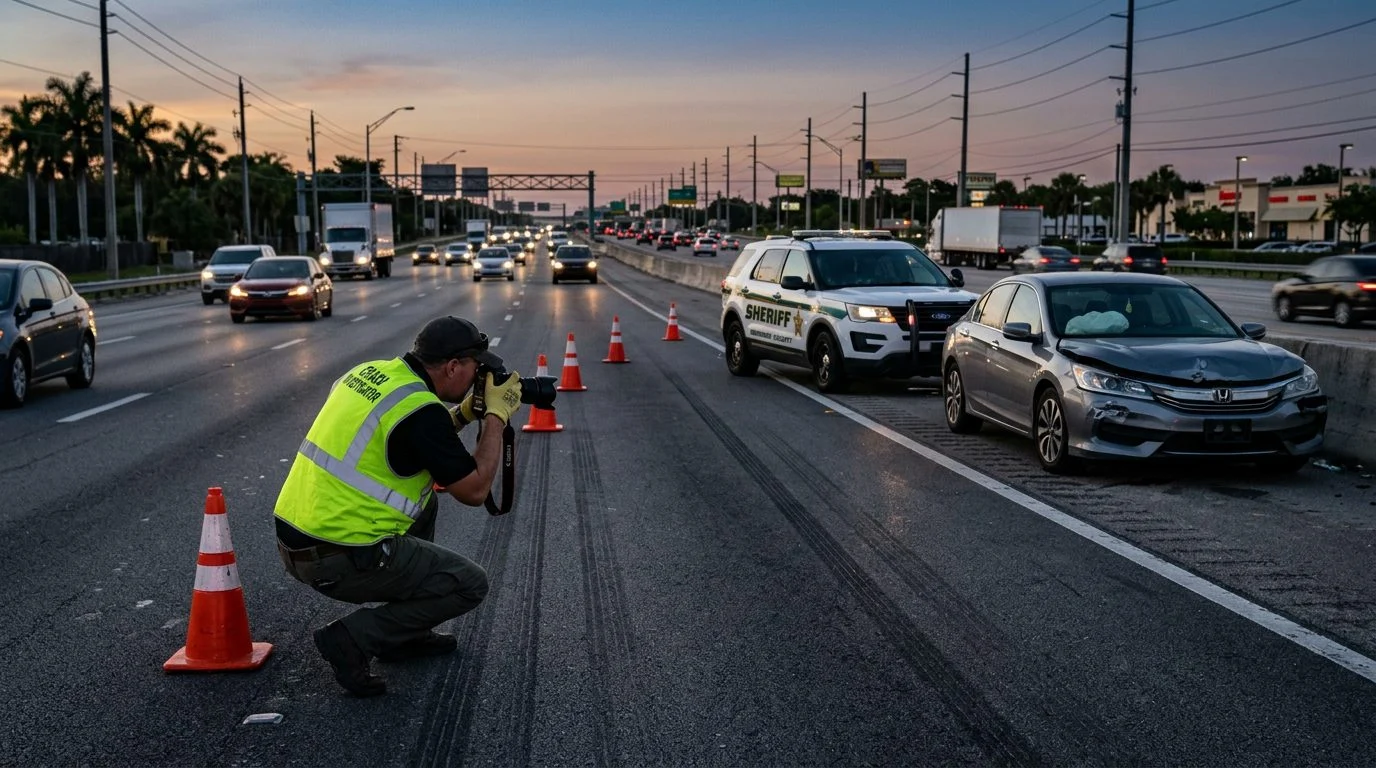
Fatal crashes on local roads can leave a family with a wrongful death claim. The claim may be against the driver or the company at fault. Many of these cases involve car crashes, motorcycle and ATV crashes, pedestrian and bicycle crashes, and Jet Ski accidents on local waterways.
Families drive busy roads every day. These include Oakland Park Boulevard, Federal Highway, Powerline Road, and Interstate 95. Crashes on these roads can involve several vehicles and several parties.
Commercial truck crashes often involve more than one responsible party. The driver may share blame with the company that operates the truck. Another business connected to the load may also play a role. Identifying every party early helps protect the claim.
The CDC also tracks traffic deaths involving impaired drivers. Its impaired driving facts page explains the risks.
When Violence or Neglect on Someone Else’s Property Causes a Death
Picture a loved one who parks in a dim apartment lot. Or they walk through a hotel garage. Or they leave a bar late at night. They are shot or attacked on that property, and they do not come home. Later, the family learns the gate was broken. The lights were out, or the cameras did not work.
Property owners are expected to keep their property reasonably safe. Depending on the property, that can mean working locks and gates, good lighting, security cameras, or guards. Lawyers call these claims negligent security.
When a person lawfully on commercial property is injured by a third party’s criminal act and sues the property owner, lessor, operator, or manager, how a court handles the claim depends on the facts of the case and on Florida law, which a lawyer can explain. Florida law also sets specific rules for apartment owners, and those rules can depend on the security measures the owner put in place. Families with questions about a property-related death can describe what happened during a consultation.
What Damages Florida Families May Seek
Florida’s wrongful death statute names the losses families can recover. The list is specific. Under Fla. Stat. § 768.21, each survivor may recover the value of lost support and services.
A surviving spouse may also recover for loss of companionship and protection. The spouse may recover for mental pain and suffering too.
Minor children, and all children of the decedent if there is no surviving spouse, may recover for lost parental companionship, instruction, and guidance. They may also recover for mental pain and suffering. Each parent of a deceased minor child may recover for mental pain and suffering.
A survivor who paid medical or funeral bills may recover those expenses. The personal representative may recover the deceased person’s lost earnings for the estate, less lost support of survivors excluding contributions in kind, from the date of injury to the date of death, with interest. These run from the date of injury to the date of death.
When a spouse is involved, the Florida Supreme Court addressed a key point. The spouse’s damages are recovered inside the wrongful death action. Each family’s losses differ, so review the specifics in a consultation.
Who Pays in a Wrongful Death Case
Compensation often comes from the liability insurance of the party found responsible. That might be a driver’s auto policy, a company’s liability policy, or a property owner’s policy. It depends on who was at fault. Policy limits can cap what an insurer pays. That is why the policies involved matter early.
Florida also applies comparative fault. This means each party’s share of blame is weighed. Under Fla. Stat. § 768.81, in a negligence action to which this section applies, any party found greater than 50 percent at fault for his or her own harm may not recover any damages. This subsection does not apply to an action for personal injury or wrongful death arising out of medical negligence pursuant to chapter 766.
A settlement can also reach the court while a wrongful death action is pending. The court may need to step in. Under Fla. Stat. § 768.25, while an action under the wrongful death act is pending, a settlement as to amount or apportionment among the beneficiaries is not effective unless the court approves it when a survivor objects to it or when the settlement affects a survivor who is a minor or an incompetent. The first is when a survivor objects to it. The second is when it affects a minor or incompetent survivor.
Not sure what your next step is?
Talk it through with our team — the first consultation is free, confidential, and carries no obligation.
Are Wrongful Death Cases Hard to Win?
Wrongful death cases can be complex. How strong a claim is depends on the facts. Disputes often center on who was at fault and what caused the death. Insurers may question both points. The evidence has to support each one.
Facing an insurance company alone can feel overwhelming. Families do not have to face that pressure without support.
No firm can promise a result. Past outcomes also do not predict how a new case will turn out. What a family can do is gather strong evidence early. That includes:
- Police and crash reports
- Photographs
- Witness names and phone numbers
- Medical and funeral records
- Any video from nearby businesses
Early evidence helps a family understand what they are dealing with.
Florida’s Filing Deadline and Steps to Take Now
Florida generally gives families two years to file a wrongful death lawsuit, but a wrongful death action brought against a natural person for an intentional tort resulting in death from acts described in s. 782.04 or s. 782.07 may be commenced at any time. Under Fla. Stat. § 95.11, a wrongful death action falls within the two-year group of deadlines.
Some intentional killings follow a different timeline. Under Fla. Stat. § 95.11, a wrongful death action brought against a natural person for an intentional tort resulting in death from acts described in s. 782.04 or s. 782.07 may be commenced at any time. The statute does not require an arrest, formal charges, or a conviction before a civil case is filed.
Other deadlines may apply. Contact a lawyer promptly rather than waiting. In the meantime, these steps can help:
- Keep the police or crash report, and note the report number.
- Save photos, videos, text messages, and voicemails.
- Write down the names and contact details of witnesses while they are fresh.
- Keep medical, funeral, and billing records together in one folder.
- Keep every letter from insurance companies.
Avoid giving recorded statements to insurance adjusters before you speak with a lawyer. Being careful with early words can protect your family’s claim.
Talk With Igor Hernandez About Your Family’s Case
If your family is weighing a wrongful death claim after a loss in Oakland Park or Broward County, now is the time to talk. A filing deadline is running, and questions keep piling up. A conversation can help you sort out the facts and the next steps.
CHG Personal Injury Lawyers is a Florida-based personal injury firm. It serves families throughout Florida. Igor Hernandez is one of the firm’s lawyers, and he is responsible for this page. The firm’s lawyers are licensed in Florida. CHG also publishes educational content in English and Spanish.
The initial consultation is free, confidential, and carries no obligation to continue. CHG charges no attorney’s fees and no case costs unless there is a recovery.
If your family is facing a decision about a wrongful death claim, contact CHG Personal Injury Lawyers today. Our team can listen to what happened and explain your options.
Frequently Asked Questions
What is a wrongful death claim in Florida?
A wrongful death claim is a lawsuit a family can bring when a person dies because of another party’s negligence or wrongful act. Examples include a crash or a violent attack on someone else’s property. It seeks compensation for losses the survivors suffered. These include lost support and services, the surviving spouse’s loss of the decedent’s companionship, and certain expenses tied to the death.
Who can bring a wrongful death lawsuit after a death in Oakland Park?
Under Florida’s wrongful death statute, the decedent’s personal representative may recover for the decedent’s estate certain losses, such as loss of earnings from the date of injury to the date of death, less lost support of survivors excluding contributions in kind, with interest. The claim is brought for certain survivors, such as a spouse, children, or parents. CHG Personal Injury Lawyers helps families in Oakland Park and throughout Florida understand who may be eligible to take part.
How long does a family have to file a wrongful death claim in Florida?
Florida generally requires a wrongful death lawsuit to be filed within two years of the date of death, but a wrongful death action brought against a natural person for an intentional tort resulting in death from acts described in s. 782.04 or s. 782.07 may be commenced at any time. The deadline can depend on the facts of the case. Families should contact CHG Personal Injury Lawyers promptly so important deadlines are not missed.
Does CHG Personal Injury Lawyers charge fees for a wrongful death case?
CHG charges no attorney’s fees and no case costs unless there is a recovery. The first consultation is free, confidential, and carries no obligation to continue.
How CHG Personal Injury Lawyers Supports Families
We Start With Your Family
We take time to understand your loss, your loved one's story and the questions weighing on you most.
We Look at the Facts
Our team reviews the accident or incident, the records and the people involved to understand how the death happened.
We Explain Your Options
We describe the wrongful death process in plain language so you can make decisions with confidence.
Licensed Florida Attorneys
Our attorneys are licensed and admitted to The Florida Bar, and we represent families throughout Florida, including Oakland Park.
Act Promptly
Deadlines apply to wrongful death claims in Florida. Contact our office as soon as you can so we can review your family's situation while the facts are still fresh.
Steps Families Often Take
Protect Your Records
Keep the police or incident reports, medical and funeral bills, and any letters from insurers or property owners.
Write Down What You Remember
Notes about the events, the people involved and the conversations you have had can help your attorney later.
Be Careful With Insurers
Insurance representatives may call quickly. Talk with an attorney before giving a recorded statement or signing anything.
Ask Questions Early
Bring your questions to a consultation. Our team will answer them in plain language, at your pace.