
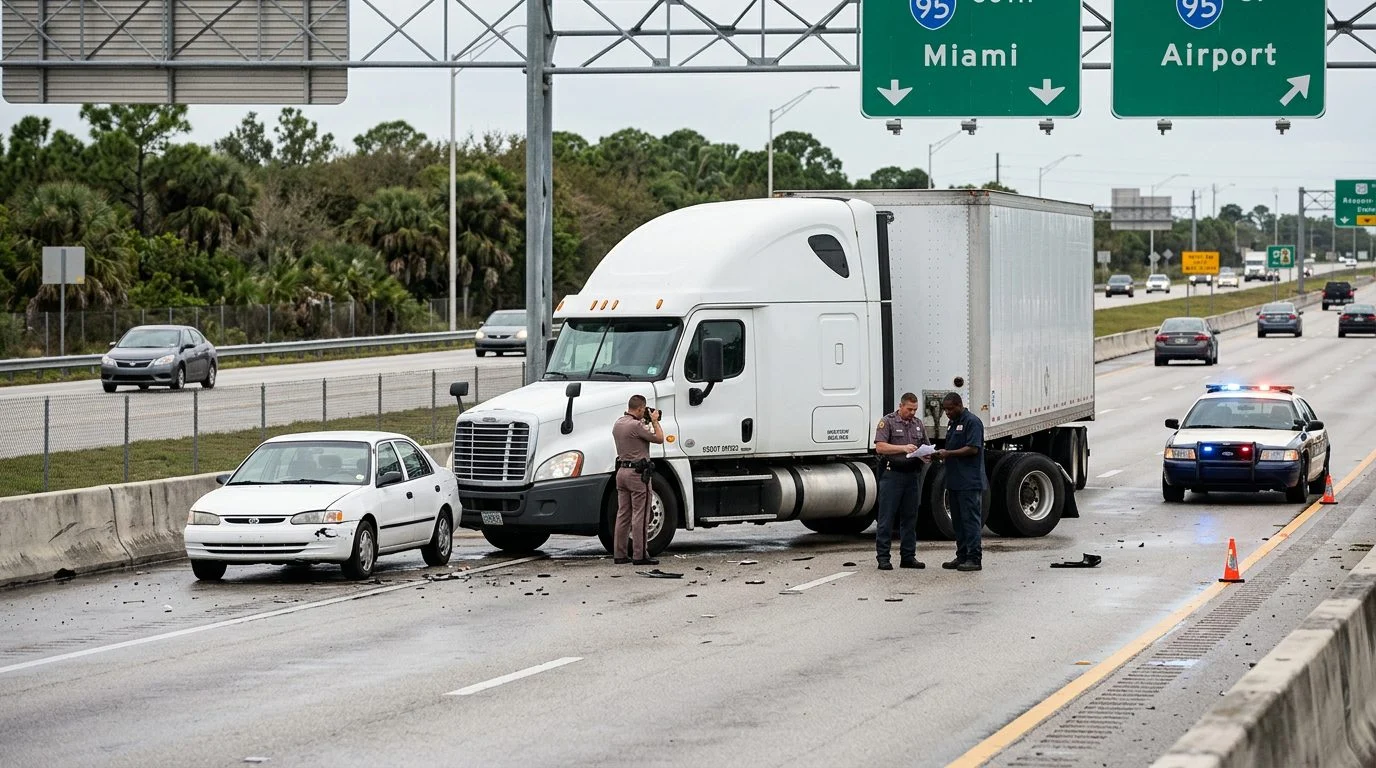
Truck Accidents | Serving Florida
The Truck Company's Own Records Can Help Prove What Went Wrong
After a crash with a commercial truck, the answers often sit in logs, inspection files, and onboard data. Here is how Florida families can start putting that evidence together.
By CHG Lawyers · Published November 29, 2026
How to Prove Trucking Company Negligence After a Florida Truck Crash
Yes, a claim after a truck crash can reach the trucking company as well as the driver. To prove it, you must show the company owed a duty, broke that duty, caused the harm, and left real losses behind.
If a truck crash has left your family with hard questions about who is responsible, our team can talk with you about your options and the records that may be at risk. Talk it through with our team — the first consultation is free, confidential, and carries no obligation.

Why the Trucking Company Can Be Responsible Too
A claim after a truck crash can name both the trucking company and the driver. The two claims often rest on different proof.
The company can also face its own claims. Those claims look at its decisions: who it hired, how it trained and supervised drivers, whether it kept the truck safe, and how it dispatched loads and tracked hours.
The driver’s conduct may be the immediate cause. The company’s records often show what it knew, what it checked, and what it let slide. Those records sit in the company’s hands, not yours.
For a broader look at these cases, see our truck accident overview.
What You Must Prove: Duty, Breach, Causation and Damages
To prove negligence, you must show four things. The company owed a duty, it broke that duty, the break caused the crash and your harm, and you suffered real losses.
Duty
Every trucking company and driver owes other road users a duty to operate safely. For commercial trucks, that duty includes the federal rules in 49 C.F.R. parts 382-386 and 390-397, which Florida applies to owners and drivers of commercial motor vehicles operated on its public highways while engaged in interstate commerce, and to those engaged in intrastate commerce, as those rules existed on December 31, 2023.
Breach
Breach means failing that duty. A driver who ignores hours-of-service limits is one example. A company that keeps a truck with known brake problems on the road is another.
Causation
Causation links the failure to the crash, and the crash to the injuries. A rule violation alone is not enough. The violation has to connect to how the crash happened.
Damages
Damages are the losses. They include medical bills, lost income, future care, and pain and suffering. In a wrongful death case, the losses belong to the family and the estate under Florida law.
Who Pays What Share
Florida does not hold each defendant liable for the whole amount. Under Fla. Stat. § 768.81, the court enters judgment against each party liable on the basis of that party’s percentage of fault, not on the basis of joint and several liability. When a truck driver and a trucking company are both sued, the court must sort out each one’s share. A defendant that wants to shift blame to someone who is not in the lawsuit must plead that nonparty’s fault and prove it at trial.
Can a Trucking Company Be Sued for Hiring or Keeping an Unsafe Driver?
Yes. Florida recognizes claims against an employer that failed to check a driver properly, or failed to act on what it knew about that driver.
Before hiring, a company should review the driver’s record and safety history. Federal rules require a carrier to investigate a prospective driver’s safety history with earlier DOT-regulated employers from the previous three years (49 C.F.R. § 391.23). If earlier employers fail to respond, prospective employers should report it to FMCSA and keep a copy of the report in the driver investigation history file. Replies, or documentation of good faith efforts to obtain them, must be placed in the driver investigation history file within 30 days of the driver’s start date (49 C.F.R. § 391.23). That review can show prior crashes, violations, or drug and alcohol problems.
Florida law also addresses hiring. In a civil action over injury caused by an employee’s intentional tort, under Fla. Stat. § 768.096, an employer is presumed not to have been negligent in hiring if it conducted a background investigation including the statute’s required steps that revealed nothing showing the driver was unsuitable. The statute says a background investigation must include a criminal background check, reasonable efforts to contact references and former employers, a job application asking about convictions and prior civil intentional-tort suits, and either a driver license record check (if relevant to the work and reasonably obtainable) or an interview. Whether those steps were actually taken, and what they uncovered, are questions the records can answer.
The story continues after hiring. Did the driver have complaints, citations, or crashes? Did the company retrain, discipline, or keep the driver on the road anyway? The answers often decide whether the company’s own conduct is part of the claim.
A common mistake is assuming the company is responsible just because it owns the truck. The claim needs proof of what the company knew or should have known.
Federal and Florida Trucking Safety Rules as Evidence of Breach
Federal trucking safety rules can help show breach. Florida law applies many of them to commercial trucks on Florida highways while engaged in interstate commerce, and to hazardous-materials transport whether interstate or intrastate.
Under Fla. Stat. § 316.302, all owners and drivers of commercial motor vehicles that are operated on Florida’s public highways while engaged in interstate commerce are subject to the federal rules and regulations contained in 49 C.F.R. parts 382-386 and 390-397. Thirty-four consecutive hours off duty ends such a period. Several areas often matter in a truck crash case:
- Driver qualification files: the application, motor vehicle records, and medical certificate (49 C.F.R. § 391.51).
- Hours and logs: carriers must require drivers to record duty status using an electronic logging device, though a carrier may allow manual logs in limited cases, such as a driver who needs a duty-status record on no more than 8 days within any 30-day period (49 C.F.R. § 395.8).
- Post-crash testing: alcohol and drug tests after certain crashes (49 C.F.R. § 382.303).
- Maintenance: systematic inspection, repair, and records (49 C.F.R. § 396.3).
Florida also publishes its hours-of-service rules for commercial drivers. A rule violation is evidence of breach. It still has to connect to the crash. For more detail, read how federal regulations affect truck accident lawsuits.
Evidence to Preserve Before It Disappears
The most useful evidence is usually the company’s own records. Some of them have short retention periods, so timing matters.
Key records include:
- Electronic logging device and hours-of-service data
- Engine data and dashcam video
- GPS data and dispatch messages
- Maintenance and inspection files
- The driver qualification file
- Post-crash drug and alcohol test results
- The police crash report
Retention periods are set by federal rules. Maintenance records must be kept where the truck is housed or maintained for one year, and for six months after the truck leaves the company’s control (49 C.F.R. § 396.3). The driver qualification file must be kept while the driver is employed and for three years after (49 C.F.R. § 391.51). These are minimums, but don’t wait for them to run out.
Post-crash testing also has time limits. If it is not administered within eight hours, the company must stop trying. For a controlled substances test, the company must stop trying after 32 hours (49 C.F.R. § 382.303). A driver who is subject to testing must stay readily available for it or may be deemed by the employer to have refused to submit to testing, but the rules also say that nothing requires delay of necessary medical attention for injured people following an accident.
A written preservation demand asks the company to keep these records. Florida courts handle lost evidence within the injury case itself. For more on the crash report, see Florida’s truck accident reporting requirements.
Not sure what your next step is?
Talk it through with our team — the first consultation is free, confidential, and carries no obligation.
Connecting the Company’s Failure to Your Injuries
Causation works as a chain. First, the company’s failure. Second, what the truck did in the crash. Third, the injuries that followed.
Accident reconstruction professionals are outside professionals. They study the crash scene, vehicle data, and photographs. They are not the firm’s own lawyers, and their findings help show how the chain fits together.
Medical records tie the injuries to the crash. Treating doctors’ notes matter. Follow your doctors’ care. This page does not give medical advice.
Some cases turn on equipment. A rear underride guard that fails in a crash is one example. Read more about underride truck accidents.
Equipment can also raise a separate question about the manufacturer. Under Florida law as amended in 2011, in a claim that a defective product, such as a vehicle’s design, made injuries worse in a crash, often called a crashworthiness claim, Florida Statute § 768.81 requires the trier of fact to consider the fault of all persons who contributed to the accident when apportioning fault between or among them; the 2011 amendment was intended to overrule the earlier Florida Supreme Court decision in D’Amario v. Ford Motor Co.. It asks whether the injuries were made worse by the design, not whether the design caused the crash.
Damages, Comparative Fault and Florida Deadlines
Florida’s fault rules and deadlines can shape a claim from the start.
For a wrongful death claim, the Florida Wrongful Death Act applies. A surviving spouse may recover for loss of support and services, for loss of the decedent’s companionship and protection, and for mental pain and suffering from the date of injury. Minor children may recover for lost parental companionship, instruction, and guidance, along with mental pain and suffering. Parents of a deceased minor child may recover for mental pain and suffering.
A surviving spouse does not bring a separate loss of consortium claim after a death. Thus, under the Act, the surviving spouse may also recover for loss of the decedent’s companionship and protection and for mental pain and suffering from the date of injury (Fla. Stat. § 768.21), and does not pursue a distinct loss of consortium claim (Ripple v. CBS Corp.).
Fault works differently in each claim. Stat. § 768.81, in a negligence action the court enters judgment against each liable party based on that party’s percentage of fault, not on joint and several liability.
Deadlines are strict. Florida law sets deadlines for filing negligence lawsuits, so contacting the firm promptly matters. Contact a lawyer promptly. The value of any claim depends on its facts, and no result is promised.
Medical bills paid by Medicare may also need attention. When Medicare has made conditional payments for accident-related care, those payments must be repaid when a settlement, judgment, award or other payment is made (CMS, Medicare Secondary Payer). CMS’s conditional payment letter does not state a final amount, and CMS does not issue a formal recovery demand until a payment is made (CMS, Attorney Services).
Settlement Values and What Shapes Them
Readers often ask what a claim against a semi truck is worth. This page does not state an average settlement figure, because no reliable average can be drawn from the facts this page covers, and a figure without the facts would mislead. Value depends on the severity and permanence of the injuries, the medical care needed, lost income, the number of parties and their shares of fault, and what the records show about the company’s own decisions. Stat. § 768.81(6), in a negligence action, any party found to be greater than 50 percent at fault for his or her own harm may not recover any damages, though this does not apply to an action for medical negligence under chapter 766.
How a Claim Against a Trucking Company Moves Forward
Most claims move through the same stages. Investigation and evidence preservation come first. Next comes a demand to the insurance carrier. If the claim doesn’t settle, a lawsuit may be filed in the proper Florida court.
Discovery follows. Lawyers may question the driver and the company’s safety managers under oath. Records are exchanged and reviewed. Then the case may settle or go to trial.
The timeline varies. Some claims settle before any lawsuit is filed. Others take longer. Each case moves at its own pace.
Insurance carriers often ask for early recorded statements. Those statements can shape how the claim is viewed later. Talk with a lawyer before giving one.
Talk With Our Lawyers About the Crash
If you’re reading this while a family member is in the hospital, or after losing someone, you’re gathering answers in the middle of something you didn’t choose. That is hard, and you don’t have to sort through it alone.
Timing matters. The company’s logs and maintenance files may be the first records to change hands, and some of them are kept for limited periods.
CHG Personal Injury Lawyers is a Florida-based firm. Igor Hernandez is the responsible attorney on this page. Contact CHG Personal Injury Lawyers to talk through the crash, the records, and the deadlines that may apply. CHG charges no attorney’s fees and no case costs unless there is a recovery.
If a truck crash has left your family with hard questions about who is responsible, our team can talk with you about your options and the records that may be at risk. Talk it through with our team — the first consultation is free, confidential, and carries no obligation.
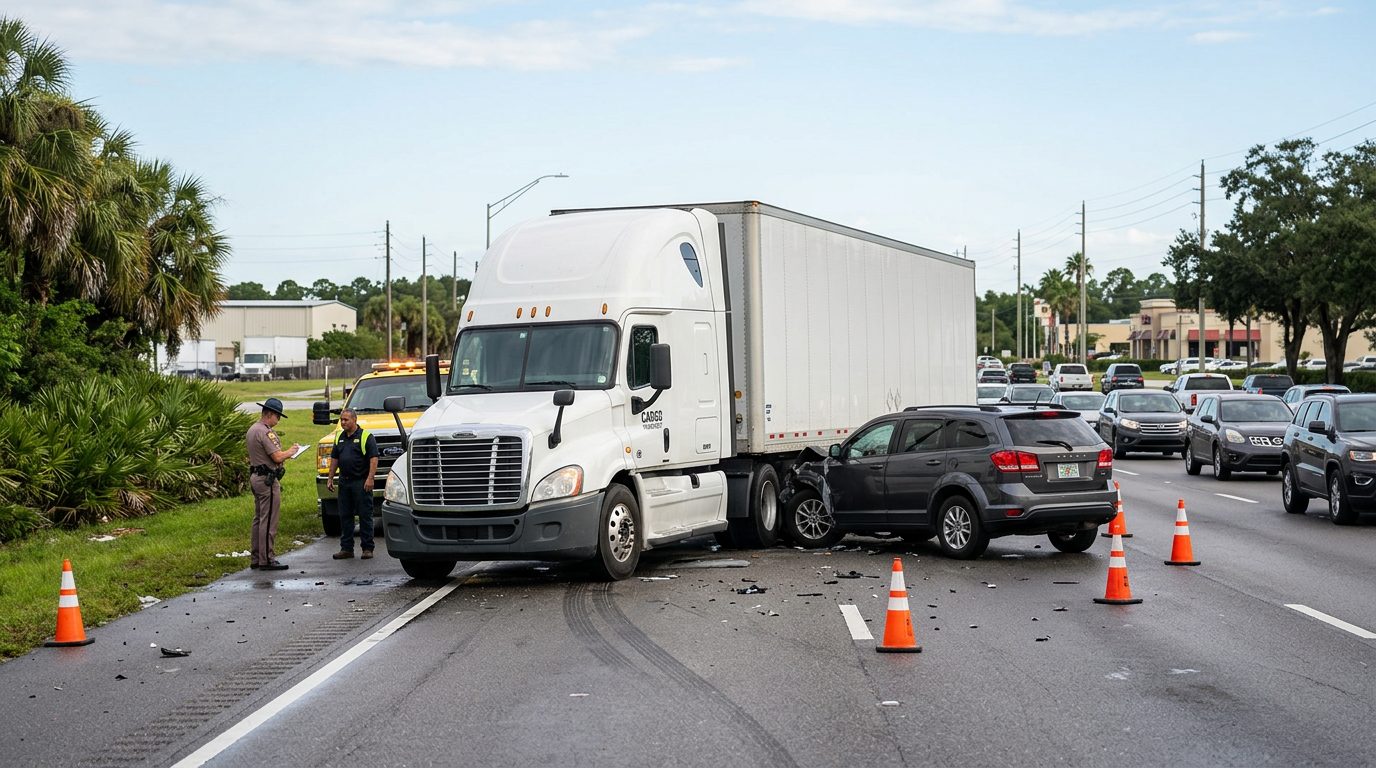
Frequently Asked Questions
What evidence is needed to prove a trucking company was negligent?
Proving negligence usually means showing the company owed a duty of care, failed to meet it, and that the failure caused the injury and damages. Key evidence includes driver logs, maintenance and inspection records, the driver’s qualification and training files, drug and alcohol testing records, and data from the truck’s onboard systems.
Can a trucking company be held responsible for its driver’s mistakes in Florida?
A company can also be liable on its own for negligent hiring, training, supervision, or retention if it knew or should have known about a driver’s risks and failed to act. In a civil action over an intentional tort committed by an employee, Florida law presumes an employer is not negligent in hiring if it conducted the background investigation described in Fla. Stat. § 768.096.
How can hours-of-service and electronic logging records help prove fault?
Federal trucking rules limit how long drivers may work and drive before resting, and carriers must keep records of that time. If logs show a driver exceeded these limits or the records do not match other evidence, such as fuel receipts or GPS data, that discrepancy can support a claim that fatigue or pressure contributed to the crash.
What deadlines apply to a truck crash claim in Florida?
Florida sets strict time limits for filing injury and wrongful death claims, so contacting the firm promptly matters. Because evidence such as logs and vehicle data can be lost over time, anyone affected by a truck crash should contact CHG Personal Injury Lawyers promptly.
Evidence That Often Matters in Trucking Cases
Driver Logs and Hours
Records of when the driver was on duty, driving, and resting can show whether fatigue or schedule pressure played a role.
Maintenance and Inspection Files
Repair orders, inspection reports, and parts records can reveal whether known problems were addressed before the crash.
Driver Qualification and Training
Hiring files, training records, and prior incident reports help show what the company knew about the driver's background.
Drug and Alcohol Testing
Testing records and related documentation can be important when impairment is in question.
Onboard Truck Data
Electronic logging, engine, and braking data can help reconstruct speed, braking, and events leading up to the collision.
Act Quickly to Protect the Evidence
Electronic data can be overwritten and records can be lost or changed over time. Acting early gives the best chance to request and preserve what matters for your case.
How a Trucking Case Is Typically Built
1. Document the Crash
Police reports, photos, witness information, and medical records create the starting point for the case.
2. Request the Company's Records
A formal request and preservation demand can ask the trucking company to keep its logs, files, and onboard data.
3. Review the Evidence
Our team reviews the records to see whether the company met its responsibility to operate safely and whether that failure contributed to the crash.
4. Connect the Dots
Medical, technical, and accident analysis is combined to show how the failure led to the injuries and losses.