
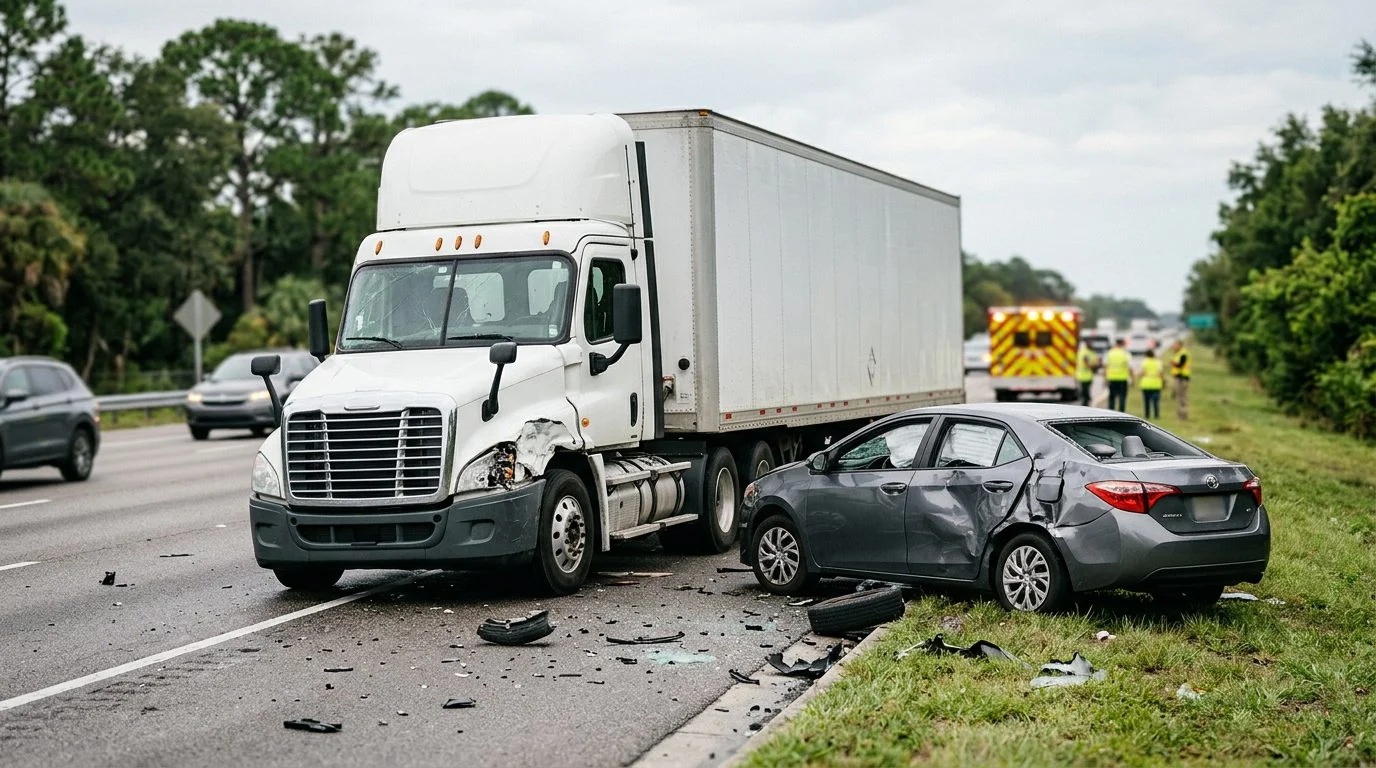
Florida Truck Accidents | FedEx Delivery Crashes
Hurt in a FedEx Truck Crash in Florida? Find Out Who May Be Responsible
Delivery trucks share Florida's roads every day. When one is involved in a crash, the question of who may be held responsible can be complicated, and the answer shapes what your family can do next.
About CHG Personal Injury Lawyers
Florida
Florida-based firm serving clients throughout the state
Licensed
Attorneys admitted to The Florida Bar
No fees
No attorney's fees or case costs unless there is a recovery
By CHG Lawyers · Published November 8, 2026
FedEx Truck Accident Liability in Florida: Who Pays and What to Do Next

Not sure what your next step is?
Talk it through with our team — the first consultation is free, confidential, and carries no obligation.
Who Pays After a FedEx Truck Crash?
A FedEx truck crash injured you or someone you love. Now you have questions. Who pays the medical bills? Who covers the lost pay and the damage to your life?
The answer depends on how the crash happened. It also depends on who did what before it happened.
This guide explains FedEx truck accident liability in plain Florida terms. Liability means legal responsibility for harm. It covers:
- Who may be responsible
- How the driver’s job status changes the analysis
- How Florida divides fault
- Which insurance may pay
- What federal trucking records can show
- The deadlines that apply
- What to do next
Who May Be Responsible?
The driver may be responsible. The company that employed or contracted the driver may be responsible too. Other parties can share responsibility. Liability depends on who did what before the crash.
Possible parties include:
- The driver. Speeding, distracted driving, following too closely, or running a red light can each be negligence. Negligence means failing to use reasonable care.
- The employer or contracting company. A claim may look at how the company hired, trained, supervised, and scheduled that driver.
- Independent delivery businesses. Many FedEx routes run through separate delivery companies under contract. Whether FedEx itself is responsible depends on who employed and controlled the driver and the route.
- The truck’s owner and maintenance providers. Brake, tire, or steering failures can point to the vehicle’s owner or the company that maintained it.
- Parties that caused a defect. A trailer without a required rear impact guard, or a defective part, can point to whoever built, installed, or maintained that equipment. Federal rules on rear impact guards are discussed below.
- Other drivers or contractors. A driver who cut you off may share fault. So may a work crew that left a lane hazard.
Each party’s role must be proven with facts. A company’s paperwork, the driver’s conduct, and the vehicle’s condition often tell different parts of the story.
Employment Status Changes the Analysis
A company is not automatically responsible for every act of a driver who works for it. The same is true for a contractor who drives its packages. Florida courts look closely at the relationship.
The Third District Court of Appeal applies a three-part test. It is often called the Sussman test. Whether an employer can be held responsible for an employee’s actions depends on the facts of each case. See Wood v. Royal Plus, Inc. (Fla. 3d DCA May 29, 2024).
The court said an employee’s conduct is within the scope of employment only if:
- The conduct is of the kind the employee is hired to perform.
- The conduct occurs substantially within the time and space limits authorized or required by the work.
- The conduct is activated at least in part by a purpose to serve the employer.
Under this test, the driver’s relationship to the company must be examined, not assumed. Several facts can matter:
- Who hired the driver
- Who set the route and schedule
- Who owned the truck
- Who gave the driver instructions
A contractor label on a paycheck does not settle the question. The facts of the job do.
Missing Rear Impact Guards and Other Equipment Questions
Some trucks and trailers must carry a rear impact guard. A rear impact guard is a bar at the back of the trailer. It helps stop a small car from sliding under the trailer.
Under 49 C.F.R. § 393.86, each trailer and semitrailer with a gross vehicle weight rating of 10,000 pounds or more must have a rear impact guard, except pole trailers, pulpwood trailers, low chassis vehicles, special purpose vehicles, wheels back vehicles, road construction controlled horizontal discharge trailers, and trailers towed in driveaway-towaway operations. This applies if the trailer was manufactured on or after January 26, 1998. The guard must meet Federal Motor Vehicle Safety Standard No. 223.
The federal standard explains why the guard matters. Under 49 C.F.R. § 571.223, the standard aims to reduce deaths and serious injuries. These happen when light duty vehicles hit the rear end of trailers and semitrailers.
If a guard was missing, damaged, or improperly mounted, that fact can matter. It may point to the owner, the maintenance provider, or the maker or installer of the equipment. Useful evidence includes:
- Photos of the rear of the trailer
- Inspection records
- Photos of the crash scene
How Florida Divides Fault in a Truck Crash
Florida divides fault by percentage. Each liable party pays its own share.
Under Fla. Stat. § 768.81, the court enters judgment against each liable party based on that party’s percentage of fault. The court does not hold each party responsible for the whole amount. This is called comparative fault, or shared fault.
Evidence drives these percentages. Common evidence includes:
- The police report
- Traffic or business camera footage
- Witness statements
- Vehicle data
- Company records and driver logs
- Maintenance and inspection records
Florida also has rules about benefits you already received. Under Fla. Stat. § 768.76, the court reduces an award by amounts paid or available from collateral sources. Collateral sources include health or income disability insurance. Fla. Stat. § 768.76 reads: “The United States Social Security Act, except Title XVIII and Title XIX; any federal, state, or local income disability act; or any other public programs providing medical expenses, disability payments, or other similar benefits, except those prohibited by federal law and those expressly excluded by law as collateral sources.” The statute says there is no reduction for collateral sources where a subrogation or reimbursement right exists. Subrogation means another party has a right to be repaid from your recovery. How this applies to your claim is a question to review early.
Which Insurance May Pay After a FedEx Truck Crash?
Several insurance policies may apply. A claim can reach more than one insurer. Don’t assume one company will pay everything.
Common sources include:
- The at-fault driver’s auto policy. This is often the first policy to review after a crash.
- A commercial auto policy. Delivery businesses often insure their trucks under commercial policies.
- Federal minimum coverage. Federal rules set minimum levels of financial responsibility for trucks. Under 49 C.F.R. § 387.9, the schedule of limits lists $750,000 in public liability for for-hire carriers in interstate or foreign commerce. This applies to nonhazardous property, with a gross vehicle weight rating of 10,001 pounds or more. A minimum is not the same as the full value of a claim. The actual policies in your case must be identified and reviewed.
- Your own uninsured or underinsured coverage. Uninsured motorist coverage pays when the at-fault driver has no insurance. Underinsured coverage helps when the at-fault driver’s insurance is not enough.
Your own insurer may ask for a medical exam or a recorded statement. Give only basic facts until you have talked with a lawyer.
Have questions about what happened?
Ask our team directly. The first conversation is free, confidential, and there is no obligation to continue.
Florida’s Threshold for Car and Truck Crash Injuries
Many people with smaller injuries wonder if a claim is worth reviewing. In Florida, car crash claims have a threshold. A threshold is a minimum level of injury the law requires before you can recover certain damages.
In Florida car crash cases, claims for pain, suffering, mental anguish, and inconvenience are allowed only when the injury includes one of these:
- Significant and permanent loss of an important bodily function.
- Permanent injury within a reasonable degree of medical probability, other than scarring or disfigurement.
- Significant and permanent scarring or disfigurement.
- Death.
This threshold can apply in car crash cases. A smaller injury does not automatically fail it. A serious injury may fall within one of these categories. Your medical records and your doctors’ findings decide whether your injury meets the threshold. That is why an evaluation still matters, even if you are not sure how serious your injuries are.
Federal Trucking Rules and Records
Federal trucking rules shape how a truck claim is built. These rules also create records that can matter early.
Hours of service. Under 49 C.F.R. § 395.3, these limits apply:
- A driver may not drive without first taking 10 consecutive hours off duty.
- A driver may not drive after 14 consecutive hours on duty that follow 10 consecutive hours off duty.
- Total driving time is limited to 11 hours in that period.
- Under § 395.1, a 150 air-mile radius driver is exempt from the requirements of §§ 395.8 and 395.11, but under § 395.3(a)(3)(ii), once more than 8 hours of driving time have passed without at least a consecutive 30-minute interruption in driving status, the driver must take a consecutive 30-minute break unless the driver qualifies for a short-haul exception in § 395.1(e)(1) or (2).
Logs that show these limits were ignored can be important evidence of fatigue.
Safety fitness. Under 49 U.S.C. § 31144, the Secretary of Transportation must decide if an owner or operator can safely run commercial motor vehicles. The Secretary considers many things. One is the accident record of the owner or operator.
Post-accident testing. Under 49 C.F.R. § 382.303, an employer must test surviving drivers after certain truck crashes. After a crash that causes a death, the employer must test each surviving driver who performed safety-sensitive work. Other crashes also trigger testing. These include crashes where:
- Alcohol testing is required for a surviving driver who was performing safety-sensitive functions in a crash involving loss of human life, or for a driver who receives a citation within 8 hours of the crash for a moving traffic violation arising from it, if the crash involved bodily injury that needed immediate treatment away from the scene, or
Timing matters for these tests:
- If an alcohol test is not given within two hours, the employer must keep a record of why.
- Attempts to give an alcohol test stop after eight hours.
- Controlled substance tests have a 32-hour cutoff.
The same rule says nothing in it requires delaying necessary medical care for injured people. Your health comes first.
Deadlines Apply
Florida sets time limits for starting a lawsuit under Fla. Stat. § 95.11. These periods vary by type of claim. Claims against government entities can follow different rules.
Deadlines apply to your case. Waiting can cost you evidence and time. Contact a lawyer promptly.
Catastrophic Injuries and What Families Can Do Next
Some FedEx truck crashes cause spinal cord injuries, traumatic brain injuries, amputations, or death. These injuries change daily life for the injured person and the family.
If someone you love has been catastrophically injured, focus first on medical care. Follow the treatment plan your doctors give you. At the same time, you can:
- Keep a written record of symptoms, appointments, and how the injury affects daily life.
- Save records of equipment, home changes, transportation, and care needs.
- Preserve photos, texts, and contact information for witnesses.
- Ask a lawyer how the claim should be organized. Ask whether other family members may have claims of their own.
When a crash causes a death, Florida families may bring a wrongful death claim. A wrongful death claim is a lawsuit the family brings after a loved one dies. These claims are painful to face, and deadlines apply. Families should act early to protect their rights while they grieve.
What to Do After a FedEx Truck Crash
Your health comes first. Good records come next. Follow the treatment plan your doctors give you, even if new symptoms appear days later.
- Get medical care right away. Keep every appointment and follow-up visit.
- Call 911 and get a police report. Note the driver’s name, the company name, and any USDOT number on the truck.
- Document the scene. Photograph the vehicle damage, the rear of the trailer, your injuries, and the road conditions. Write down witness names and phone numbers.
- Keep every cost record. Save medical bills, prescription receipts, pay stubs, missed-work notes, and travel costs.
- Be careful with insurers. Give only basic facts in a recorded statement. Don’t accept a quick settlement offer. Don’t sign anything before you talk with a lawyer.
- Report promptly. Video, vehicle data, and driver logs can be overwritten or lost.
What to Expect When You Contact CHG Personal Injury Lawyers
The first step is a free, confidential first consultation. There is no obligation to continue.
It serves people throughout Florida, including Miami, Orlando, Tampa, and Jacksonville. The firm handles truck accidents, car accidents, and other personal injury cases of every severity. Igor Hernandez is the responsible lawyer for this page. Our lawyers are admitted to The Florida Bar.
Here is what a typical path looks like:
- Free first consultation. We review the crash facts, the parties involved, and your injuries.
- Investigation. We may obtain the police report and request company and insurance information. We may also review driver records and equipment records. When the facts call for it, we may work with accident reconstruction professionals. These professionals rebuild how the crash happened.
- Insurance communication. We handle contact with insurers so you can focus on your recovery.
- Resolution path. A case may resolve through negotiation or a lawsuit. No timeline or result can be promised. Each case moves on its own facts.
CHG charges no attorney’s fees and no case costs unless there is a recovery.
Want to know where you stand?
Tell us what happened and our team will walk you through the options available to you, at no cost.
Common Questions About FedEx Truck Accident Liability
Can I sue FedEx if the driver worked for a contractor?
Possibly. Under the Sussman test, the driver’s relationship to the company must be examined. This includes who hired the driver, who controlled the route, and whether the driver’s conduct was tied to the work.
Does my own insurance pay if the FedEx driver was at fault?
Your own coverage may apply. This is especially true for uninsured or underinsured motorist coverage. Ask about these coverages early.
What if I was partly at fault?
Florida divides fault by percentage. A claim can involve more than one party’s share. Talk with a lawyer about how your own conduct may affect your claim.
Do I need a police report to make a claim?
A report helps a great deal. It is one of the key records of how the crash happened.
Is my injury serious enough for a claim?
For car crash claims, Florida’s threshold under Fla. Stat. § 627.737 turns on specific categories of injury. These include permanent injury and death. An evaluation can answer that question.
How long do I have to file in Florida?
Florida sets time limits for starting a lawsuit under Fla. Stat. § 95.11. These limits can be short. Contact a lawyer promptly.
What can a family do after a fatal truck crash?
A family that has lost a loved one may bring a wrongful death claim. Florida’s deadlines apply. Families should act early to protect their rights.
Should I talk to the FedEx insurance adjuster first?
Be cautious. An adjuster is the insurance company’s representative who evaluates claims. Share basic facts only. Talk with a lawyer before you give a full statement or sign a release. A release is a document that gives up your right to bring more claims.
If a FedEx truck has left you or a family member facing bills, lost work, and hard questions, you don’t have to sort it out alone. Reach out to CHG Personal Injury Lawyers for a free, confidential first consultation with no obligation.
How Our Team Can Help
Reviewing the crash
We look at the crash report, photos, and driver and vehicle information to understand how the collision happened.
Identifying the parties
A FedEx delivery crash can involve the company, a driver, a contractor, or others. We work to determine who may be liable.
Focused on your family
Serious injuries and losses affect the whole household. We take time to explain your options in plain language.
A confidential first step
Your first consultation is free, confidential, and carries no obligation to continue.
Act Promptly
Deadlines apply to injury claims in Florida, and evidence from a delivery truck crash can be lost quickly. Keep your medical records, photos, and any letters from insurers, and contact the firm promptly so your case can be reviewed while information is still available.
FedEx itself
Depending on the facts, a claim may be brought against the company that operates the delivery network and the vehicle.
The driver
A driver whose careless or unsafe conduct caused the crash may be a party to a claim, along with any other responsible person.
Contractors and subcontractors
Many FedEx routes are run by independent contractors. Whether the company is also responsible can depend on how the driver worked and who controlled the route.
Vehicle and maintenance parties
Defects in a truck, its brakes or tires, or poor maintenance may point to other companies that could share responsibility.