

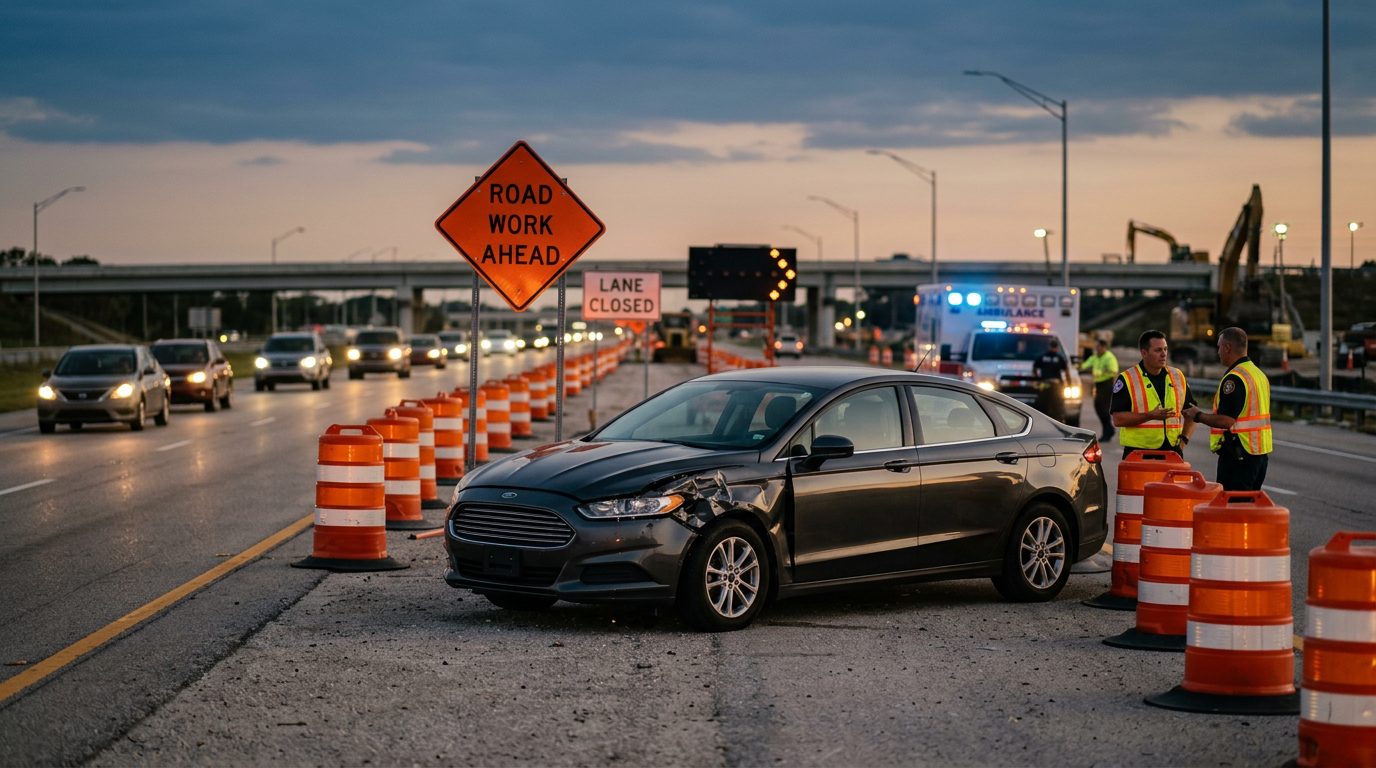
Work Zone Accidents
Florida Work Zone Accident Attorney for Catastrophic Injuries
When negligence on a construction site leaves you with permanent injury, CHG Personal Injury Lawyers fights for the compensation you deserve.
By CHG Lawyers · Published September 24, 2026
Florida Work Zone Accident Attorney for Catastrophic Injuries
If you’ve suffered a catastrophic, permanent injury in a Florida work zone accident—spinal cord injury, paralysis, traumatic brain injury, amputation, or severe burns—you may have a legal claim. You can pursue damages against the negligent construction company, equipment operator, driver, or property owner responsible for your harm.
Work zone accidents that cause life-altering injuries demand experienced legal representation. This firm focuses exclusively on catastrophic cases, not routine injury claims.
This guide explains what a work zone accident claim covers, how the legal process works, Florida’s comparative negligence rule, and why working with attorneys who focus exclusively on catastrophic injuries matters for your recovery and future (Fla. Stat. § 768.81(6)).
Not sure what your next step is?
Talk it through with our team — the first consultation is free, confidential, and carries no obligation.
What Is a Work Zone Accident Claim in Florida?
A work zone accident claim is a legal action brought by an injured person or their family against a negligent party. The defendant’s failure to maintain safe conditions caused a catastrophic, permanent injury or death in an active construction zone, highway work zone, or road maintenance area.
Work zone accidents occur in active construction sites, highway maintenance zones, and road work areas. They result from inadequate safety measures, reckless drivers, or negligent equipment operators.
These aren’t minor fender-benders or soft-tissue injuries. They result in spinal cord injuries, paralysis (paraplegia or quadriplegia), traumatic brain injuries, amputations, severe burns, and wrongful death.
Liability may rest with:
- Construction companies
- Equipment operators
- Negligent motorists
- Property owners
- Government entities
Each party is subject to different legal standards and notice requirements.
Who can file a work zone accident claim?
- Injured construction workers harmed by unsafe conditions or inadequate training
- Motorists and passengers struck by construction vehicles or equipment
- Pedestrians injured in active construction areas
- Families of loved ones killed in fatal work zone accidents
Who This Service Is For
This firm focuses exclusively on people who have suffered catastrophic, permanent injuries—not minor or routine injuries—in work zone accidents.
You may be a candidate for representation if you are:
- A construction worker injured by unguarded equipment or unsafe working conditions
- A motorist or passenger struck by a construction vehicle or equipment
- A pedestrian struck or injured in an active construction area
- A family member of someone killed in a fatal work zone accident
- Anyone who has suffered a permanent, life-altering injury as a direct result of negligence in a work zone
If your injury is minor—a simple fracture, whiplash, or soft-tissue injury without permanent complications—this firm is not the right fit.
What a Work Zone Accident Claim Covers
Damages (compensation) in a catastrophic work zone accident claim typically include:
- Medical expenses: emergency care, surgery, hospitalization, rehabilitation, ongoing treatment, adaptive equipment, and home modifications
- Lost wages and lost earning capacity: income lost during recovery and permanent income loss due to permanent disability
- Pain and suffering: compensation for physical pain, emotional trauma, and loss of quality of life
- Wrongful death damages (for families): funeral expenses, loss of companionship, and loss of financial support
- Punitive damages: additional compensation in cases of gross negligence or recklessness
- Vocational rehabilitation and life care planning: costs for retraining and long-term care planning
The goal is to make you whole by recovering all quantifiable losses and compensation for your suffering.
Common Causes of Work Zone Accidents in Florida
Work zone accidents happen when negligent parties fail to maintain safe conditions. Common causes include:
- Inadequate warning signs, barriers, lane markings, or traffic control devices
- Speeding or reckless driving by construction vehicles or passing motorists
- Operator error or inadequate training of equipment operators or drivers
- Failure to enforce safety protocols or maintain safe working conditions
- Defective or poorly maintained construction equipment or vehicles
- Truck crashes caused by driver fatigue, distraction, or mechanical failure
- Lack of lighting or visibility measures in work zones
- Failure to provide proper personal protective equipment (PPE) to workers
- Inadequate supervision or safety oversight on the job site
In catastrophic-injury cases, many work zone accidents stem from a combination of factors—inadequate warnings, speeding, poor equipment maintenance, and operator negligence—that compound the harm.
How Work Zone Accident Claims Work: Step-by-Step
Understanding the legal process helps you know what to expect and why early action matters.
Step 1 – Investigation and Evidence Gathering
Your attorneys will quickly gather and preserve critical evidence:
- Accident scene photos and measurements
- Police reports
- Witness statements
- Construction company safety records
- Equipment maintenance logs
- OSHA inspection reports
- Medical records
- Dash-cam or surveillance footage
Work zone evidence degrades fast. Signage moves, debris is cleared, and witnesses’ memories fade. Early investigation protects your claim.
Step 2 – Liability Determination
Your legal team identifies all potentially liable parties: the construction company, equipment operator, negligent driver, property owner, government agency, or equipment manufacturer.
Each may bear responsibility, and each has different insurance coverage and legal defenses. A thorough investigation uncovers all sources of recovery.
Step 3 – Demand and Negotiation
Your attorneys calculate your full damages—medical costs, lost income, pain and suffering, and future care needs. They present a demand to the liable parties’ insurance carriers. Negotiation often resolves cases without trial.
Step 4 – Settlement or Litigation Decision
If a reasonable settlement offer emerges, your attorneys will advise you. If not, they file a lawsuit to protect your rights and pursue trial.
Step 5 – Discovery and Trial Preparation
Both sides exchange evidence and take depositions (recorded testimony) from witnesses and parties. Medical specialists, engineers, accident reconstruction experts, and vocational rehabilitation professionals are retained as expert witnesses.
This phase builds your case and often leads to settlement.
Step 6 – Trial or Settlement Resolution
If settlement is reached, you recover. If trial proceeds, your case is presented to a jury, which decides liability and damages.
Timeline: Most work zone accident cases resolve within 1 to 3 years, depending on complexity and whether litigation is necessary. Catastrophic injury cases often take longer due to the need for extensive medical evidence and expert testimony.
Have questions about what happened?
Ask our team directly. The first conversation is free, confidential, and there is no obligation to continue.
What Is the 51% Rule in Florida?
Florida follows a legal principle called comparative negligence (shared fault). Under Fla. Stat. §768.81, an injured person can recover damages even if they are partially at fault—as long as they are 50% or less responsible for the accident.
Here’s how it works:
- If you are found 50% or less at fault, you can recover damages (Fla. Stat. § 768.81(6)).
- If you are found 51% or more at fault, you cannot recover.
- Your recovery is reduced by your percentage of fault. For example, if you are 20% at fault and your total damages are $100,000, you recover $80,000.
In work zone accidents, this rule protects injured workers and motorists who may have made minor errors but were primarily harmed by the construction company’s or operator’s negligence.
How Long Do I Have to Sue for a Work Zone Injury in Florida?
Time matters. Florida law sets strict deadlines for filing claims.
Personal injury claims: You have 2 years from the date of injury to file a lawsuit, per Fla. Stat. §95.11.
Wrongful death claims: Families have 2 years from the date of death to file.
Workers’ compensation claims: A separate timeline applies. You must report your injury to your employer promptly and file within the workers’ compensation system.
Government entities: If a government agency is liable, special notice requirements apply. You must file a notice of claim within 3 years of injury.
Do not delay. Evidence deteriorates, witnesses’ memories fade, and waiting weakens your claim’s strength. Contact an attorney immediately after a catastrophic work zone injury.
Work Zone Accident Settlement and Damages: What to Expect
Settlement amounts in work zone accident cases vary widely based on injury severity, liability strength, medical costs, lost income, and jurisdiction. No two cases are identical.
Catastrophic injuries—spinal cord injury, paralysis, traumatic brain injury, amputation—typically result in higher settlements because they require lifetime medical care, rehabilitation, adaptive equipment, and home modifications. A spinal cord injury can cost $500,000 to over $3 million in lifetime care, depending on severity and age at injury.
Factors affecting your settlement include:
- Your age and remaining earning potential
- The degree of permanent disability
- Quality and strength of evidence of negligence
- The defendant’s insurance limits
- Local jury verdicts in similar cases
- Your jurisdiction (urban vs. rural, conservative vs. progressive juries)
A free case evaluation can provide a realistic, honest estimate based on your specific circumstances. Remember: outcomes depend on the facts and cannot be promised in advance, and cases may proceed to trial if a fair settlement cannot be reached.
Why Choose This Firm for Your Work Zone Accident Claim
Exclusive focus on catastrophic injuries: This firm focuses exclusively on life-altering injuries—spinal cord injuries, paralysis, traumatic brain injuries, amputations, severe burns, and wrongful death—not minor or routine injuries.
Florida Bar-admitted attorneys: Licensed to practice in Florida, with experience in state-specific negligence law, workers’ compensation claims, and third-party liability actions.
Comprehensive investigation and expert retention: Dedicated resources to reconstruct accidents, retain medical specialists and engineers, and build strong liability cases backed by expert testimony.
Contingency fee arrangement: You pay no upfront fees. The firm is paid only if it recovers compensation for you, aligning the firm’s incentive with yours.
Bilingual support: English and Spanish-language resources for clients and families.
Want to know where you stand?
Tell us what happened and our team will walk you through the options available to you, at no cost.
Frequently Asked Questions
Q: Can I sue my employer for a work zone injury?
A: Workers’ compensation typically covers work injuries, but you may have a third-party claim against a negligent contractor, equipment manufacturer, or other party not your direct employer.
Q: What if the accident was partially my fault?
A: Florida’s 51% rule allows recovery if you are 50% or less at fault; your recovery is reduced by your percentage of fault.
Q: How much will I receive from a settlement?
A: Settlement amounts depend on injury severity, liability strength, medical costs, lost income, and other factors. A free case evaluation can provide a realistic estimate.
Q: How long will my case take?
A: Most work zone accident cases resolve within 1 to 3 years; complex cases or those requiring trial may take longer.
Q: Do I have to go to trial?
A: Many cases settle before trial. The firm will pursue settlement if reasonable, but will litigate if necessary to protect your rights.
Q: What if the at-fault party has no insurance?
A: The firm will investigate all available sources of recovery, including uninsured
Why Choose CHG for Your Work Zone Claim
Focus on Catastrophic Injuries
We focus exclusively on the most serious injuries—spinal cord damage, traumatic brain injury, amputations, severe burns, and permanent disability—and the accidents that cause them.
Third-Party Claims Beyond Workers' Comp
While workers' compensation covers many work injuries, we pursue claims against negligent contractors, equipment manufacturers, property owners, and other responsible parties.
Nationwide Reach, Florida Foundation
Based in Florida and licensed to practice here, we handle work zone cases across the country and understand both state and federal safety regulations.
Empathetic, Plain-Language Guidance
We explain your rights and options clearly, without legal jargon, and treat your injury and your family's situation with the dignity they deserve.
Important: Workers' Comp vs. Third-Party Claims
If you were injured at work, you likely qualify for workers' compensation benefits. But you may also have a separate claim against a negligent third party—a contractor, equipment maker, or site supervisor not your direct employer. These are different claims with different rules and potential recoveries. Do not assume workers' comp is your only option.
Common Work Zone Accident Scenarios
Struck by Equipment or Debris
Negligent operation, inadequate guards, or failure to warn can leave you with catastrophic injury. We investigate equipment maintenance, operator training, and site safety protocols.
Trench Collapse or Cave-In
Improper shoring, inadequate inspection, or violation of OSHA standards can cause crushing injuries, suffocation, or death. Liability often rests with the contractor or site supervisor.
Fall from Height
Missing guardrails, defective harnesses, inadequate training, or failure to inspect equipment can result in spinal cord injury, brain damage, or fatal falls.
Electrocution or Burn
Faulty wiring, inadequate grounding, failure to de-energize lines, or proximity to power sources can cause severe burns, nerve damage, or death.
Machinery Entanglement
Unguarded machinery, missing emergency stops, or inadequate lockout-tagout procedures can cause amputation, crushing injuries, or fatal entrapment.
Vehicle or Crane Accident
Operator error, mechanical failure, inadequate training, or blind-spot hazards can cause catastrophic multi-vehicle collisions or crushing injuries on site.
What We Investigate in Your Case
Site Safety Violations
OSHA standards, state safety codes, industry best practices, and the contractor's own safety plan. Violations often establish negligence.
Equipment and Maintenance Records
Inspection logs, repair history, recalls, and manufacturer defects. Poorly maintained or defective equipment is a common source of liability.
Training and Supervision
Whether operators were properly trained, whether the site was adequately supervised, and whether warnings or instructions were given or ignored.
Witness Statements and Site Photos
We gather evidence quickly—before it disappears—including photos, videos, and accounts from coworkers and other witnesses to the accident.
Report Your Injury Promptly
Notify your employer and file a workers' compensation claim as soon as possible. Then contact us. Early investigation preserves evidence, identifies third parties, and protects your rights.