

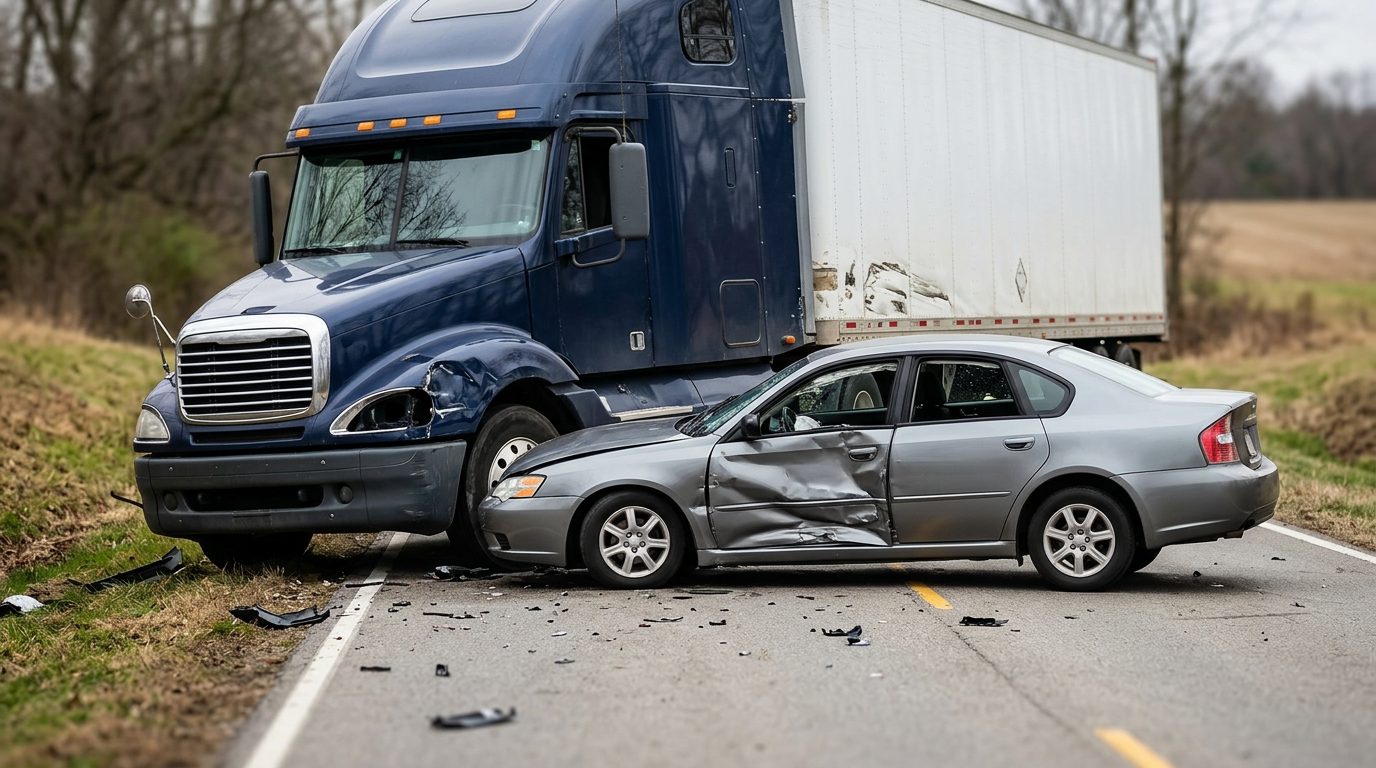
Truck Accidents
Why Truck Accidents Cause Catastrophic Injuries: The Physics Behind the Damage
Understanding the forces at work in commercial truck collisions—and what it means for survivors and their families.
By CHG Lawyers · Published September 07, 2026
Why Truck Accidents Cause Catastrophic Injuries: Physics, Data & Your Legal Rights
Truck accidents cause catastrophic injuries because of physics. A fully loaded commercial truck weighs 80,000 pounds. A passenger car weighs 3,000–4,000 pounds. When these vehicles collide, the truck’s mass transfers devastating energy to the lighter vehicle and its occupants. The result is often spinal cord injury, paralysis, traumatic brain injury, amputation, or death.
Understanding why truck accidents are more serious than car crashes helps you recognize what happened and what legal steps may be available.
Not sure what your next step is?
Talk it through with our team — the first consultation is free, confidential, and carries no obligation.
It Comes Down to Physics: Weight, Speed, and Force
A fully loaded commercial truck weighs approximately 80,000 pounds. That’s 20 to 27 times heavier than a typical passenger car.
In a collision, destructive force depends on weight and speed. Here’s the critical insight: if a truck’s speed doubles, its destructive power quadruples. A truck traveling at 55 mph carries vastly more destructive energy than a car at the same speed.
When a truck and car collide, the truck’s weight and momentum transfer catastrophic energy to the lighter vehicle. The human body cannot absorb the forces generated in a truck-versus-car impact without severe, often permanent injury.
The National Highway Traffic Safety Administration (NHTSA) reports that occupants of light vehicles involved in crashes with heavy trucks are significantly more likely to be killed or severely injured than truck occupants.
Stopping Distance: Why Truck Drivers Cannot Always Brake in Time
A loaded commercial truck traveling at 65 mph requires approximately 400–450 feet to stop completely. That’s roughly the length of a football field. A passenger car at the same speed requires 150–200 feet.
That difference of 200–250 feet is the distance between a survivable near-miss and a catastrophic collision.
Truck drivers have significantly less time to react and brake. This is especially true on wet or icy roads, downhill grades, or in heavy traffic. The Federal Motor Carrier Safety Administration (FMCSA) notes that brake failure, inadequate maintenance, or driver fatigue can eliminate a truck’s ability to stop in an emergency.
A passenger vehicle caught in front of a truck that cannot stop faces near-certain catastrophic injury or death. In the catastrophic-injury cases our attorneys handle, we often find that a truck driver saw the danger but simply could not stop in time.
Blind Spots: The Danger Zone
Commercial trucks have massive blind spots on all sides:
- Directly in front (extending 20 feet or more)
- Behind (extending 200 feet or more)
- Along both sides
A passenger car can disappear from the driver’s view entirely. A truck’s size and length also make it difficult to maneuver quickly to avoid a collision. Vehicles in a truck’s blind spot may be struck without warning, often at full highway speed.
Underride Crashes: A Mechanism of Catastrophic Injury
A truck’s cargo bed sits 4–5 feet above the ground. A passenger car’s roof is typically 4–5 feet tall.
In a rear-end or side collision, a car can slide under a truck’s trailer. This shears off the vehicle’s roof and exposes occupants to the full force of the impact. These are called underride crashes, and they are among the most severe and fatal truck accidents.
Survivors of underride crashes often suffer:
- Traumatic brain injury (TBI) from direct impact and extreme acceleration-deceleration forces
- Spinal cord injury with resulting paralysis (paraplegia or quadriplegia)
- Amputation from crushing or entrapment
- Severe burns if fuel ignites
The mechanism of injury is so violent that it leaves little room for survival without permanent, life-altering disability. Federal regulations now require underride guards on new trailers, but millions of older trailers remain on the road without adequate protection.
Jackknife, Rollover, and Multi-Vehicle Pileups
A truck’s articulated design (cab and trailer) can cause jackknifing. The trailer swings perpendicular to the cab, creating a barrier across multiple lanes. Jackknifes often cause multi-vehicle pileups with catastrophic injuries across several people.
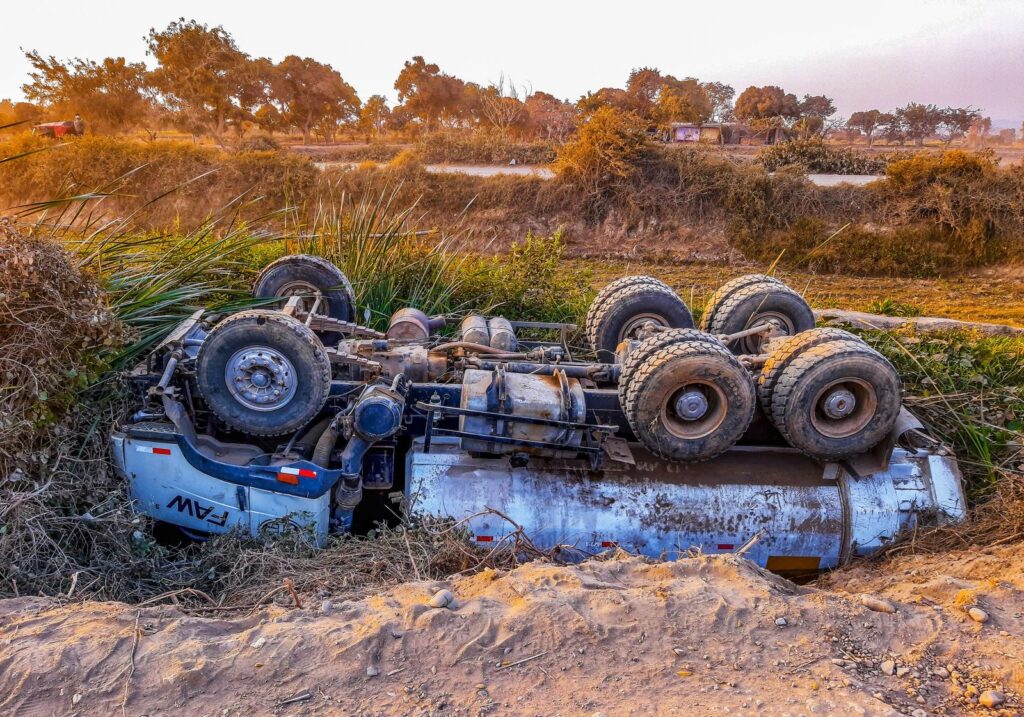
Improperly loaded or shifted cargo can cause a truck to roll over. This can crush vehicles nearby or eject cargo onto other vehicles. Rollovers and jackknifes frequently involve multiple vehicles and result in catastrophic injuries to all occupants involved.
Have questions about what happened?
Ask our team directly. The first conversation is free, confidential, and there is no obligation to continue.
What Causes Most Truck Accidents?
The NHTSA attributes the vast majority of crashes to human error: speeding, distraction, fatigue, impaired driving, and failure to follow traffic laws.
Truck drivers face unique pressures that amplify these risks:
- Hours-of-service violations: Federal regulations limit truck drivers to 11 hours of driving per 14-hour workday, with mandatory rest periods. Violations of these rules, governed by 49 CFR § 395, impair judgment and reaction time. The FMCSA reports that fatigue is a factor in approximately 13% of commercial truck crashes.
- Pressure to meet delivery deadlines, which incentivizes speeding and fatigue
- Inadequate rest between shifts
- Distracted driving (phone use, eating, adjusting controls)
- Failure to maintain safe following distance
- Inadequate vehicle maintenance (brake failure, tire blowouts, steering problems)
When a truck driver’s negligence combines with the truck’s inherent mass and power, the result is catastrophic injury. Many truck accidents are preventable. The driver or company knew or should have known about the hazard.
Speeding and Distraction: Leading Causes of Fatal Truck Crashes
Speeding is consistently identified by NHTSA as a leading factor in fatal crashes across all vehicle types. For trucks, speed combined with mass creates a lethal combination: a truck traveling too fast for conditions cannot stop or maneuver to avoid a collision.
NHTSA data shows that speeding is involved in approximately 26% of all fatal traffic crashes.
Distracted driving (particularly phone use) is also a major killer. This is especially true among younger drivers and in commercial fleets with inadequate safety policies. When a truck driver speeds or drives while distracted, they risk not just their own life but the lives of everyone on the road.
Traffic Crashes: The Leading Cause of Occupational Death for Truck Drivers
According to the Bureau of Labor Statistics (BLS), traffic crashes are the leading cause of occupational death for truck drivers. They account for the majority of work-related fatalities in the trucking industry.
Fatigue, distraction, and speed are major contributors to fatal truck crashes. When a truck driver is killed or seriously injured, the crash often involves other vehicles and results in multiple catastrophic injuries or deaths.
Surviving family members may have legal rights to pursue a wrongful-death claim against the driver, the trucking company, or both.
The Catastrophic Injuries That Result from Truck Accidents
Truck accidents commonly cause injuries that are permanent and life-altering:
-
Spinal cord injuries and paralysis (paraplegia and quadriplegia) are common outcomes. They often result from underride crashes or rollover impacts. A spinal cord injury can result in loss of sensation, movement, and bodily function below the level of injury. Survivors require lifelong medical care, assistive devices, and home modifications.
-
Traumatic brain injury (TBI) occurs when the head strikes the vehicle interior. It can also result from extreme acceleration and deceleration forces. TBI can cause cognitive impairment, memory loss, personality changes, loss of physical function, and permanent disability.
-
Amputation and limb loss can result from crushing injuries, entrapment, or cargo strikes. Survivors face lifelong disability, phantom pain, and the need for prosthetics and ongoing rehabilitation.
-
Severe burns may occur if the truck is carrying flammable materials or if a fuel tank ruptures and ignites.
-
Catastrophic back and neck injuries can cause permanent nerve damage, chronic pain, and loss of function.
-
Wrongful death claims arise when a truck accident kills a family member. Surviving family members may have legal rights to pursue compensation for their loss and the pain and suffering they endured.
Want to know where you stand?
Tell us what happened and our team will walk you through the options available to you, at no cost.
What Happens Next After a Catastrophic Truck Accident
Immediate medical care is critical. Catastrophic injuries require specialized treatment and long-term rehabilitation. Beyond medical care, several legal and practical steps are essential. They must happen quickly.
Evidence Preservation (Urgent)
The truck’s black box (electronic control module or ECM) records speed, braking, acceleration, and other data for the seconds before and after a crash. This evidence is often overwritten within days or weeks.
Logbook records, maintenance logs, driver records, and scene evidence must be secured before they are lost or destroyed. Trucking companies and insurers often move quickly to preserve their own interests. Your attorney must act just as quickly to preserve evidence that supports your claim.
Federal regulations require trucking companies to preserve certain records. But they will not do so unless they receive a preservation notice. An attorney can send this notice immediately to prevent evidence destruction.
Liability Investigation
Liability investigation must determine whether the truck driver, the trucking company, the vehicle manufacturer, a maintenance contractor, or a third party was negligent.
This investigation may involve:
- Accident reconstruction experts who analyze vehicle damage, skid marks, and impact dynamics
- Medical specialists who document the severity and permanence of your injury
- Review of the driver’s logbook (electronic logging device or ELD records) to determine hours-of-service violations
- Review of the trucking company’s safety records, driver hiring practices, and training
- Inspection of the truck’s maintenance records to identify mechanical failures
- Analysis of the truck’s black box data to determine speed, braking, and other factors
Insurance Claims and Legal Action
Trucking companies carry substantial insurance—often $1 million or more in liability coverage. But they will not pay fairly without pressure.
An attorney can:
- Demand investigation and preservation of evidence
- Negotiate with the trucking company’s insurance carrier
- File a lawsuit if necessary to recover full damages
- Pursue claims against multiple defendants (driver, company, manufacturer, etc.)
Damages in a catastrophic truck accident case may include:
- Medical care (past and future)
- Lost income and loss of earning capacity
- Disability and loss of function
- Pain and suffering
- Home modifications and assistive devices
- Wrongful death (in fatal cases)
Frequently Asked Questions
Can a truck accident cause permanent paralysis?
Yes. Underride crashes, rollovers, and high-impact collisions commonly cause spinal cord injuries that result in paraplegia (paralysis of the lower body) or quadriplegia (paralysis of all four limbs). Survivors often face lifelong disability. They require ongoing medical care, assistive devices, and home modifications. Learn more about spinal cord injury compensation.
How long do I have to file a claim after a truck accident?
In Florida, the statute of limitations for personal-injury claims is generally two years from the date of injury under Fla. Stat. § 95.11. But evidence can disappear quickly. Contact an attorney as soon as possible to preserve evidence and protect your rights.
What damages can I recover in a truck accident case?
You may recover damages for medical care (past and future), lost income, loss of earning capacity, disability, pain and suffering, and other losses. In cases of wrongful death, surviving family members may recover damages for their loss. See our guide to catastrophic injury claims for more details.
Who can be held responsible for a truck accident?
The truck driver, the trucking company, the vehicle manufacturer, a maintenance contractor, or a third party may be liable. The cause of the accident determines who is responsible. A thorough investigation is necessary to identify all responsible parties.
Trucking companies can be held liable for the negligence of their drivers under the doctrine of respondeat superior. They may also be directly liable for negligent hiring, training, or supervision. Learn more about commercial truck accident settlement options.
If you or a family member suffered a permanent injury in a truck crash—spinal cord injury, paralysis, traumatic brain injury, amputation, or severe burns—you’re likely facing overwhelming medical bills, lost income, and questions about what happens next.
People in your situation reach out to us regularly. Our team focuses exclusively on catastrophic injuries caused by truck accidents and other serious accidents. We can help you understand what occurred, who may be responsible, and what you may have a claim for.
Contact us for a free case evaluation to discuss your situation with someone who understands both the injury and the law.
The Physics That Make Truck Crashes Different
Mass and Momentum
A fully loaded commercial truck can weigh 80,000 pounds or more—up to 20 times heavier than a passenger car. When two objects collide, the damage depends on both speed and weight. That enormous mass means the forces involved in a truck crash are exponentially greater, causing more severe injuries even at lower speeds.
Stopping Distance and Braking Failure
Trucks require significantly longer distances to stop than cars, especially when fully loaded or traveling downhill. Brake failure, inadequate maintenance, or driver fatigue can make stopping impossible. When a truck cannot brake in time, the collision energy is catastrophic—often resulting in spinal cord injuries, traumatic brain injuries, and amputations.
Underride Crashes
An underride occurs when a smaller vehicle slides beneath a truck's trailer. These crashes are among the most deadly and disabling. Survivors often suffer severe head trauma, spinal cord injuries causing paralysis, and crush injuries. The low profile of the truck bed means the impact strikes at the passenger compartment's most vulnerable points.
Rollover and Jackknife Accidents
The height and center of gravity of a loaded truck make rollovers common, especially on curves, during sudden maneuvers, or on uneven terrain. When a truck rolls, it can crush vehicles nearby and eject cargo. Occupants face violent forces from multiple directions, leading to spinal cord damage, traumatic brain injuries, and fatal outcomes.
Impact Energy and Deceleration
The human body cannot withstand the sudden deceleration forces in a truck collision. Organs shift violently within the body cavity, bones fracture, and the brain moves inside the skull, causing traumatic brain injury. Even restrained passengers suffer severe, permanent injuries from these extreme forces.
Negligent Maintenance and Failure
Truck accidents often result from preventable mechanical failures: worn brakes, tire blowouts, defective coupling systems, or inadequate cargo securement. When a trucking company or owner fails to maintain their vehicle properly, they bear responsibility for the catastrophic injuries that follow.
Common Causes of Severe Truck Accidents
Driver fatigue, speeding, improper lane changes, distracted driving, inadequate training, and failure to secure cargo are leading causes of truck crashes. Many are preventable. When a truck driver or company acts negligently, survivors and families have the right to pursue a claim for compensation.
Types of Injuries in Truck Accidents
Spinal Cord Injuries & Paralysis
High-impact collisions and underride crashes frequently cause spinal cord damage, resulting in paraplegia (lower-body paralysis) or quadriplegia (all-four-limb paralysis). These injuries are permanent and require lifelong medical care, assistive devices, and home modifications.
Traumatic Brain Injuries
The violent forces in a truck crash can cause the brain to move and shift inside the skull, leading to bleeding, swelling, and permanent cognitive or physical impairment. Survivors may face memory loss, personality changes, chronic pain, and loss of independence.
Amputation & Limb Loss
Crush injuries from truck rollovers, underride crashes, or cargo shifts can result in the loss of arms, legs, hands, or feet. Amputation is catastrophic—requiring prosthetics, rehabilitation, and lifelong adaptation.
Severe Burns & Crush Injuries
Truck accidents involving hazardous materials, fuel leaks, or cargo fires cause severe burns. Crush injuries from rollovers or cargo collapse result in tissue damage, organ failure, and permanent disfigurement requiring extensive surgical care.
Who Is Responsible in a Truck Accident?
The Truck Driver
Negligent driving—speeding, fatigue, distraction, or reckless maneuvers—is a common cause. Drivers have a duty to operate their vehicles safely and follow traffic laws.
The Trucking Company
Companies must hire qualified drivers, provide adequate training, enforce safety policies, and maintain their vehicles. Failure to do so can make them liable for injuries their negligence causes.
Vehicle Manufacturers
Defective brakes, tires, coupling systems, or design flaws can cause accidents. Manufacturers are responsible for designing and producing safe vehicles.
Maintenance Providers
Third-party maintenance shops that fail to repair brakes, tires, or other critical systems properly can be held liable for resulting accidents and injuries.
Truck Accidents Often Involve Multiple Liable Parties
A single crash may involve the driver, the trucking company, the vehicle manufacturer, a maintenance provider, and others. Identifying all responsible parties is essential to recovering full compensation for your injuries, medical care, lost income, and pain and suffering.