
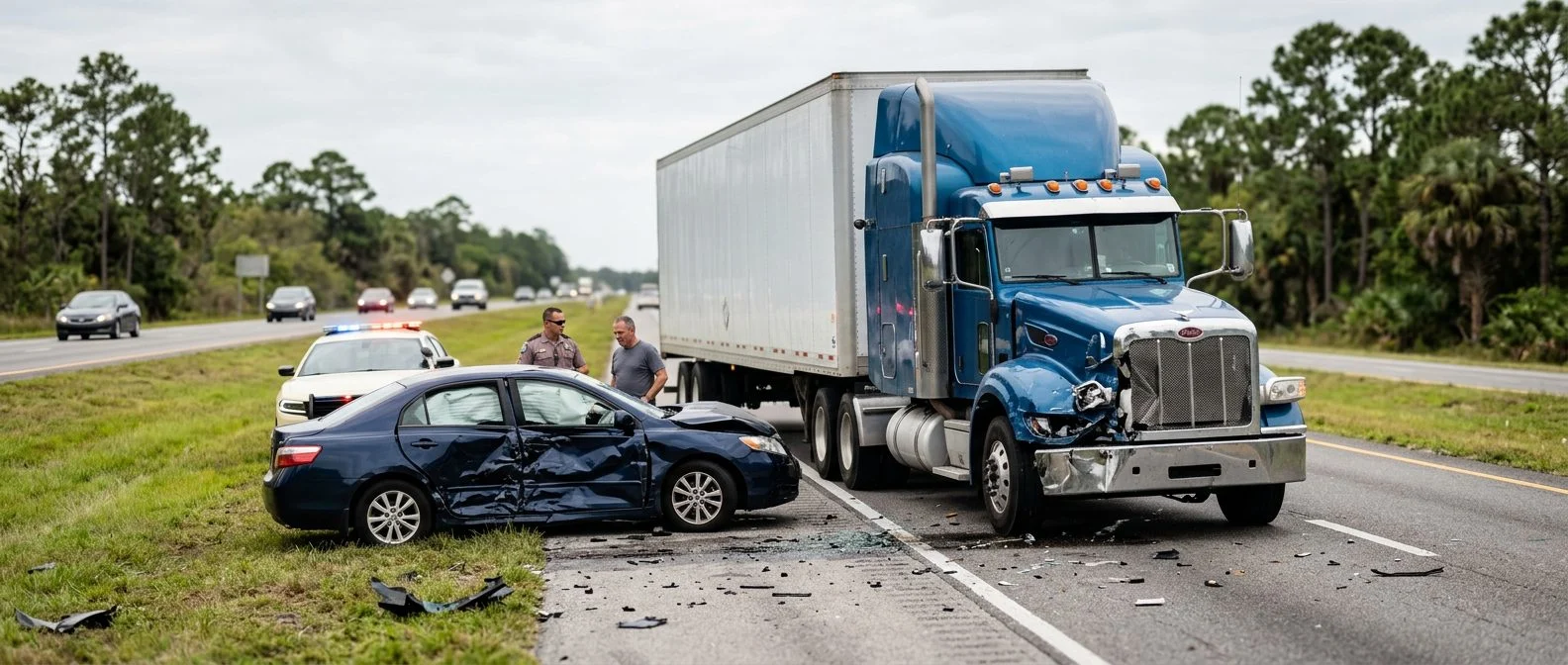
Truck Accidents | Florida
Hurt in a Florida Truck Crash? Federal Trucking Safety Rules May Matter to Your Claim
CHG Personal Injury Lawyers helps injured people and their families across Florida understand how FMCSA trucking rules can connect to what happened on the road.
By CHG Lawyers · Published November 2, 2026
The FMCSA, or Federal Motor Carrier Safety Administration, is the federal agency that sets safety rules for commercial trucks, their drivers, and the companies that run them. In a Florida truck crash case, those rules can become important evidence. This page explains how the FMCSA affects truck accident cases in Florida, what shapes a claim’s value, and what to do first.
What the FMCSA Is and Why It Matters After a Florida Truck Crash
The FMCSA is a federal agency within the U.S. Department of Transportation. It sets safety rules for commercial motor vehicles, the drivers who operate them, and the carriers that employ or dispatch them. Federal law lets the Secretary of Transportation set rules on driver hours and the safety of motor carriers’ vehicles and operations (federal motor carrier law).
Under the Florida commercial vehicle safety statute, owners and drivers of commercial vehicles operating on Florida public highways in interstate commerce are subject to federal rules in 49 C.F.R. parts 382-386 and 390-397.
Those rules can reach more than the driver. A rule violation is one piece of the picture. It is not an automatic payout.
If someone you love was hurt in a crash with a commercial truck, our team can talk through what those rules may mean for your claim, with no obligation to continue. Talk it through with our team — the first consultation is free, confidential, and carries no obligation.

The FMCSA Rules Most Often at Issue in Truck Accident Cases
The rules that come up most often in truck crash cases cover driving time, driver files, vehicle maintenance, and testing after a crash.
- Driving time. A driver may not drive without first taking 10 consecutive hours off duty. Under 49 C.F.R. § 395.3, a driver may drive a total of 11 hours during the period specified in paragraph (a)(2) of this section. Except for drivers who qualify for either short-haul exception in § 395.1(e)(1) or (2), a driver may not keep driving once 8 hours of driving time have passed without at least a consecutive 30-minute break in driving (49 C.F.R. § 395.3). Weekly on-duty limits also apply.
- Driver qualification files. Each motor carrier must keep a file for every driver it employs. The file includes the driver’s application, driving record, and medical certificate. It must be kept while the driver works there and for three years after, though some records in it, such as annual driving-record checks and medical examiner’s certificates, may be removed three years after they were made (49 C.F.R. § 391.51).
- Vehicle maintenance. Carriers must systematically inspect, repair, and maintain their vehicles. Parts that affect safe operation, such as wheels, suspension, axles, and steering, must be in safe condition at all times (49 C.F.R. § 396.3).
- Post-crash testing. After a qualifying crash, the employer must test the surviving driver for alcohol as soon as practicable. If a test is delayed, the employer must keep a written reason (49 C.F.R. § 382.303). The FMCSA’s post-accident testing guidance explains these requirements for commercial drivers.
How a Rule Violation Becomes Part of a Truck Accident Claim
A rule violation matters when it connects to how the crash and the injuries happened. The claim must show the violation contributed to the crash or the harm.
Useful proof usually comes from:
- Driver logs and time records
- Electronic data from the truck
- Maintenance and inspection records
- Driver qualification files
- Dispatch messages and company safety files
Timing matters. The federal retention period for maintenance records is one year, plus six months after a vehicle leaves the carrier’s control (49 C.F.R. § 396.3). Early written requests help keep this evidence from being lost.
Claims can also reach beyond the driver. Whether that matters in a given crash turns on its facts.
Other Factors That Shape a Truck Claim’s Settlement Value
A truck claim’s settlement value usually turns on how serious the injury is, what it costs over time, and how much insurance is available.
- Severity and permanence. Spinal cord injuries, traumatic brain injuries, and amputations often bring long-term medical needs. Rehabilitation, equipment, and home changes add to the total.
- Past and future medical costs. Both today’s bills and future care needs are part of the claim.
- Lost income. Age, work history, and the ability to return to work all affect this loss.
- Pain and suffering. These non-economic losses reflect how the injury changes daily life.
- Wrongful death. When a crash causes a death, the family may bring a wrongful death claim. Florida law sets who may bring it and what losses can be recovered.
- Insurance. The federal minimum for for-hire interstate carriage of nonhazardous property by trucks rated 10,001 pounds or more is $750,000 (49 C.F.R. § 387.9). The policy limits in a real case can be higher.
Florida’s Serious-Injury, Fault, and Deadline Rules That Affect Value
Three Florida rules can change what a claim is worth: the serious-injury threshold, the 50 percent fault bar, and the filing deadline.
- Serious-injury threshold. For pain and suffering damages after a motor vehicle crash, Florida’s tort exemption statute limits recovery to injuries that include a significant and permanent loss of an important bodily function, a permanent injury, significant and permanent scarring or disfigurement, or death.
- Under Florida’s comparative fault statute, a person found more than 50 percent at fault for their own harm may not recover any damages in a negligence action, except for a personal injury or wrongful death action arising out of medical negligence under chapter 766.
- Punitive damages. Florida’s pleading statute allows a claim for punitive damages only if there is a reasonable showing by evidence in the record, and a defendant may be held liable for them only if the trier of fact, based on clear and convincing evidence, finds that the defendant was personally guilty of intentional misconduct or gross negligence.
- Deadlines apply, so contact a firm promptly.
What to Expect: Steps From Crash to Resolution
Most truck crash claims move through medical care, evidence gathering, a demand to the insurer, and then negotiation or a lawsuit.
- Get medical care first. Follow your doctors’ recommendations and keep every record of care.
- Ask for evidence in writing. A written preservation request asks the carrier to keep logs, electronic data, dashcam video, and maintenance files.
- Document the losses. This includes medical bills, wage records, and reports that explain how the crash happened.
- Present the claim. The claim goes to the insurers, often with a written demand package.
- Negotiate or file suit. Many claims settle through negotiation. Others need a lawsuit in Florida courts. Timelines vary, and the outcome depends on the facts of each case.
Not sure what your next step is?
Talk it through with our team — the first consultation is free, confidential, and carries no obligation.
Frequently Asked Questions
Does every FMCSA violation increase a claim’s value?
No. A violation matters most when it connects to how the crash and the injuries happened.
Can a trucking company be responsible for its driver’s violations?
It can be. That question turns on the company’s relationship with the driver and its own conduct.
Is there a deadline to file a Florida truck claim?
Florida’s general deadline for most negligence claims is two years (Fla. Stat. § 95.11(5)(a)). Contact a lawyer early so nothing is missed.
Does a Florida truck claim always go to trial?
No. Many claims resolve without trial, while others require a lawsuit.
Who can bring a wrongful death claim after a fatal truck crash?
Florida law sets who may bring the claim. A family can ask a lawyer about its options.

Talk With Our Team About Your Florida Truck Accident
If you are reading this while a loved one recovers from a truck crash, or after you have lost someone, you are carrying a lot at once. Insurers may be calling, and you may not know what the case is worth. You don’t have to sort out federal trucking rules alone.
Igor Hernandez, one of the lawyers at CHG Personal Injury Lawyers, is the responsible lawyer for this page. The firm is Florida-based and serves clients throughout Florida.
CHG offers a free, confidential initial consultation with no obligation to continue. CHG charges no attorney’s fees and no case costs unless there is a recovery. To ask about your situation, contact our team.
How CHG Personal Injury Lawyers Can Help After a Truck Crash
Florida-Based Representation
Our Florida-based firm represents people hurt in truck crashes throughout Florida, including Miami, Orlando, Tampa and Jacksonville.
Review of Trucking Records
We look at the records that can shed light on a crash, such as driver logs, maintenance files and company safety paperwork.
Support for Families
When a crash causes a death or a life-changing injury, we work to take the pressure of the claim off the family so they can focus on care and recovery.
No Fees Unless There Is a Recovery
CHG charges no attorney's fees and no case costs unless there is a recovery.
Free First Consultation
Your first consultation is free, confidential and comes with no obligation to continue.
Compassionate, Plain-Language Guidance
We explain each step clearly, so you always know where your case stands and what comes next.
Important: Trucking Evidence Can Disappear
Trucking companies often keep electronic logs, vehicle data, maintenance records and dispatch messages. Some of this information may be overwritten or discarded as time passes. If you or a loved one was hurt in a truck crash, contact the firm promptly so that important evidence can be preserved.
Records That Often Matter in Truck Accident Cases
Driver Logs and Hours
Records of driving time and rest breaks can show whether a driver was operating within the federal hours-of-service rules.
Maintenance and Inspection Files
Repair, inspection and maintenance histories help show the condition of the truck and trailer before the crash.
Driver Qualification Records
Hiring, training, testing and medical files help show what the trucking company knew about its driver.
Crash and Vehicle Data
Electronic data from the truck and any dash cameras can help show how the crash happened.