
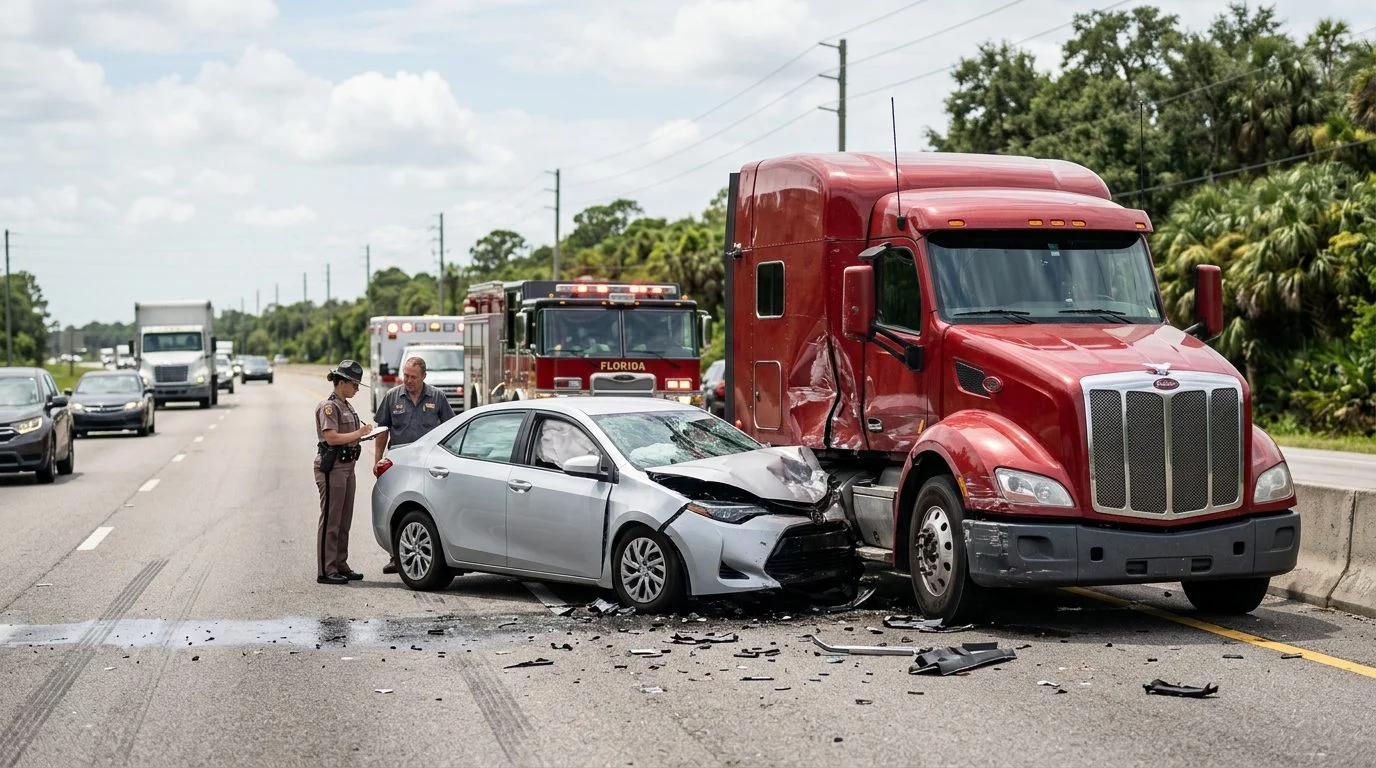
Truck Accidents | Serving Florida
Hurt in a Dump Truck or Garbage Truck Crash? You Do Not Have to Handle the Claim Alone
Heavy trucks are large, and the companies that run them have insurers working from the first day. Our Florida attorneys can listen to what happened and explain what your options may be.
Why Florida Clients Contact CHG
Florida
Florida-based personal injury firm
Licensed
Attorneys admitted to The Florida Bar
Free
Confidential first consultation
By CHG Lawyers · Published November 25, 2026
A crash with a dump truck or garbage truck can leave your family facing hospital bills, lost paychecks, and hard questions. All at once. If this happened to you or someone you love, you may want to know who can be held responsible. You also need to know what to do first.
Injured people and families may be able to bring a claim. The claim could be against the driver, the company that runs the truck, or another party whose actions led to the crash. Florida’s deadlines are short. Acting early matters.
What a Dump Truck or Garbage Truck Accident Claim Is, and Who It Helps
A dump truck or garbage truck accident claim asks the people responsible for a crash to pay compensation, meaning money for the harm done. It is a civil claim, not a criminal case.
It can help drivers, passengers, pedestrians, cyclists, and other motorists who were hurt. It can also help families when a crash causes a death. This is called a wrongful death claim. The family brings it after a loved one dies.
Dump trucks often work on busy job sites and county roads. Garbage trucks stop and start on neighborhood streets many times a day. They often back up to bins and turn in tight spaces. CHG Personal Injury Lawyers takes personal injury cases of every severity. That includes everyday crashes and catastrophic injuries, such as spinal cord injuries, traumatic brain injuries, amputations, and wrongful death.
For a wider view of truck crash injuries, read our guide to catastrophic truck accident injuries.
If a dump truck or garbage truck crash has left you or a family member hurt, you may have a claim, and our team can talk it through with you. Talk it through with our team — the first consultation is free, confidential, and carries no obligation.
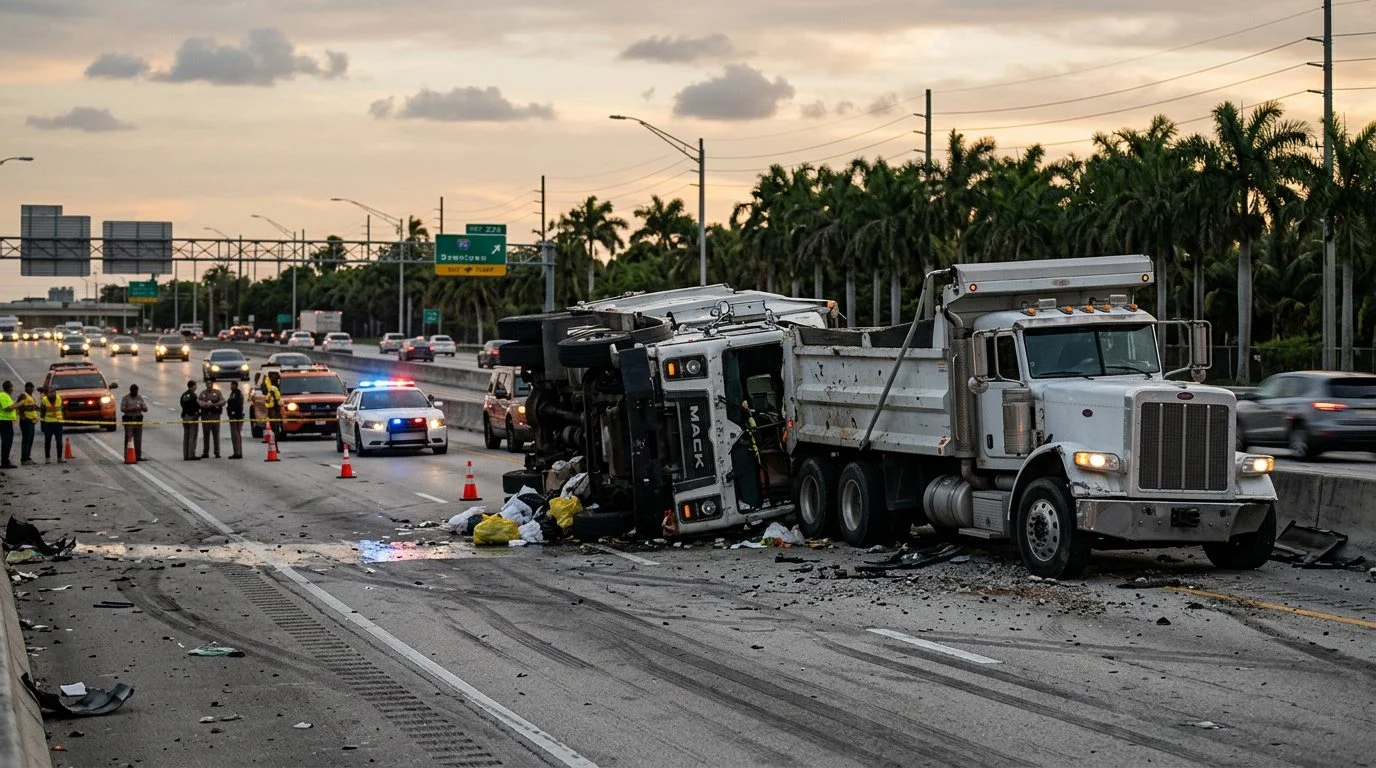
Why Dump and Garbage Truck Crashes Differ, and Who Can Be Held Responsible
Several parties can share responsibility for a dump or garbage truck crash. The truck’s size and the way it works often shape the injuries.
A loaded dump truck or garbage truck is much heavier than a passenger car. A hit from one of these trucks often causes severe harm to smaller vehicles, cyclists, and pedestrians.
- Crash patterns: tipping on uneven ground, backing and blind-spot collisions, and strikes near curbs and sidewalks during pickups.
- Work zones: lane shifts, equipment, and hauling routes near active sites.
- Possible defendants: the driver; the company that operates, leases, or employs the driver; a contractor or site operator; and anyone responsible for maintenance or loading. A “defendant” is a person or company a claim is brought against.
In a Florida negligence case, meaning a case that says someone failed to act with reasonable care, each liable party is judged on its own share of fault. A defendant that wants to shift fault to a nonparty, meaning someone not in the case, must plead that nonparty’s fault and, absent good cause, identify it or describe it as specifically as practicable; to put the nonparty on the verdict form, it must also prove that fault at trial by a preponderance of the evidence. So the claim may need to account for more than one party. See Fla. Stat. § 768.81.
- Government fleets: a city or county garbage truck or public works dump truck may be government-owned. Claims against government entities follow Fla. Stat. § 768.28. This statute limits what can be recovered and sets its own steps.
- Raise government fleets with the firm early.
- Records to preserve: The rule covers daily driver vehicle inspection reports, repairs, and how long those records must be kept.
- 49 C.F.R. § 396.11 requires a written daily inspection report for each vehicle operated, though drivers need not prepare one when no defect is found. The rule does not apply to a private motor carrier of passengers (nonbusiness), a driveaway-towaway operation, or a carrier operating only one commercial motor vehicle. The carrier must keep it, along with repair certifications, for three months from the date it was prepared.
- Send requests for these records early, before the three-month window closes.
- Crash reports: under Fla. Stat. § 316.066, a Florida Traffic Crash Report, Long Form, must be completed and submitted. This applies to a crash that resulted in death, personal injury, or any indication of complaints of pain or discomfort, that involved a violation of s. 316.061(1) or s. 316.193, that rendered a vehicle inoperable to a degree that required a wrecker to remove it from the scene, or that involved a commercial motor vehicle. It must be submitted within 10 days after the investigating officer finishes the investigation.
- Ask the investigating agency for the report as soon as it is available.
What a Claim Can Cover
A claim can seek payment for medical costs, lost income, and the harm injuries cause to daily life.
- Medical care: emergency treatment, surgery, hospital stays, rehabilitation, medication, and future care that treating doctors document.
- Lost income: wages missed during recovery. If injuries are permanent, this can also include lost ability to earn.
- Pain and suffering: loss of enjoyment of life, permanent impairment, disfigurement, or loss of a limb.
- Home help: caregiving at home, adaptive equipment, and changes to the home.
- Wrongful death: Fla. Stat. § 768.19 makes the liable party responsible for damages even when the injured person dies, if the event would have entitled the person injured to maintain an action and recover damages if death had not ensued.
- Fla. Stat. § 768.21 lets a surviving spouse recover for lost companionship and mental pain and suffering.
- Minor children, and all children of the decedent if there is no surviving spouse, may also recover for lost parental companionship, instruction, and guidance and for mental pain and suffering from the date of injury (though adult children cannot recover these damages in medical negligence claims).
- The Florida Supreme Court has held that a surviving spouse’s losses are recovered within the wrongful death action. They are not a separate loss of consortium claim, which is a separate claim for losing a spouse’s companionship.
- The court also held that the marriage-before-injury rule does not bar a surviving spouse’s wrongful death damages under § 768.21(2).
Every claim is different. The value depends on the facts, the injuries, and the evidence. No amount can be promised.
Medical Bills, Letters of Protection, and Medicare
Medical bills are often the first worry after a crash. Florida law sets rules for how medical expenses are proven.
- Evidence of treatment that has already been paid is limited to the amount actually paid.
- This applies no matter who made the payment. See Fla. Stat. § 768.0427.
Some providers treat patients under a letter of protection. This is a promise that the provider will be paid from any judgment or settlement. The same statute requires the claimant to disclose a copy of that letter. This is a condition of asserting the medical expense claim. Tell the firm about every provider and every arrangement. That keeps the records complete from the start.
If Medicare paid for care, Medicare must be notified.
- The CMS guidance on reporting a case explains that a Medicare beneficiary must notify Medicare when a claim is made against a party with liability insurance. This applies whether the claim is handled through an attorney or otherwise.
- Notice is given through the MSP Recovery Portal or by contacting the Benefits Coordination & Recovery Center.
- CMS also explains that Medicare conditional payments must be repaid when a settlement, judgment, award, or other payment is made.
How the Claim Process Works, Step by Step
A typical claim starts with a free consultation. Next comes evidence gathering and negotiation. A lawsuit comes only if needed.
- Free consultation: you describe the crash, your injuries, and your treatment. The first consultation is free and confidential.
- Preserve evidence: requests can ask that driver logs, daily inspection reports, maintenance files, and video be kept before they are lost.
- Investigate: gather crash reports, witness details, and medical records. Accident reconstruction analysis, a study of how the crash happened, may be needed from outside professionals.
- Document treatment: follow your doctors’ care plan. Keep records of bills and missed work.
- Present and negotiate: the claim goes to the insurers or responsible parties. Medicare reporting and repayment duties are handled as described above.
- File a lawsuit if needed: if a fair resolution is not reached, a case may be filed in court. Timelines vary by case.
Florida Deadlines and Rules to Know Now
In Florida, most negligence claims must be filed within two years. Act promptly.
- Under Fla. Stat. § 95.031, a cause of action accrues, meaning the clock starts, when the last element of it occurs.
-
The timing of a claim should be checked against the actual date of the crash and the injury.
-
Two-year deadline: Fla. Stat. § 95.11 says an action based on negligence must be started within two years.
- Application of the act: Under ch. 2023-15, Laws of Fla., “Except as otherwise expressly provided in this act, this act shall apply to causes of action filed after the effective date of this act.”
- Government claims: Claims against government entities follow special Florida rules that can differ from other injury claims. Raise this issue early.
- Florida law: CHG Personal Injury Lawyers represents clients throughout Florida.
Deadlines apply. Contact the firm promptly.
Not sure what your next step is?
Talk it through with our team — the first consultation is free, confidential, and carries no obligation.
Common Questions About Dump Truck and Garbage Truck Claims
Below are short answers to questions families ask most after a dump or garbage truck crash.
Can you sue a trucking company if its truck hits you?
Often, yes, depending on the facts. A claim may name the driver and the company that operates, leases, or employs the driver.
How much does a construction truck accident lawyer cost?
CHG charges no attorney’s fees and no case costs unless there is a recovery. If the case is lost, you do not owe attorney’s fees or case costs.
What is the average settlement against a semi or work truck?
There is no reliable single average. Each claim depends on injuries, fault, evidence, and insurance. No amount can be promised.
Should I talk to the police or the employer first?
Get medical care first. Parties and their legal representatives can access crash reports under Fla. Stat. § 316.066. Speak with the firm before giving recorded statements to insurers.

Talk With Igor Hernandez About Your Dump or Garbage Truck Crash
Igor Hernandez, a lawyer with CHG Personal Injury Lawyers, can review your crash, injuries, and deadlines in a free consultation. The firm is Florida-based and serves people throughout Florida.
Our lawyers are admitted to The Florida Bar. Our team can help you gather the records described above while you focus on recovery.
The initial consultation is free, confidential, and carries no obligation to continue.
If a dump truck or garbage truck crash has left you or a family member hurt, you may have a claim. Contact us through our contact page.
How Our Attorneys Can Help
Reviewing the Crash
We look at police reports, photos, and records to understand how the collision happened and who may share responsibility.
Identifying Every Responsible Party
Depending on the facts, a claim may involve the driver, the hauling or waste company, the owner of the truck, or a contractor.
Dealing With Insurance Companies
We communicate with insurers so that you can focus on your recovery instead of their questions and deadlines.
Caring for the Whole Family
Serious injuries and wrongful death affect every part of life. We take time to understand what your family is facing.
Important: Speak With a Lawyer Before You Sign Anything
Insurance adjusters may ask for a recorded statement or a signed release soon after a crash. Before you agree to anything, talk with a lawyer about what you are being asked to sign.
Steps to Take After a Heavy-Truck Crash
Get Medical Care
See a doctor as soon as you can and follow your doctor's care, even if your injuries seem minor at first.
Protect Your Evidence
Photograph the scene, the vehicles, and your injuries. Keep the names of witnesses and the truck's company name if you can see it.
Report the Crash
Make sure a police or crash report is filed, and keep copies of every document you receive about the collision.
Speak With a Florida Attorney
A free, confidential consultation can help you understand your situation. Deadlines apply, so contact us promptly.