
Florida Injury Claims | Truck and Car Accidents
How Truck and Car Accident Claims Differ in Florida
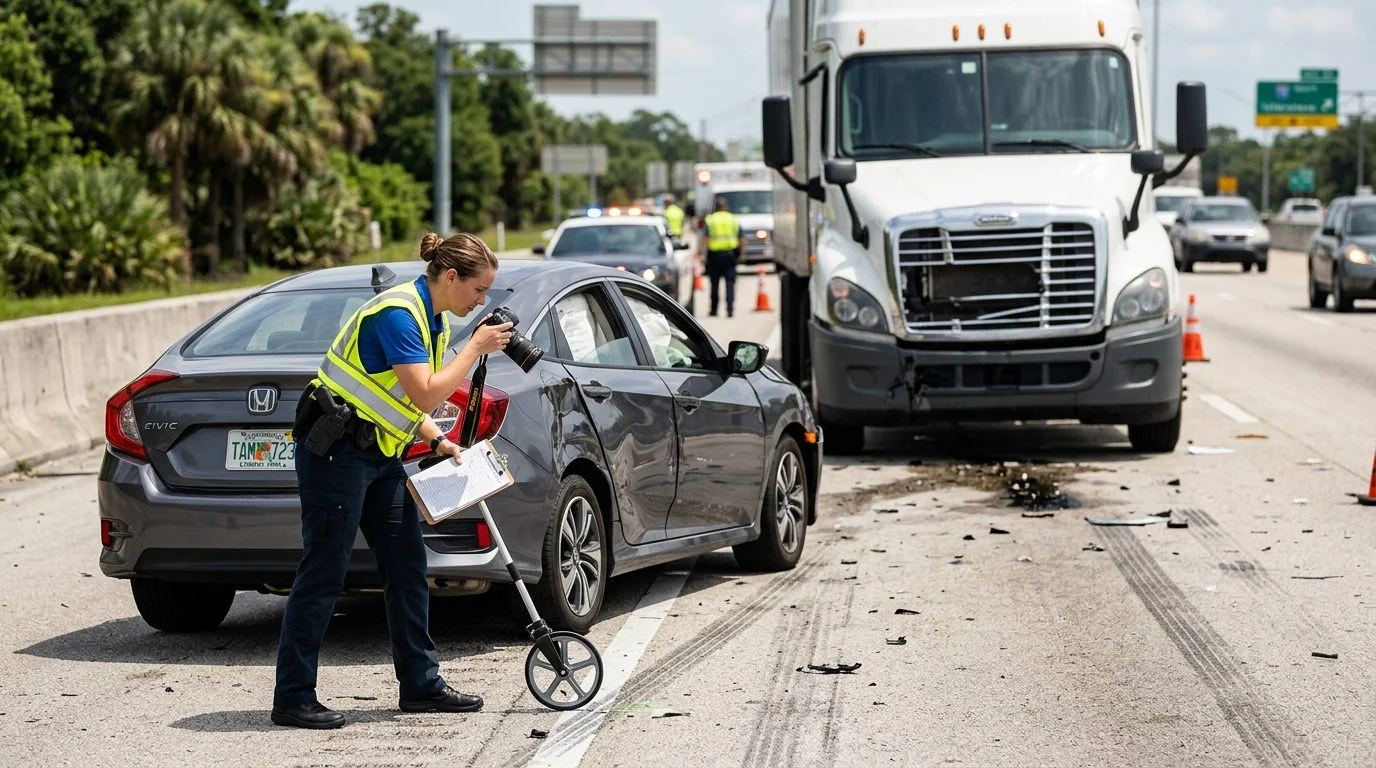
A crash with a commercial truck can involve many more parties, records and rules than a typical car crash. Here is what sets the two apart and why it matters for your next step.
Why Florida Families Contact Our Firm
Florida
Based in Florida and serving clients throughout the state
Free
Confidential first consultation with no obligation to continue
Licensed
Attorneys admitted to The Florida Bar
By CHG Lawyers · Published November 25, 2026
Being hurt in a crash with a big rig can leave you with many questions about what comes next. You may be trying to understand a truck case for someone you love. You are not wrong. Several factors shape how these claims are handled:
- Federal trucking rules apply.
- More companies may share responsibility.
- Evidence can disappear quickly.
- Insurance policies are often larger.
- Injuries are often more severe.
Florida’s basic negligence rules apply to both. Negligence means careless conduct that causes harm.
Quick Answer: How Are Truck Accident Claims Different From Car Accident Claims?
A car claim usually asks what two drivers did in the seconds before impact. A truck claim asks that too. It also asks how the trucking company ran its business.
Truck cases add four layers:
- Federal safety rules that govern the driver, the carrier (the trucking company), and the truck.
- Company records that can be lost if no one requests them early.
- More potentially responsible parties and insurers.
- Larger coverage limits and, often, more serious injuries.
Each crash has its own facts. Those facts shape how a claim is built. For a broader look at the process, read our car accident settlements guide in Florida.
If a truck or car crash has left you with injuries and hard questions, our team can talk through your situation with you, with no obligation. Talk it through with our team — the first consultation is free, confidential, and carries no obligation.
A Federal Rulebook Applies to Many Truck Crashes, and It Can Matter as Proof
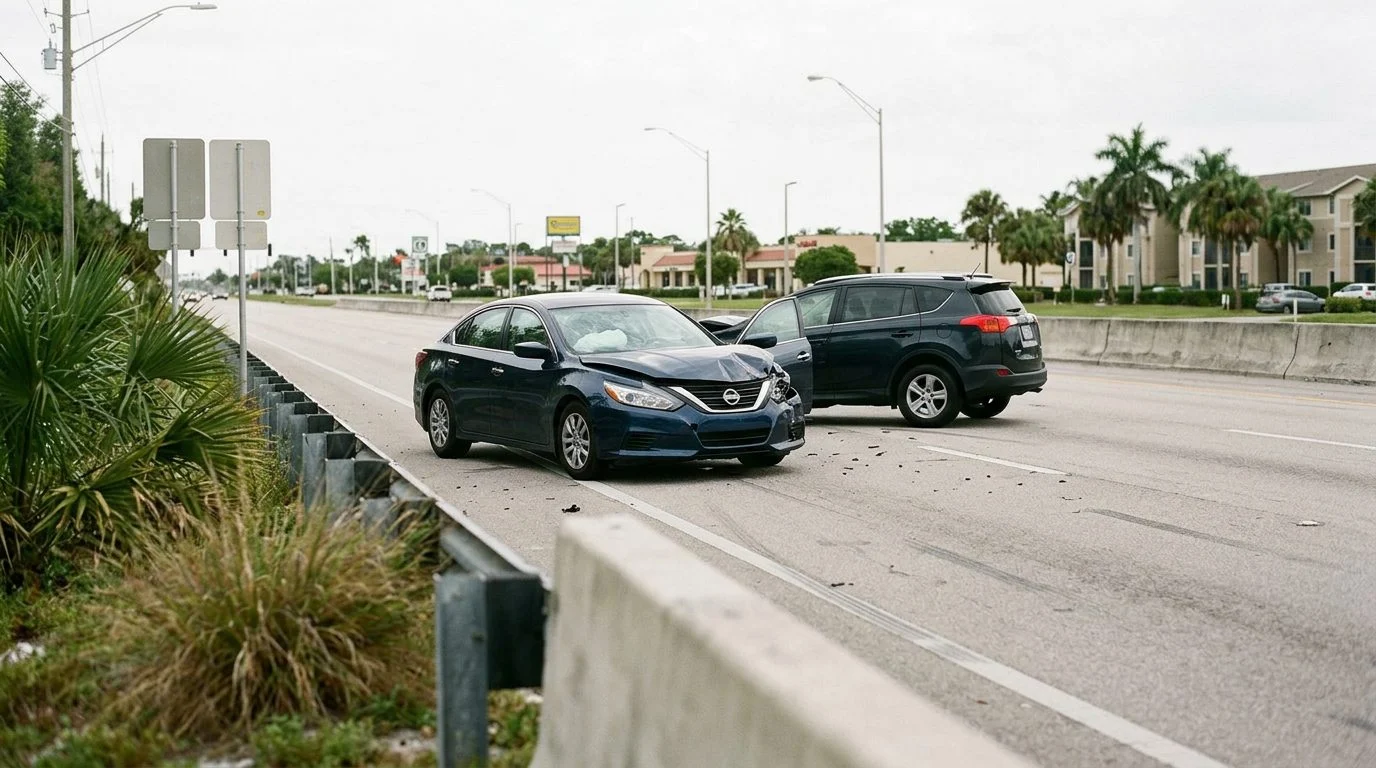
Many commercial trucks must follow federal safety rules. Passenger cars do not. Several parts come up again and again in truck cases:
- Part 382 (drug and alcohol testing). This part sets rules for testing drivers after certain crashes.
- Part 387 (financial responsibility). This part sets minimum insurance levels that carriers must carry. More detail is below.
- Part 390 (general rules). A motor carrier must require that drivers follow the driver rules. A carrier that is also the driver must follow them too (49 CFR 390.11).
- Part 391 (driver qualifications). Carriers must keep a driver qualification file. This is the company’s record of the driver’s application, driving record, road test, and medical certification (49 CFR 391.51).
- Part 392 (operating rules). A truck must be operated under the laws of the state where it is driving. If a Federal Motor Carrier Safety Administration regulation sets a higher standard than the state or local law, that regulation must be followed (49 CFR 392.2).
- Part 395 (hours of service). Motor carriers must require drivers to record their duty status for each 24-hour period, except private motor carriers of passengers (nonbusiness). The rule also sets out what those records must show, including total miles driven and the carrier’s name (49 CFR 395.8).
Why does this matter for proof? Each rule creates a record or a standard. When a driver’s logs, testing, qualification file, or operating practices do not match the rules, the other side may have to answer for it. The mismatch can also show what the driver or company was supposed to do. It can show whether they did it.
A typical car crash turns mainly on Florida traffic law and each driver’s conduct. A truck crash adds a second set of standards. Which ones apply depends on the trip, the carrier, and the vehicle.
Insurance Coverage: The Difference That Often Determines Recovery
In a car crash, the key question is often which policies cover the drivers and vehicles. In a truck crash, the question is broader. Which policies cover the carrier, the driver, the vehicle owner, and sometimes others? Are those limits high enough for the injuries?
Federal rules set minimum levels of liability coverage.
Think of that figure as a floor set by federal rules. It is not a measure of what any claim is worth. The actual coverage in a case depends on the policies that apply. Those policies can differ from one party to the next.
Coverage matters most when injuries are catastrophic. A person with a spinal cord injury or a traumatic brain injury may need years of care. The available insurance may be the main source of payment. Early questions about which policies exist, and who issued them, often shape the rest of the claim.
The Physics: Size, Weight, and Force
A loaded commercial truck is far heavier than a passenger car. It also takes much longer to slow down or change direction.
When a heavy vehicle hits a light one, the smaller vehicle absorbs much of the force. People inside can be hit by forces they could not expect while driving. This is a major reason truck crashes often cause catastrophic injuries. These include spinal cord injuries, traumatic brain injuries, amputations, severe burns, and serious back and neck injuries.
Car crashes can cause these injuries too. The difference is one of degree and frequency, not of kind.
That is why a truck case often needs a closer look at the trip itself. It also needs a look at the vehicle’s load and maintenance, and at the driver’s schedule. Accident reconstruction professionals can help explain how forces, speeds, and road conditions worked together. Their analyses often depend on preserved vehicle data and records.
The Evidence Is Different, and Some of It Can Be Lost
Truck crash evidence often sits with the trucking company. Some of it can disappear if no one asks early. Federal testing rules show how time-sensitive this is.
- If an alcohol test is not given within two hours after a qualifying accident, the company must keep a record stating why it was not promptly given.
- After eight hours, the company must stop trying to give the alcohol test. It must keep the same record (49 CFR 382.303).
Driver qualification files matter too. A carrier keeps them while a driver is employed.
Other records can matter as well:
- Electronic logs
- Engine data
- Dashcam video
- Dispatch messages
- Maintenance records
Roadside inspections check the driver, the vehicle, safety equipment, cargo securement (how the load is tied down), and credentials (Commercial Vehicle Safety Alliance inspection levels).
A preservation letter is a written request sent early. It asks the trucking company and its insurer to keep the crash records and the truck itself. Trucks are often repaired or returned to service quickly. The vehicle and its data can change fast. A car crash usually involves fewer records, held by fewer organizations.
The Other Side Is Often Organized Quickly
Trucking companies and their insurers may start their own investigation soon after a crash. Safety staff, claims adjusters, and sometimes outside investigators may gather statements, photos, and vehicle data. These early steps can shape the case. Learn what they are before anyone asks you to act.
Be careful with recorded statements and insurance forms. Ask for time to review anything before you sign or speak on the record.
Follow your doctors’ care. Keep your own file. Include:
- Medical bills
- Notes about missed work
- Photos
- A simple log of symptoms and daily limits
Early decisions about medical records and evidence often affect the rest of the claim.
Not sure what your next step is?
Talk it through with our team — the first consultation is free, confidential, and carries no obligation.
More Potential Defendants and More Insurance Layers
A truck crash can involve several companies. Each may have its own insurer. Depending on the facts, the responsible parties can include:
- The driver
- The motor carrier
- The vehicle owner or lessor
- A freight broker
- A cargo loader
- A maintenance contractor
- Sometimes, a parts maker
A carrier may answer for how it hired, trained, supervised, or dispatched a driver. It may answer for more than the moment of impact.
Florida’s dangerous instrumentality doctrine adds another question. Under this doctrine, a vehicle owner who voluntarily lets someone else drive can be held legally responsible for that person’s careless driving that injures another (Aurbach v. Gallina). Whether it applies depends on the facts and the law at the time.
Some truck cases also involve the vehicle’s design. Florida’s 2011 law, ch. 2011-215, states that the Legislature intends it to overrule D’Amario v. Ford Motor Co., and that under Fla. Stat. § 768.81, fault in a products liability action should be apportioned among all responsible persons, subject to the statute’s exceptions and conditions.
In a products liability case alleging enhanced injuries, the jury must consider the fault of everyone who contributed to the accident. The jury does this when dividing fault (§ 768.81).
Florida divides fault by percentage. In a negligence action, a court enters judgment against each liable party based on its share of fault. In negligence actions, Florida does not use joint and several liability: the court enters judgment against each party liable on the basis of its percentage of fault.
Medicare and Other Payers: Questions to Raise
Many truck and car crash pages skip this part. But it can affect how a settlement is handled. Medicare rules about who pays first after an accident can be complex. The questions below are for you to raise with the firm. They are not legal advice.
- Who pays first? CMS guidance says that when a Medicare patient is in an accident covered by no-fault or liability insurance, that insurance pays first for accident-related care. Under the Medicare secondary payer rules, when a person entitled to Medicare is in an accident or other situation involving no-fault or liability insurance, that insurance pays primary for the accident-related health care services claimed or released (CMS).
- Did Medicare make a conditional payment? CMS explains that Medicare may pay for care when the liability insurer or another payer will not pay promptly. That payment, called a conditional payment, must be repaid when a settlement, judgment, award, or other payment is made (CMS).
- Does federal law control? CMS states that federal law takes precedence over state laws and private contracts (CMS).
Florida’s personal injury protection (PIP) rules also shape car claims. PIP is the no-fault coverage Florida drivers carry.
Bring any health insurance, PIP, and Medicare information to your first conversation. That way, these questions can be addressed early.
The Injuries and the Damages Can Be More Serious
Florida law limits pain-and-suffering damages in motor vehicle cases. You may recover them only if your injury includes one of the following:
- A significant and permanent loss of an important bodily function
- A permanent injury, within a reasonable degree of medical probability, other than scarring or disfigurement
- Significant and permanent scarring or disfigurement
- Death
(§ 627.737).
Medical records and doctors’ documentation matter in both truck and car cases.
When a Truck Crash Is Fatal: A Family’s Next Steps
A fatal crash changes everything for the family left behind. Our team handles these cases with care for those who are grieving. The first questions are often practical:
- Who needs information?
- What paperwork is pending?
- What protections might the family have?
When a crash is fatal, the family may have a wrongful death claim under Florida’s Wrongful Death Act. The statute may be cited as the Florida Wrongful Death Act. The family’s needs and next steps sit at the center of that claim.
Florida law also recognizes that a surviving spouse’s wrongful-death damages are not barred by the timing of the marriage relative to the injury. In Ripple v. CBS Corp. (Fla. 2024), the Florida Supreme Court held that the “marriage before injury” rule does not bar a surviving spouse’s recovery of damages under § 768.21(2) (Ripple v. CBS Corp.).
Wrongful death claims are subject to a time limit, discussed below. Families often have many questions at once. It is reasonable to ask for help sorting them out.
Florida Deadlines and Why Timing Matters
Under Fla. Stat. § 95.11(5)(a), an action founded on negligence must be commenced within two years.
Florida also has a fault cutoff. In a negligence action, a party found more than 50 percent at fault for its own harm may not recover any damages (§ 768.81). Fla. Stat. § 768.81 reads: “This subsection does not apply to an action for damages for personal injury or wrongful death arising out of medical negligence pursuant to chapter 766.”
Truck claims can take longer to investigate. Deadlines apply in every case. Waiting can make evidence harder to preserve.
If a truck or car crash has left you with injuries and hard questions, our team can talk through your situation with you, with no obligation. Talk it through with our team — the first consultation is free, confidential, and carries no obligation.

Talk With Our Team About Your Florida Crash
You may be managing pain, missed work, and calls from insurers. Or you may be researching for a family member after a crash. Either way, you do not have to sort out these rules alone.
How long do I have to file a truck accident claim in Florida?
Under Florida Statutes § 95.11, an action founded on negligence must be commenced within two years, so reach out to the firm without delay to protect your rights. Deadlines apply in every case. Do not wait to learn your options.
Can more than one company be responsible?
Yes. A truck crash can involve several companies and insurers. Florida divides fault by each party’s percentage.
CHG Personal Injury Lawyers is a Florida-based firm. We serve people throughout Florida, including in Miami, Orlando, Tampa, and Jacksonville. Igor Hernandez is the responsible lawyer for this page. The firm may refer a matter to, or handle it together with, another firm where appropriate. CHG charges no attorney’s fees and no case costs unless there is a recovery.
If you are weighing whether your truck or car crash needs its own approach, reach out to our team. The initial consultation is free, confidential, and carries no obligation to continue.
What Makes Truck Crash Claims Different
More Parties Can Be Involved
A truck crash may involve the driver, the trucking company, a cargo loader, a maintenance contractor or a manufacturer of parts, each with its own insurer.
Records Matter Early
Driver logs, maintenance files, dispatch communications and electronic data from the truck can be central to understanding what happened.
Federal Safety Rules Often Apply
Commercial trucks are generally subject to federal safety regulations, which can shape how a claim is investigated and presented.
Injuries Can Be Severe
Because of their size and weight, large trucks often cause serious, long-term injuries that require careful medical documentation.
Be Careful With Early Insurance Calls
Insurance representatives, including those working for trucking companies, may contact you soon after a crash. Before you give a recorded statement or sign any paperwork, consider speaking with a lawyer who can explain what you are being asked to do.
Key Differences at a Glance
Who May Be Responsible
Car crashes often involve two drivers. Truck crashes can extend responsibility to employers, carriers and others connected to the vehicle or its load.
Evidence That Can Disappear
Trucking companies may keep certain records for limited periods. Acting quickly helps preserve photos, witness details and vehicle data.
Severity of Injuries
Both car and truck crashes can cause catastrophic harm, including spinal cord injuries, traumatic brain injuries and wrongful death.
Complexity of the Claim
Truck claims often involve more documents, more investigators and more negotiation, which is why many families prefer to have a lawyer guide them.