

Florida Injury Guide | Construction Zone Crashes
Hurt in a Construction Zone Crash? You Don't Have to Sort Out Who Is Responsible Alone
Work zones can involve drivers, contractors, subcontractors, traffic control companies, and government agencies. Learn what that means for an injured Floridian and their family, and where to start.
By CHG Lawyers · Published October 13, 2026
A car accident in a construction zone can involve more than one responsible party, not just the driver who hit you. Depending on the facts, responsibility may fall on the other driver, a construction company, a subcontractor, a traffic control firm, or a government agency that owns the road.
A search for “car accident in construction zone” often starts with a hard question. Someone was hurt, and the family wants to know who is to blame. This page explains those possibilities in plain language, along with the Florida rules that often shape them. It’s written for injured drivers, passengers, and the family members helping them.
When a Drive Through Road Work Turns Into a Crash
Most work zone crashes start with a sudden change in traffic that a driver does not see in time.
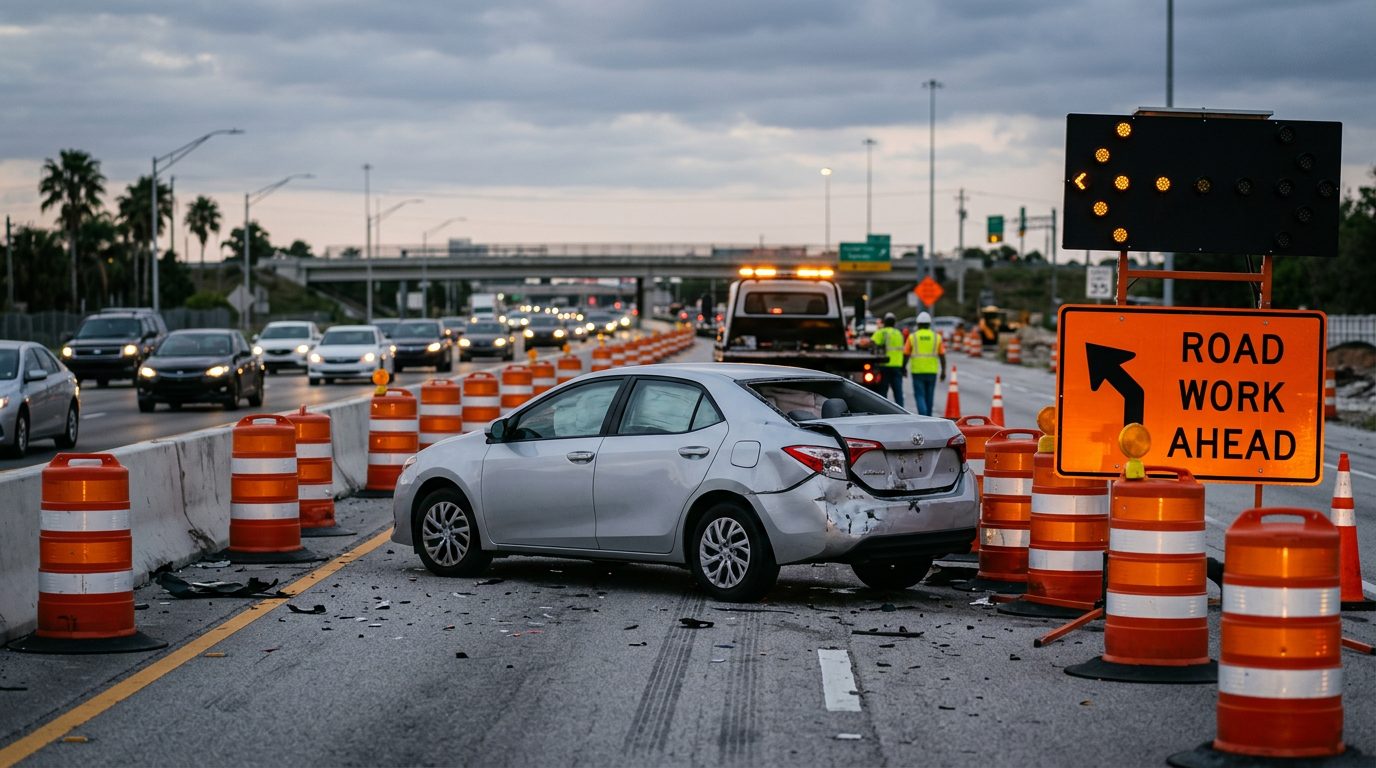
Picture the scene. Orange barrels line both sides of the road. The left lane ends without much warning. Traffic slows to a crawl, and a flagger waves cars through a single open lane. Then a vehicle behind you, or beside you, doesn’t stop in time.
If you were hurt, or someone you love was, the first questions tend to be simple. What happened? Whose fault is this? Those are fair questions. They are also hard to answer in the first days, when the body hurts, the car sits in a tow yard, and insurance calls keep coming.
Here is what to know early. More than one person or company may share responsibility. The other driver may have been at fault. A construction company, a subcontractor, or a traffic control firm may have played a role in how the zone was set up or watched. A government agency may own the road. The answer depends on your crash’s facts. No one can know it from a single detail. This page walks through each possibility so you know what to ask about.
If someone you love was hurt in a work zone, you may be wondering whether another driver or company is responsible, and our team can talk that through with you in a free case evaluation. Talk it through with our team — the first consultation is free, confidential, and carries no obligation.
Common Types of Construction Zone Crashes
The most common work zone crash is a rear-end collision, where a slowing vehicle is struck from behind.
Rear-end crashes happen because traffic often slows or stops fast in a work zone. A driver focused on the road ahead may not notice brake lights until it’s too late. These impacts can still be serious, even at lower speeds. A car may be pushed into stopped traffic or into the work area itself.
Sideswipes are another common pattern. When lanes narrow, drivers may merge too late or drift toward the barrier. A vehicle can strike a row of orange barrels, a temporary concrete barrier, or a sign stand. Some crashes happen when a driver enters a lane that is closed, perhaps because the lane markings were faded or confusing.
Work zones also put people on foot at risk. Flaggers, crew members, and pedestrians near the road can be struck. Heavy trucks and construction equipment add another layer. When a large truck is involved, the damage to the smaller vehicle and its occupants can be much worse.
Each crash type raises different questions. Was the speed reasonable for the conditions? Was the lane clearly marked? Was the work zone set up as it should have been? The answers help show who may be responsible.
Why Work Zone Crashes Can Cause Catastrophic Injuries
Work zone crashes can cause catastrophic injuries when a vehicle hits heavy equipment, a concrete barrier, or another vehicle at high speed.
The force of a crash shapes how much harm the body takes. High-speed impacts can cause spinal cord injuries, traumatic brain injuries, amputations, and severe burns. Some of these injuries are permanent. The Mayo Clinic explains the symptoms, causes, and complications of spinal cord injury in plain terms.
The numbers show how serious these injuries are. In the United States, about 54 people per million suffer a traumatic spinal cord injury each year, according to the National Spinal Cord Injury Statistical Center.
In a Florida motor vehicle case, pain and suffering damages generally require meeting the permanency threshold in § 627.737(2), which applies to claims against owners, operators, or occupants of vehicles covered by PIP security, and comparative fault may also limit recovery. Under § 627.737, the injury must include things like significant and permanent loss of an important bodily function, permanent injury, significant and permanent scarring or disfigurement, or death.
Early medical records matter. They document the injury from the start. Doctors who treat these injuries may recommend care and equipment that take months or years. For more on these injury types, read our construction zone catastrophic accidents guide.
The Other Driver
The other driver may be responsible if they were speeding, distracted, impaired, or following too closely.
Florida law is clear about speed in these areas. Under § 316.183, no driver may exceed the posted maximum speed limit in a work zone area. Drivers must also go at a speed that is reasonable and prudent for the conditions. Under § 316.185, they must also slow down when a special hazard exists, including one caused by roadway conditions.
Evidence helps show what happened. Collect the crash report number, photos of the scene and vehicles, and any dashcam video. Write down names and phone numbers of witnesses. If you were a passenger, note who was driving and what you saw.
Don’t assume the first explanation given at the scene is the final one. People often say things in shock that don’t match the physical evidence. The other driver’s insurance may also be relevant, so keep a list of every call, who made it, and what was said.
Construction Companies, Subcontractors, and Traffic Control Firms
A construction company or traffic control firm may share responsibility if the work zone was set up, marked, or watched in an unsafe way.
A general contractor may answer for how the work zone was set up, maintained, and monitored under its contract. Subcontractors, such as paving, striping, or barrier companies, may share responsibility for their own work.
Traffic control companies place cones, signs, flaggers, and arrow boards. Poor placement, missing signs, or unclear lane markings can all contribute to a crash. Florida requires official traffic control devices installed by a public body to match state standards. Under § 316.0745, those devices must conform with the manual and specifications published by the Florida Department of Transportation.
Responsibility depends on the contract, the facts, and what each party did or failed to do. Florida divides fault by percentage among the parties found liable. Each party generally answers for its own share, not for the whole amount, though exceptions apply in some situations.
Government Agencies and Strict Notice Rules
When a state agency or local government owns or controls the road, special legal rules can apply to a claim against it.
Roads may belong to the Florida Department of Transportation, a county, or a city. Under § 768.28, the state and its agencies are liable for tort claims in the same way and to the same extent as a private person in similar circumstances. Liability does not include punitive damages or interest before judgment.
That same statute sets dollar limits. The state generally may not pay more than a set amount on one person’s claim, or more than a set total on all claims from the same incident, unless the Legislature acts further.
Claims against government entities can also involve special steps before a lawsuit can be filed. If a government road was involved, ask about those steps early, before time passes.
Not sure what your next step is?
Talk it through with our team — the first consultation is free, confidential, and carries no obligation.
Equipment Makers and Crashworthiness Claims
A vehicle or equipment defect can make injuries worse, even when another driver caused the crash.
This idea is called crashworthiness (whether a vehicle protects its occupants as designed in a crash). A part that fails or a safety system that doesn’t work as designed can turn a survivable impact into a catastrophic one. An attorney can review what happened and explain whether you may have a claim. Under § 768.81, a product case can allege that injuries were greater than they would have been without the defect, and the fault of everyone who contributed to the accident must be considered.
These questions are technical. Accident reconstruction professionals and engineers study crash data, vehicle damage, and design records. Don’t try to answer equipment questions on your own.
Preserve evidence when you can. Keep the vehicle, parts, and photos. Ask that the vehicle not be sold for salvage without a record of what it looked like after the crash.
How Florida Fault Rules and Deadlines Apply
Under Florida law, a person found more at fault for their own harm than everyone else combined generally cannot recover damages.
Florida uses a modified comparative fault system. Under § 768.81, the court enters judgment against each liable party based on that party’s percentage of fault. It does not hold one party responsible for the whole amount just because others also share fault.
Florida also sets time limits for filing lawsuits. Those limits are found in § 95.11. Missing one can end a claim, so don’t wait to ask questions.
These are general rules. Each case turns on its own facts. No outcome can be promised, and a fault split that seems fair to one person may look different to another.
When a Work Zone Crash Is Fatal
When a work zone crash causes a death, a wrongful death claim is generally brought by the personal representative of the estate, on behalf of the survivors and the estate.
Losing a loved one this way is devastating. The law recognizes that the family is the one left behind. The wrongful death statute, § 768.20, sets out who brings the action, and how it applies depends on the facts of each case.
Families often don’t know who can act or what deadlines apply. Those deadlines are real, so ask for help promptly, even if you aren’t ready to decide anything.
In the meantime, keep practical records. Save the crash report, medical and funeral paperwork, insurance letters, photos, and the names of witnesses. Write down questions as they come up. Focus on the people who need care and support now.
Talking Through Your Situation With CHG Personal Injury Lawyers
If you are weighing who is responsible for a crash in a work zone, you don’t have to sort it out alone.
Common questions
Can the Florida Department of Transportation be sued? Possibly. Florida’s sovereign immunity law allows some claims against state agencies, subject to special rules and dollar limits.
Is there a deadline? Yes. Florida sets time limits for lawsuits, and claims against government entities can have their own steps.
Can I recover if I was partly at fault? Florida divides fault by percentage. A person found more at fault than everyone else combined generally cannot recover damages.
Caring for someone who was hurt, while handling medical visits and insurance calls, is a lot to carry. If someone you love was hurt in a work zone, and you want to understand who may be responsible, reach out to CHG Personal Injury Lawyers for a free case evaluation.
CHG Personal Injury Lawyers is a Florida firm. It focuses on serious personal injury cases, including catastrophic injury, truck, and construction zone matters, for people throughout Florida. CHG charges no attorney’s fees and no case costs unless there is a recovery.
This page is published by CHG Personal Injury Lawyers for general information only. It is not legal advice. Every case is different. Past results do not predict future outcomes, and no particular outcome can be promised.
Who Else May Share Responsibility
The Other Driver
A driver who was speeding, distracted, or failed to slow for lane shifts or flaggers may bear responsibility for a crash in a work zone.
The Construction Company
The company managing the project may be responsible for how the zone was set up, marked, and maintained while work was underway.
Traffic Control Firms
Companies hired to direct traffic, place signs, and set barriers may share responsibility when those safety measures fail.
Government Agencies
A state or local agency that owns the road may be involved, and claims against government entities can follow different procedures than claims against private parties.
How CHG Personal Injury Lawyers Can Help
Focused Practice
Our practice focuses on serious injury claims arising from car, truck, and other crashes across Florida.
Licensed Attorneys
Our attorneys are admitted in Florida as members of The Florida Bar.
Reviewing Whether Other Parties May Have Contributed
We look into whether other parties may have contributed to the crash, not only the driver who hit you.
No Fees Unless There Is a Recovery
CHG charges no attorney's fees and no case costs unless there is a recovery.
Protect Your Claim Early
If you can, photograph the work zone, signs, lane markings, and vehicle damage, and write down what you remember while it is fresh. Be careful about giving recorded statements to insurance companies or other parties before you have spoken with an attorney.