

Amputation Claims · Florida & Nationwide
The Cost of a Wheelchair-Accessible Home Belongs in Your Amputation Claim
After a limb loss caused by someone else's negligence, ramps, widened doorways, and adapted vehicles are real, recoverable costs. Here's how the law treats them as future damages — and how a documented claim can ask for them.
By CHG Lawyers · Published August 01, 2026
Home and Vehicle Modifications After Limb Loss: What You Can Recover
Yes, you can often recover the cost of making your home and vehicle accessible after an amputation. This is true when someone else’s negligence caused the limb loss. The law treats these as “future damages” — costs you will face later on. A well-documented claim can ask for reasonable, medically needed changes.
Losing an arm or leg changes daily life overnight. The home you’ve lived in for years can suddenly feel like an obstacle course. The car in your driveway may no longer be safe to drive.
This guide explains the changes people really need. It gives honest cost ranges. It also shows how these costs fit into a larger claim.
This page is educational. It is not legal advice for any specific case. For the full picture of a limb-loss claim, see our main page on amputation and limb-loss injury claims.

Not sure what your next step is?
Talk it through with our team — the first consultation is free, confidential, and carries no obligation.
Why accessibility costs matter after limb loss
These costs go on and on. They are not one-time. They stretch across a lifetime. A single ramp isn’t the end of it. Equipment wears out. Your needs change as you age, as your body changes, and as your prosthetic use changes.
People who lose a lower limb often face higher home and vehicle costs than families expect. Here is why: walking on a prosthesis takes far more effort. One peer-reviewed study on how people walk (Waters & Mulroy, Gait & Posture, 1999) found that a person with a transfemoral (above-knee) amputation uses about 60% more energy to walk than someone with two whole legs. A transtibial (below-knee) amputee uses about 25% more.
That is why many above-knee amputees use a wheelchair for part of the day. And it is why the home must handle both walking and wheeling — not one or the other.
There is also a reason a claim can’t be based on today’s device alone. The federal Amputee Coalition uses federal survey data. It reports that about 185,000 amputations are performed in the U.S. each year. It also reports that about 2 million Americans are living with limb loss.
Prosthetic feet and sockets are not permanent. A socket often needs replacing as the residual limb (the remaining part of the limb) changes shape. Parts are usually refit or replaced every three to five years. A claim that covers only the first prosthesis undervalues a lifetime of care.
Are home and vehicle modifications recoverable in an amputation claim?
Yes. In many cases you can recover them as “future damages” (also called cost-of-care damages). This applies when negligence caused the limb loss. The money to make your life accessible can be part of what you seek from the at-fault party.
It helps to separate two things. An injury claim goes against the person or company whose negligence caused the amputation. Health insurance and workers’ compensation are separate sources of coverage. They may pay some costs, but often not all. An injury claim can cover the gap they leave behind.
A strong claim asks for reasonable, medically needed changes backed by expert evidence. That usually means:
- a treating doctor’s recommendation,
- a home assessment by a Certified Aging-in-Place Specialist (CAPS) or occupational therapist, and
- a written cost estimate.
Every case turns on its own facts. No lawyer can promise a specific dollar result. Florida law also affects what you can recover. Under Fla. Stat. §768.81, Florida uses modified comparative negligence. That means your fault reduces your recovery. A claimant found more than 50% at fault generally recovers nothing. To learn how fault is decided, see who is liable for an amputation injury.
Common home modifications amputees may need
The right changes depend on which limb was lost. They also depend on whether you use a prosthetic or a wheelchair. A useful guide is the technical standards from the Americans with Disabilities Act (ADA). The ADA covers public buildings. Still, its measurements are the reference that contractors and life-care planners use for homes.
Entrances and exits
Getting in and out safely comes first. Common changes include:
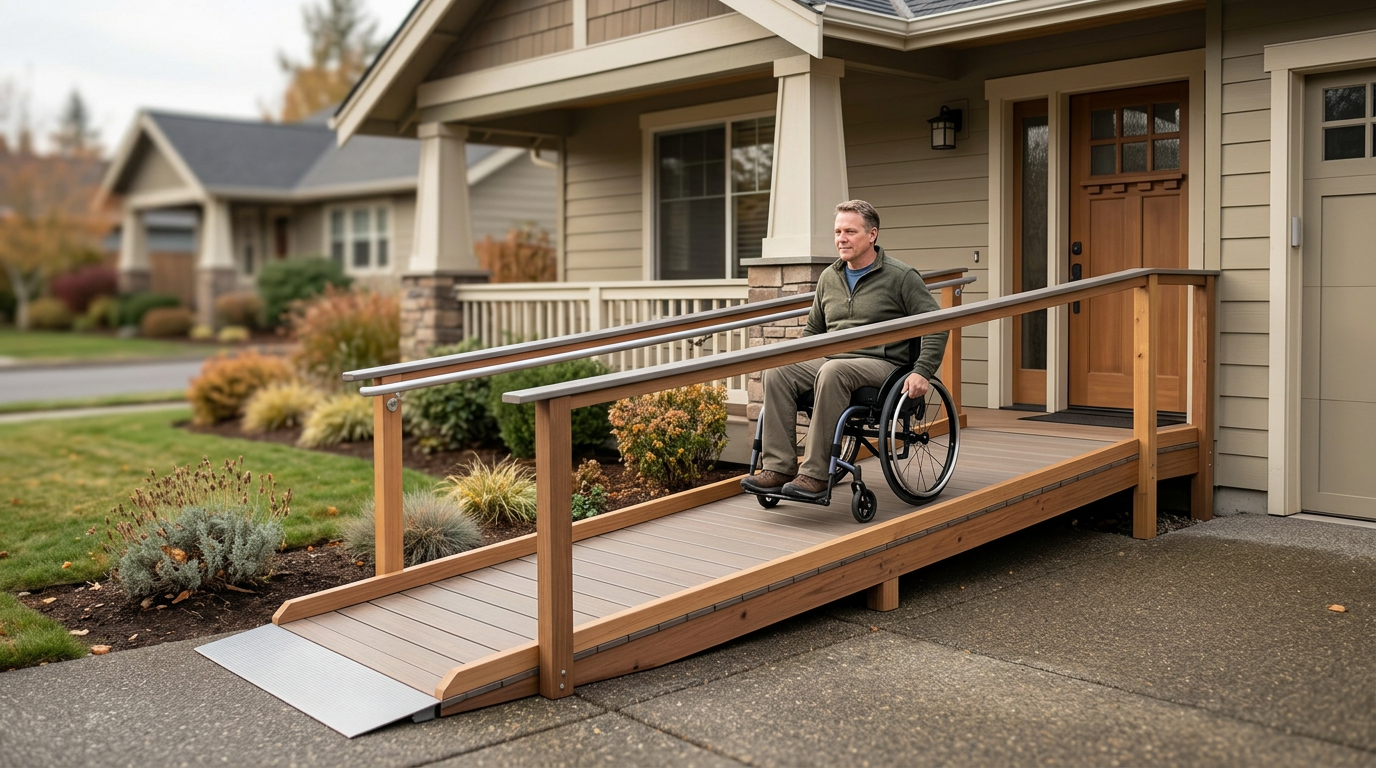
- Ramps or a zero-step entry. ADA guidance limits ramp slope to 1:12 — one inch of rise per foot of length. So a 30-inch porch needs a 30-foot ramp plus level landings.
- Lower thresholds so wheels roll smoothly.
- Lever door handles instead of round knobs (you can use a lever with a residual limb or one hand).
- Keyless or push-button entry.
Doorways and hallways
A standard interior door leaves only about 23–27 inches of clear space. A manual wheelchair needs roughly 32 inches of clear width. Many homes need wider doorways, or the jambs (the side frames) removed, before a chair can pass without scraping.
Bathroom safety
The bathroom is where many falls happen. Helpful changes include grab bars anchored to wall blocking, a roll-in curbless shower, a shower seat, a comfort-height toilet, and a wall-mounted sink you can roll under while seated.
Kitchen accessibility
A standard kitchen is hard to use with a wheelchair or a single arm. Lowered counter sections (about 34 inches), pull-out shelving, side-opening ovens, and front-mounted controls make cooking safe again.
Bedrooms and living space
If your bedroom is upstairs, that becomes a daily problem. Common solutions include turning a first-floor room into a bedroom, adding a hospital bed, or installing a stair lift or home elevator.
Flooring, lighting, and hardware matter too. Firm, smooth flooring helps, since deep carpet is exhausting to wheel across. Brighter lighting and easy-grip hardware also cut fall risk. Needs differ sharply between upper-limb and lower-limb loss. So a professional home assessment is worth its cost.
Vehicle modifications after limb loss
Vehicle changes restore your ability to drive and travel. The right equipment depends on which limb you lost.
For lower-limb amputees, options include hand controls, a left-foot accelerator, and adaptive steering. For upper-limb amputees, spinner knobs, modified pedals, and push-button or joystick controls can help. Some people need a full wheelchair-accessible van with a lowered floor, ramp, or transfer seat.
People often forget two costs: evaluation/training and replacement. A driver rehabilitation specialist checks what you need and trains you to drive safely. (Many hold CDRS certification through the Association for Driver Rehabilitation Specialists.) States often require this before you can re-license. Adapted vans and equipment also wear out. They must be replaced every several years. Those repeat costs belong in your claim, not just the first purchase.
Temporary vs. permanent modifications
You’ll likely need two waves of changes. First come temporary fixes during early recovery. Then come permanent ones, once your long-term needs are clear.
Early on, portable ramps and rental equipment help while you heal and rehab. Later, permanent changes make sense. That is once your residual limb has fully settled and your prosthetist and therapists understand your lasting mobility level. There is no point in a full kitchen remodel before you know if you’ll mostly walk, mostly wheel, or both.
Document both stages. Temporary rental costs and permanent construction are both real losses. Keeping records of each helps prove the full scope of what the injury required.
Have questions about what happened?
Ask our team directly. The first conversation is free, confidential, and there is no obligation to continue.
How much do home and vehicle modifications cost?
Costs vary widely by region, home layout, and level of impairment. So treat these figures as a general guide — not a value for any claim.
- Low end: Grab bars, handrails, and small safety fixes — often a few hundred to a few thousand dollars.
- Mid range: Roll-in bathrooms, wider doorways, and ramps — commonly in the tens of thousands.
- High end: Full accessible remodels, stair lifts, and home elevators — many tens of thousands of dollars.
Vehicles have their own range. Adding hand controls to an existing car is far cheaper than a full wheelchair-accessible van conversion. A van conversion can add tens of thousands on top of the vehicle itself.
Here’s the part most pages skip: think in decades, not dollars today. A converted van gets replaced every several years. Add regular service, and the total grows far larger than the first bill. That’s why these figures guide you but never value your own claim. A life care planner does that.
How these costs fit into your overall future damages
Home and vehicle changes are one piece of your future cost of care. A full claim also covers prosthetics and their replacement cycles, ongoing medical care, therapy, home health aides, and lost earning capacity.
To capture all of this, experts prepare a life care plan. This is a full document, often written by a Certified Life Care Planner. It projects your needs and their costs over your lifetime. Medical and rehab experts build it. Then a forensic economist reduces those future costs to present value. The economist also measures lost earning capacity across decades.
Amputation often comes with related injuries. When limb loss happens alongside spinal or nerve damage, the picture gets more complex. The Mayo Clinic describes long-term complications of spinal cord injury. The National Spinal Cord Injury Statistical Center tracks U.S. data on these injuries. To understand the rehab side, see our page on amputation recovery and rehabilitation.
Proving modification costs: what evidence helps
Strong records turn a modification cost into a recoverable loss. Helpful evidence includes:
- Receipts, invoices, and contractor estimates — money already spent and written quotes for planned work.
- Doctor and occupational-therapist recommendations that tie each change to your injury. (A change is far easier to recover when a treating provider ordered it in writing.)
- Life care plans and cost projections supported by expert testimony for future needs.
- Before-and-after photos and a written home assessment.
In the amputation cases our attorneys handle, some clients save receipts and follow their providers’ written recommendations. These clients give us the clearest, most convincing record. Spoken advice from a doctor is hard to prove years later. A note in the chart is not. Don’t throw anything away.
Does insurance or workers’ comp cover modifications?
Insurance sometimes helps, but it rarely covers the full cost. Health plans often label home and vehicle changes as “non-medical.” Then they leave them out completely.
If your amputation was work-related, Florida workers’ compensation can cover some accommodations. But coverage is limited and often falls short of what you really need. Charities and nonprofit programs can help fill gaps, though they seldom pay for everything.
That’s exactly why an injury claim against the at-fault party matters. Someone else’s negligence may have caused your limb loss — a truck crash, a crush injury, or an unsafe property. A claim can seek the shortfall those other sources leave behind. If your amputation followed a preventable crush injury, see crush injury and compartment syndrome amputation.
Keep the deadline in mind. Under Fla. Stat. §95.11, the deadline to file most Florida negligence claims is two years. This applies to causes accruing on or after March 24, 2023. You can confirm the law yourself on Online Sunshine, the Florida Legislature’s official site.
People also ask
How much is an amputated leg worth in a lawsuit?
There’s no fixed figure. Value depends on the facts. These include the level of the amputation, your lifetime medical and care costs, lost earning capacity, and who was at fault. An above-knee loss generally carries higher future costs than a below-knee loss, in part because walking takes more energy. No lawyer can promise a specific amount.
How much money do you get for losing a limb?
It varies case by case. The main factors are the extent of the limb loss and your lifetime future costs (including prosthetic replacement every few years). It also depends on how the injury affects your ability to work and how strong the liability evidence is.
How much compensation for losing a toe?
Even smaller amputations carry real damages. Loss of the big toe can affect balance and push-off when you walk. The value depends on those effects and the details of the injury.
Are amputations covered by insurance?
Insurance may cover part of your medical care. But it often leaves out home and vehicle changes and rarely covers everything. An injury claim against the at-fault party can seek the full cost of your losses.

Want to know where you stand?
Tell us what happened and our team will walk you through the options available to you, at no cost.
Talk to a catastrophic injury lawyer about your recovery
You shouldn’t have to pay for ramps, an accessible bathroom, or an adapted van on your own — not when someone else’s negligence caused your amputation. These are real, recoverable losses. And understanding the full lifetime cost of a limb-loss claim is a key step toward rebuilding your life.
CHG Personal Injury Lawyers handles catastrophic amputation and limb-loss cases. This includes cases caused by truck accidents and unsafe properties, in Florida and nationwide. Our team is bilingual (English and Spanish). Our attorneys are licensed and admitted to The Florida Bar.
Ready to talk? Request a free case evaluation. We’ll listen to what happened and explain your options — with no promise of a specific result, just honest guidance. To keep learning, return to our main page on amputation and limb-loss injury claims.
What Accessibility Costs May Belong in Your Claim
Home Modifications
Wheelchair ramps, widened doorways, roll-in showers, lowered counters, stair lifts, and grab bars that make a familiar home safe to live in again.
Vehicle Adaptations
Hand controls, wheelchair lifts, and modified seating — or a properly equipped vehicle — so you can travel safely after limb loss.
Future Damages
The law treats these as costs you will face later. A well-documented claim can ask for reasonable, medically needed changes over time.
Related Care Needs
Prosthetics, maintenance, and the day-to-day realities of living with an amputation are often part of the bigger picture your claim addresses.
Document Before You Modify
Keep every estimate, invoice, and doctor's note tying each change to your medical needs. Photos and written quotes help show why a modification is reasonable and necessary — the foundation of a strong future-damages claim.
Common Questions About Recovering These Costs
Can I recover costs I haven't spent yet?
Often, yes. Modifications you will need in the future are treated as future damages. A claim can seek reasonable amounts even before the work is done, when properly documented.
What makes a modification 'reasonable'?
Changes that a medical or rehabilitation professional connects to your limb loss and daily safety — not luxury upgrades. Medical support and cost estimates help establish this.
Does this apply to my vehicle too?
Yes. If your amputation makes your current car unsafe to drive, the cost of adaptive equipment or an accessible vehicle can be part of the claim.
Who pays for these costs?
When another party's negligence caused the amputation, that party — and often their insurer — may be responsible for accessibility costs as part of your damages.