

Amputation & Limb Loss Claims
How the Level of Your Amputation Shapes What Your Claim Documents
Losing a limb changes a life permanently. The level of the amputation affects lost function, lifetime medical costs, and the impairment rating that helps measure your losses. Here is how it works in plain language.
By CHG Lawyers · Published August 05, 2026
Above-Knee vs. Below-Knee Amputation: How the Level of Loss Affects Recovery and Compensation
If you or someone you love just lost a leg, life may feel like a blur. There are surgeries, appointments, and questions no one prepared you for.
One question keeps many people up at night. It is about money. What will this cost us for the rest of our lives? Can we hold the responsible party accountable?
This page answers that honestly. We will not throw “average settlement” numbers at you. As we explain below, those numbers cannot predict your outcome.
Instead, we use the one detail that everyone treats as key: where the leg was lost, above the knee or below it. Doctors, prosthetists, and economists all rely on it. That single point shapes recovery, lifetime cost, and the real harm a claim documents.
This article is educational only. It is not legal advice about your specific case.
Not sure what your next step is?
Talk it through with our team — the first consultation is free, confidential, and carries no obligation.
Why the level of amputation is the right lens (not a price tag)
An amputation is described by where the limb is separated. The two most common lower-limb levels are:
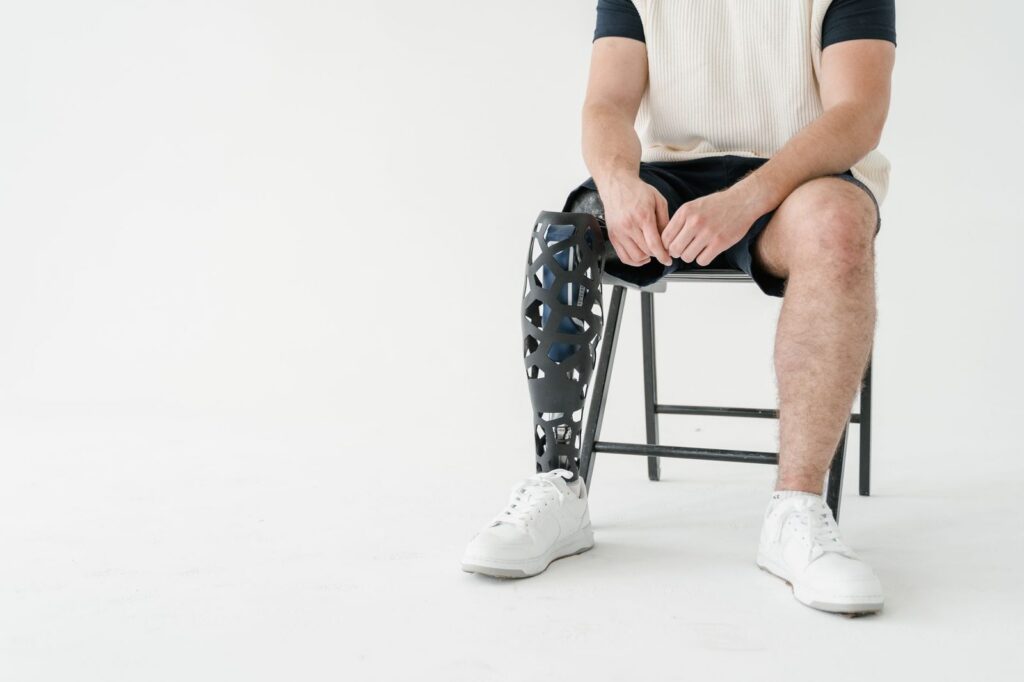
- Below-knee (transtibial) — the cut is through the shin. The knee joint stays.
- Above-knee (transfemoral) — the cut is through the thigh. The knee joint is gone.
That difference is not just about looks. It predicts how hard rehab will be. It predicts how much a person can do afterward. And it predicts what the next several decades of care will cost.
This is also how the medical and legal systems measure the injury. The AMA Guides to the Evaluation of Permanent Impairment is the standard reference. Doctors, insurers, and courts use it to assign an impairment rating. It rates lower-limb amputation by level.
The higher the loss, the higher the whole-person impairment. That is because more limb and joint function is gone. So when a doctor says an above-knee loss is “worth more” in impairment terms, that is not just an opinion. It is the Guides framework doing its job.
Below-knee (transtibial): what recovery usually involves
Keeping the knee is the single biggest advantage a lower-limb amputee can have. A natural knee bends, steadies you, and absorbs shock on its own. That is why walking with a below-knee prosthesis is usually more natural and less tiring.
Recovery usually moves through clear stages:
- Wound healing at the surgical site.
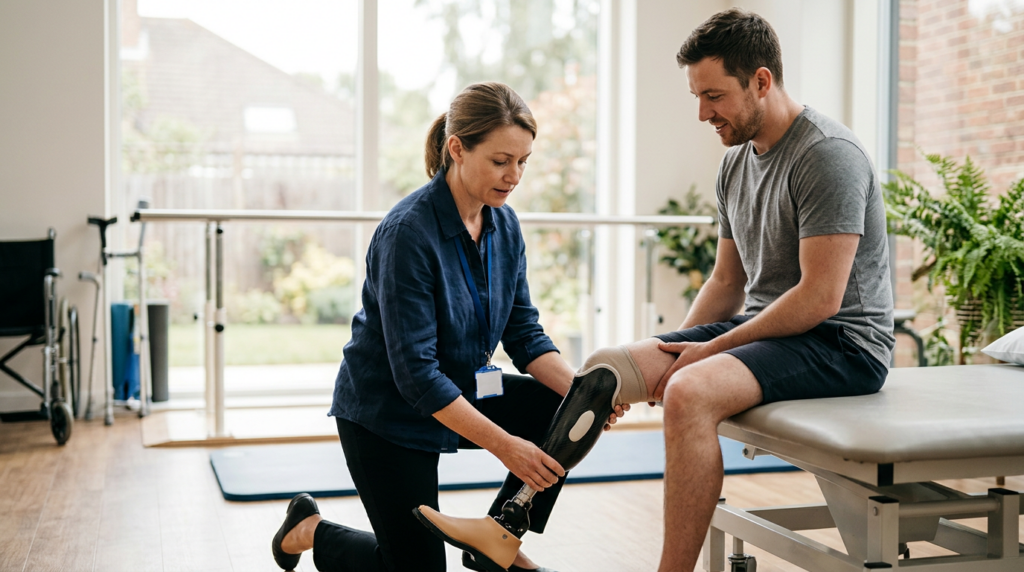
- Residual-limb shaping and desensitization — the remaining leg is compressed and toughened. This helps it bear a socket, the cup that holds the prosthesis.
- Prosthetic fitting — casting and building the artificial lower leg and foot.
- Gait training — relearning to walk, often with a physical therapist.
Because the knee still works, many people regain real mobility. They also spend less energy walking than they would after an above-knee loss.
None of this makes it a minor injury. A below-knee amputation is permanent and life-altering. It changes how a person works, drives, parents, and moves through every ordinary day.
Above-knee (transfemoral): why recovery is harder
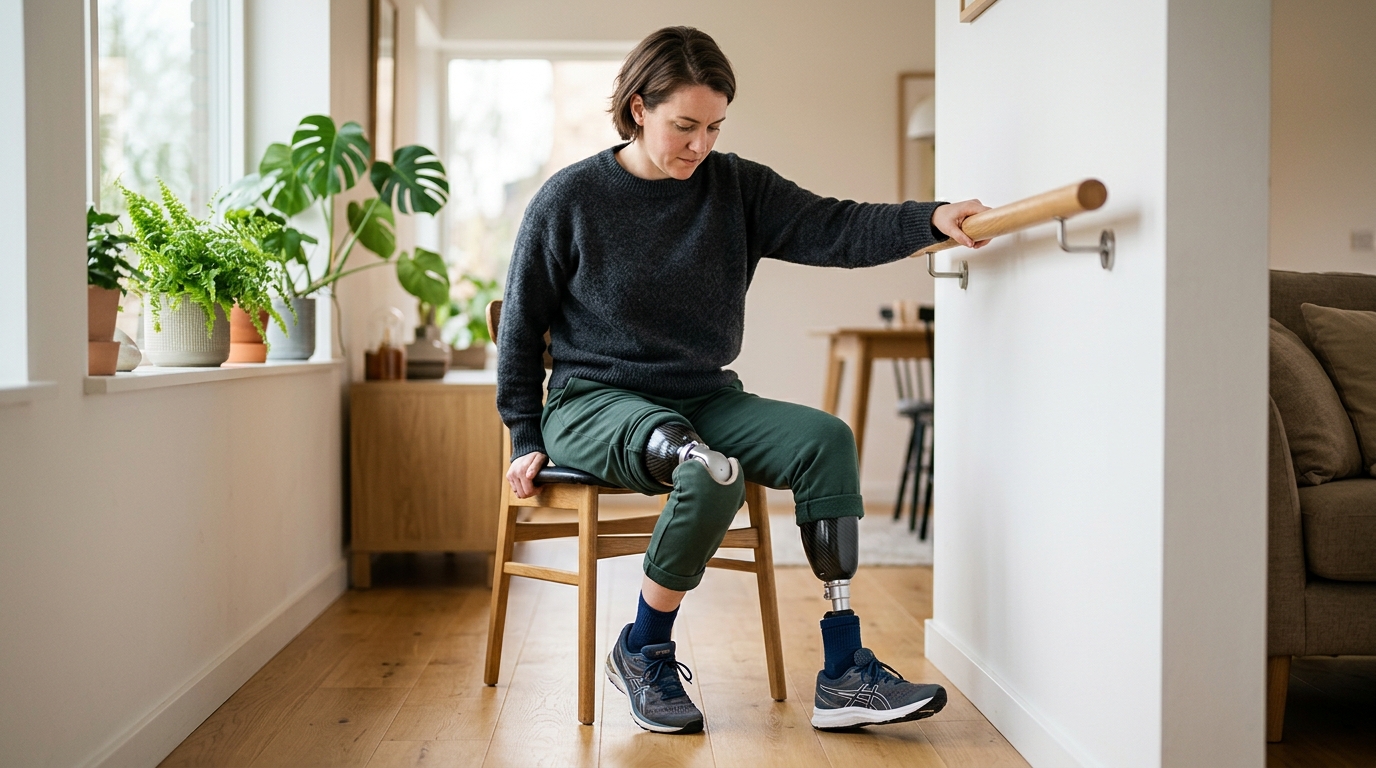
Above the knee, the body has lost the joint that does most of the work of walking. Now the prosthesis has to replace the lower leg and a working knee. The person’s own hip and remaining thigh muscles have to control it.
Here is what that means in real life:
- Higher energy cost. Walking on an above-knee prosthesis takes much more effort than a below-knee one. Some people use a wheelchair for part or all of their mobility. It depends on health, age, and fitness.
- More complex, costlier devices. Many above-knee patients get a microprocessor knee. This is a computerized joint. It reads each step and adjusts to reduce falls. These cost far more to buy. They also need more service and replacement than a basic below-knee limb.
- More home and vehicle changes. Ramps, wider doorways, roll-in showers, and hand controls for driving are more often needed. Some people need help with daily tasks.
- Bigger return-to-work barriers, especially for physical jobs.
Why we will not quote you a settlement figure — and why that’s the honest answer
If a website or a caller promises you “the average amputation settlement is $X,” walk away. Here is why that number means nothing for your family:
- Published averages come from other people’s cases. Different crashes, different injuries, different insurance policies, different jobs.
- Averages hide the two things that most often limit a real recovery. One is how much insurance coverage actually exists to pay. The other is how fault is divided.
- Under Florida Bar advertising rules, no lawyer may promise or predict a specific result. A number dressed up as a prediction is not confidence. It is a red flag.
What an honest lawyer can do is explain the kinds of harm your claim is built from. We can also explain how the amputation level moves each one:
- Medical costs — surgery, hospital stays, rehab, and prosthetics. This includes lifetime replacement and upkeep. These are usually higher above the knee.
- Future care and assistance — home changes, mobility equipment, and possible help with daily tasks. This is needed more often with higher losses.
- Lost income and reduced earning capacity — a higher amputation hits physical jobs harder. See our loss of earning capacity page.
- Pain, disfigurement, and loss of enjoyment of life — the law weighs how permanent and limiting the loss is.
These are factors that affect value. They are not a promise of any amount. To see how the pieces fit together, read how amputation settlements are calculated.
Have questions about what happened?
Ask our team directly. The first conversation is free, confidential, and there is no obligation to continue.
Lifetime cost: a prosthesis is a subscription, not a purchase
The most undercounted number in an amputation claim is the future. A prosthetic limb is not bought once. Devices wear out and are replaced many times across a person’s life. And the higher the amputation, the higher and more frequent those replacement costs tend to be.
An above-knee limb with a microprocessor knee needs regular servicing. It will also need replacing over time. Multiply that across decades. Then add the costs that outlast the device itself:
- ongoing physical therapy;
- follow-up surgeries called revisions;
- lifelong skin and residual-limb care, plus treatment when problems come up.
This is why a life-care plan is central to serious limb-loss cases. In the catastrophic-injury cases our attorneys handle, a life-care planner works with an economic or vocational expert. Together they document these future costs. That way the costs can be shown, not guessed at. Without that proof, an insurer will often undercount what a lifetime of care really costs.
Some amputations are not immediate. A severe crush injury can lead to a delayed amputation weeks later. See crush injuries that lead to amputation.
How these injuries happen — and when someone else may be responsible
Catastrophic limb loss often traces back to someone else’s carelessness. Common causes include truck and highway crashes, workplace and machinery accidents, and crush injuries that later require amputation. If another party’s carelessness caused the accident, the injured person may be able to bring a claim. For crash cases, see truck accident injury claims.
A limb can also be lost in a violent attack. Say someone was shot or attacked in an apartment-complex parking lot, a dark parking garage, a hotel, or a store. The property owner may share the blame if they failed to provide reasonable security. That means working locks and gates, good lighting, cameras, or guards.
Lawyers call this negligent security. But you don’t need to know the term to have a case. Learn more on our negligent security page.
Responsibility always turns on the facts. Two Florida rules matter:
- Deadline to file. Under Fla. Stat. §95.11, most Florida negligence claims must be filed within two years. This applies to claims that arise on or after March 24, 2023.
- Shared fault. Under Fla. Stat. §768.81, Florida uses modified comparative negligence. A person found more than 50% at fault generally recovers nothing.
Talk to a catastrophic injury attorney about your situation
You do not have to figure this out alone. If a serious accident or an unsafe property caused your amputation, a free case evaluation can help you understand your options.
A lawyer’s job here is concrete. We document your future costs with the right experts. We find every responsible party and every insurance policy. And we deal with the insurers on your behalf. That last part matters most in amputation cases. Lifetime costs are so easy to undercount.
CHG Personal Injury Lawyers are licensed attorneys admitted to The Florida Bar. The firm is based in Florida. It handles catastrophic-injury cases nationwide and publishes educational resources in English and Spanish.
We cannot promise a result, and no honest lawyer can. What we can do is explain how the law applies to your specific facts. For the bigger picture, visit our amputation and limb loss pillar page.
Frequently asked questions
How does amputation level affect compensation?
A higher amputation usually means greater lost function and higher lifetime costs. Under the AMA Guides, it also means a higher impairment rating. All of this can affect what an injury claim documents. There is no fixed price per limb.
Is an above-knee amputation worth more than a below-knee amputation?
Often the harms are greater. Above-knee loss usually causes more disability. It also brings higher prosthetic and care costs. But value depends on each person’s facts, insurance, and fault — not a set formula.
How much compensation do you get for losing a leg?
There is no set amount. Any “average” you see online comes from other people’s cases. Value depends on the level of loss, the cause, the fault involved, the available insurance, and the person’s age and job.
How long do I have to file an amputation lawsuit in Florida?
Under Fla. Stat. §95.11, most Florida negligence claims must be filed within two years for claims that arise on or after March 24, 2023. Talk to a lawyer promptly to protect your rights.
Can I sue if a workplace accident or truck crash caused my amputation?
You may be able to bring a claim if another party’s carelessness caused the accident. Responsibility depends on the specific facts of your case.
There Is No Fixed Price Per Limb
Be cautious of anyone who quotes a set dollar figure for an arm or a leg. Every case turns on your specific injury, your future medical and prosthetic needs, your work, and the facts of how the harm happened. A careful claim is built on documentation, not formulas.
What Drives the Value of an Amputation Claim
Level of Amputation
A higher amputation generally means greater lost function and a higher impairment rating under the AMA Guides. An above-knee loss, for example, often involves more lasting limitation than a below-knee loss.
Lifetime Medical & Prosthetic Costs
Prosthetic devices wear out and must be replaced over a lifetime. Higher-level amputations often require more advanced, costlier devices plus ongoing therapy, fittings, and revision surgeries.
Impact on Work & Income
How the injury affects your ability to earn a living matters. This includes lost wages, reduced future earning capacity, and any need to change careers or stop working.
Daily Life & Independence
Pain, mobility limits, home and vehicle modifications, and the day-to-day toll on independence are real losses that a well-documented claim can reflect.
Want to know where you stand?
Tell us what happened and our team will walk you through the options available to you, at no cost.
How We Help Document a Catastrophic Injury Claim
Building the Medical Record
We work to gather the records, imaging, and expert opinions that show the level of amputation and its lasting effects.
Life-Care Planning
For lifelong needs, we can involve professionals who project future prosthetic, medical, and care costs so nothing is overlooked.
Licensed, Florida Bar Attorneys
Our attorneys are admitted to the Florida Bar and handle catastrophic injury cases for clients across the country.
An Approach Centered on You
We know limb loss reshapes daily life. We listen first, explain your options clearly, and move at a pace that respects what you are going through.