

Catastrophic Injury | Wrongful Death
Airplane Crash Wrongful-Death Claims: Guidance for Families
If a loved one was killed in an airplane crash, you may have the right to pursue a wrongful-death claim. We focus exclusively on catastrophic injuries and fatal accidents. Learn what steps to take now.
By CHG Lawyers · Published August 26, 2026
Airplane Crash Wrongful-Death Claims: Legal Guidance for Grieving Families
When a loved one dies in an airplane crash, the loss is catastrophic—the most severe outcome imaginable. Beyond the immediate grief, you face urgent practical questions: Who is responsible? What legal options exist? How do you move forward when you’re overwhelmed?
A wrongful-death claim is a legal action your family can bring against the parties responsible for the death. It seeks compensation for your loss and holds them accountable. This guide explains what you need to know, what compensation may be available, and how to navigate the process during an overwhelming time.
We understand this is not just a legal matter—it is a profound loss. This firm focuses exclusively on catastrophic injuries and deaths, including aviation fatalities. We handle cases nationwide and provide bilingual (English/Spanish) support. A free, confidential case evaluation is available to help you understand your rights.

Not sure what your next step is?
Talk it through with our team — the first consultation is free, confidential, and carries no obligation.
What Is an Airplane Crash Wrongful-Death Claim?
A wrongful-death claim is a lawsuit brought by the family or estate of someone killed in an aviation accident. It seeks compensation from the party or parties responsible for the death.
In Florida, the wrongful-death claim is filed by the personal representative of the estate on behalf of the survivors, such as the spouse, children and parents (Fla. Stat. § 768.20). The claim holds responsible parties accountable and provides financial recovery for:
- Medical expenses incurred before death
- Funeral costs
- Lost income
- The family’s loss of companionship and support
Aviation wrongful-death claims cover commercial airline crashes, private plane accidents, charter flights, and other aviation incidents. These include cases where negligence, mechanical failure, pilot error, or maintenance violations contributed to the fatality. These are among the most serious legal claims because they involve the loss of life—the most catastrophic outcome there is.
Who This Guidance Is For
This is for you if:
- Your spouse, child, parent, or dependent died in an airplane crash
- You believe airline negligence, pilot error, mechanical failure, or inadequate maintenance caused or contributed to the death
- You’re unsure whether you have a legal claim or what compensation may be available
- You’re navigating the immediate aftermath of an aviation fatality and need clarity on your rights and next steps
Grief is overwhelming. You shouldn’t have to figure out complex aviation law alone. An experienced attorney can guide you through the process so you can focus on healing.
What an Airplane Crash Wrongful-Death Claim Covers
Wrongful-death compensation typically includes two categories of damages:
Economic damages (financial losses): – Medical and emergency response costs incurred before death – Funeral and burial expenses – The value of lost support and services each survivor would have received from the deceased
Non-economic damages (personal losses): – Your pain and suffering – Loss of companionship, guidance, and emotional support – Emotional distress and grief – Loss of consortium (the loss of the marital or family relationship)
Punitive damages (rare but possible): In cases of gross negligence or willful misconduct—such as serious safety violations or reckless decisions—a court may award punitive damages. These punish the defendant and deter similar conduct.
Liable parties may include the airline, aircraft manufacturer, maintenance contractor, pilot, flight crew, airport operator, or air traffic control facility—depending on what caused the crash.
How Liability Is Determined in Aviation Accidents
Establishing who is responsible is central to your claim. Here’s how it works:
The NTSB investigation: The National Transportation Safety Board (NTSB) conducts a factual investigation into the cause of the crash. The NTSB’s findings—whether pilot error, mechanical failure, maintenance violations, or other factors caused the accident—inform your legal claim but do not determine liability by themselves.
The NTSB publishes preliminary reports (typically within weeks) and final reports (often 12–24 months after the accident).
The negligence standard: To hold a party liable, your attorney must prove three things: – The party owed a duty of care to your loved one – The party breached that duty – The breach caused the death
This is established through evidence, expert testimony, and legal argument.
Common causes of aviation accidents include: – Pilot error or poor decision-making (including fatigue, inadequate training, or failure to follow procedures) – Mechanical or structural failure – Inadequate maintenance or inspection – Air traffic control mistakes – Weather-related decisions made without proper caution – Design defects in the aircraft
Multiple parties often share responsibility. For example, an airline might have failed to maintain the aircraft per Federal Aviation Administration (FAA) regulations, while the manufacturer might have designed a defective component. Your attorney will identify all liable parties to maximize recovery for your family.
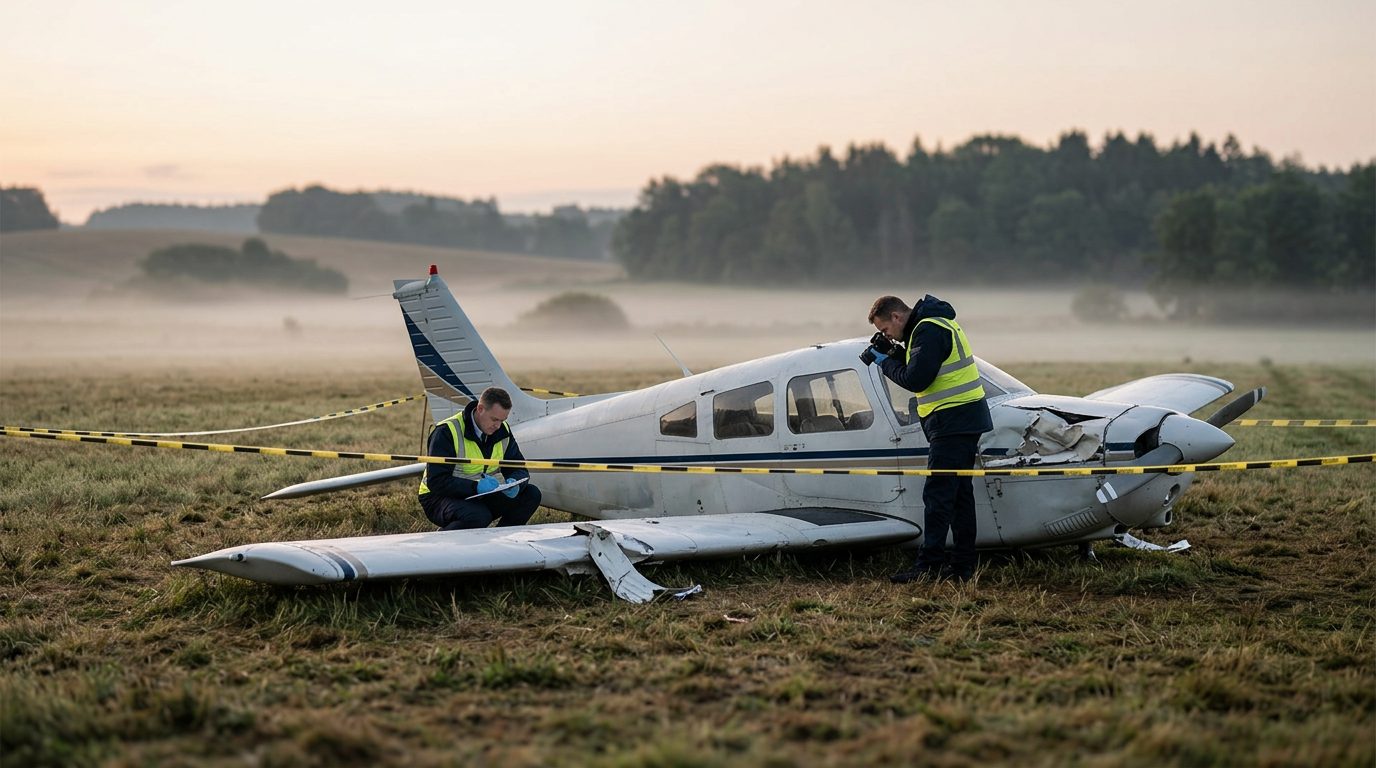
Expert analysis is critical. Aviation engineers, accident reconstructionists, and medical experts help establish what caused the crash and which parties bear responsibility. These experts review maintenance records, pilot training files, cockpit voice recordings, flight data recorders, and wreckage evidence.
How an Airplane Crash Wrongful-Death Claim Works: Step-by-Step
Understanding the process reduces uncertainty and helps you know what to expect.
Step 1 – Initial consultation: You meet with an aviation wrongful-death attorney to discuss the crash, your relationship to the deceased, and your concerns. The attorney explains your legal rights and whether you have a viable claim. This consultation is confidential and free.
Step 2 – Investigation and evidence gathering: Your attorney obtains the NTSB preliminary and final reports, Federal Aviation Administration (FAA) records, maintenance logs, pilot records, cockpit voice recordings (if available), and other evidence. This phase establishes the cause of the crash and identifies liable parties. It often requires coordination with federal agencies and expert analysis.
Step 3 – Identify liable parties: Working with aviation experts, the firm determines which parties—the airline, manufacturer, maintenance contractor, or others—bear responsibility for the death. This may include domestic and international entities, depending on the flight and the accident.
Step 4 – Demand and negotiation: Your attorney sends a detailed demand letter to the liable parties’ insurers. It outlines the claim, the evidence of liability, and the damages your family has suffered. Settlement negotiations often follow. Many aviation wrongful-death claims resolve during this phase without trial.
Step 5 – Litigation (if necessary): If settlement is not reached, the case proceeds to litigation in state or federal court, depending on jurisdiction.
Step 6 – Discovery and expert testimony: Both sides exchange evidence and expert reports. Depositions and expert testimony establish liability and the extent of damages. This phase can last 12–24 months or longer, depending on case complexity.
Step 7 – Trial or settlement: The case may settle before trial or proceed to jury trial. A verdict determines liability and the amount of compensation. Aviation wrongful-death trials are rare but do occur when the parties cannot reach agreement.
Step 8 – Resolution and compensation: Once liability is established, compensation is distributed to your family according to state law and the terms of the settlement or judgment.
Have questions about what happened?
Ask our team directly. The first conversation is free, confidential, and there is no obligation to continue.
Timeline and What to Expect
Aviation wrongful-death claims follow a predictable timeline, though each case is unique.
Immediate steps (first weeks): Consult an attorney. Gather family documentation (birth certificates, marriage licenses, financial records) and preserve evidence. Do not speak with insurers or other parties without legal counsel present. Early legal guidance protects your rights and prevents inadvertent statements that could harm your claim.
Investigation phase (months 1–6): The NTSB investigation unfolds. Your attorney begins gathering records, obtaining FAA documents, and identifying liable parties. Expert analysis begins during this phase.
Claim development (months 6–12): Aviation experts analyze evidence and provide written reports. Your attorney prepares a detailed demand letter outlining your family’s damages and the legal basis for liability.
Negotiation phase (months 12–24): Settlement discussions with insurers and liable parties begin. Many aviation wrongful-death claims resolve during this phase, often without litigation.
Litigation (if needed): If no settlement is reached, the case enters federal court. Litigation can take 2–5 years or longer, depending on complexity and court schedules. However, settlement can occur at any point during litigation.
Overall timeline: Most aviation wrongful-death claims take 2–4 years from filing to resolution, though some settle sooner and highly complex cases may take longer. Early action ensures that deadlines are met and evidence is preserved.
Why This Firm Handles Airplane Crash Wrongful-Death Claims
Exclusive focus on catastrophic injuries and fatalities: This firm focuses exclusively on the most serious, life-altering injuries and deaths—including aviation fatalities—not routine personal-injury cases. This focus means deep experience and resources dedicated to your case.
Licensed Florida attorneys with nationwide reach and federal-court experience: The firm is based in Florida and licensed to practice in Florida. It handles airplane crash wrongful-death claims nationwide, bringing federal-court experience and national resources to your family’s claim. This nationwide reach is critical in aviation cases, where crashes may involve parties and evidence across multiple states and countries.
Complex aviation law: Aviation wrongful-death claims involve federal law, international treaties (for international flights), and specialized technical knowledge.
Relationships with aviation experts: The firm works with accident reconstructionists, aviation engineers, and medical experts to build strong, evidence-backed cases.
No upfront costs: The firm works on a contingency-fee basis. You pay nothing unless the firm recovers compensation for your family. This removes financial barriers during an already difficult time.
Bilingual support and nationwide availability: The firm provides English and Spanish-language resources and support for families, ensuring accessibility and clear communication regardless of language preference.
Frequently Asked Questions
Q: How long do I have to file a wrongful-death claim after an airplane crash?
The statute of limitations (the deadline to file) varies by state and the type of defendant (airline, manufacturer, etc.); in Florida, an action for wrongful death generally must be filed within two years under Fla. Stat. §95.11. Federal aviation claims may have different deadlines depending on the defendant and the legal theory. Consult an attorney immediately to ensure your claim is filed on time. Waiting can bar your claim entirely.
Q: Can I file a claim if the crash occurred outside the United States?
Yes. International aviation accidents may fall under federal law, international treaties (such as the Montreal Convention, which governs liability for international flights), or the laws of the country where the crash occurred. An experienced aviation attorney can determine which law applies, where to file, and how to navigate international legal proceedings. This firm handles international aviation claims.
Q: What if the airline or manufacturer files for bankruptcy?
Bankruptcy does not eliminate your claim. Your family’s wrongful-death claim becomes part of the bankruptcy proceeding, and compensation may be available from the bankruptcy estate or insurance. Bankruptcy claims require specialized legal knowledge to ensure your family’s rights are protected. An attorney experienced in aviation bankruptcies can guide you through this process.
Q: What if multiple parties are liable for the crash?
Your attorney will pursue claims against all liable parties—the airline, manufacturer, maintenance contractor, pilot, or others. This maximizes the potential recovery for your family. In complex crashes, multiple parties often share responsibility, and a comprehensive investigation identifies all of them.
Q: How much compensation can my family receive?
Compensation depends on the deceased’s age, income, life expectancy, your relationship to the deceased, and the extent of liability. Each case is unique. An attorney can provide an estimate based on comparable cases and the specific facts of your situation. Economic damages (lost income, funeral costs) are often more straightforward to calculate, while non-economic damages (loss of companionship, emotional distress) vary based on your circumstances and the jury’s assessment.
Q: Do I need to hire an attorney?
Aviation wrongful-death claims are complex and involve federal law, expert analysis, and negotiation with well-resourced insurers and corporations. An experienced attorney significantly improves your family’s chances of fair compensation and reduces stress during an overwhelming time. Insurers and defendants have teams of lawyers; your family deserves experienced legal representation.
Q: Will my case go to trial?
Many aviation wrongful-death claims settle before trial. However, if a fair settlement is not reached, your attorney will be prepared to take the case to trial and present your family’s claim to a jury. Trial is rare but occurs when the parties cannot agree on liability or damages.
Time Is Critical: Act Now
The statute of limitations is fixed by law. Waiting too long can bar your claim entirely. Early action matters for three reasons:
- Evidence preservation: The sooner you engage an attorney, the sooner critical evidence—NTSB reports, maintenance records, witness statements—can be preserved before it is lost or destroyed.
- Expert availability: Experienced aviation experts are in demand. Early retention ensures the best experts are available for your case.
- Your family’s clarity: Understanding your legal options and taking action provides peace of mind during an overwhelming time.

Want to know where you stand?
Tell us what happened and our team will walk you through the options available to you, at no cost.
Your Family’s Claim Matters
If your family has lost a loved one in an airplane crash and you believe negligence or wrongdoing played a role, you have legal options. This firm focuses exclusively on catastrophic injuries and fatalities, including aviation wrongful-death claims. The firm handles cases nationwide and works on a contingency-fee basis—no upfront cost to your family.
Reach out today for a free, confidential case evaluation. During this consultation, an attorney will listen to your family’s story, answer your questions, and explain what compensation and legal action may be available to you.
Families in your situation reach out regularly. You are not alone, and this firm is ready to help.
Contact CHG Personal Injury Lawyers now for your free case evaluation.
Time Matters
The deadline to file a wrongful-death claim after an airplane crash is set by law and varies depending on the defendant and jurisdiction. Waiting too long can cost you the right to pursue compensation. Contact an attorney as soon as possible to protect your claim.
What You Need to Know About Airplane Crash Wrongful-Death Claims
Who Can File
In Florida, a wrongful-death claim is brought by the decedent’s personal representative, who recovers for the benefit of the survivors (such as the spouse, children, or parents) and the estate. An attorney can explain who qualifies in your situation.
Types of Defendants
Claims may be filed against the airline, aircraft manufacturer, maintenance contractors, airport operators, or other parties whose negligence or failure to maintain safety standards contributed to the crash.
What Damages May Cover
Wrongful-death claims seek compensation for loss of income, medical and funeral expenses, and the loss of companionship and support to surviving family members.
Federal vs. State Law
Airplane crash claims may be governed by federal aviation law, international treaties, or state law, depending on the circumstances. The rules and deadlines can differ significantly.
Why Families Choose CHG Personal Injury Lawyers
Focused on Catastrophic Cases
We focus exclusively on the most serious, life-altering injuries and fatal accidents. We understand the stakes and the complexity of wrongful-death claims.
Licensed Florida Attorneys
Our team is admitted to the Florida Bar and handles wrongful-death and catastrophic injury cases nationwide.
Compassionate Representation
We treat your family with respect and dignity while we work to hold responsible parties accountable.
No Attorney’s Fees Unless There Is a Recovery
We work on a contingency basis, so you pay nothing upfront and no attorney fees unless we recover compensation for you.