

Wrongful Death | Airplane Crashes
Airplane Crash Wrongful Death Lawyer
When a loved one is lost in an aviation accident, you need a firm that understands both the devastating impact on your family and the complex legal claims that follow. CHG Personal Injury Lawyers focuses exclusively on catastrophic injury and wrongful death cases nationwide.
By CHG Lawyers · Published August 30, 2026
Airplane Crash Wrongful Death Claims for Grieving Families
When a loved one dies in an airplane crash, the loss is devastating. The shock, the unanswered questions, the sudden absence—these are the realities families face.
A wrongful death claim is a legal action. It lets your family or the estate seek financial compensation from the party or parties whose negligence, mechanical failure, or misconduct caused the death. Beyond money, the claim holds responsible parties accountable and sends a message that their failures matter.
This page explains what wrongful death claims cover, who can file, what damages may be recoverable, and how the legal process works—written in plain language for families, not lawyers.

If you lost a loved one in an airplane crash, take these steps: Your family does not have to face this alone. Talk it through with our team — the first consultation is free, confidential, and carries no obligation.
What Is an Airplane Crash Wrongful Death Claim?
A wrongful death claim is a lawsuit filed by your family or the estate of someone killed in an airplane crash. You seek compensation from the defendant or defendants responsible for the death.
Wrongful death claims apply to: – Commercial airline crashes – Private plane accidents – Charter flights – Cargo aircraft incidents
The claim exists to provide financial recovery to your family and to hold responsible parties accountable. It is separate from any criminal prosecution. You do not need to prove a crime—only that the defendant’s negligence or wrongdoing caused the death.
In aviation, liability can arise from:
- Airline or operator negligence. Failure to maintain the aircraft, inadequate crew training, or violation of safety protocols.
- Manufacturer defect. A design flaw or manufacturing defect in the aircraft or a critical component.
- Maintenance failure. Improper repair, use of defective parts, or failure to inspect and service the aircraft according to Federal Aviation Administration (FAA) standards.
- Pilot or crew error. Negligent operation, failure to follow procedures, or inadequate response to an emergency.
- Airport or air traffic control negligence. Failure to maintain safe conditions or provide accurate guidance.
Who Is Eligible to File an Airplane Crash Wrongful Death Claim?
Florida Statute § 768.19 creates a right of action when a person’s death is caused by the wrongful act, negligence, default, or breach of contract or warranty of any person.
Under Florida law, only the personal representative files the claim, and it is brought for the survivors: the decedent’s spouse, children, and parents, and any blood relatives and adoptive brothers and sisters who were partly or wholly dependent on the decedent for support or services. If you are unsure whether you qualify, an attorney can review your relationship to the deceased and advise you.
Time limits are strict. Florida law allows 2 years from the date of death to file a wrongful death claim. Other states have different deadlines. Waiting too long can bar your right to file. Act quickly to preserve your claim.
What Does an Airplane Crash Wrongful Death Claim Cover?
Wrongful death claims seek compensation for both economic and non-economic losses caused by the death.
Non-economic damages compensate for emotional and relational losses—the irreplaceable harm to your family:
- Loss of companionship and emotional support
- Loss of parental guidance (if a child died)
- Loss of consortium (the loss of the spouse’s company, affection, and support)
- Emotional pain and suffering of the surviving family members
These losses are real and measurable in the eyes of the law, even though no amount of money can restore what you have lost.
Punitive damages (damages meant to punish the defendant) may be awarded in rare cases. This happens when the defendant’s conduct was grossly negligent or intentional. Aviation cases sometimes involve punitive damages if, for example, an airline ignored known safety defects, a manufacturer concealed a design flaw, or a maintenance contractor knowingly failed to perform required inspections.
Who may be liable depends on the cause of the crash. Potential defendants include:
- The airline or operator
- The aircraft manufacturer
- The maintenance contractor or repair facility
- The pilot or crew members
- The airport operator
- Air traffic control facilities or the Federal Aviation Administration (FAA)
Your attorney will investigate the crash and identify all parties who bear responsibility.
How Much Can You Sue for in an Airplane Crash Wrongful Death Case?
Damages in wrongful death cases vary widely. There is no fixed formula or average settlement amount. Each case depends on the specific facts and circumstances.
Factors that affect the amount of damages include:
- The deceased’s age and life expectancy
- The deceased’s earning capacity and income at the time of death
- The deceased’s role in the family (breadwinner, parent, caregiver)
- The number and age of surviving children
- The strength of the family relationship
- The severity of the defendant’s conduct (negligence vs. gross negligence)
- The resources and insurance coverage of the defendant
- The jurisdiction (state) where the case is filed
Economic damages are calculated from documented income, tax returns, employment records, and expert economic analysis. Non-economic damages are determined by a jury, judge, or settlement negotiation and have no fixed cap in most states.
Aviation cases often involve substantial claims because of the catastrophic nature of the loss and the significant resources of airlines and manufacturers. However, no two cases are identical. A detailed evaluation of your family’s circumstances, the cause of the crash, and the evidence is necessary to estimate potential recovery.
How Hard Is It to Win an Airplane Crash Wrongful Death Lawsuit?
Aviation wrongful death cases are among the most complex personal injury claims. Success depends on the evidence, expert analysis, applicable law, and the specific facts of your crash—not on a general “win rate.”
Why aviation cases are complex:
- Expert analysis required. Liability must be proven through expert testimony on aircraft systems, maintenance records, pilot conduct, weather, and air traffic control communications.
- Multiple defendants. Airlines, manufacturers, maintenance contractors, and crew members may all be involved. This complicates liability and settlement strategy.
- Substantial legal resources. Airlines and manufacturers have experienced legal teams and insurance coverage. They defend cases vigorously.
- Causation must be established. You must prove that negligence occurred and that it directly caused the crash and the death.
The NTSB investigation is crucial. The National Transportation Safety Board (NTSB) investigates all commercial aviation accidents in the United States. The NTSB publishes a preliminary report within 30 days. A final report typically takes 12–24 months. These reports document the probable cause of the crash and identify contributing factors. They are essential evidence in your wrongful death claim.
However, the NTSB investigation focuses on safety and accident prevention, not legal liability. The NTSB does not determine who is legally responsible or award damages. Your attorney uses the NTSB report, along with other evidence and expert testimony, to build your case and prove liability to a judge or jury.
An experienced aviation wrongful death attorney can assess the strength of your claim based on the evidence, expert analysis, and applicable law. They can advise you on realistic outcomes for your family.
If you lost a loved one in an airplane crash, you may have a right to pursue a wrongful death claim. Talk it through with our team — the first consultation is free, confidential, and carries no obligation.
How Does the Airplane Crash Wrongful Death Claims Process Work?
The process from initial consultation to resolution typically follows these steps:
Step 1 – Initial consultation. You meet with an attorney to discuss the crash, your relationship to the deceased, and your questions. The attorney evaluates the potential claim and advises you on your rights and options.
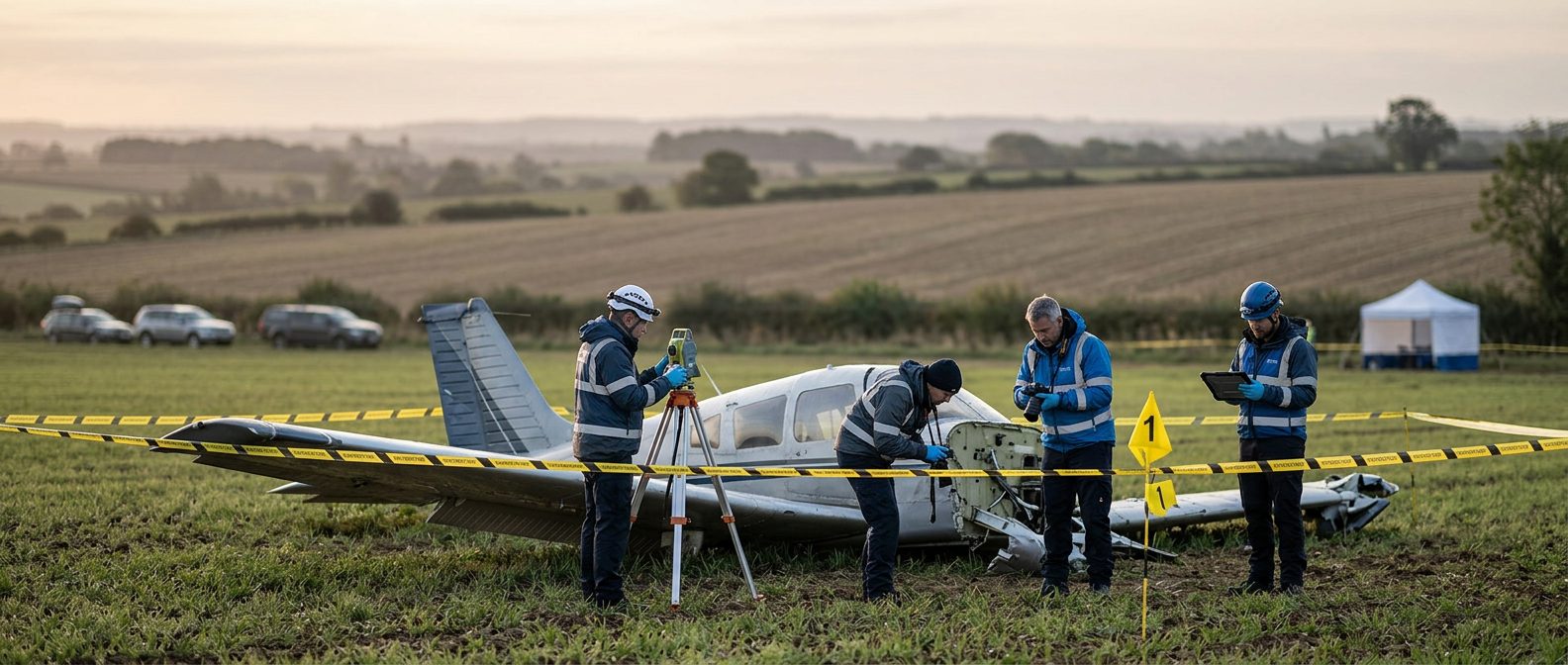
Step 2 – Investigation. Your attorney obtains the NTSB preliminary and final reports, aircraft maintenance records, crew qualifications and training records, weather data, air traffic control communications, and other evidence related to the crash.
Step 3 – Retain experts. Aviation engineers, accident reconstructionists, medical examiners, and economists are retained. They analyze the evidence, establish the cause of the crash, and calculate damages.
Step 4 – Identify defendants. Your attorney determines which parties (airline, manufacturer, maintenance contractor, airport, air traffic control, etc.) bear responsibility based on the evidence and expert analysis.
Step 5 – File the claim or lawsuit. Depending on applicable law and insurance, claims may be filed with the airline’s insurance carrier, in state or federal court, or both.
Step 6 – Discovery. Your attorney and the defendant’s attorneys exchange evidence and documents. Depositions (recorded interviews) of witnesses and experts are conducted.
Step 7 – Settlement negotiation or trial. Most wrongful death cases settle before trial. Your attorney negotiates on your behalf. If settlement is not reached, the case proceeds to trial before a judge or jury.
Step 8 – Resolution. Your family receives the settlement or judgment. Funds are distributed to eligible claimants or the estate.
How Long Does an Airplane Crash Wrongful Death Claim Take?
The timeline varies depending on the complexity of the case and whether it settles or goes to trial.
- NTSB investigation produces a preliminary report within 30 days. The final report typically takes 12–24 months.
- Settlement negotiations can begin while the investigation is ongoing.
- Simple cases may resolve in 1–2 years.
- Complex aviation cases often take 3–5 years or longer.
- Trial, if necessary, adds 6–12 months or more.
Remember: the statute of limitations does not wait. You have a limited time to file. An experienced attorney can manage the process efficiently and keep your family informed at every stage.
Why Choose CHG Personal Injury Lawyers for Your Airplane Crash Wrongful Death Claim?
Catastrophic injury focus. We focus exclusively on the most serious, life-altering injuries and deaths—including airplane crash fatalities. We do not handle routine or minor claims.
National reach. We represent families nationwide, not just in Florida. Your family receives representation no matter where the crash occurred.
Aviation knowledge. Our team understands aviation law, NTSB investigation procedures, aircraft systems, and the parties typically involved in crash litigation.
Licensed Florida attorneys. Our attorneys are admitted to the Florida Bar.
Compassionate approach. We understand the shock and profound grief of losing a loved one in an airplane crash. We handle your case with dignity and respect. We communicate clearly throughout the process. Your family’s loss is at the center of everything we do.
No upfront costs. We work on a contingency-fee basis. You pay no attorney fees unless we recover compensation for your family. Court costs and expert fees are typically advanced by our firm and recovered from any settlement or judgment.
Thorough investigation. We retain aviation experts, accident reconstructionists, economists, and other specialists to build a strong case on your family’s behalf.
Frequently Asked Questions
Do I have to go to trial?
No. Most wrongful death cases settle before trial. We will pursue the best outcome for your family, whether through settlement or litigation.
How much will this cost me?
We work on contingency—you pay no attorney fees unless we recover money for you. Court costs and expert fees are typically advanced by our firm and recovered from any settlement or judgment.
What if the crash was caused by bad weather?
Weather alone does not prevent liability. If the airline, pilot, or manufacturer failed to account for known weather hazards or failed to respond appropriately, liability may still exist.
Can I file a claim if I was not on the airplane?
Yes. Wrongful death claims are filed by family members who were not on the flight. You do not have to be a passenger to have a claim.
What if multiple parties are responsible?
Multiple defendants can be sued. We will identify all responsible parties and pursue claims against each.
What is the statute of limitations for an airplane crash wrongful death claim?
In Florida, you have 2 years from the date of death to file. Other states have different deadlines. Do not delay.

Not sure what your next step is?
Talk it through with our team — the first consultation is free, confidential, and carries no obligation.
What to Do Now
If you lost a loved one in an airplane crash, take these steps:
- Gather documents. Collect any correspondence with the airline, insurance information, and details about your relationship to the deceased.
- Do not sign anything. Do not accept settlement offers or sign releases without speaking to an attorney first.
- Preserve evidence. Keep all records related to the crash and your family’s losses.
- Act quickly. Statutes of limitations apply. Waiting too long can bar your claim.
Your family does not have to face this alone. If you lost a loved one in an airplane crash, you may have a right to pursue a wrongful death claim. Families in your situation can reach out to us to understand their options and next steps.
Contact us today for a free case evaluation. We are here to listen, to answer your questions, and to help your family move forward. Call or fill out our contact form—there is no obligation, and we are available to speak with you.
Why CHG Personal Injury Lawyers
Focused on Catastrophic Cases
We focus exclusively on serious, life-altering injuries and wrongful death. Airplane crash cases demand that level of singular focus.
Contingency Representation
You pay no attorney fees unless we recover money for your family. We advance costs and expert fees, recovered from any settlement or judgment.
National Reach
Based in Florida and licensed to practice there, we handle catastrophic injury and wrongful death claims across the United States.
Plain-Language Guidance
We explain your rights and options in clear terms, never legal jargon. Your family deserves to understand every step.
Time Matters
Wrongful death claims are subject to strict legal deadlines. The sooner you speak with an attorney, the sooner we can investigate the crash, preserve evidence, and protect your family's rights.
What Happens in an Airplane Crash Wrongful Death Case
Investigation & Evidence
We work with aviation experts to examine the aircraft, maintenance records, crew training, air traffic control communications, and weather data. Understanding what caused the crash is the foundation of your claim.
Identifying Liability
Responsibility may rest with the airline, aircraft manufacturer, maintenance provider, airport operator, or air traffic control. We identify all parties whose negligence or wrongdoing contributed to the loss.
Damages & Compensation
We pursue compensation for funeral and burial costs, lost income and benefits your loved one would have earned, pain and suffering, and the loss of companionship and guidance your family has endured.
Settlement or Trial
Most wrongful death cases resolve through settlement. We pursue the best outcome for your family, whether through negotiation or litigation in court.
Frequently Asked Questions
Do I have to go to trial?
No. Most wrongful death cases settle before trial. We will pursue the best outcome for your family, whether through settlement or litigation.
How much will this cost me?
We work on contingency—you pay no attorney fees unless we recover money for you. Court costs and expert fees are typically advanced by our firm and recovered from any settlement or judgment.
What if the crash happened outside the United States?
International aviation accidents involve complex treaties and laws. We can advise whether you may have a viable case under U.S. law or other applicable frameworks.
How long does a wrongful death case take?
Timeline varies depending on the complexity of the investigation, the number of parties involved, and whether the case settles or goes to trial. We keep you informed every step of the way.