

Traumatic Brain Injury
Diffuse Axonal Injury After a Car Crash: What It Means for Your Family
One of the most serious brain injuries a crash can cause — often invisible on a first scan, yet life-altering. Here is what a DAI is, and how to protect what comes next.
Focused on Catastrophic Injury
Nationwide
Cases accepted across the U.S.
Florida Bar
Licensed, admitted attorneys
EN / ES
Bilingual client support
Brain & Spinal
Catastrophic-injury focus
By CHG Lawyers · Published August 04, 2026
How a Diffuse Axonal Injury Happens in High-Speed Crashes
Did a doctor say the words “diffuse axonal injury” about someone you love? You probably left that talk scared and holding a page of terms nobody explained. Maybe the first CT scan came back “normal.” Now an MRI is telling a very different story. Maybe your family member is in a coma, and no one will give you a straight answer about what comes next.
This page is for you — the spouse, parent, or adult child trying to make sense of a diagnosis in a hospital hallway. It explains a diffuse axonal injury car accident in plain words. You will learn what the injury is, why it is so serious, and what families can do next.
This page is educational only. It is not medical advice. It is not legal advice for your case either. Your doctors know your loved one’s brain. A lawyer would need the facts of your crash. Use this to ask better questions, not as a substitute for either one.

If your family is facing this diagnosis, you do not have to sort it out alone. Talk it through with our team — the first consultation is free, confidential, and carries no obligation.
What a diffuse axonal injury actually is
A diffuse axonal injury (DAI) is a widespread tearing of the brain’s nerve fibers, called axons. It is not a bruise in one spot. According to Johns Hopkins Medicine, this tearing happens as the brain shifts and rotates inside the skull.
The word “diffuse” is the whole point. Damage in one place is easy to picture. But DAI scatters injury across many parts of the brain at once. It hits the deep white matter hardest — the wiring that carries signals between brain cells. When that wiring tears, the messages break down.
The NIH StatPearls medical reference calls DAI a severe type of traumatic brain injury (TBI). It is marked by this widespread white-matter damage. It is also a leading cause of long-lasting unconsciousness after a head injury.
How a diffuse axonal injury happens in high-speed crashes
DAI is an injury of physics. When a vehicle stops suddenly, the skull stops with it. But the soft brain keeps moving for a fraction of a second, then whips back. That lag stretches and tears the axons inside.
The Brain Injury Association of America explains that twisting and shaking forces do the most damage. Straight-line force is bad. Twisting force is worse. Rotation wrings the brain and shears the long fibers deep inside it.
Here is the fact that catches families off guard. DAI can happen even when the head never strikes anything. There may be no cut, no lump, no visible wound on the person you are looking at. The damage is all internal. That is one reason it can be missed at first.
What kind of crash leads to this brain injury
The crashes most linked to DAI are high-force crashes with sudden, violent changes in motion:
- High-speed highway and head-on crashes. The bigger the change in speed — engineers call it delta-v — the greater the strain on the brain.
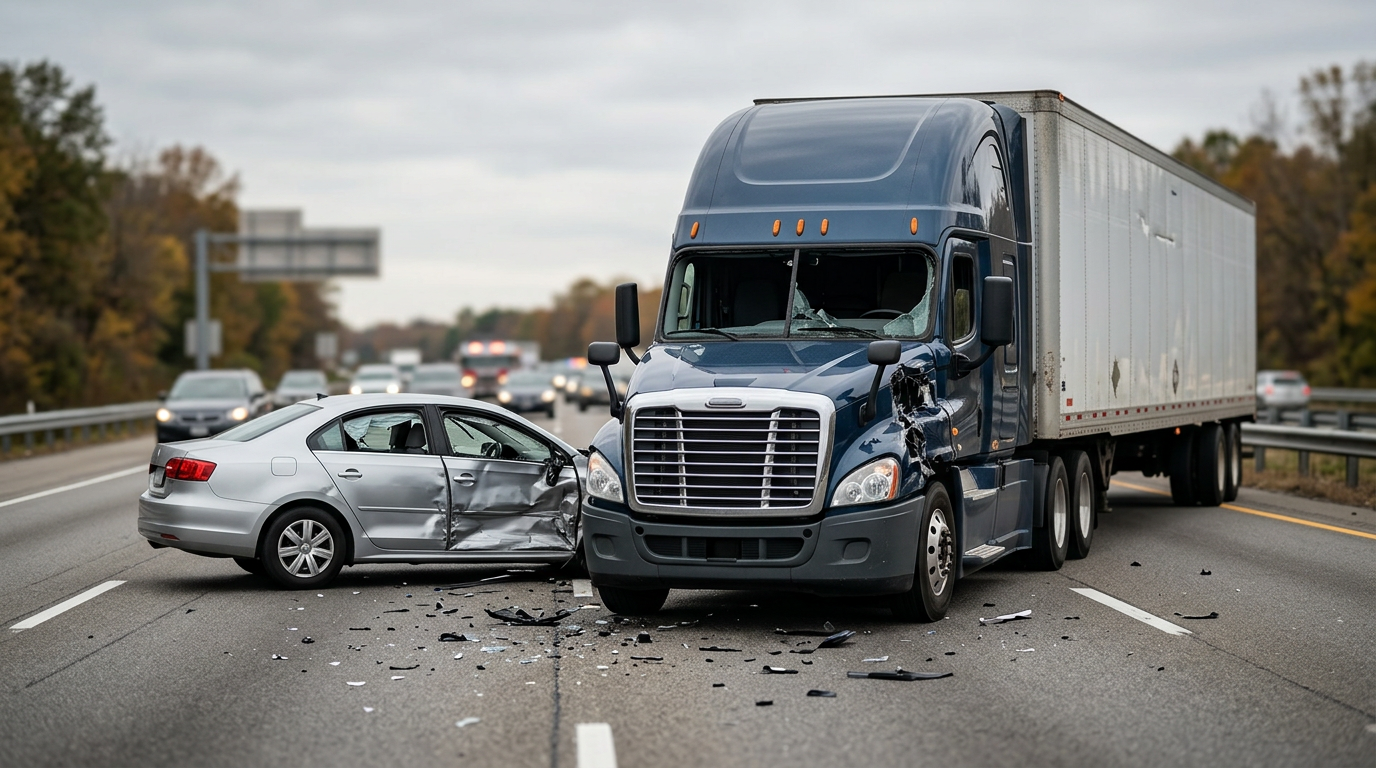
- Truck accidents. A fully loaded truck can weigh up to 80,000 pounds under federal weight limits (23 U.S.C. §127). That is about 20 times a typical car. That mass multiplies the forces that reach a person’s head. See our truck accident cases overview.
- Rollover crashes. The tumbling, spinning motion creates the rotational forces most linked to torn axons.
- Sudden stops or ejection. Even a person wearing a seat belt can suffer DAI. The body is held in place, but the brain is not.
Falls and violent attacks can cause DAI too. But crashes remain a leading cause. They combine speed, force, and rotation in a single event.
Why the first scan can look “clean” — and what doctors do next
This part confuses and even angers many families. So it deserves to be plain.
A standard CT scan can look normal even when a serious DAI is present. CT is great at spotting bleeding and skull fractures. But the tiny tears of DAI often do not show up on it. The NIH StatPearls reference notes that an MRI is far more sensitive to this kind of damage. So are special scans like diffusion tensor imaging (DTI) and susceptibility-weighted imaging.
Do not assume a normal early CT means everything is fine. If the symptoms do not match the scan, that mismatch is a clue. It is why many trauma teams order an MRI.
Doctors usually describe DAI in three grades. The grade reflects how deep and widespread the tearing is. Grade 1 is more surface-level. Grade 3 reaches the brainstem. Higher grades usually mean a more serious outlook. Only your treating team can assign the grade for your loved one.
Symptoms families notice
The most common sign of a severe DAI is immediate loss of consciousness or coma. The injury touches many parts of the brain at once, so the whole brain struggles to work.
Survivors may live with lasting symptoms. These can include:
- Confusion and trouble thinking clearly
- Memory and attention problems
- Changes in movement, balance, or coordination
- Changes in mood, personality, and behavior
- Trouble with speech and communication
Some of these show up right away. Others appear days later. That is why families should watch for a delayed brain bleed after an accident. Get any new or worsening symptom checked right away.
Not sure what your next step is?
Talk it through with our team — the first consultation is free, confidential, and carries no obligation.
Can you fully recover from a diffuse axonal injury?
Recovery varies a great deal. No honest source will give you a timeline that fits every person. Outcomes depend on the severity and grade of the injury. They also depend on how fast and how good the medical care is. And they depend on personal factors doctors cannot fully predict.
Some people with milder DAI improve a lot over time. Others live with permanent changes to thinking, movement, or behavior. When recovery does come, it often means long, hard rehab. Think months and years, not weeks.
Families often ask us how long the brain takes to heal. The honest answer is that there is no fixed clock. The brain can keep changing for a long time. Progress tends to be slow and uneven. We will not promise a specific medical result — no one honestly can. Lean on your doctors and rehab specialists. They know your loved one’s situation best.
When the outcome is the worst one
Survival and long-term outlook depend heavily on how severe the injury is. They differ for every person. Milder DAI carries a better outlook. Severe DAI can be life-threatening. We say that gently, because families deserve honesty rather than false comfort.
A death is the most catastrophic outcome any family can face. It deserves to be treated with dignity. If a family loses a loved one because of another party’s negligence, they may have a wrongful-death claim. Under Florida’s Wrongful Death Act (Fla. Stat. §768.21), certain surviving family members may recover for losses. These can include support, companionship, and, for parents of a child who died, mental pain and suffering. Nothing about a claim undoes the loss. What it can do is provide financial stability and accountability for the people left behind.
The long-term impact and lifetime cost
A severe brain injury can permanently change how a person thinks, moves, and behaves. Those changes reach into their work, their independence, and their closest relationships for the rest of their life.
Daily life often includes ongoing therapy and in-home attendant care. It can mean home changes like ramps and bathroom retrofits. It can mean adaptive equipment. In the most severe cases, it means round-the-clock supervision. These needs do not stop when the hospital sends the patient home. They can stretch across decades.
To understand the money side, read about the lifetime cost of severe brain injury care. See how future needs get documented in a life care plan for a brain injury claim.
Pursuing a claim after a diffuse axonal injury from a crash
Did another driver’s or company’s negligence cause the crash? If so, the injured person or their family may be able to seek compensation. A diffuse axonal injury car accident is severe and permanent. That is why it often qualifies as a catastrophic injury claim. Such a claim looks well beyond today’s hospital bills. It covers future care, lost earning ability, and the deep impact on daily life.
Documentation carries these cases. That means detailed records, the right imaging (often MRI or DTI, not just an early CT), and evaluations from treating specialists. This kind of proof shows the true scope of the harm. In the catastrophic cases our attorneys handle, that proof is central to explaining what a family has actually lost.
Florida also sets firm deadlines. For most negligence claims that arose on or after March 24, 2023, you generally have two years to file, under Fla. Stat. §95.11. Florida also follows a modified comparative-negligence rule. Under Fla. Stat. §768.81, a person found more than 50% at fault generally recovers nothing. Deadlines and exceptions vary, so confirm yours with a lawyer.
Every case is different, and we cannot guarantee any outcome. What we can do is listen and explain your options in plain language. CHG Personal Injury Lawyers are licensed attorneys admitted to The Florida Bar. We handle catastrophic-injury cases nationwide.
If your family is facing this diagnosis, you do not have to sort it out alone. Contact us for a free case evaluation.

Have questions about what happened?
Ask our team directly. The first conversation is free, confidential, and there is no obligation to continue.
Frequently asked questions
Can you fully recover from a diffuse axonal injury?
Recovery varies widely. It depends on severity, grade, medical care, and personal factors. Some people improve greatly. Others live with permanent changes. No one can honestly promise a full recovery.
Why did the CT scan look normal if the injury is serious?
CT is best at finding bleeding and fractures. But the tiny axon tears of DAI often do not appear on it. MRI, including diffusion tensor imaging, is far more sensitive. That is why a normal early CT does not rule out a serious brain injury.
How long does it take for the brain to heal after a car accident?
There is no fixed timeline. Healing can take months to years. For severe injuries, the changes may be permanent and require lifelong care.
What kind of car accident leads to this brain injury?
High-speed crashes, head-on crashes, truck accidents, and rollovers are the most likely causes. They create the strong acceleration and rotational forces that shear the brain’s nerve fibers.
Why a Diffuse Axonal Injury Is So Serious
It Can Hide on Early Imaging
A CT scan is good at spotting bleeding and fractures. DAI is different — it involves microscopic tearing of nerve fibers that a first scan may not show. A normal CT does not mean nothing is wrong.
The Effects Can Be Permanent
Many DAI patients face lasting changes in memory, thinking, movement, or awareness. Recovery varies widely, and some impairments do not fully resolve.
It Changes the Whole Family
Caregiving, lost income, and long-term therapy fall on the people closest to the injured person. A catastrophic claim looks at those costs, not just the hospital bill.
Proof Requires the Right Evidence
Advanced imaging (like MRI), medical records, and expert opinions often tell the real story. Preserving this evidence early matters.
A Normal First Scan Is Not the Final Word
If a loved one was in a serious crash and is confused, unusually sleepy, or unresponsive, keep pushing for follow-up care — even if the first CT looked clear. DAI often needs advanced imaging to detect, and delays can cost time in both treatment and any injury claim.
Common Questions About Diffuse Axonal Injury
Can you fully recover from a DAI?
Recovery varies widely and depends on severity, grade, medical care, and personal factors. Some people improve greatly; others live with permanent changes. No one can honestly promise a full recovery.
Why did the CT scan look normal?
CT scans are best at finding bleeding and fractures. DAI involves microscopic damage to nerve fibers that a standard CT can miss. Advanced imaging like MRI is often needed to see it.
Is a DAI considered a catastrophic injury?
In many cases, yes. When a DAI causes lasting impairment to thinking, movement, or independence, it is treated as a life-altering injury — the kind our firm focuses on.
What if the crash was fatal?
A severe DAI can be fatal. When a family loses a loved one, they may be able to bring a wrongful-death claim. We handle these matters with care and can explain your options.