


Traumatic Brain Injury Claims
Proving a Brain Injury Is Real — Even When the Scan Looks Normal
A traumatic brain injury can change a person's memory, mood, and ability to work for the rest of their life. Understanding how doctors diagnose a TBI is the first step to building a claim that reflects what you and your family are living through.
Focused on Life-Altering Injuries
Nationwide
Catastrophic injury cases accepted
Florida Bar
Licensed, admitted attorneys
EN / ES
Bilingual client resources
TBI
A core practice focus
By CHG Lawyers · Published August 02, 2026
How a Traumatic Brain Injury Is Diagnosed and Documented for a Legal Claim
Doctors diagnose a traumatic brain injury (TBI) in three main ways. They use clinical exams, brain scans, and thinking-and-memory tests (also called neuropsychological tests). For a legal claim, each step becomes evidence. It proves the injury happened, how serious it is, and that the accident caused it.
If you or a loved one had a brain injury, you may worry that no one can see it. That fear is real and common. It comes from the way these injuries actually behave. This page explains, in plain language, how a serious brain injury is diagnosed. It also shows how each medical record supports a claim. It’s written for the injured person and their family — not for lawyers.
This is a supporting guide within our larger Traumatic Brain Injury Guide.
Not sure what your next step is?
Talk it through with our team — the first consultation is free, confidential, and carries no obligation.
Why diagnosis and documentation matter so much in a brain injury claim
A serious brain injury can change a life forever. Yet it often leaves no visible mark. That’s exactly why documentation matters so much.
A brain injury isn’t like a broken arm. You can’t point to an X-ray and see a clean break. Instead, the story comes together across many records. These include the EMS run report, the ER visit, follow-up exams, brain scans, and special testing.
Your medical record is the proof. It shows the injury is real, how bad it is, and that it came from the accident. In the catastrophic-injury cases our attorneys handle, a strong, consistent record often shapes how seriously an insurer takes the claim. This page walks through each step and how it becomes legal evidence.
What qualifies as a traumatic brain injury?
A traumatic brain injury is damage to the brain from an outside force. This could be a blow, a jolt, or a penetrating injury during an accident. According to the National Institute of Neurological Disorders and Stroke, a TBI happens when sudden trauma disrupts normal brain function.
Our firm focuses on serious, life-altering brain injuries. That includes moderate and severe TBIs. It also includes so-called “mild” TBIs (concussions) that leave lasting problems with memory, mood, or daily life.
There’s an important gap here — and insurers use it. Hospitals classify TBI severity in the first hours. They rely mostly on the Glasgow Coma Scale and imaging. But that early label describes the initial injury. It does not describe how disabling the injury turns out to be.
A person can carry a “mild” label on paper and still struggle months later. They may be unable to return to work, drive safely, or follow a conversation. Medicine even has a name for this pattern: persistent post-concussive symptoms. The Mayo Clinic describes these as symptoms lasting weeks or months after a concussion. The word on the chart and the reality in daily life are two different things. Much of the claim is won or lost in that gap.
The most catastrophic outcome is a fatal brain injury. When a brain injury causes death, the family may be able to pursue a wrongful-death claim. We explain who can be held responsible on our page about who is liable for a traumatic brain injury.
The initial assessment right after the injury
The first assessment usually happens at the scene and in the emergency room. Responders check for loss of consciousness, confusion, and memory gaps. These early notes are some of the most valuable evidence you’ll ever have. That’s because no one wrote them with a lawsuit in mind.
EMS crews and ER staff record what they see. Did the person lose consciousness, and for how long? Were they confused or repeating questions? Could they remember the crash, or is there a gap? That memory gap has a clinical name: post-traumatic amnesia. Its length is one of the better real-world signs of how severe the injury is. These on-the-spot observations are hard for an insurer to dispute years later.
Doctors often use the Glasgow Coma Scale (GCS) to rate early severity. It scores eye, verbal, and motor responses from 3 to 15. As a general benchmark, a GCS of 13–15 is often called mild. A score of 9–12 is moderate, and 8 or below is severe. It’s a quick roadside snapshot, not the full picture. A high GCS in the ER does not rule out lasting harm.
Keep every record from this stage. That means the EMS run report, the ER triage and intake notes, and even what a bystander told the paramedics. Seek medical care right away, even if you feel “okay.” Some brain injuries hide their symptoms for hours or days.
Neurological and physical exams
A neurological exam checks how well your brain and nervous system work right now. Per NINDS, it tests motor and sensory skills, hearing and speech, coordination and balance, and mental status.
During these exams, a doctor may check several things. These include your reflexes, your eye movements and pupil response, your balance, and your ability to follow multi-step commands. Each finding creates an objective, dated record of how the injury has affected you.
Follow-up exams matter just as much as the first one. They show whether symptoms stay, fade, or get worse over time. A pattern of ongoing problems, recorded across several visits, tells a stronger story than a single note.
So keep every appointment. Describe your symptoms honestly and clearly each time. “I lose my train of thought mid-sentence” is more useful in your record than “I feel foggy.”
Brain imaging studies (and why a “normal” scan is not the end of the story)
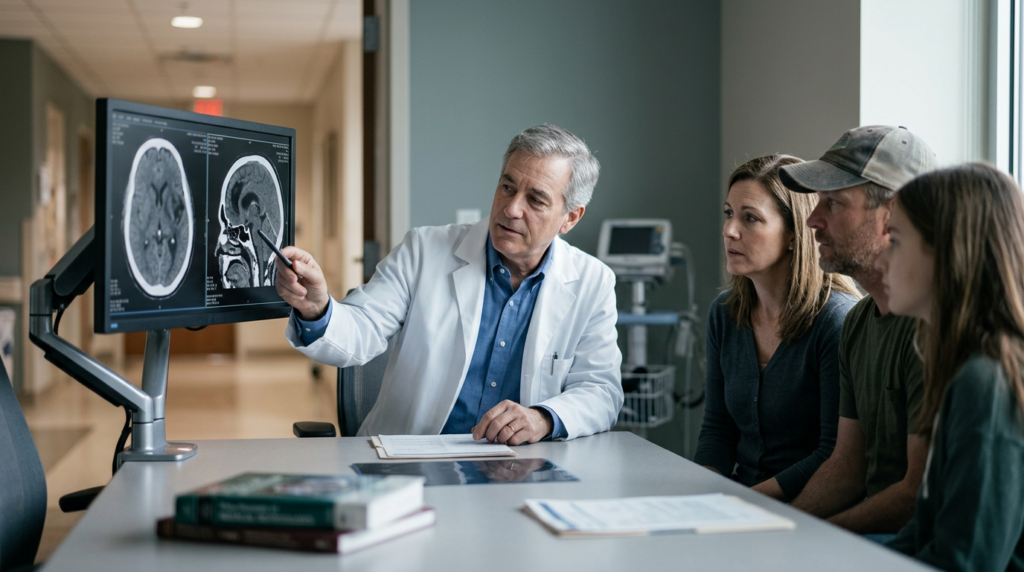
Brain scans can show bleeding, swelling, and structural damage. But a normal scan does not mean there’s no serious injury. This is one of the most important things for TBI survivors and families to understand.
A CT scan is usually the first imaging test in the ER, according to Mayo Clinic. It quickly spots bleeding, blood clots, bruising, and swelling. These are the emergencies doctors must rule out first. An MRI gives a more detailed view of tissue. It is often used for follow-up.
Here’s the catch. These standard scans are built to catch large, visible damage. Many serious brain injuries happen at a microscopic level, as nerve fibers stretch and tear. This is called diffuse axonal injury, and it’s common in concussions. A CT or MRI can look completely “clean” while a person still has real, life-altering symptoms. In plain terms: the scanner checks whether you’ll survive the next few hours. It doesn’t check whether you’ll be able to do your job in six months.
Advanced imaging can sometimes show what standard scans miss. Diffusion tensor imaging (DTI) maps the brain’s white-matter tracts. It can show damage to that microscopic wiring. Functional MRI (fMRI) measures brain activity. These aren’t ordered in every case, and not every courtroom accepts them. But when a treating specialist orders them, they can be powerful, objective evidence.
Insurers know most people assume a clean scan means no injury. Some wrongly use a normal CT to deny valid claims. A single scan is not the verdict on your case. Learn more about delayed and hidden brain injury symptoms.
Have questions about what happened?
Ask our team directly. The first conversation is free, confidential, and there is no obligation to continue.
Cognitive and neuropsychological testing
Neuropsychological testing measures how your brain actually performs at thinking tasks. It’s often the strongest evidence for injuries that don’t show up on a scan.
A neuropsychologist gives a set of structured, standardized tests. These measure memory, attention, processing speed, executive function (planning and decision-making), language, and mood. The results turn “I just don’t feel like myself” into measurable data.
The key is comparison. Specialists compare your current scores against normed data. That means what someone of your age, education, and background would be expected to score. A clear gap between expected and actual performance documents a real, measurable problem. Good testing also includes built-in validity measures. These flag whether someone is exaggerating. That actually makes a genuine result harder for an insurer to wave away.
Several treating specialists usually work together on a serious TBI. A neurologist handles brain and nerve function. A neuropsychologist runs the cognitive testing. A physiatrist (rehabilitation physician) guides recovery, therapy, and return-to-work planning. Their combined records paint a full, credible picture.
Documenting the injury over time: the human record
Beyond scans and tests, the everyday changes in a person’s life are powerful evidence. Personality shifts, mood swings, and trouble with routine tasks all belong in the record.
Family members often notice things the injured person cannot see in themselves. This is a documented feature of TBI, not a failing. Maybe your loved one is quicker to anger, forgets appointments, or can no longer tolerate noise or crowds. These before-and-after observations help doctors — and later, an insurer or jury — understand the true impact.
Keep a symptom journal. Note headaches, memory lapses, sleep problems, and mood changes as they happen, with dates. Consistent, dated notes carry real weight. Read more about TBI personality and behavior changes families see.
The harm also includes lost work, the need for caregiving, and strain on relationships. All of it becomes part of the documented damage when it’s written down and tied to the injury.
How each diagnostic step becomes legal evidence
Each medical step proves a different piece of the claim. Together, they build the whole case. Records prove the injury exists. Testing proves how severe it is. Expert opinions connect it to the accident (this is called causation).
Think of it like a chain. The ER notes show the injury happened during the accident. The exams and testing show how disabling it is. Medical experts then explain, in plain terms, why the accident caused it. Break any link, and the claim gets weaker.
Consistency is key. When your ER notes, follow-up exams, testing, and journal all point the same way, the story holds up. Gaps happen. People miss appointments, records get lost, and symptoms show up late. Those gaps can often be explained and fixed with the right medical and legal help.
This section is general education, not legal advice. Every case is different, and no page can promise any specific result.
How insurers dispute traumatic brain injury claims
Insurers use several common tactics to reduce or deny brain injury claims. Knowing them ahead of time helps you and your family push back.
- They question your treatment. They may argue you didn’t need the care you got, or that it was too much.
- They downplay cognitive symptoms. They call memory and mood problems “subjective.” Standardized neuropsychological testing with validity measures helps counter this.
- They use incomplete records against you. A missed appointment becomes their argument that you weren’t hurt. Consistent care closes that door.
- They weaponize the word “mild.” A “mild” TBI can still be life-altering. The label describes the initial injury, not your daily reality.
- They blame pre-existing conditions. Your records and experts can separate old issues from new harm.
- They dismiss delayed symptoms. Many TBI symptoms appear days later. A delay does not mean the accident didn’t cause them.
These are routine tactics, not proof that your claim is weak.
Want to know where you stand?
Tell us what happened and our team will walk you through the options available to you, at no cost.
Who may be responsible for a brain injury
Several parties may be responsible, depending on how it happened. It’s not always the obvious person.
An at-fault driver may be liable. This includes a trucking company after a serious truck accident. Medical negligence can also cause or worsen a brain injury.
There’s another situation many people don’t realize gives them a claim. Say you or a loved one were attacked, shot, robbed, or assaulted on someone else’s property. This could be an apartment complex, a parking lot or garage, a hotel, or a store. If the owner failed to provide reasonable security — like working locks, gates, lighting, or guards — they may be responsible. Lawyers call this negligent security. You don’t need to know the term to have a claim.
Learn more on our page about who is liable for a traumatic brain injury.
Talk to a lawyer about your brain injury claim
Proving a traumatic brain injury is challenging. But strong medical documentation and skilled legal support can make a real difference. You don’t have to sort through it alone.
In Florida, deadlines apply. For most injury claims that arose on or after March 24, 2023, you generally have two years to file under Fla. Stat. §95.11. Florida also follows a modified comparative-negligence rule under Fla. Stat. §768.81. Under this rule, a person found more than 50% at fault generally recovers nothing.
Our licensed attorneys are admitted to The Florida Bar. We handle catastrophic-injury cases nationwide. We offer help in English and Spanish.
Request a free case evaluation to talk about your situation. This page is general information, not legal advice, and no outcome is ever guaranteed.

Frequently asked questions
How is a traumatic brain injury diagnosed?
Doctors diagnose a TBI using clinical exams, brain scans like CT and MRI, and neuropsychological testing that measures memory and thinking.
Can you have a serious brain injury with a normal CT scan?
Yes. Many serious brain injuries, especially concussions with lasting effects, don’t appear on a routine CT scan. They still cause real, life-altering symptoms because the damage is microscopic.
How do you prove a traumatic brain injury for a legal claim?
You prove a TBI with consistent medical records, brain imaging, neuropsychological testing with validity measures, and expert opinions linking the injury to the accident.
Why do insurers deny mild traumatic brain injury claims?
Insurers often use the word “mild,” a normal scan, or a gap in records to downplay a life-altering injury. Thorough documentation helps counter these tactics.
How long do I have to file a brain injury claim in Florida?
For most injury claims arising on or after March 24, 2023, Florida generally allows two years to file under Fla. Stat. §95.11.
How Doctors Diagnose a Traumatic Brain Injury
Clinical Examination
Physicians assess responsiveness, speech, balance, coordination, and pupil response. Tools like the Glasgow Coma Scale help measure the severity of a brain injury soon after an accident.
Imaging: CT and MRI
A CT scan can reveal bleeding, swelling, or fractures. An MRI shows finer detail and can capture damage a CT scan misses. Advanced imaging may be ordered when symptoms don't match a 'normal' result.
Neuropsychological Testing
Detailed testing measures memory, attention, processing speed, and problem-solving. These evaluations document how a brain injury affects daily life and work, even when scans appear unremarkable.
Ongoing Documentation
TBI symptoms can evolve over weeks and months. Follow-up records from neurologists, therapists, and specialists build a picture of lasting impairment that a single visit cannot.
A Normal CT Scan Does Not Mean You're Fine
Many serious brain injuries — including concussions with lasting effects — do not show up on a routine CT scan. If you or a loved one has ongoing headaches, memory problems, confusion, mood changes, or trouble concentrating after an accident, keep seeking care and keep records. Do not let an early 'normal' result end your treatment.
Why Diagnosis Matters to Your Claim
It Connects Injury to Cause
Consistent medical records help link a brain injury to the truck crash, unsafe property, or negligence that caused it.
It Captures Invisible Harm
Neuropsychological testing gives objective evidence of memory, focus, and cognitive changes that others can't see.
It Shows the Long-Term Picture
Follow-up care documents lasting impairment and future needs — critical for a fair evaluation of a catastrophic injury.
It Supports the Whole Family
A TBI affects careers, relationships, and independence. Thorough diagnosis helps account for the full impact on your household.